Enzyme conjugates are the functional core of modern immunoassays, transforming highly specific molecular recognition into measurable colorimetric, fluorescent, chemiluminescent, or electrochemical signals. The quality of an enzyme conjugate directly influences assay sensitivity, specificity, reproducibility, and overall analytical performance. From ELISA and chemiluminescence immunoassays (CLIA) to lateral flow assays (LFA), biosensors, and other in vitro diagnostic (IVD) platforms, well-designed enzyme conjugates are essential for achieving reliable and robust results.
At Creative Enzymes Diagnostic, we provide comprehensive Enzyme Conjugation and Signal Amplification Services to support assay development from early feasibility studies to commercial manufacturing. Our platform integrates reporter enzyme selection, conjugation chemistry development, enzyme-antibody conjugate optimization, analytical characterization, substrate compatibility evaluation, and assay-specific signal optimization to deliver high-performance conjugates tailored to your application.
Our expertise covers horseradish peroxidase (HRP), alkaline phosphatase (AP), β-galactosidase, urease, glucose oxidase, and other reporter enzymes, enabling customized solutions for research, diagnostic development, and industrial production.
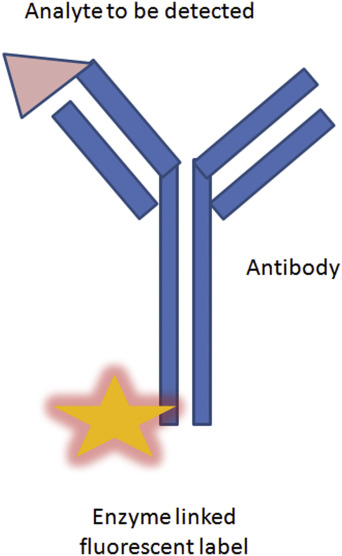
Why Enzyme Conjugation Matters
Reporter enzymes act as biological signal amplifiers by converting substrate molecules into detectable products following antigen-antibody recognition. However, successful conjugate development involves much more than simply attaching an enzyme to an antibody. Critical factors such as conjugation chemistry, enzyme-to-antibody ratio, molecular orientation, linker selection, purification strategy, and analytical characterization all contribute to the final assay performance.
A properly optimized enzyme conjugate should provide:
- High enzymatic activity with minimal loss during conjugation
- Preserved antibody affinity and antigen recognition
- Controlled enzyme-to-antibody stoichiometry
- Low nonspecific binding and background signal
- Excellent batch-to-batch reproducibility
- Long-term storage stability
- Compatibility with multiple assay formats and sample matrices
By combining optimized conjugation strategies with comprehensive quality evaluation, our scientists develop enzyme conjugates that maximize analytical sensitivity while maintaining consistent performance throughout product development and manufacturing.
Our Enzyme Conjugation and Signal Amplification Platform
Creative Enzymes has established an integrated development platform covering every stage of enzyme conjugate generation, from reagent selection and conjugation chemistry to analytical characterization and application-specific optimization.
Our platform supports:
- Reporter enzyme selection based on assay requirements
- Antibody, antigen, protein, peptide, nucleic acid, and small-molecule conjugation
- Multiple conjugation chemistries for different biomolecules
- Controlled enzyme-to-target labeling ratios
- Purification and removal of unconjugated components
- Comprehensive physicochemical and functional characterization
- Signal amplification optimization
- Assay validation for research and diagnostic applications
- Process scale-up and manufacturing support
Rather than providing a single conjugation protocol, we develop customized solutions according to the target biomolecule, intended detection platform, required sensitivity, regulatory considerations, and manufacturing requirements.
Our Enzyme Conjugation and Signal Amplification Services
Our enzyme conjugation and signal amplification platform encompasses specialized services designed for different reporter enzymes, assay formats, and diagnostic applications.
| Services |
Details |
Applications/Capabilities |
| HRP Conjugation Service for Immunoassays |
Horseradish peroxidase (HRP) remains the most widely used reporter enzyme for ELISA, Western blotting, immunohistochemistry, chemiluminescence assays, and biosensors. We develop optimized HRP conjugates using carefully selected conjugation chemistries that preserve both enzymatic activity and antibody affinity while minimizing background interference. |
- - ELISA
- - Chemiluminescent immunoassays
- - Western blot
- - Immunohistochemistry
- - Biosensors
|
| Alkaline Phosphatase (AP) Conjugation Service |
Alkaline phosphatase provides excellent signal stability and broad substrate compatibility, making it particularly suitable for multiplex immunoassays, nucleic acid detection, and applications requiring prolonged signal generation. We optimize AP conjugation for maximum catalytic performance and long-term storage stability. |
- - ELISA
- - CLIA
- - DNA/RNA detection
- - Multiplex assays
- - Automated diagnostic platforms
|
| β-Galactosidase, Urease and Oxidase Labeling Services |
Beyond HRP and AP, we provide conjugation services for additional reporter enzymes that support specialized analytical platforms. Our scientists optimize conjugation strategies according to enzyme structure, catalytic mechanism, substrate system, and intended application. Available enzyme systems include: β-Galactosidase, Urease, Glucose Oxidase, Lactate Oxidase, Cholesterol Oxidase, and other customized oxidases. |
These conjugates are widely used in biosensors, electrochemical detection, molecular diagnostics, environmental testing, and industrial biotechnology. |
| Enzyme-Antibody Conjugate Development and Optimization |
Successful immunoassays depend on much more than successful conjugation. We provide comprehensive optimization services that improve conjugate homogeneity, enzyme activity retention, antibody binding performance, and overall assay sensitivity. |
- - Conjugation strategy selection
- - Enzyme-to-antibody ratio optimization
- - Linker evaluation
- - Purification process development
- - Stability optimization
- - Analytical characterization
- - Functional validation
|
| Enzyme-Substrate Signal System Optimization |
Signal generation depends on the compatibility between the reporter enzyme and its substrate chemistry. We optimize complete enzyme-substrate systems to improve analytical sensitivity, dynamic range, signal stability, and background reduction. |
- - Chromogenic substrate evaluation
- - Chemiluminescent substrate screening
- - Fluorogenic substrate optimization
- - Buffer formulation
- - Reaction kinetics optimization
- - Signal amplification strategy development
|
| Lateral Flow and Membrane Assay Enzyme Signal Support |
Lateral flow assays require enzyme conjugates that remain active after membrane immobilization while generating rapid, reproducible signals under challenging sample conditions. Our platform supports enzyme selection, membrane compatibility evaluation, conjugate formulation, and signal optimization for point-of-care diagnostics. |
- - Lateral flow immunoassays (LFA)
- - Nitrocellulose membrane assays
- - Paper-based biosensors
- - Point-of-care testing (POCT)
- - Multiplex membrane diagnostics
|
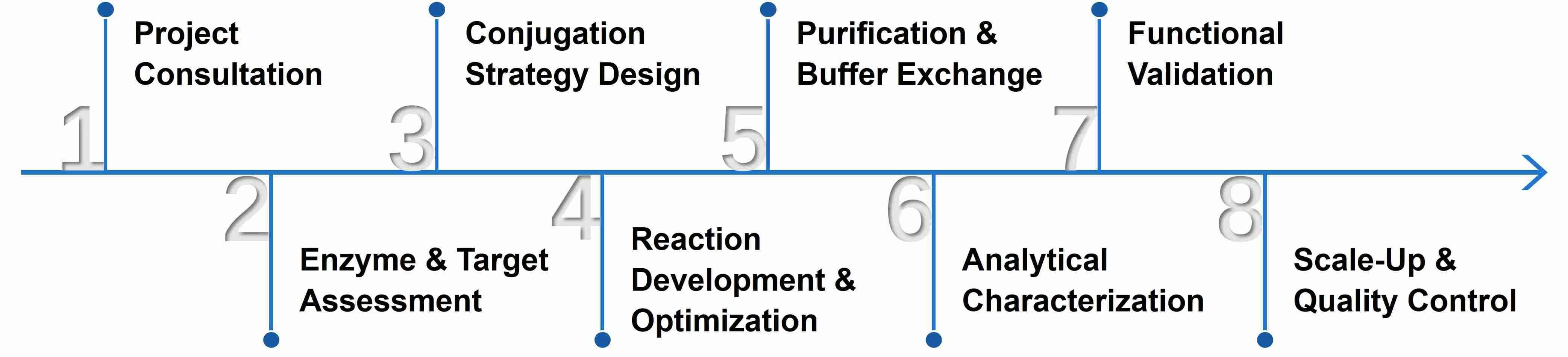
Workflow for Enzyme Conjugate Development
Every conjugation project follows a structured development workflow designed to maximize conjugate quality, reproducibility, and assay performance. Rather than applying a standard protocol to every project, our scientists optimize each stage according to the target biomolecule and intended application.
Applications
Our enzyme conjugation platforms support a broad spectrum of diagnostic, research, and therapeutic applications where precise molecular recognition and signal amplification are critical.
- Immunoassays (ELISA & CLIA): Enzyme-antibody conjugates for sandwich, competitive, and indirect ELISA formats, as well as chemiluminescence immunoassays. Optimized for high signal-to-background ratios, broad dynamic ranges, and compatibility with automated analyzer platforms.
- Western Blotting: Secondary antibody-enzyme conjugates for sensitive detection of target proteins in cell lysates and tissue homogenates, with low-background formulations and minimal cross-reactivity across common host species.
- Immunohistochemistry (IHC) & Immunocytochemistry (ICC): Enzyme-labeled primary and secondary antibodies for chromogenic staining of formalin-fixed tissue sections and cultured cells, compatible with DAB, AEC, BCIP/NBT, and permanent red substrates.
- Biosensors & Point-of-Care Devices: Enzyme conjugates integrated into electrochemical, optical, and paper-based biosensors for metabolite monitoring, infectious disease detection, and environmental analyte quantification at the point of care.
- Lateral Flow & Rapid Diagnostic Tests: Enzyme signal systems for nitrocellulose membrane-based rapid assays, delivering enhanced sensitivity, quantitative readout capability, and ambient-temperature stability for home testing and resource-limited settings.
- Nucleic Acid Detection: Enzyme conjugation to oligonucleotides, probes, and aptamers for signal amplification in hybridization assays, molecular beacons, and CRISPR-based diagnostic platforms.
- Pharmaceutical & Drug Delivery: Enzyme-polymer and enzyme-small molecule conjugates engineered as smart therapeutic vehicles, prodrug activation systems, and targeted delivery platforms with improved pharmacokinetics and reduced immunogenicity.
Why Choose Creative Enzymes Diagnostic
With decades of combined expertise in protein chemistry, enzymology, and diagnostic assay development, Creative Enzymes Diagnostic delivers conjugates that meet the exacting standards of modern biotechnology and clinical diagnostics.
Precision & Control
- Controlled stoichiometry: Near 1:1 enzyme-to-target ratios achieved through site-specific conjugation and optimized random-labeling protocols, ensuring homogeneous product populations and reproducible assay performance.
- Preserved functionality: Gentle coupling chemistries and rational linker selection minimize disruption to enzyme active sites and antibody binding domains, maintaining high activity and affinity retention.
Quality & Scale
- High yield and purity: Advanced purification strategies (SEC, affinity, ion-exchange) deliver conjugates with high purity and minimal aggregate content, supported by comprehensive Certificates of Analysis.
- Scalable manufacturing: Production capacity from milligram research quantities to gram and kilogram manufacturing batches, with seamless technology transfer and ISO 13485-compliant quality systems.
Technical Excellence
- Rigorous validation: Every batch characterized by SDS-PAGE, SEC-HPLC, activity assays, binding kinetics, and stability profiling to ensure conformance to predefined release criteria.
- Integrated platforms: End-to-end capabilities spanning protein expression, conjugation chemistry, analytical characterization, and assay optimization under one roof.
Regulatory & Partnership
- Regulatory support: Stability studies, validation data packages, and manufacturing documentation designed to support 510(k), IVDR, and CLIA-waived submissions.
- Collaborative approach: Dedicated project scientists work closely with client teams from feasibility through commercialization, leveraging tight connections in both academia and industry.
FAQs
Q1. What types of molecules can you conjugate to enzymes?
A1. We conjugate enzymes to a broad range of functional molecules including monoclonal and polyclonal antibodies, antibody fragments (Fab, scFv, nanobodies), streptavidin and protein A/G, nucleic acids (oligonucleotides, aptamers), peptides, small-molecule haptens, polymers (PEG, dextran), and nanoparticles (gold, magnetic beads, quantum dots). The conjugation chemistry is selected based on the target molecule's reactive groups, size, and intended application.
Q2. How long does a typical enzyme conjugation project take?
A2. A standard custom conjugation project from feasibility through delivery of characterized conjugate typically spans 6–10 weeks. This includes 1–2 weeks for reagent evaluation and chemistry selection, 2–3 weeks for conjugation and purification, and 2–3 weeks for analytical characterization and functional validation. Complex projects involving iterative optimization, site-specific engineering, or extensive formulation development may extend to 12–16 weeks. Expedited timelines are available for urgent diagnostic development programs.
Q3. What scale of production do you support?
A3. Our platform supports development-scale production from milligram to gram quantities for research and assay development, with seamless scale-up to multi-gram or kilogram manufacturing batches for commercial diagnostic kits. The same conjugation chemistry, purification protocol, and quality standards are maintained across scales to ensure that research-grade feasibility data directly translates to manufacturing performance.
Q4. What quality data do you provide with each conjugate batch?
A4. Every batch is released with a comprehensive Certificate of Analysis (CoA) that includes SDS-PAGE analysis, SEC-HPLC purity profile, enzyme specific activity, antigen-binding validation (EC50 or KD), degree of labeling (DOL), endotoxin level, and stability data. Additional characterization such as SPR kinetics, mass spectrometry, DLS aggregation analysis, and functional assay validation in the client's target platform is available upon request.
Q5. Can you support regulatory submissions for diagnostic products?
A5. Yes. Our development and manufacturing processes are conducted under ISO 13485-certified quality management systems. We provide full documentation packages including batch records, stability study protocols and reports, analytical method validation, and manufacturing documentation suitable for FDA 510(k), PMA, and IVDR technical documentation submissions. All stability studies are designed in accordance with ICH Q1A(R2) guidelines.
Q6. Do I need to provide my own antibody, or can you source it?
A6. We welcome client-provided antibodies and antigens, which we evaluate for conjugation compatibility prior to project initiation. Alternatively, our team can support antibody sourcing, recombinant expression, or hybridoma development through our partner network. We also maintain an inventory of validated secondary antibodies and streptavidin conjugates for immediate use in assay development while custom primaries are being prepared.
Creative Enzymes Diagnostic combines deep expertise in protein chemistry, enzymology, and diagnostic assay development to deliver enzyme conjugates and signal systems that meet the exacting standards of modern biotechnology and clinical diagnostics. From single conjugate batches to integrated assay optimization and manufacturing-scale production, our Enzyme Conjugation and Signal Amplification Services provide the technical foundation for reliable, sensitive, and reproducible immunoassay performance.
Contact our business development team today to discuss your enzyme conjugation and signal amplification requirements!
References
- Belorkar SA, Jogaiah S. Biotechnological applications of enzymes and future prospective. In: Protocols and Applications in Enzymology. Elsevier; 2022:225-238. doi:10.1016/B978-0-323-91268-6.00006-5
Related Services

