
Analyte conversion
The enzyme converts an analyte into a stereoisomer that can enter a selective colorimetric, fluorometric, or electrochemical reaction.

| Catalog | Product Name | EC No. | CAS No. | Source | Price |
|---|---|---|---|---|---|
| DIA-432 | Beta-Phosphoglucomutase (β-PGM) from E. coli | EC 5.4.2.6 | E. coli | Inquiry | |
| DIA-542 | High Purity Phosphoglucose Isomerase | EC 5.3.1.9 | 9001-41-6 | Escherichia coli | Inquiry |
| DIA-543 | High Purity Phosphomannose Isomerase | EC 5.3.1.8 | 9023-88-5 | Escherichia coli | Inquiry |
| DIA-692 | Phosphopentomutase (EcDeoB) | EC 5.4.2.7 | 54-2-71 | Inquiry | |
| DIA-783 | O-Glycopeptidase (IMPa) | EC 5.3.1.52 | 53-1-52 | Inquiry | |
| DIA-790 | Phosphoglucomutase | EC 5.4.2.2 | 9001-81-4 | Inquiry | |
| DIA-892 | UDP-Glc 4-Epimerase (GalE) | EC 5.1.3.2 | 9032-89-7 | Inquiry | |
| DIA-893 | UDP-Glc 4-Epimerase | EC 5.1.3.2 | 9032-89-7 | Inquiry |
Isomerases rearrange atoms within a molecule without changing its overall elemental composition. In diagnostic assays, they are used when the analyte must be converted into an isomer that a downstream enzyme or detector can recognize.
An isomerase does not simply make a substrate more reactive. It produces a defined stereochemical or structural form, and the rest of the assay must respond selectively to that product. Phosphoglucose isomerase, for example, interconverts glucose-6-phosphate and fructose-6-phosphate, while phosphomannose isomerase acts on a different sugar-phosphate pair. Similar names therefore do not imply interchangeable analytical roles.
Many isomerase reactions are reversible. The observed conversion depends on substrate ratio, cofactor state, pH, temperature, and removal or consumption of the product by the next reaction. A coupled assay should be designed so that the indicator reaction drives or measures the intended direction without becoming the rate-limiting step.
The enzyme converts an analyte into a stereoisomer that can enter a selective colorimetric, fluorometric, or electrochemical reaction.
An isomerase can connect a target metabolite to a well-characterized indicator enzyme when direct detection is impractical.
Defined rearrangement steps help analytical teams reproduce part of a metabolic pathway for research or reagent development.
Stereospecific conversion can distinguish closely related sugars or phosphorylated intermediates when the full reaction chain is selective.
Choose the enzyme class from the required rearrangement, then confirm the exact substrate pair and reaction direction. Broad class names alone are not sufficient for procurement.
Phosphomutases move a phosphate group between positions on the same molecule. They are useful in coupled assays involving phosphorylated sugars and related metabolites.
Check: activator requirements, phosphorylated intermediates, and equilibrium.
These enzymes interconvert aldose and ketose forms of phosphorylated sugars, linking an analyte to a compatible downstream detection reaction.
Check: the exact sugar-phosphate pair and direction of measurement.
Epimerases change configuration at one stereocenter; racemases interconvert enantiomers. Their value depends on strict stereochemical recognition.
Check: stereocenter, cofactor dependence, and side activity.
These isomerases redistribute oxidation states within one molecule and may require tightly bound cofactors.
Check: cofactor integrity and redox interference.
Ring-opening, ring-closing, and related rearrangements can support specialized carbohydrate or metabolite analysis.
Check: product identity, competing reactions, and analytical confirmation.
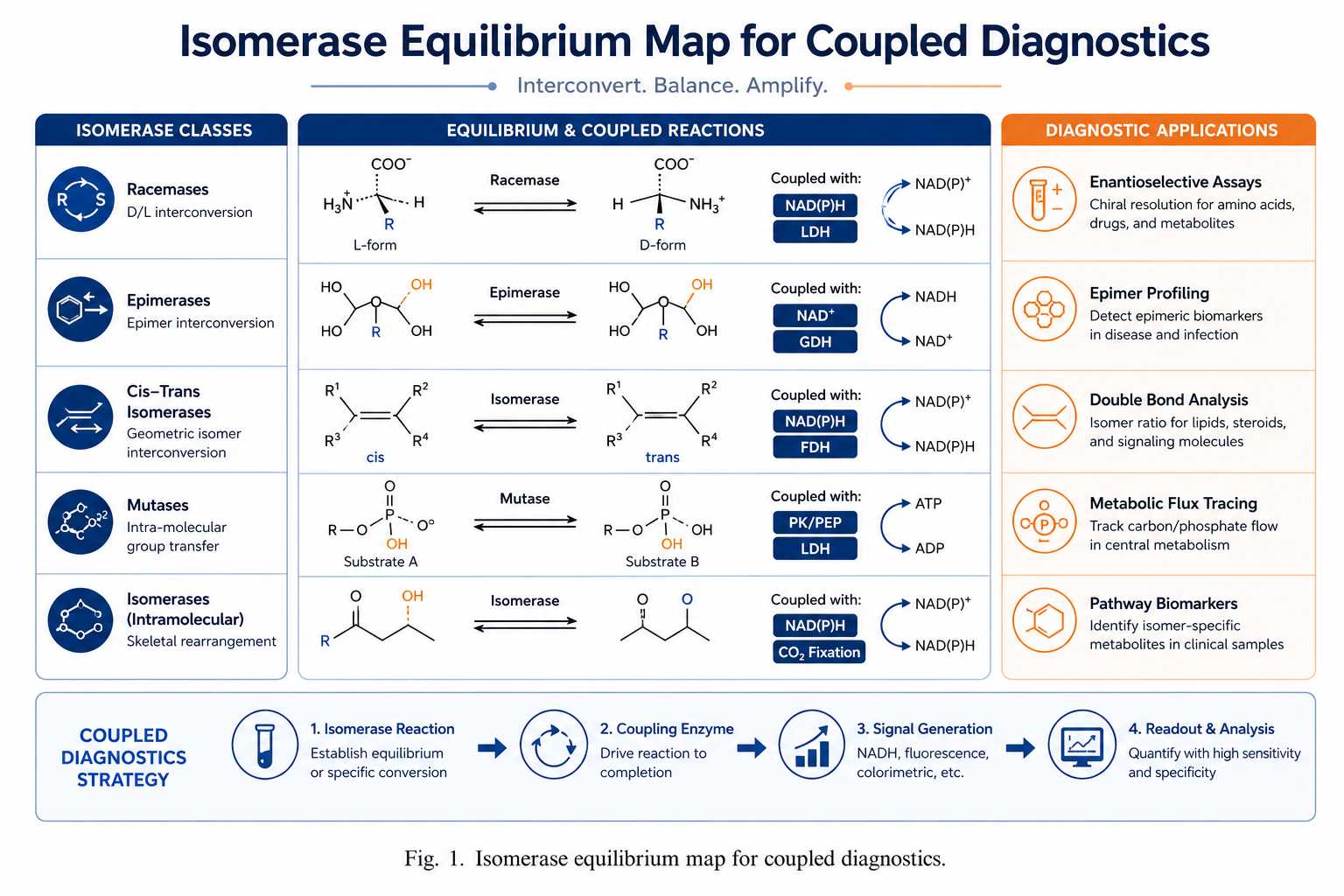 Fig 1. Isomerase equilibrium map for coupled diagnostics.
(Creative Enzymes Diagnostic)
Evaluate conversion with the intended substrate and the actual indicator system. An activity result obtained with another isomer or a different coupled reaction may not predict assay performance.
| Selection factor | How to evaluate it | Why it matters |
|---|---|---|
| Substrate and product identity | Specify the complete chemical names, phosphorylation state, and stereochemical configuration of both sides of the reaction. | A change in one stereocenter or phosphate position can place the reaction outside the enzyme's useful specificity. |
| Reaction direction and equilibrium | Measure time courses across the intended substrate range and reagent composition. | A reversible reaction may stop before the required conversion unless the product is consumed or the substrate ratio is controlled. |
| Cofactors and activators | Confirm metal ions, phosphorylated activators, or bound cofactors in the complete buffer. | Insufficient activation can reduce apparent activity; excess cofactor may disturb the indicator reaction. |
| Coupled-enzyme capacity | Titrate the isomerase and downstream enzyme independently and together. | The signal should track isomer formation rather than saturation or limitation of the indicator step. |
| Matrix background | Use no-isomerase and no-substrate controls with representative samples. | Endogenous enzymes, related isomers, and spontaneous conversion can create blank drift or bias. |
| Activity method and stability | Compare candidates with one common functional method and include the planned storage and working hold times. | Supplier unit definitions and cofactor states may differ even when nominal concentrations appear similar. |
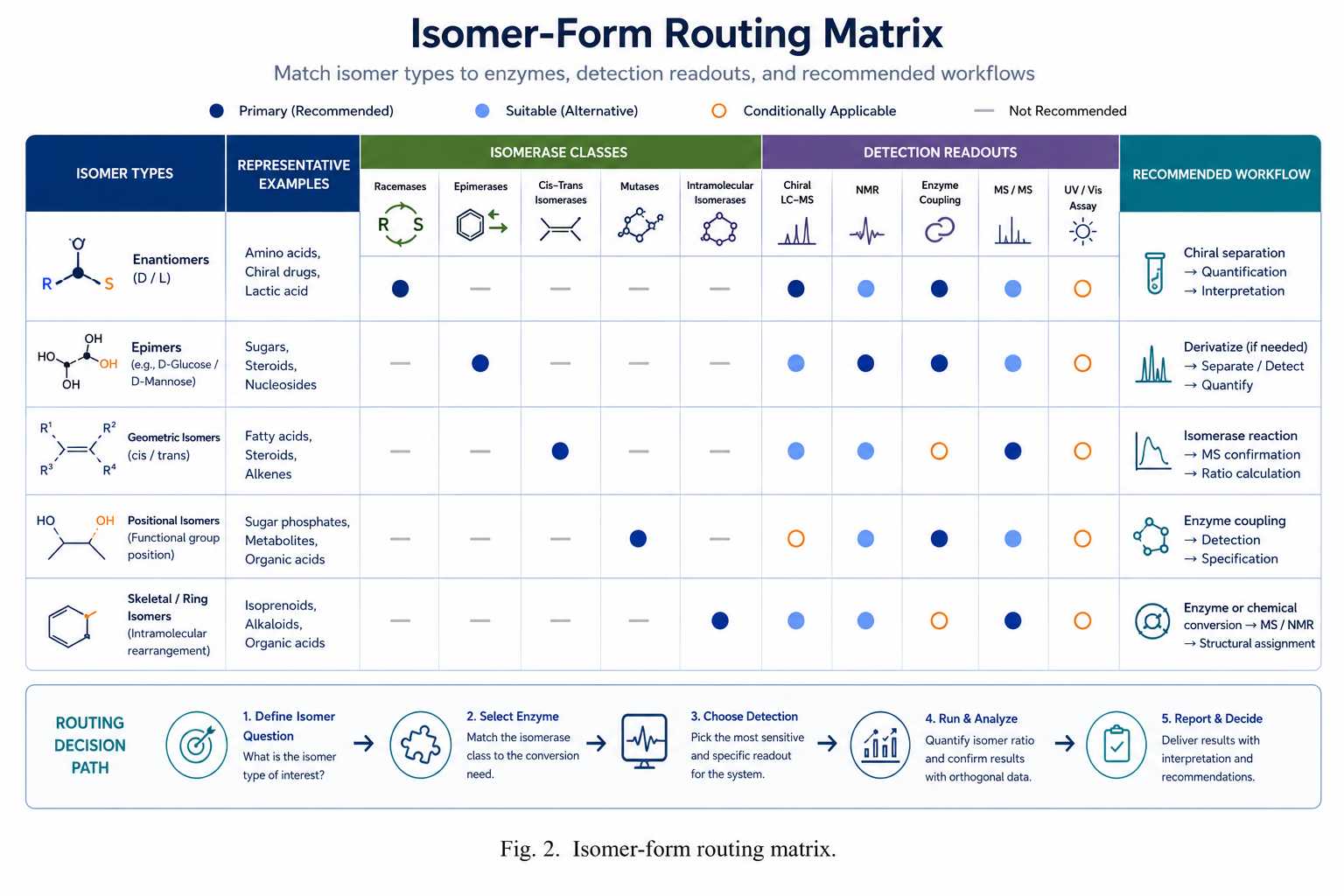 Fig 2. Isomer-form routing matrix.
(Creative Enzymes Diagnostic)
Creative Enzymes supplies phosphomutase and sugar-phosphate isomerase products for analytical research and diagnostic reagent development. Select a product name to review its available specifications.
| Product | Catalog | EC number | Source | Activity |
|---|---|---|---|---|
| Beta-Phosphoglucomutase (β-PGM) from E. coli | DIA-432 | EC 5.4.2.6 | E. coli | ≥ 30 U/mg |
| High Purity Phosphoglucose Isomerase | DIA-542 | EC 5.3.1.9 | Escherichia coli | ~ 550 U/mg of protein (25 °C, pH 7.6 on fructose 6-phosphate) ~ 649 U/mg of protein (40 °C, pH 7.6 on fructose 6-phosphate) |
| High Purity Phosphomannose Isomerase | DIA-543 | EC 5.3.1.8 | Escherichia coli | ~ 89 U/mg (25 °C, pH 7.6 on mannose 6-phosphate) |
Activity values use product-specific assay definitions. Review the stated method and test conditions before comparing unit values across materials.
Qualification should show that the isomerase, indicator reaction, and sample matrix work as one quantitative system. High activity in an isolated enzyme assay is not enough.
Document the starting isomer, target product, required direction, analytical range, and acceptable reaction time.
Determine the enzyme and cofactor concentrations that keep the isomerization step and indicator step within their useful kinetic ranges.
Test representative samples, related isomers, likely interferents, and controls that separate endogenous conversion from reagent activity.
Specify the incoming activity method, cofactor state, formulation limits, storage, lot bridging, and functional release test.
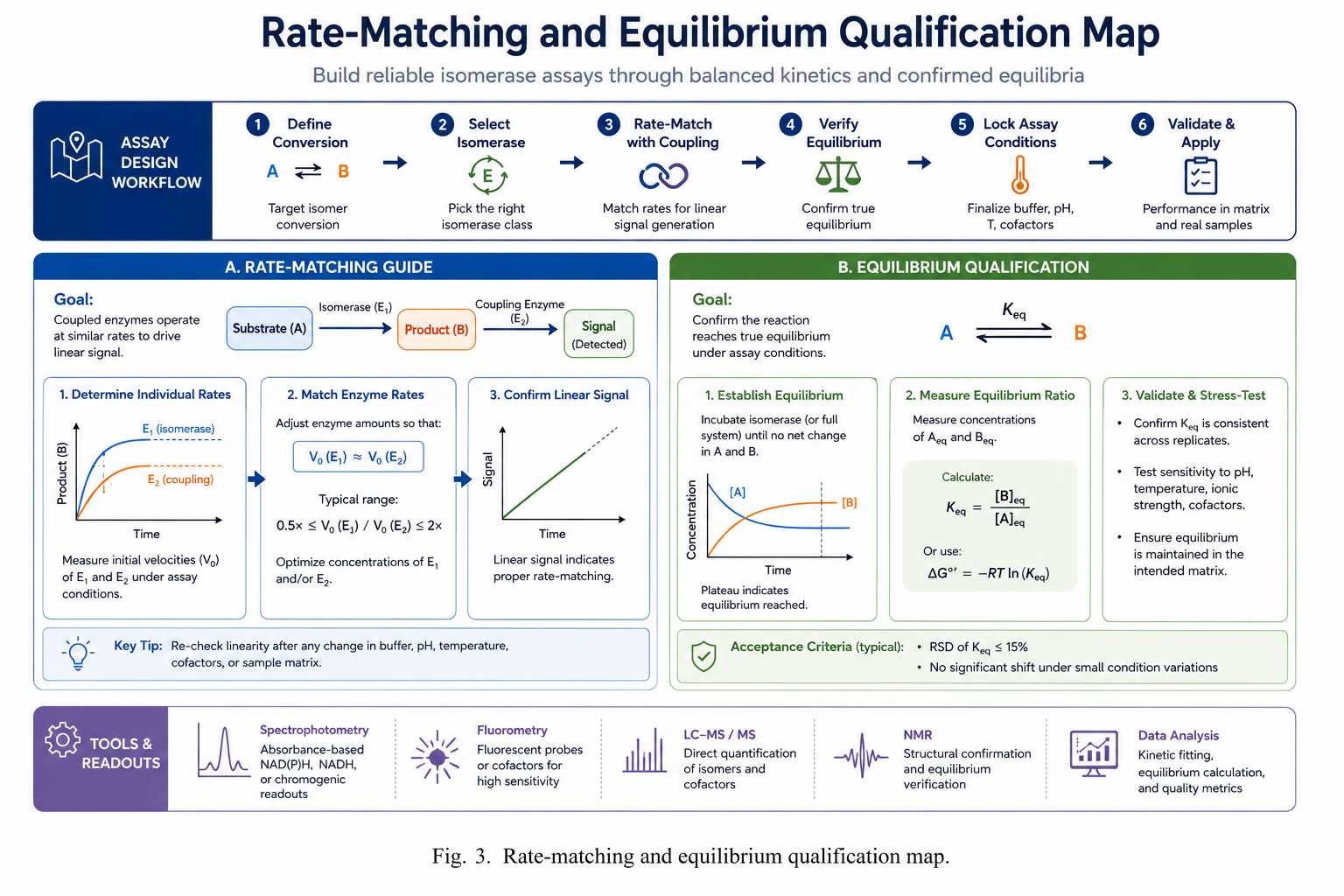 Fig 3. Rate-matching and equilibrium qualification map.
(Creative Enzymes Diagnostic)
Provide the starting and product isomers, reaction direction, concentration range, indicator enzyme and readout, buffer and cofactor composition, sample matrix, required format, scale, and documentation needs.
They convert an analyte into a molecular form that an established indicator reaction can measure. The coupled system must still be balanced so that neither step limits the result.
No. Quantitation is possible when substrate ratios, reaction time, and product consumption keep conversion predictable across the analytical range.
Only if they act on the same substrate pair with suitable specificity and kinetics. Closely related sugars and phosphate positions often require different enzymes.
Run controls without isomerase, substrate, cofactor, or indicator enzyme, then test related isomers and representative sample matrices.
The isomerase must form product at a rate the indicator reaction can follow without becoming saturated or limiting the measured response.
Include the exact substrate pair, activity method, required cofactors or activators, formulation, storage, and an application-level acceptance test.
These sources support the scientific classification and technical selection criteria. Product specifications must be confirmed in current Creative Enzymes documentation.