
| Catalog | Product Name | EC No. | CAS No. | Source | Price |
|---|---|---|---|---|---|
| BDE-026 | Native α-L-fucosidase (AFU) from Microorganism | EC 3.2.1.51 | Microorganism | Inquiry | |
| BDE-027 | 2-chloro-4- Nitrophenyl-α-L-fucopyranoside (CNP-AFU) | Inquiry | |||
| BDE-028 | L-γ-glutamyl-3-carboxy-4-nitroanilide (Glupa-C) | Inquiry | |||
| BDE-044 | Recombinant Glutamate Dehydrogenase (GLDH) | EC 1.4.1.2 | Recombinant protein expression | Inquiry | |
| BDE-046 | Recombinant Adenosine Deaminase (ADA) | EC 3.5.4.4 | Recombinant microbial proteins | Inquiry | |
| BDE-055 | Recombinant 3α-Hydroxysteriod Dehydrogenase (HSD) | EC 1.1.1.50 | Recombinant protein expression | Inquiry | |
| DIA-160 | Native Microorganism Malate Dehydrogenase | EC 1.1.1.37 | 9001-64-3 | Microorganism | Inquiry |
| DIA-207 | Native Microorganism D-lactate dehydrogenase | EC 1.1.1.27 | 9001-60-9 | Microorganism | Inquiry |
| DIA-429 | Alpha-L-Fucosidase from Microorganism | EC 3.2.1.51 | Microorganism | Inquiry |
Liver-related laboratory testing includes measurements associated with hepatocellular injury, cholestasis, bile acid metabolism, and hepatic synthetic capacity. Common panels may contain alanine aminotransferase, aspartate aminotransferase, alkaline phosphatase, gamma-glutamyl transferase, bilirubin, and albumin. However, these markers provide different information and should not be interpreted as interchangeable measures of overall liver function.
This product category focuses on enzymes, substrates, reference materials, and auxiliary reagents used in enzyme activity assays and enzymatic liver-related tests. Bilirubin and albumin are important liver-associated measurands, but their routine methods are not necessarily enzyme based and therefore are not the primary focus of this enzyme portfolio.
Creative Enzymes supplies aminotransferase reference enzymes, coupling enzymes, GGT substrates, alkaline phosphatase preparations, glutamate dehydrogenase, 3α-hydroxysteroid dehydrogenase, α-L-fucosidase, and related reagents for clinical chemistry analyzers, kinetic assays, calibrators, controls, and diagnostic reagent development. The existing product portfolio includes GLDH, 3α-HSD, malate dehydrogenase, α-L-fucosidase, and GGT-related substrates.
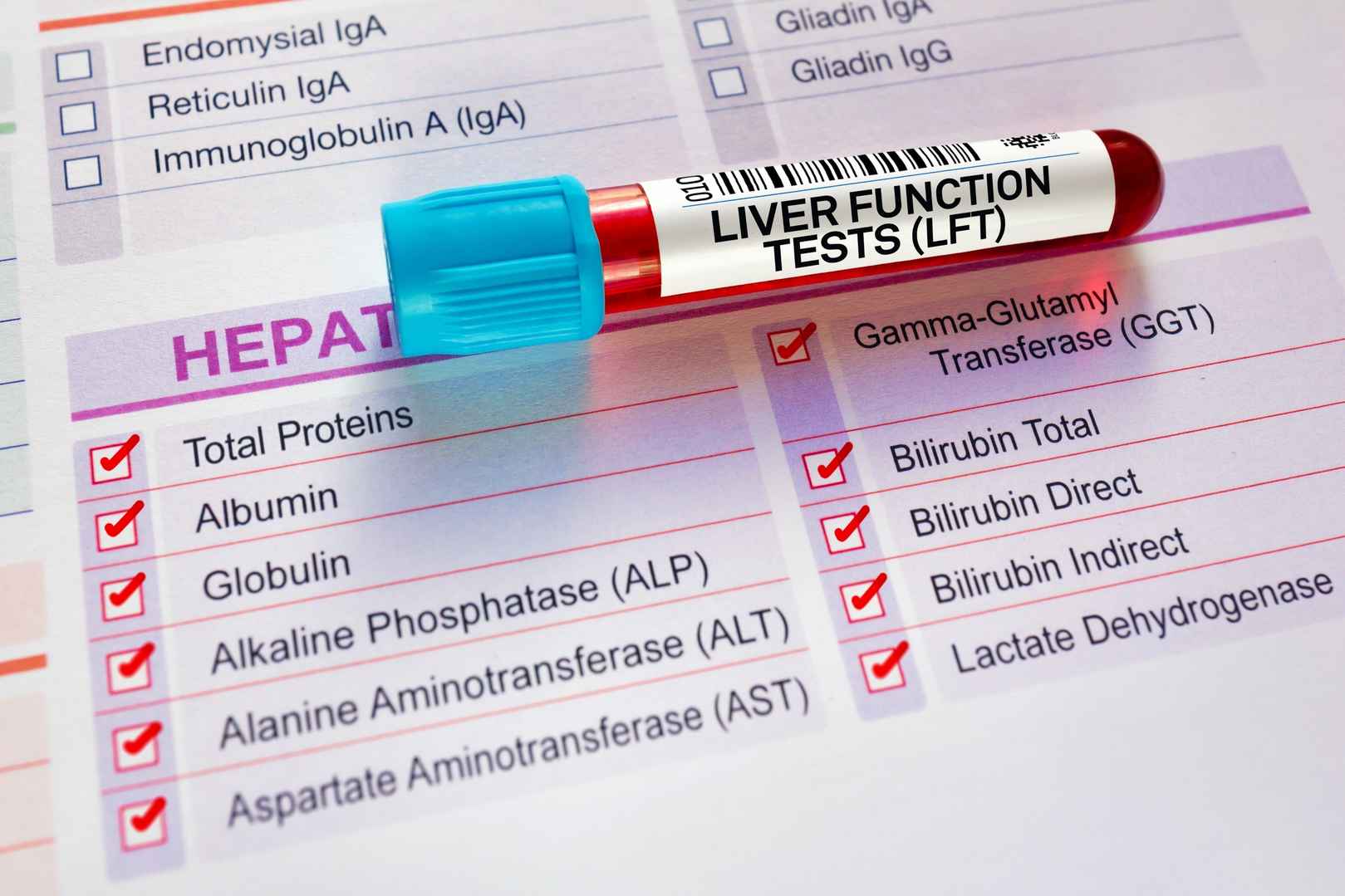
ALT and AST are endogenous aminotransferases measured through kinetic activity assays. In these methods, the patient's enzyme is the analyte, while auxiliary enzymes convert the primary reaction product into a measurable change in NADH absorbance.
A typical ALT assay includes:
A typical AST assay includes:
Pyridoxal-5′-phosphate may be included in activated aminotransferase methods. IFCC reference procedures have been established for the measurement of ALT and AST catalytic activity at 37°C.
Representative products include:
GGT activity assays commonly use a synthetic gamma-glutamyl donor together with glycylglycine as the acceptor. GGT transfers the gamma-glutamyl group and releases a colored nitroaniline derivative, whose rate of formation is proportional to GGT activity.
One established method uses L-γ-glutamyl-3-carboxy-4-nitroanilide and measures the released chromophore near 405 nm.
Relevant products include:
Substrate purity, spontaneous background, buffer pH, and enzyme-reference traceability should be considered during reagent development.
Alkaline phosphatase activity is frequently measured using phosphomonoester substrates such as p-nitrophenyl phosphate under alkaline conditions. ALP hydrolyzes the substrate and generates a colored product that can be monitored kinetically.
ALP is present in several tissues, including liver and bone. Total ALP activity alone is therefore not liver specific, and assay interpretation may require other markers or isoenzyme-related information. FDA-reviewed ALP assays are used in the evaluation of liver, bone, parathyroid, and intestinal disorders.
Products may include:
Glutamate dehydrogenase is a mitochondrial enzyme that can be measured as a marker associated with hepatocellular injury. GLDH activity assays generally monitor an NADH- or NADPH-dependent reaction involving 2-oxoglutarate, ammonium, and glutamate.
GLDH is also widely used as an auxiliary reagent enzyme in ammonia and urea assays. The intended role should therefore be clearly defined:
These uses require different activity assignments, impurity limits, and formulation strategies.
Total bile acid assays can use 3α-hydroxysteroid dehydrogenase in an enzymatic cycling system. In the presence of thio-NAD and NADH, 3α-HSD repeatedly interconverts bile acids and corresponding 3-keto steroids, amplifying the formation of thio-NADH.
The change in absorbance, commonly monitored near 405 nm, is proportional to the concentration of bile acids in the specimen.
Representative products include:
Serum cholinesterase activity may be evaluated in selected liver-related testing workflows. Assays commonly monitor hydrolysis of an ester substrate through direct or coupled color development.
Additional specialized products may include:
α-L-Fucosidase has been investigated in liver disease and oncology-related research, but it should not be presented as a universal routine liver-function marker.
| Assay Target | Typical Reaction Strategy | Representative Products | Product Role |
|---|---|---|---|
| ALT activity | Pyruvate formation followed by LDH-dependent NADH consumption | ALT reference enzyme, LDH | Reference material and coupling enzyme |
| AST activity | Oxaloacetate formation followed by MDH-dependent NADH consumption | AST reference enzyme, MDH | Reference material and coupling enzyme |
| GGT activity | Transfer of a gamma-glutamyl group from a chromogenic substrate | GGT reference enzyme, Glupa-C-type substrate | Reference enzyme and substrate |
| ALP activity | Hydrolysis of a phosphomonoester at alkaline pH | ALP reference enzyme and substrate | Reference material and assay reagent |
| GLDH activity | NAD(P)H-linked glutamate or 2-oxoglutarate reaction | GLDH reference enzyme | Calibrator, control, or reference |
| Total bile acids | 3α-HSD enzymatic cycling | 3α-HSD and cycling reagents | Primary assay enzyme |
| Cholinesterase | Ester-substrate hydrolysis | Cholinesterase reference enzyme and substrate | Reference material and assay reagent |
| α-L-Fucosidase | Hydrolysis of a chromogenic fucoside | AFU and CNP-AFU-type substrate | Specialized activity-assay reagent |
First determine whether the required product will be used as:
An ALT reference enzyme and the LDH used in an ALT reaction are both enzymes, but they serve fundamentally different analytical roles.
For ALT, AST, GGT, and ALP activity assays, consider:
IFCC provides reference procedures and reference materials for several clinically measured enzymes, including ALT, AST, GGT, and ALP.
Coupling enzymes should be present in sufficient activity so that they do not limit the primary reaction. Important attributes include:
Assay performance may be influenced by:
Need Help Selecting a Liver Assay Enzyme?
Share your assay target, reaction method, reference procedure, analyzer platform, and formulation requirements with our technical team.
Request Product Selection Support →
Q1. Which enzymes are used in ALT and AST assays?
Q2. Are ALT and AST reagent enzymes or assay targets?
Q3. Is alkaline phosphatase specific to the liver?
Q4. Which enzyme is used in total bile acid assays?
Q5. Is GLDH used only in liver testing?
Q6. Can one reference enzyme be used for every analyzer method?
Q7. Can you provide glycerol-free or lyophilized enzymes?
