| Cat# | ENZD-RT08 |
| Specification | 100 rxns 500 rxns |
| Aplications | LAMP/RT-LAMP Isothermal Amplification |
| Description | A premixed solution for isothermal amplification detection of DNA or RNA, easy to operate and results are intuitive. Integrates Bst enzyme and reverse transcriptase, can complete detection within 30 minutes, and features a contamination prevention design to enhance result reliability. |
| Features | Excellent LAMP & RT-LAMP amplification performance. |
| Quality Control | Easy operation: One-tube Mix with pre-mixed fluorescent and visualization dyes, add primers and template to start amplification. Fast amplification: Complete detection within 30 minutes. Amplification results can be visually interpreted: Distinct color contrast between negative (red) and positive (yellow) results. Anti-contamination system: Pre-mixed UDG enzyme and dUTP to effectively prevent false positives caused by aerosol contamination. |
| Components | ColorDetect LAMP/RT-LAMP 2x Master Mix |
| Shipping and Storage Conditions | Store at -30 ~ -15°C, transport at ≤0°C |
| Download Datasheet: | 
|
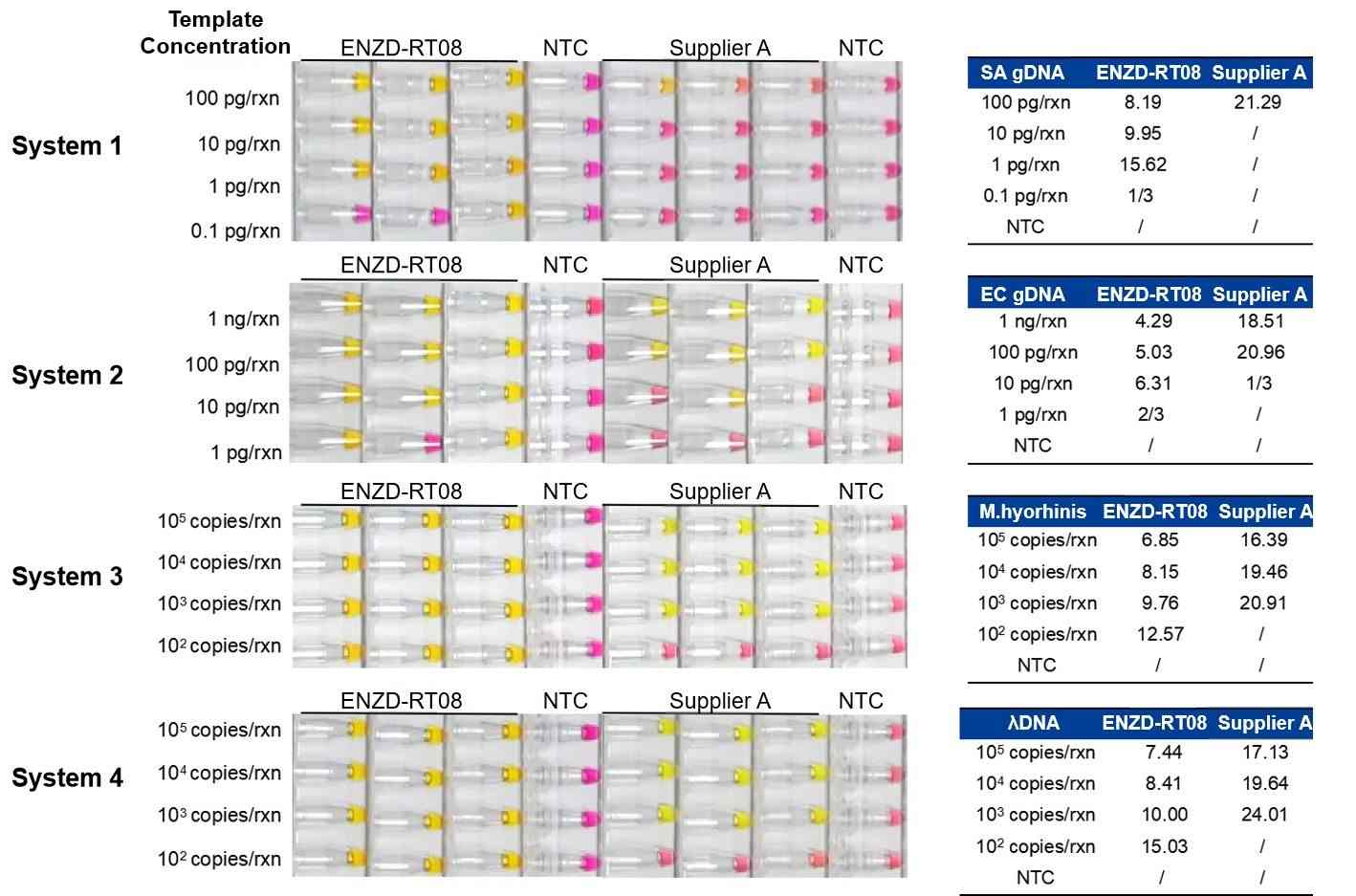
The isothermal amplification premix ENZD-RT08, developed by Creative Enzymes, was evaluated in LAMP reactions using multiple DNA templates, including Staphylococcus aureus genomic DNA, Escherichia coli genomic DNA, mycoplasma plasmid DNA, and λDNA. Performance was benchmarked against a commercially available reagent (Supplier A) across four template concentration gradients.
Under conditions supporting stable detection, ENZD-RT08 consistently exhibited lower CT values, indicating faster amplification kinetics. In addition, the minimum detectable template concentration was lower across all tested systems, demonstrating enhanced analytical sensitivity. No amplification was observed in all no-template control (NTC) groups, confirming high specificity and minimal background interference.
These results highlight the suitability of ENZD-RT08 as a high-performance isothermal amplification premix mix for rapid and sensitive nucleic acid detection workflows. Data sourced from internal validation studies evaluating LAMP amplification performance across multiple DNA templates and concentration gradients.
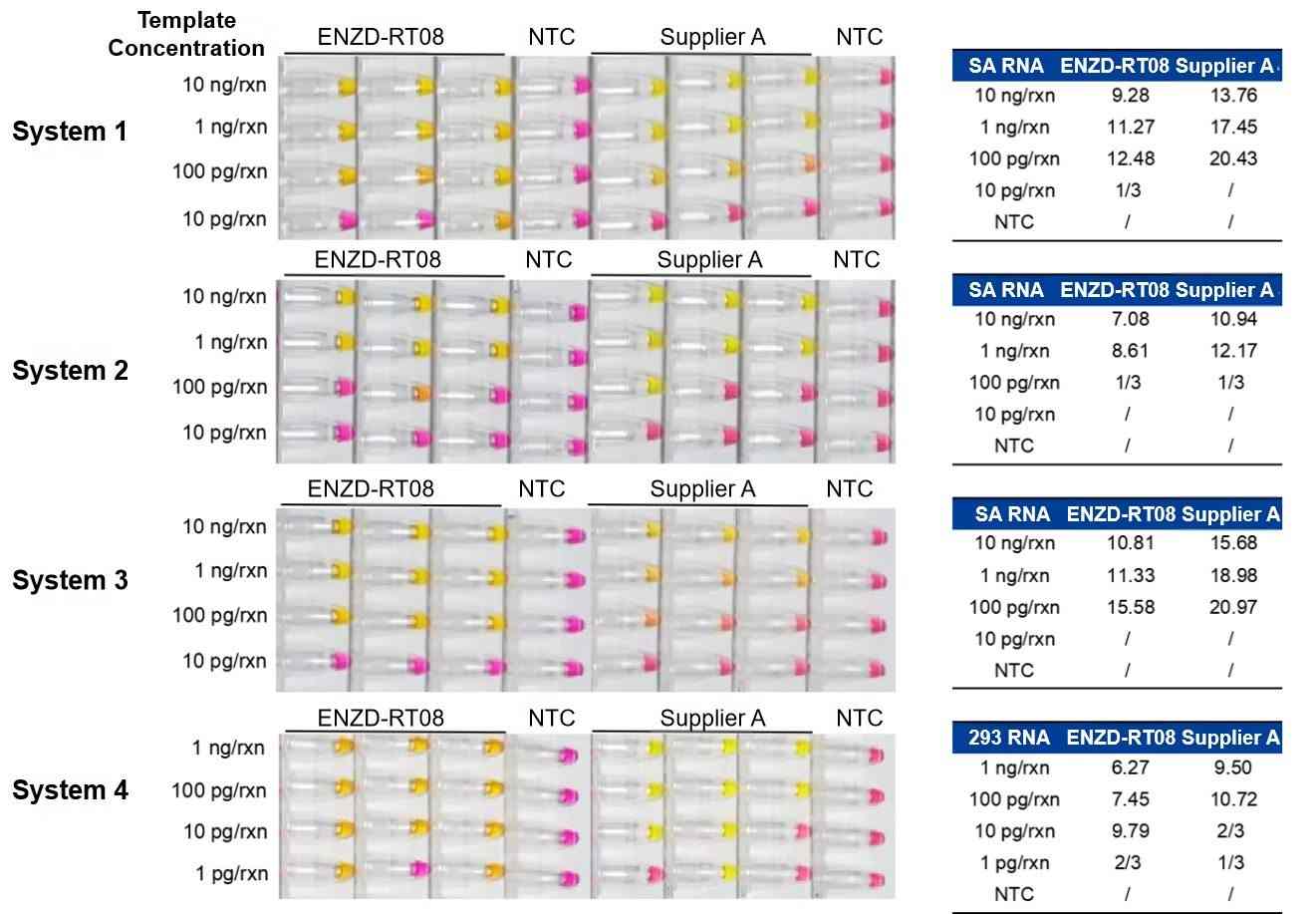
To further assess reverse transcription capability within isothermal workflows, ENZD-RT08 was tested in RT-LAMP assays using total RNA extracted from Staphylococcus aureus and 293 cells. Amplification performance was compared with Supplier A under identical reaction conditions and multiple template input levels.
ENZD-RT08 demonstrated consistently faster amplification, reflected by reduced CT values across all detectable template concentrations. In one system, the premix achieved a lower detection limit than the comparator, while in the remaining systems, comparable sensitivity was maintained. Importantly, all NTC reactions showed no detectable amplification, confirming strong specificity in RNA-based detection.
These findings indicate that ENZD-RT08 provides reliable reverse transcription and amplification efficiency within a single isothermal amplification premix mix, supporting stable performance across different RNA sample types. Data sourced from internal validation studies assessing RT-LAMP amplification efficiency, sensitivity, and specificity using diverse RNA templates.