| Cat# | ENZD-RT20 |
| Specification | 100 rxns (20 μl/rxn) 1000 rxns (20 μl/rxn) 10000 rxns (20 μl/rxn) |
| Aplications | Virus Detection; Pathogen Detection; Fusion Gene Detection; DNA/RNA Co-Detection; Gene Expression Analysis |
| Description | High stability one-step RT-qPCR premix, detection sensitivity can reach 0.1 pg total RNA or <10 copies RNA. Contains Heat-labile UDG anti-contamination system, combined with high-performance reverse transcriptase and DNA polymerase, suitable for TaqMan probe detection. |
| Features | 1. One-tube operation, more convenient. 2. High stability. |
| Quality Control | Excellent amplification balance between high and low templates |
| Components | RNase-free ddH2O U+ One Step RT-qPCR Probe 5x Master Mix 50 × ROX Reference Dye 1 50 × ROX Reference Dye 2 |
| Shipping and Storage Conditions | Store at -30 ~ -15℃, transport at ≤0℃. |
| Download Datasheet: | 
|
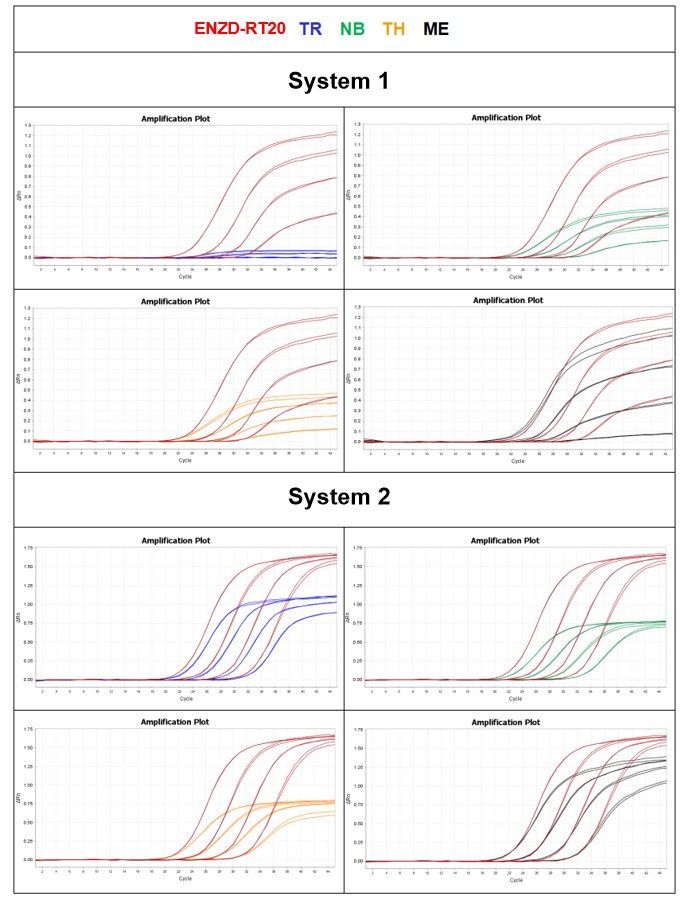
The ENZD-RT20 RT-qPCR system from Creative Enzymes was examined using viral RNA and HeLa-derived RNA templates, with performance directly compared to a benchmark reference system under identical primer–probe settings.
Across both sample types, amplification behavior closely matched the reference system, with CT deviations controlled within ±0.5, indicating strong consistency in sensitivity. The formulation incorporates a hot-start DNA Polymerase, Heat-labile UDG, and a dUTP/UDG contamination prevention system, providing controlled reaction activation and stable background suppression during amplification. Data sourced from internal validation studies evaluating cross-platform RT-qPCR performance consistency.
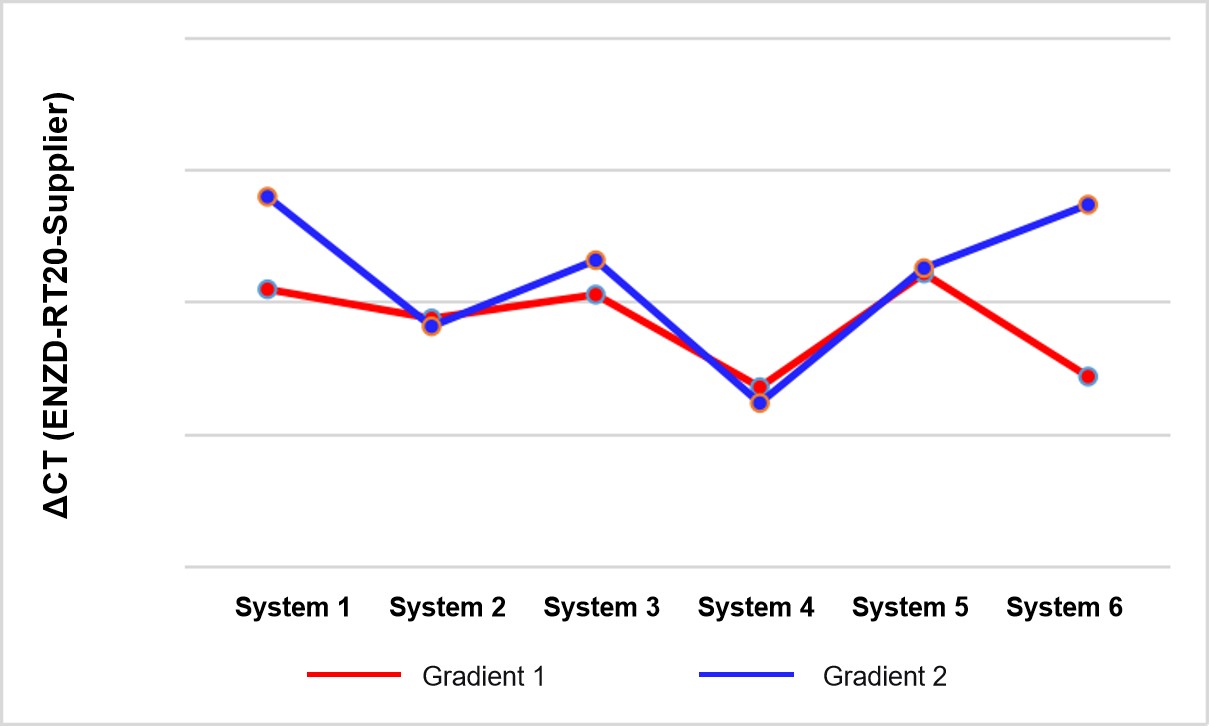
To assess quantitative robustness, ENZD-RT20 was tested using serial dilutions of viral RNA and HeLa RNA and compared against multiple commercial competitor systems.
Rather than showing bias toward high or low template inputs, ENZD-RT20 maintained a more even amplification profile across the entire dilution range, with improved CT distribution and linear response stability. This indicates stronger balance in signal generation under varying template loads. The system is built on a hot-start DNA Polymerase, supported by Heat-labile UDG and a dUTP/UDG contamination control system, ensuring stable performance even under challenging quantitative conditions. Data sourced from internal validation studies evaluating amplification linearity and balance across template gradients.