| Cat# | ENZD-P02 |
| Specification | 500 U; 1000 U; 5000 U |
| Unit Concentration | 5 U/μl |
| Description | Taq HS DNA polymerase is a hot-start Taq enzyme obtained by mixing Taq antibody and Taq DNA polymerase in a specific ratio. It exhibits higher stability and detection rate. Based on the thermostability of Taq antibody, Taq HS DNA polymerase maintains strict blocking at 55°C, minimizing non-specific amplification during sample mixing and temperature rise. When the reaction is held at 95°C for more than 30 seconds, Taq antibody is inactivated, and Taq enzyme activity is fully released, ensuring high amplification sensitivity and specificity in the PCR system. Activation of Taq HS DNA polymerase is unaffected by buffer pH, ionic strength, or other factors, making it suitable for various hot-start PCR and qPCR reactions based on Taq DNA polymerase. It is commonly used to amplify low-copy genes from complex templates (genomic DNA, cDNA) and is a hot-start Taq enzyme based on PCR/qPCR molecular diagnostic reagents. This product offers higher stability and detection rate. |
| Features | • Excellent amplification line pattern • Higher amplification sensitivity • Improved stability of the premixed liquid pressurization platform • Higher stability and detection rate |
| Applications | Hot-start PCR/qPCR; low-copy gene amplification; direct amplification of SNPs in liquid for genotyping; multiplex pathogen detection |
| Components | 10 × Taq HS Buffer (Mg 2+ plus); dNTP Mix (10 mM each); Taq HS DNA polymerase (5 U/μl). |
| Quality Control | 1. Excellent amplification sensitivity and plateau phase 2. Higher detection rate 3. Product stability testing |
| Shipping and Storage Conditions | Store at -30 ~ -15℃, transport at ≤0℃. |
| Download Datasheet: | 
|
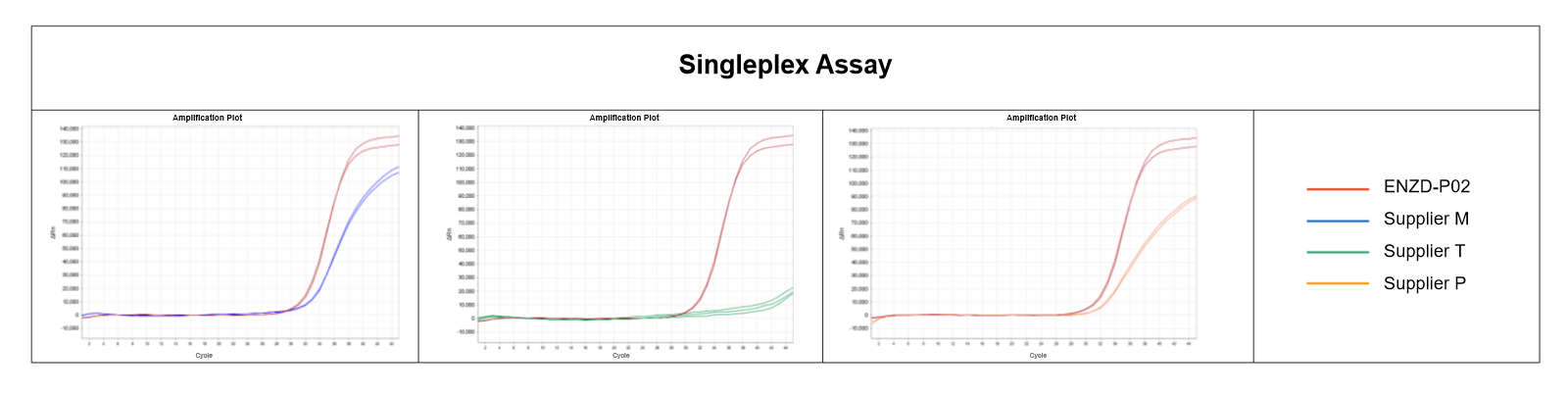
ENZD-P02 was evaluated alongside comparable products from three sources under identical qPCR conditions using the same primer–probe sets. The amplification profiles were compared in a singleplex system. The results demonstrated that ENZD-P02 achieved higher amplification sensitivity and a more stable plateau phase, indicating improved reaction efficiency and signal consistency. Data sourced from internal validation studies.
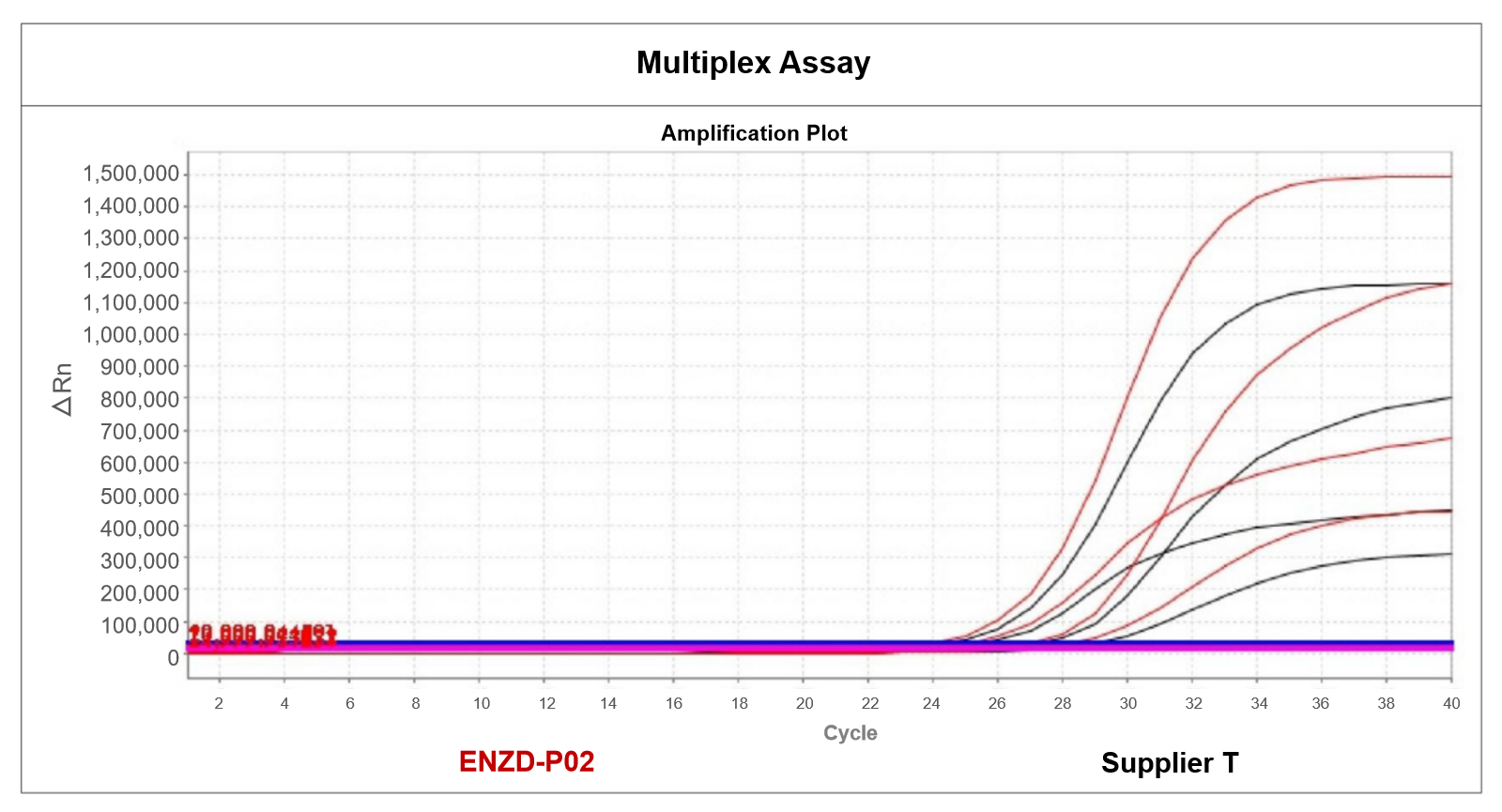
Multiplex qPCR experiments were conducted using the same sample to simultaneously amplify four target genes under identical conditions. Compared with a commercial reagent from Supplier T, ENZD-P02 showed superior plateau uniformity and amplification linearity across all targets, demonstrating robust performance in multiplex detection systems. Data sourced from internal validation studies.
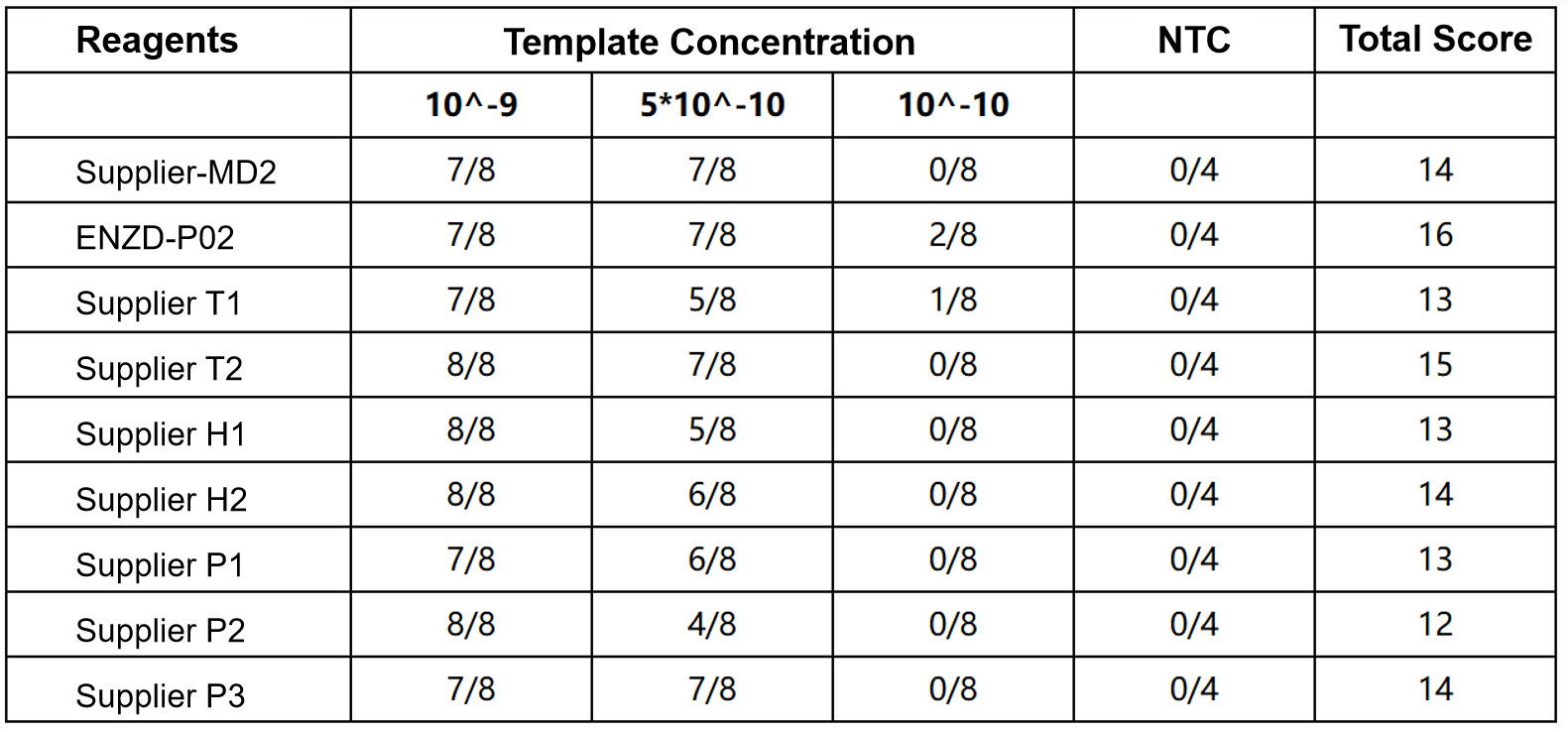
Detection performance was assessed across serial dilutions of template DNA. ENZD-P02 consistently achieved higher positive detection rates at low template concentrations compared to multiple commercial enzymes, while maintaining zero amplification in no-template controls (NTC). These results highlight its high sensitivity and robust discrimination capability, supporting accurate detection in low-copy-number scenarios. Data sourced from internal validation studies.
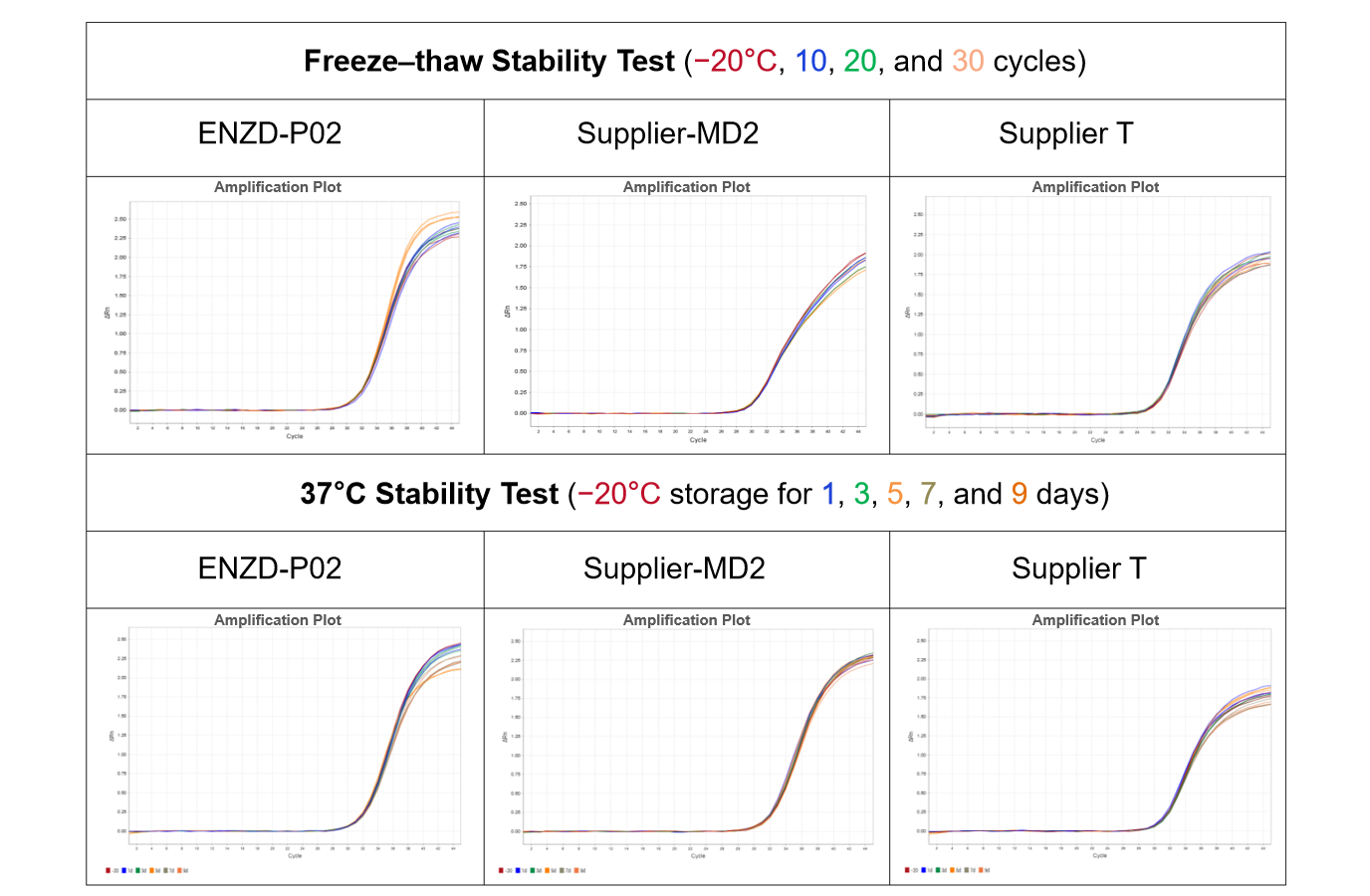
The stability of ENZD-P02 was evaluated under defined storage and operational conditions. The enzyme maintained consistent amplification performance over time, demonstrating reliable stability suitable for diagnostic workflow integration. Data sourced from internal validation studies.