| Cat# | ENZD-P03 |
| Reaction | 200 rxns; 500 rxns |
| Unit Concentration | 20 μl/rxn |
| Description | EnzSmart U+ Taq HS DNA Polymerase is an enzyme with strong 3' mismatch recognition capability and high specificity, selected through the EnzSmart platform. It binds to a high-blocking-rate bispecific antibody to form a hot-start Taq enzyme, maintaining strict blocking at 55°C. Combined with an optimized buffer system, it effectively reduces non-specific amplification caused by primer-probe cross-mixing during sample mixing, system warming, and long-term storage, supporting pre-mixing of primers and probes. This product is sold in separate enzyme and buffer formulations, allowing for flexible adjustment of enzyme, Mg2+, and dNTP concentrations to suit various system differences . It is suitable for various hot-start Taq enzyme-based PCR and qPCR reactions. Furthermore, the product includes additional UDG enzyme, dUTP, and dTTP components, supporting the construction of a custom UDG anti-contamination system and providing greater operational flexibility. |
| Features | Better premixed probe stability; Excellent amplification linearity; Includes dUTP/UDG anti-pollution system. |
| Applications | Hot-start PCR/qPCR; gene expression analysis; multiplex pathogen detection; tumor detection |
| Components | EnzSmart Taq HS DNA Polymerase (5 U/ul) 10 x BioSmart Taq HS Buffer (Mg2+ free) MgCl2 (100 mM) dA/C/GTP Mix (10 mM each) dTTP (25 mM) dUTP (25 mM) Heat-labile UDG (2 U/ul) |
| Quality Control | 1. Good premixed stability 2. Excellent amplification linearity |
| Shipping and Storage Conditions | Store at -30 ~ -15℃, transport at ≤0℃. |
| Download Datasheet: | 
|
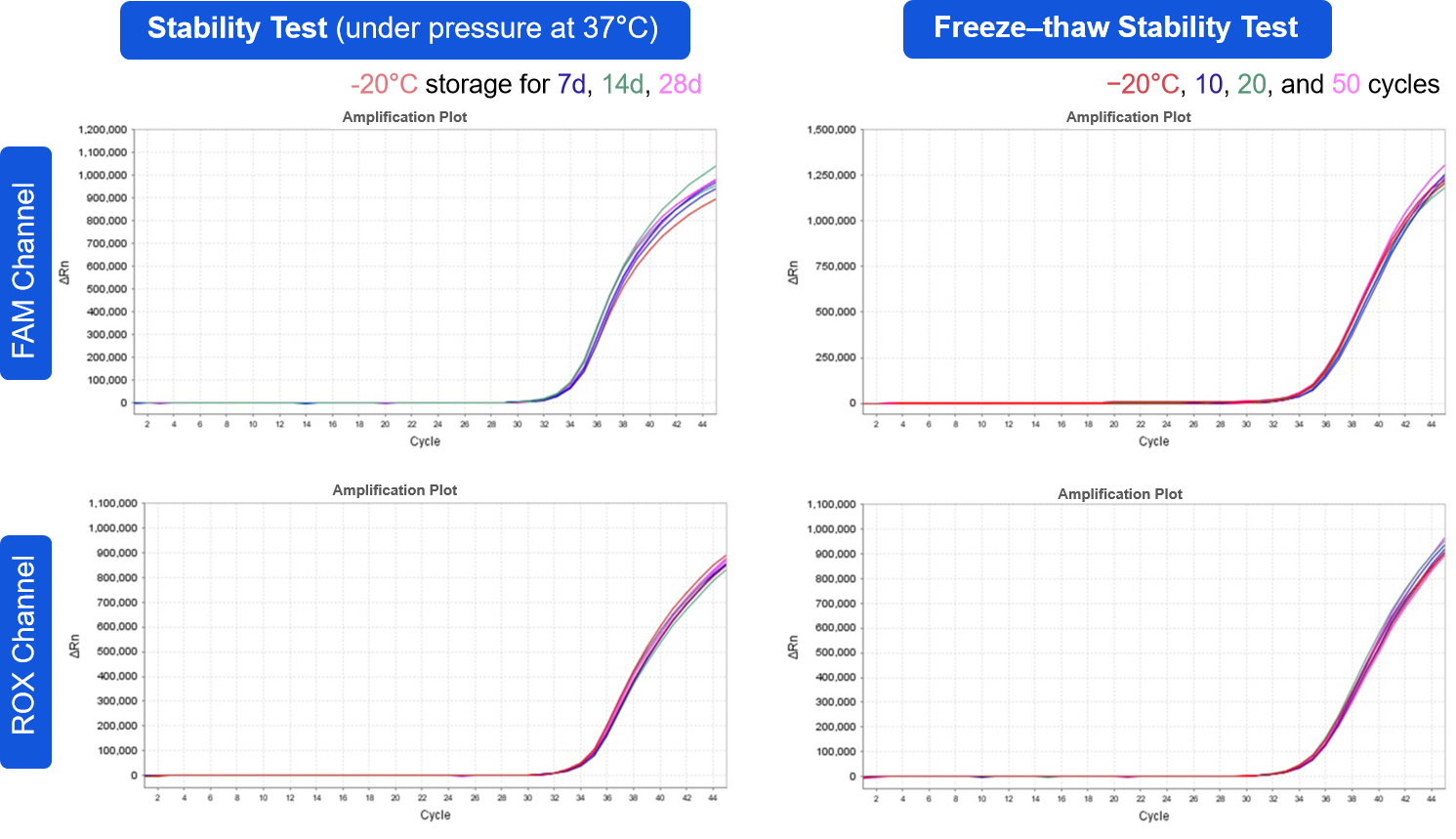
ENZD-P03 was evaluated for premix stability following primer–probe combination under accelerated storage conditions. The premixed formulation was subjected to 37°C incubation for 28 days and 50 freeze–thaw cycles, respectively, and compared with a −20°C control. No significant performance differences were observed across conditions, indicating excellent stability and robustness of the premixed system. Data generated from internal stability studies under defined stress conditions.
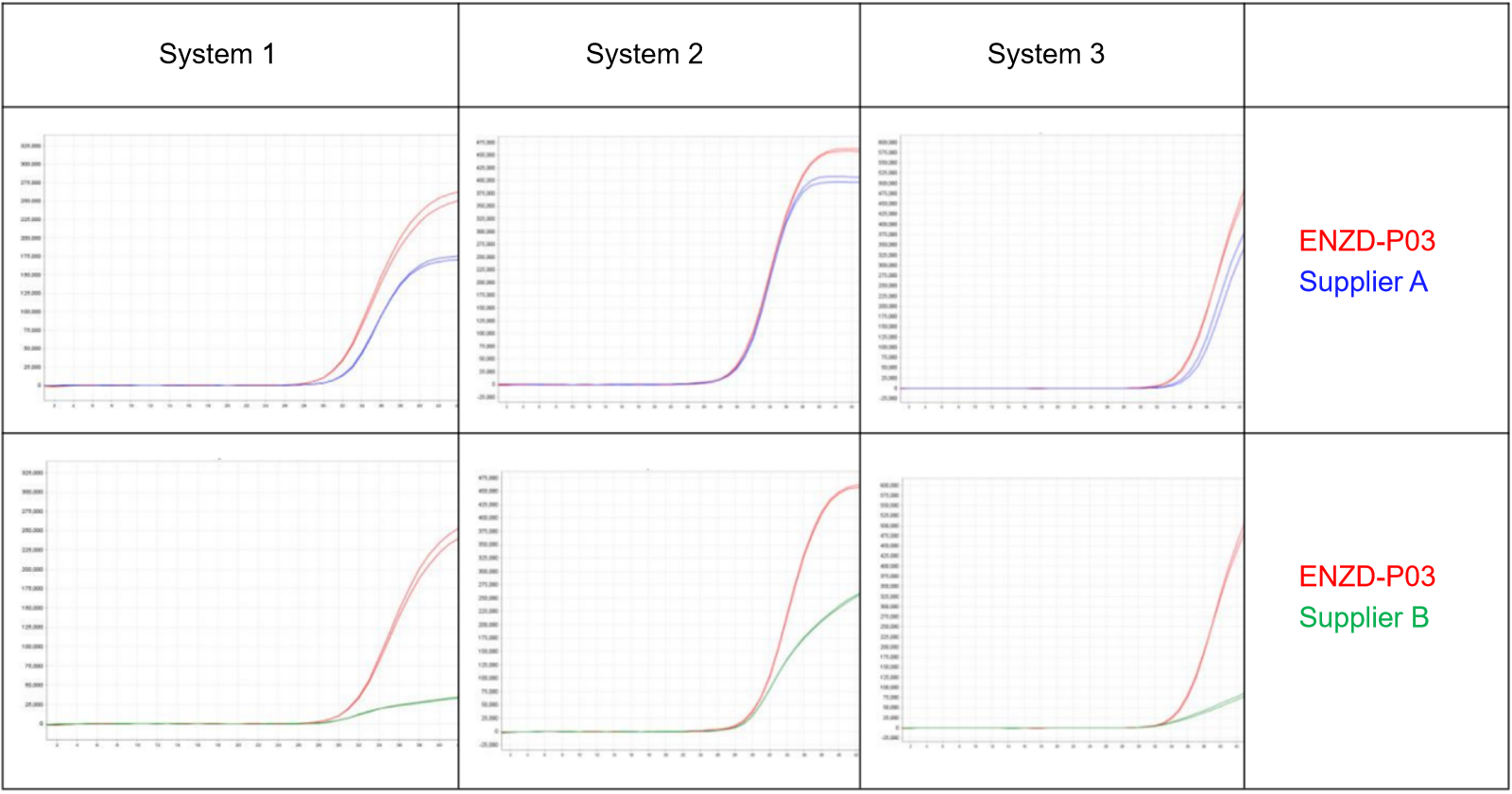
ENZD-P03 was compared with equivalent products from Supplier A and Supplier B under identical singleplex qPCR conditions using the same primer–probe sets. The results demonstrated that ENZD-P03 achieved improved amplification sensitivity and a more stable plateau phase, reflecting enhanced reaction efficiency and consistent signal output across amplification cycles. Data generated from internal qPCR performance evaluation.