
Creative Enzymes plans and executes closed-loop Design-Build-Test-Learn (DBTL) enzyme evolution programs for diagnostic-reagent development. Variant design, molecular construction, expression, screening, data review, and next-round selection are connected through shared identifiers, comparable controls, application-relevant measurements, and an explicit decision gate. The deliverable from a round is therefore not only a list of high-scoring variants. It is a traceable evidence package that explains whether to confirm, exploit, explore, reframe, transfer, or stop.
A loop is closed only when the experimental record changes the next experimental plan. Repeating mutagenesis and screening is not enough. Each result must remain connected to the sequence that produced it, the construct and expression context used, the sample and plate on which it was measured, the controls that establish assay validity, and the decision rule used to select the next candidates.
For diagnostic enzymes, this distinction matters because the apparent “best” variant depends on what the measurement represents. A polymerase that generates more endpoint fluorescence in a permissive buffer may not improve time-to-positive, inhibitor tolerance, fidelity, or low-copy detection in the intended assay. A signal enzyme with high turnover on a purified substrate may lose specificity in a structurally related analyte panel. A variant that looks stable in a thermal-shift assay may not retain activity after drying, storage, and reconstitution. The DBTL loop must therefore begin with the diagnostic decision and work backward to measurements that can support it.
Our closed-loop service can combine established protein-engineering approaches, including rational and structure-informed design, focused mutagenesis, directed evolution, recombination, and machine-learning-guided candidate selection. The method is configured to the starting evidence and the value of the next decision. AI is not mandatory. For a small or heterogeneous dataset, careful experimental design, mechanistic reasoning, and diversity-aware sampling may be more useful than a complex predictive model. When the data justify modeling, we can use sequence, structure, evolutionary, and measured performance information to rank or generate hypotheses while retaining uncertainty and domain constraints.
Designers need to know what the assay can resolve. The build team needs to preserve intended sequence diversity. Test operators need variant lineage and randomized layouts. Analysts need controls, metadata, and failed-run flags. Closing the loop means these dependencies are specified before the plate is run.
A model score, docking pose, language-model likelihood, or predicted stability change does not prove function. We record why a candidate was proposed, what property it is expected to change, how it will be tested, and what result would contradict the hypothesis.
Continuation is based on measurement readiness, observed improvement, remaining uncertainty, diversity, transfer relevance, and budget. The scientifically sound outcome can be confirmation, a reworked assay, transfer of qualified leads, or an evidence-based stop.
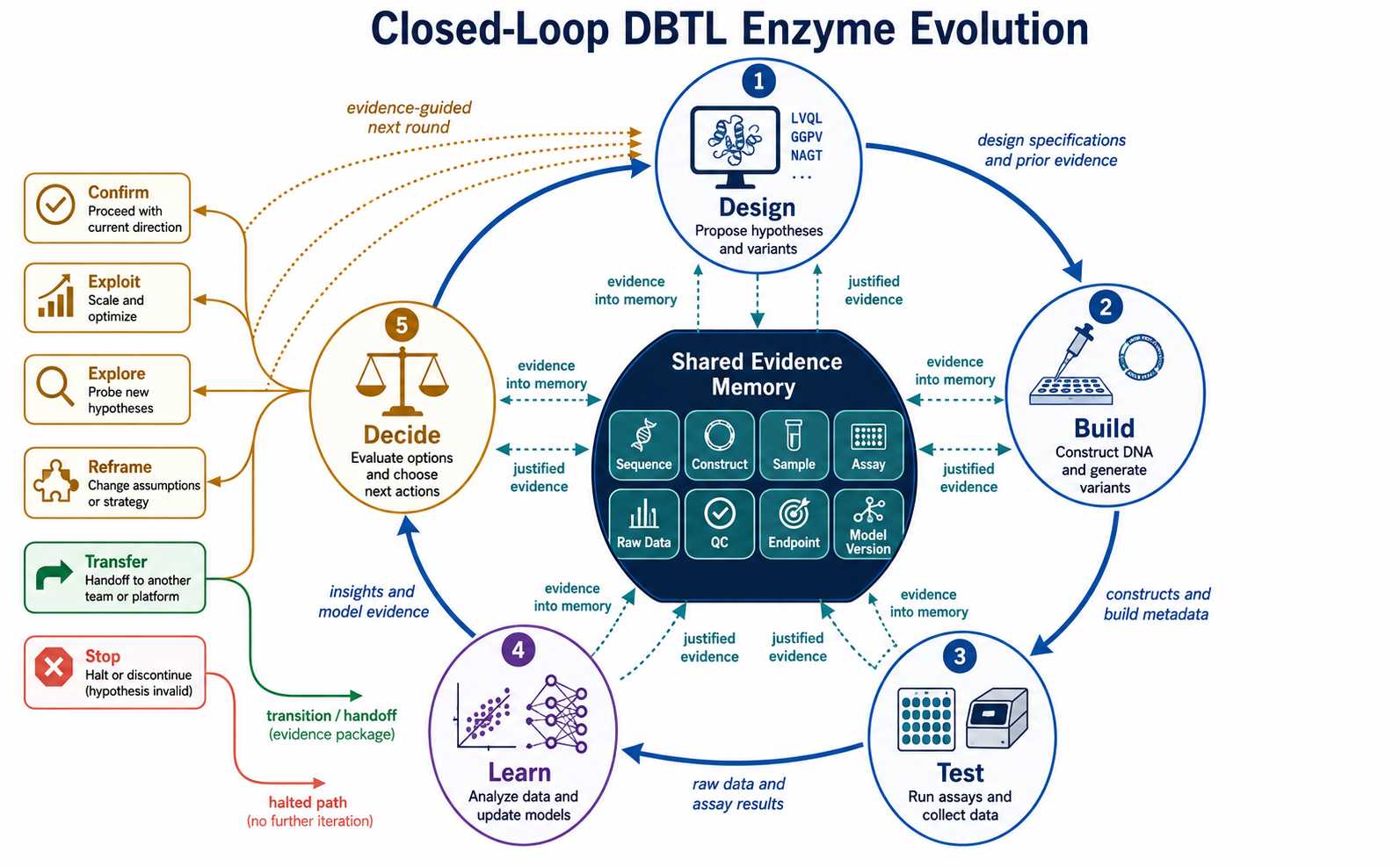 Fig. 1. Closed-loop DBTL enzyme evolution control system: Design, Build, Test, and Learn share a traceable evidence memory before the round-end gate selects confirm, exploit, explore, reframe, transfer, or stop.
(Creative Enzymes)
Closed-loop optimization becomes expensive when a campaign begins with an appealing technology but an ambiguous objective. Before designing variants, we translate the intended application into an objective vector, identify hard constraints, establish a baseline, and assess whether the proposed measurements are fit for the first decision. This “round zero” is also where we decide which evidence can be reused and which must be regenerated under comparable conditions.
“Higher activity and better stability” is not an executable engineering objective. We define the readout, condition, comparator, and decision threshold for each property. For example, the primary objective might be reduced time-to-threshold at low template concentration in a specified master mix, while maintaining no-call or false-positive performance in no-template controls, activity after a defined storage challenge, and an expression yield above a practical floor. The objective vector also records properties that may be monitored but are not yet used for selection.
Hard constraints are separated from preferences. A forbidden mutation, sequence liability, cofactor requirement, temperature limit, formulation incompatibility, or maximum enzyme loading may eliminate a candidate even when its primary assay score is strong. Preferences such as higher soluble yield or broader pH tolerance can be optimized within the feasible set. Making this distinction visible prevents a hidden weighted score from promoting a candidate that violates a non-negotiable requirement.
A baseline run estimates within-run and between-run variability, response range, edge or position effects, control behavior, and the concentration region in which variants can be discriminated. If the intended improvement is smaller than the method can resolve, a larger library will generate more ambiguous data, not more learning. We may recommend modifying the assay, changing the challenge condition, adding replicates, or establishing a secondary confirmation method before a costly design cycle.
Although DBTL is commonly written as four verbs, a service program needs a fifth: Decide. The decision step converts interpreted evidence into the next authorized scope. Without it, “Learn” can become a retrospective report while the next library is designed from habit. We use the five-part cycle below, with client review points configured to the confidentiality, IP, schedule, and technical needs of the project.
Allocate candidates to explicit hypotheses, controls, confirmations, exploitation, exploration, and diversity.
Construct, express, and identify variants while preserving intended library composition and sample lineage.
Run tiered assays with references, layout controls, QC rules, and application-relevant challenges.
Separate biological effects from execution noise; update hypotheses, models, and uncertainty.
Confirm, exploit, explore, reframe, transfer, or stop, with a documented rationale.
| Phase | Key question | Typical work | Round artifact |
|---|---|---|---|
| Design | Which experiments are most valuable now? | Hypothesis definition, sequence/structure analysis, mutation and recombination planning, diversity review, candidate/plate design, constraint application | Design register, candidate list, expected information gain, control map, and build specification |
| Build | Did we create the intended test articles? | DNA synthesis or mutagenesis, cloning, expression, purification or normalized lysate preparation, identity and concentration checks | Variant lineage, sequence/QC status, construct and expression metadata, sample map, and exceptions log |
| Test | Can the assay distinguish relevant performance? | Primary screening, reference and plate controls, replication, confirmation, kinetic/biophysical tests, matrix or formulation challenges | Raw data, plate maps, QC flags, normalized endpoints, method version, and confirmed results |
| Learn | What changed, what is uncertain, and why? | QC review, covariate and batch analysis, sequence-function interpretation, model fitting, uncertainty assessment, cluster/diversity analysis | Evidence report, model card where applicable, Pareto set, failure analysis, and updated hypothesis register |
| Decide | What action is justified by this evidence? | Gate review, tradeoff discussion, next-round budget allocation, transfer-readiness review, scope change, or stop recommendation | Decision memo, next-round experimental plan, transfer package, or closure rationale |
A plate filled only with near-neighbors of the current top hit can improve a local optimum but teaches little about alternatives. A plate filled only with diverse or uncertain designs may generate information without enough near-term candidates. We therefore treat build capacity as a portfolio. The proportions are not fixed: they depend on round maturity, assay noise, observed epistasis, remaining sequence diversity, confidence in the current model, and the cost of confirmation.
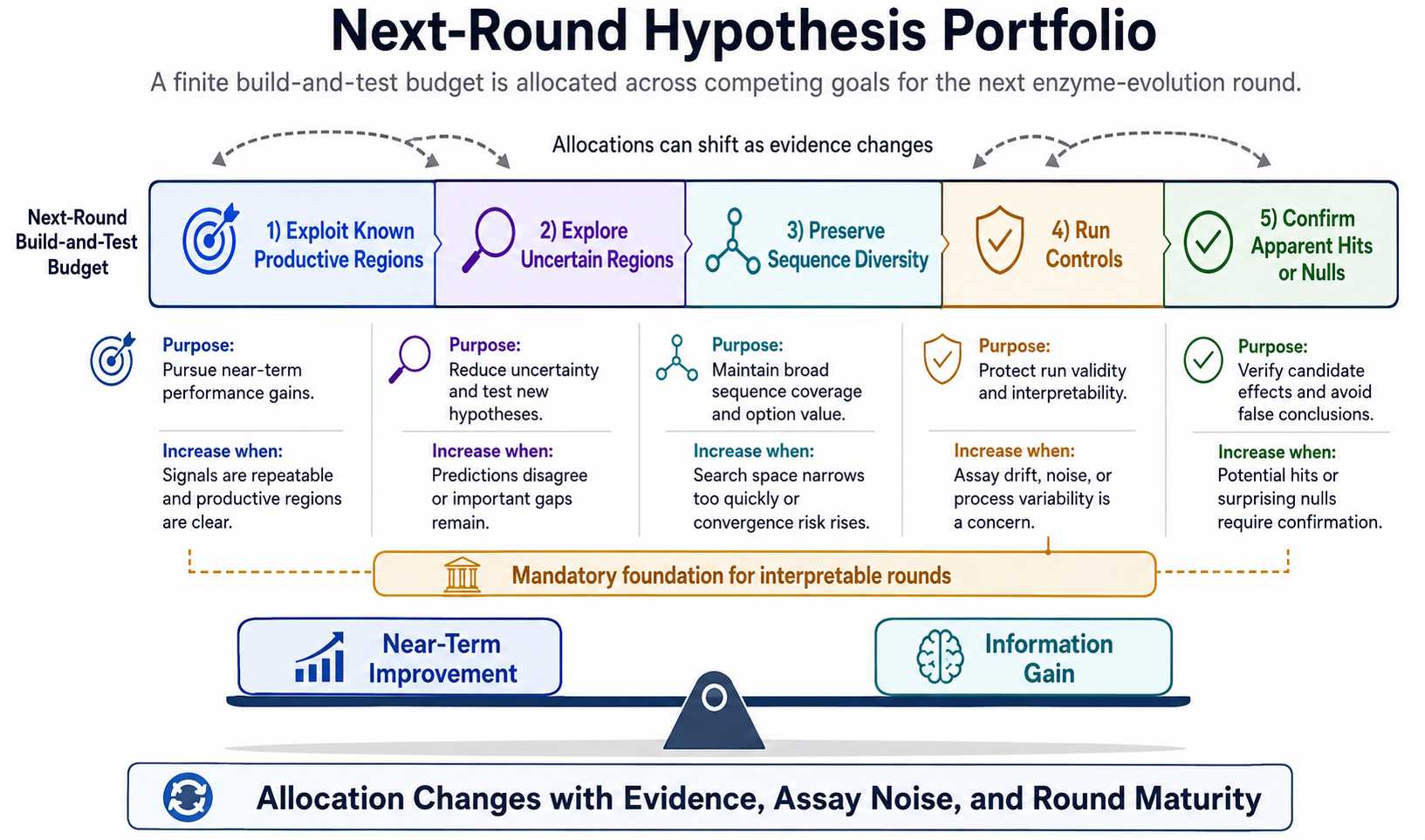 Fig. 2. A next-round hypothesis portfolio balances near-term performance, uncertainty reduction, sequence diversity, run validity, and confirmation within the available build and test budget.
(Creative Enzymes)
Inactive and unchanged variants can define the boundary between functional and nonfunctional sequence regions, reduce survivorship bias, and help models distinguish activity from background. They are not automatically trustworthy labels. A null result may reflect an incorrect construct, poor expression, insolubility, degradation, concentration error, failed reagent, edge effect, or a censored readout. We retain these variants in the dataset with QC status and explanatory metadata, but we do not interpret them as biological negatives until the execution evidence supports that conclusion.
Depending on the project, design may use mechanistic hypotheses, multiple-sequence alignments, coevolution, structural modeling, docking, residue conservation, protein language model embeddings, supervised sequence-function models, Gaussian processes, ensemble methods, Bayesian or active-learning acquisition functions, or a hybrid. A low-data program may benefit from pretrained representations and conservative exploration, but low-N methods do not eliminate sensitivity to assay quality or distribution shift. A larger dataset can support more project-specific models, provided that train/test separation respects sequence families, rounds, and experimental batches.
Model validation is aligned to the decision. Correlation alone may be inadequate if the practical need is to enrich the top fraction of a plate, identify diverse candidates above a threshold, or avoid variants that violate a secondary property. We therefore examine ranking or enrichment behavior, calibration or uncertainty where relevant, performance by sequence distance and subgroup, and failure cases—not only an aggregate metric.
A design becomes experimental evidence only after the intended molecule has been constructed and its test context is known. For each variant, we can retain the design identifier, nucleotide and amino-acid sequence, construct architecture, tags, vector, host, expression condition, purification or lysate method, sample concentration, storage history, and QC status. These records allow a later round to distinguish a sequence effect from a change in production or sample handling.
If expression or solubility is itself an optimization target, the build phase and test phase are intentionally coupled. A high apparent activity per volume can result from higher expression, higher specific activity, or both. The campaign can measure these separately when the decision requires it. Programs centered on production constraints may also connect to our AI-Guided Expression, Solubility and Manufacturability Optimization Service and Enzyme Expression and Purification capabilities.
A high-throughput primary screen is useful when it preserves rank or classification relevant to the final application. It does not need to reproduce every product condition, but its relationship to later evidence should be tested rather than assumed. We design a tiered testing ladder that uses fast measurements to reduce candidate count, confirmation to remove false discoveries, and lower-throughput assays to challenge the properties that determine diagnostic utility.
| Tier | Decision | Possible measurements | Key controls and cautions |
|---|---|---|---|
| Tier 0: build/QC | Is the test article suitable for interpretation? | Identity, expression, solubility, concentration, purity, sample integrity | Do not label a low-signal sample as a functional null without enough build evidence. |
| Tier 1: primary screen | Which variants merit repeat or follow-up? | Endpoint activity, initial rate, time-to-threshold, fluorescence, absorbance, luminescence, or other scalable readout | Reference, blank, plate/location controls, dynamic range, randomization, and predeclared QC rules |
| Tier 2: confirmation | Is the effect repeatable and attributable to the variant? | Independent expression or rebuild, replicate testing, dose response, kinetic or challenge confirmation | Use independent preparation where the magnitude or surprise of the result warrants it. |
| Tier 3: orthogonal characterization | What mechanism or secondary property explains the result? | Kinetics, substrate panel, fidelity, inhibitor tolerance, thermal/chemical stability, aggregation, or biophysical analysis | Orthogonal does not mean unrelated; the measurement must resolve a decision-relevant uncertainty. |
| Tier 4: application-relevant challenge | Does the lead retain performance in the intended context? | Formulation, matrix, instrument, dried reagent, storage challenge, low-copy input, cross-reactivity, or workflow simulation | A single simulated matrix or accelerated condition does not establish universal clinical or shelf-life performance. |
For diagnostic applications, the testing plan may include molecular amplification metrics, enzyme-coupled signal generation, cross-reactivity panels, inhibitor challenges, precision, dose response, formulation compatibility, or simulated sample matrices. These are configured to the project and do not imply clinical validation. Where needed, the loop can connect to Assay Interference and Matrix Effect Evaluation, Enzymes Activity and Stability Analysis, or dedicated stability and lot-consistency work.
Cross-round learning depends on more than a spreadsheet containing sequences and normalized scores. A data contract defines the identifiers, units, permissible values, missing-data codes, QC flags, normalization rules, censoring, and metadata required to interpret each result. The contract can be lightweight for a small feasibility round or more formal for a multi-round, multi-site program, but it must preserve the relationship between the molecule, physical sample, experimental run, computed endpoint, and model version.
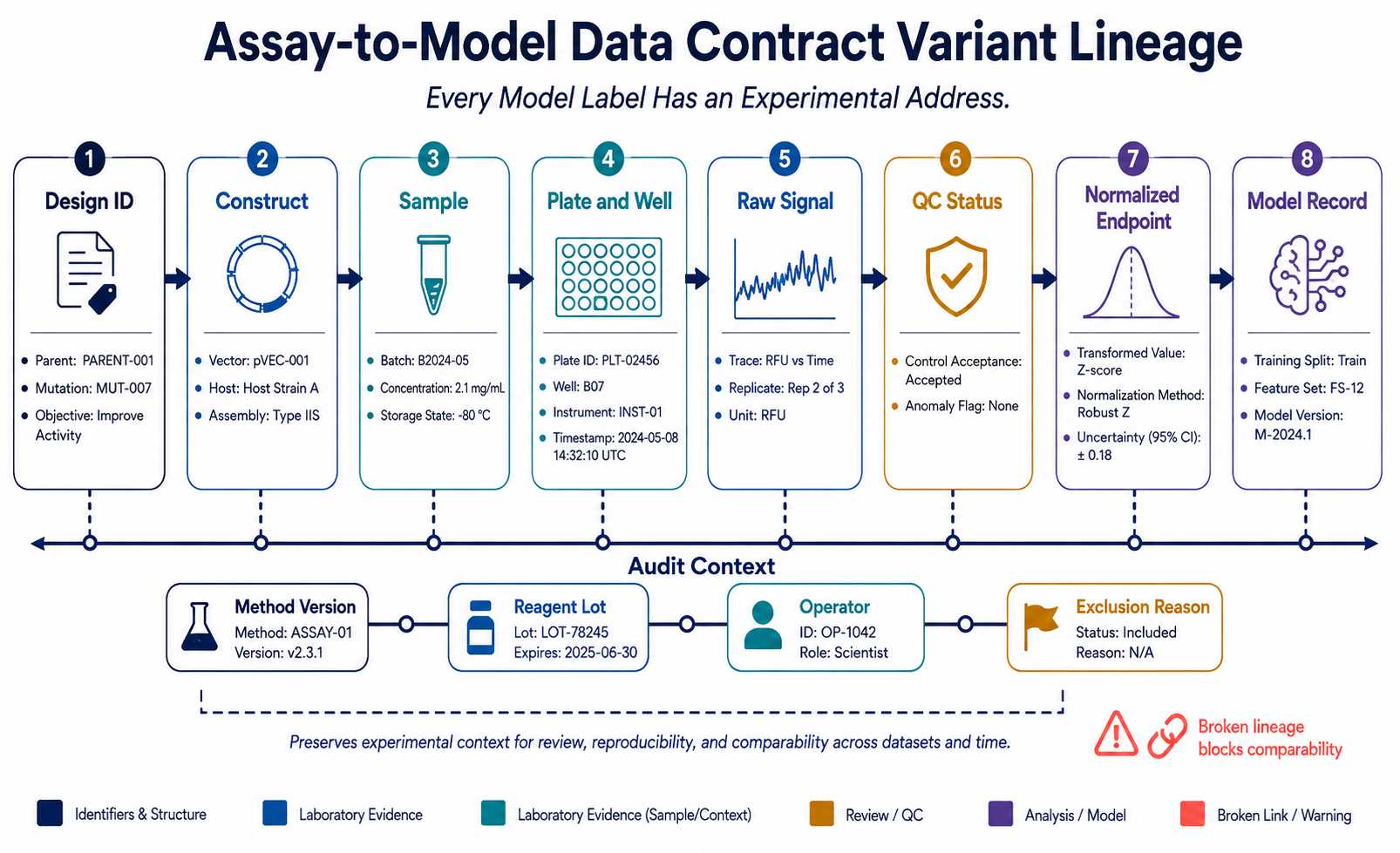 Fig. 3. The assay-to-model data contract preserves variant lineage and experimental context from design through the model record, allowing later rounds to audit labels and comparability.
(Creative Enzymes)
Normalized values are convenient for analysis, but raw signals are needed to reassess background subtraction, saturation, curve fitting, outliers, control drift, and changed rules. We retain or return transformation logic and the method version used to create an endpoint. When a processing rule changes, prior data can be reprocessed or explicitly versioned rather than mixed invisibly with new results.
Protein variants are related, and random row-level splits can place close relatives, duplicates, or measurements of the same construct on both sides of model evaluation. Round information, sequence clusters, parental lineage, plates, and batches may also leak into features or normalization. The split strategy is chosen to reflect the intended prediction: ranking nearby combinations, extrapolating to more distant sequences, or selecting candidates for a future experimental round. Reported performance is interpreted within that scope.
Our AI-Ready Experimental Dataset Design and Screening Data Analysis Service can be used as a focused work package when the immediate need is data architecture or analysis rather than execution of a complete evolution loop.
Diagnostic-enzyme development rarely has one objective. More signal may come with more nonspecific activity. Greater thermostability may reduce catalytic rate. Improved activity in a screening buffer may coincide with weaker matrix tolerance. High soluble yield may not predict performance after formulation. Collapsing these properties into one composite score can be useful for triage, but it can also conceal how weights determine the winner.
Where appropriate, we identify a Pareto set: candidates for which one objective cannot be improved without worsening at least one other measured objective. Dominated variants are those for which another tested candidate is at least as good on all considered properties and better on one or more. The Pareto view does not make the product decision automatically. It gives the project team an interpretable set of tradeoff candidates and shows where additional measurements or stakeholder priorities are needed.
Remove candidates that violate a non-negotiable constraint such as unacceptable cross-reactivity, sequence restriction, no-template behavior, activity floor, or expression failure.
Preserve candidates that represent different efficient balances among activity, specificity, stability, expression, matrix tolerance, and other measured properties.
Choose confirmation and transfer candidates using intended-use priorities, uncertainty, diversity, manufacturability, and the cost of being wrong.
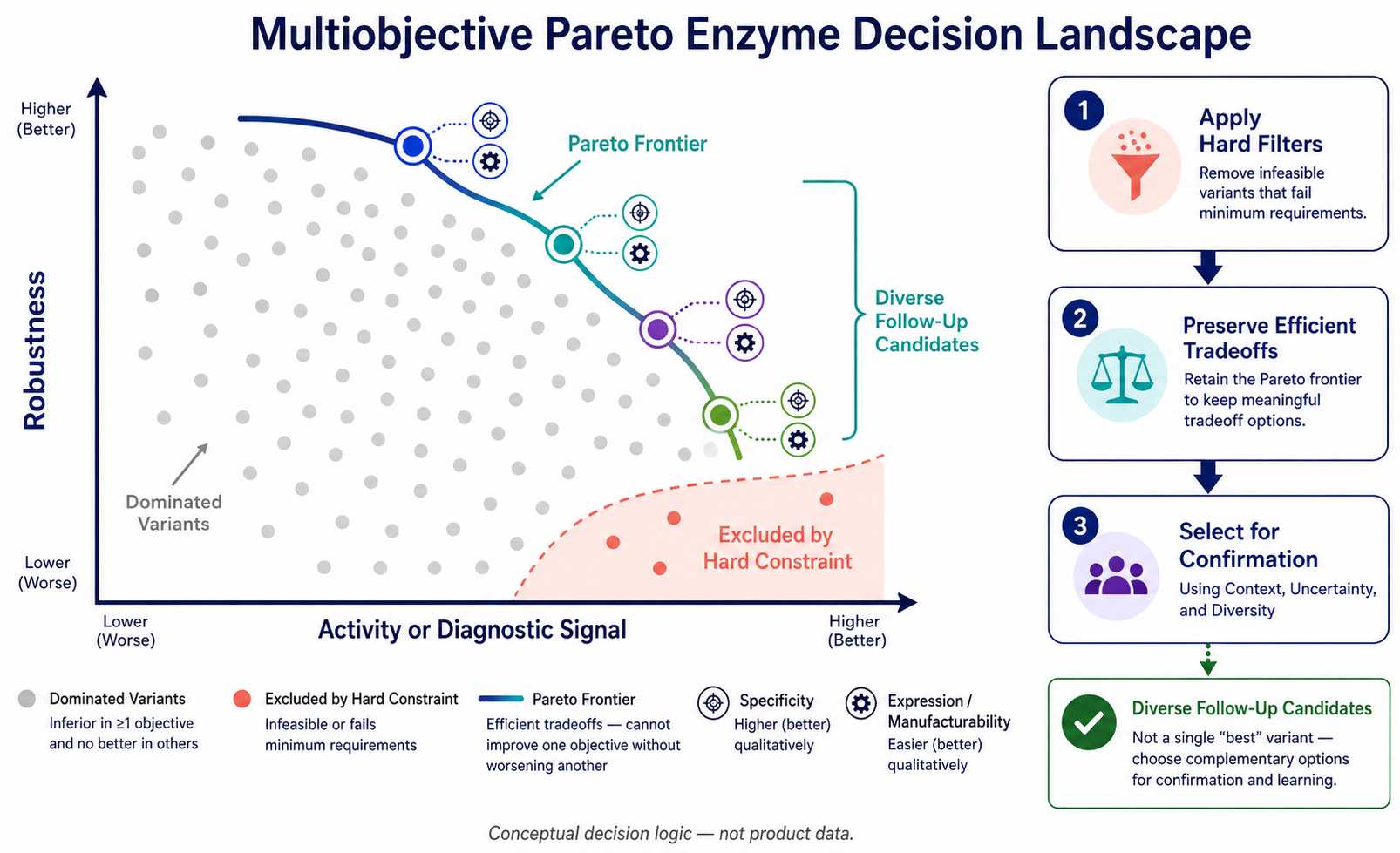 Fig. 4. A multiobjective decision landscape separates infeasible and dominated variants from an interpretable Pareto set, then applies diagnostic context, uncertainty, and diversity to choose follow-up candidates.
(Creative Enzymes)
A property must be measured under defined conditions before it can participate as experimental evidence. Predicted properties may be used to prioritize designs, but we label them separately from measured endpoints. If a secondary property has not been tested, the absence of a failure is not evidence that the candidate meets the requirement.
A closed loop can fail quietly. The top score may rise while control drift, batch effects, narrowing diversity, or changed assay conditions make comparisons less trustworthy. At each round, we review “loop health”: whether the measurement remains stable, labels remain traceable, candidates cover the intended design space, the model is being used within a supportable domain, and the application assay still agrees with the selection strategy.
References shift across plates or rounds, changing the meaning of the endpoint.
Expression batch, reagent lot, plate position, day, or operator is confounded with variant class.
Closely related variants, duplicate samples, or future-round information inflate evaluation.
Only promising variants are confirmed or retained, distorting the observed landscape.
Missing or low-quality constructs are recorded as low function without build evidence.
Failed, inactive, or unchanged variants disappear, limiting boundary learning.
Later designs, assay conditions, or sequence families differ from the model's training domain.
The primary screen improves while the application-relevant endpoint does not.
Actions can include repeating controls, re-randomizing layouts, blocking by batch, revising normalization, rebuilding a subset, adding orthogonal measurements, increasing diversity, retraining with new splits, reducing reliance on the model, or changing the primary selection assay. Reframing is not a failure of the loop; it is a legitimate decision when evidence shows that the current loop is optimizing a poor proxy or operating outside reliable measurement conditions.
The decision memo summarizes evidence quality, improvement relative to the defined baseline, repeatability, tradeoffs, uncertainty, diversity, loop-health issues, and the expected value of another round. A recommendation to exploit may still reserve capacity for controls and exploration. A transfer decision can include multiple leads rather than one nominal winner, especially when downstream formulation or scale introduces new selection pressure.
Transfer is a change of evidence regime. A lead selected in a microplate assay is not automatically ready for a dried POCT reagent, high-concentration formulation, manufacturing host, new enzyme lot, or alternative instrument. We define what remains provisional, which properties must be rechecked, and whether the engineering loop should stay open during downstream development. Related work may include AI-Driven Multiparameter Enzyme Optimization for POCT Reagents, Batch-to-Batch Consistency Validation, or broader Enzymes Production and Engineering.
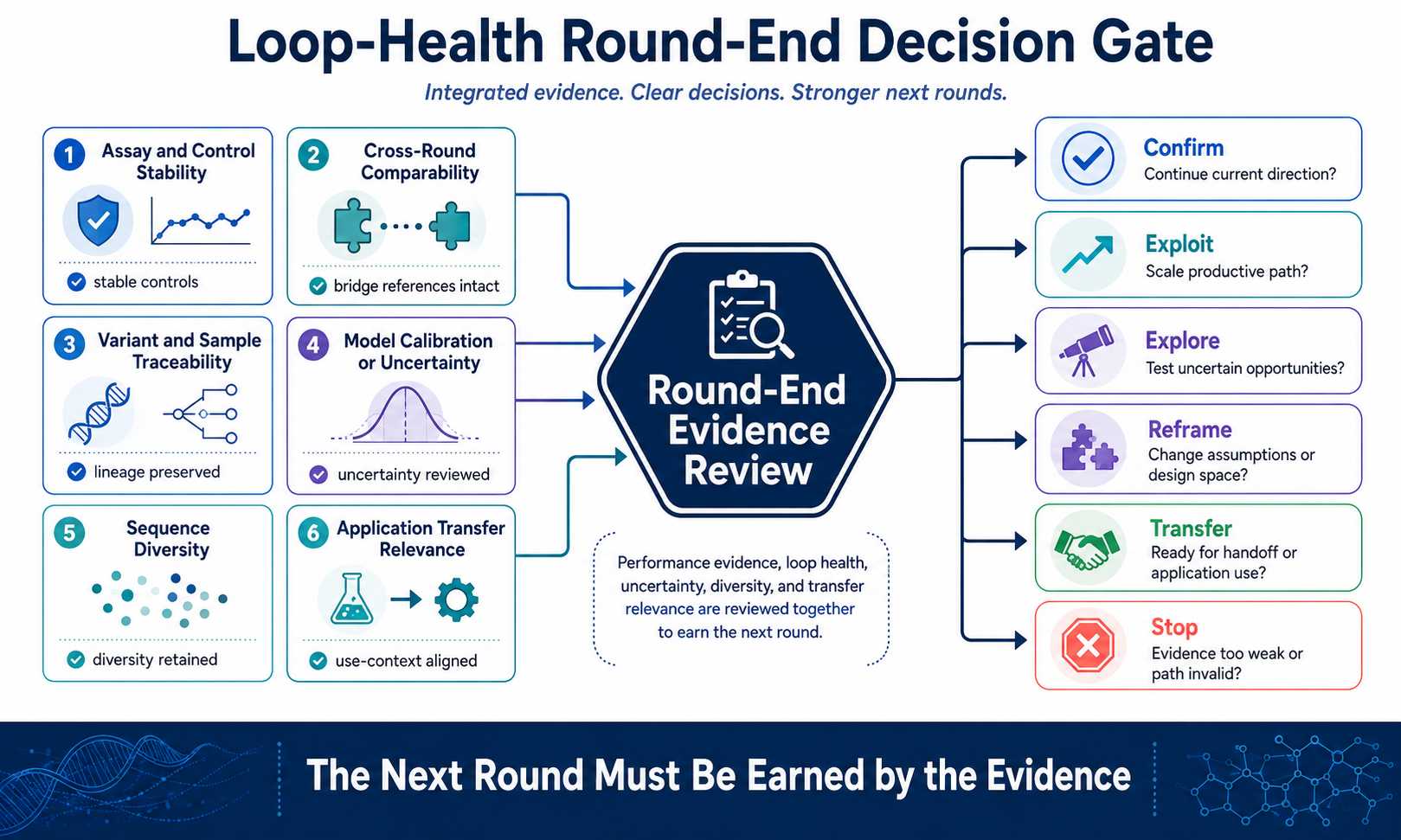 Fig. 5. The round-end gate reviews loop health, performance evidence, uncertainty, diversity, and transfer relevance before authorizing one of six next actions.
(Creative Enzymes)
Not every client enters at round zero. Some programs begin with one enzyme sequence and an assay concept; others have historical libraries, raw screening files, several apparent leads, or a stalled campaign. We can scope the service around the decision that is currently blocked rather than requiring the same sequence of work for every project.
Define objectives and constraints, establish baseline and assay readiness, design the first information-rich library, and create the data contract.
Audit sequence and assay records, reconstruct lineage and QC, assess model readiness, and propose a validation or next-round portfolio.
Examine proxy relevance, noise, convergence, missing negatives, build failures, and selection bias before deciding whether to reframe or explore.
Confirm selected variants, evaluate downstream properties, define the transfer package, and keep the loop open for formulation or scale feedback.
Programs may be fully integrated or modular. Creative Enzymes can execute the complete loop, execute laboratory work from client-provided designs, provide design and learning support around a client-run assay, or establish the data and decision framework for a distributed team. Responsibilities, data exchange, approval gates, confidentiality, sequence ownership, and physical-material disposition are defined in the project plan.
Objectives, hard constraints, baseline, method readiness, capacity, and initial stop/transfer criteria
Hypothesis register, library/candidate design, plate/control plan, expected learning, and build specification
Traceable constructs and samples, primary screen, confirmation, challenges, raw data, and QC status
Sequence-function interpretation, multiobjective analysis, uncertainty, model record, failure analysis, and loop health
Next-round plan, qualified lead set, transfer package, revised scope, or program-closure rationale
Exact methods and deliverables depend on the enzyme class, diagnostic platform, sample context, data maturity, throughput, and agreed scope. We do not prescribe a universal number of variants, plates, rounds, or weeks. The first proposal is designed around the next decision that can be supported reliably, with optional stages identified separately.
The closed-loop service is the integration layer for the AI-Driven Diagnostic Enzyme Engineering Services cluster. A program can draw on focused capabilities without duplicating their purpose:
Use AI-Guided Diagnostic Enzyme Variant Design and Screening, AI-Assisted Diagnostic Enzyme Mutation Library Design, or De Novo Enzyme Discovery and Enzyme Mining when candidate generation is the primary work package.
Connect rounds to Activity and Kinetic Performance Optimization, Thermostability and Lyophilization Stability Engineering, or Substrate Specificity and Cross-Reactivity Reduction.
Configure application evidence through Polymerase and Reverse Transcriptase Engineering, LAMP, RPA and Isothermal Enzyme Optimization, or CRISPR/Cas Diagnostic Enzyme Engineering Support.
Mechanistic questions can be addressed through In Silico Structural Modeling and Enzyme-Substrate Interaction Analysis. Second-source programs can use the same feedback architecture with AI-Assisted Second-Source and Sequence Equivalency Engineering, but equivalency conclusions remain limited to the properties and methods actually compared.
No. Closed loop means that traceable experimental evidence is reviewed and used to choose the next action. Automation can accelerate design, liquid handling, data capture, and analysis, but scientific review, client constraints, assay validity, and project authorization remain part of the loop. We do not imply that an algorithm independently runs or guarantees the campaign.
No. The design method should match the evidence. Rational, structure-informed, evolutionary, diversity-driven, or statistical approaches may be more appropriate when data are sparse, heterogeneous, or poorly aligned. Machine learning can be introduced when there are enough trustworthy labels and a useful decision it can improve; it can also be reduced or removed if calibration or transfer performance is inadequate.
Yes, subject to feasibility. A first round may use literature and database evidence, sequence conservation, structure or predicted structure, mechanistic hypotheses, pretrained protein representations, and designed diversity. Its purpose is often dual: find early improvement and create an informative, quality-controlled dataset for later rounds. The feasible design space depends on the enzyme, assay, expression system, and build/test capacity.
Yes. We first review sequence identity, parent-child lineage, raw and normalized data, units, controls, plate maps, method versions, missingness, exclusions, and batch structure. Data that cannot be made comparable may still inform hypotheses, but they should not be merged as equivalent labels without qualification.
There is no universal number. We consider sequence and mechanism knowledge, assay variability, expected effect size, library type, build/test throughput, objective complexity, confirmation burden, prior-round learning, diversity, and budget. We propose a decision-sized scope and reassess after each round rather than promise a fixed success rate.
They can be measured and considered together when suitable assays and material are available. Hard constraints, secondary objectives, and Pareto tradeoffs are kept visible. Not every property needs to be measured at full throughput; tiered testing can use a primary screen followed by confirmation and lower-throughput secondary assays. A predicted property is not treated as equivalent to a measured property.
We examine control performance, sample lineage, assay range, normalization, variant subset, and the mechanistic relationship between the assays. The next action may be to confirm, change the challenge condition, introduce a bridge assay, modify selection weights, or reframe the primary screen. Continuing to optimize a proxy after it diverges from application performance is not a sound closed-loop strategy.
Yes. The data contract, identifiers, controls, transfer format, approval points, and responsibility matrix become especially important. We can provide design and learning work around client-generated data, perform build or testing modules, or manage the integrated loop. Feasibility depends on whether shared methods and metadata support reliable cross-site interpretation.
No. This page describes enzyme engineering and development support for research use, diagnostic-reagent development, and applicable industrial raw-material contexts. Application-relevant testing can support development decisions, but it does not by itself establish clinical performance, regulatory clearance, or suitability for direct personal treatment or consumption.
References provide scientific context and do not define a universal campaign design or predict a project-specific outcome.
Send the enzyme sequence, intended diagnostic reaction or assay format, baseline and raw data if available, primary objective, unacceptable tradeoffs, expression/formulation context, assay controls, and approximate build/test capacity. Creative Enzymes will use that information to define a feasible round-zero review, first loop, rescue analysis, confirmation plan, or lead-transfer package.
Research use and development support only. Services and resulting materials are not intended for direct personal treatment or consumption.
