
Do you need a faster enzyme, or do you first need to explain why the diagnostic reaction produces too little useful signal? Creative Enzymes' AI-Guided Activity and Kinetic Performance Optimization Service separates catalytic performance from enzyme amount, expression, coupling chemistry, substrate depletion, background, matrix effects, and detector behavior. We then define the kinetic change that matters in the intended reagent, use sequence, structure, substrate, condition, and experimental data to prioritize variants, and confirm whether selected enzymes improve the real reaction without sacrificing specificity, fidelity, stability, expression, or manufacturability.
Scope and use boundary: this service supports research-use-only (RUO) and industrial diagnostic-reagent development. An AI score, engineered sequence, activity value, fitted kinetic parameter, screening hit, or selected enzyme is not a finished consumer test, authorization for direct diagnosis, clinical validation, a therapeutic or food product, regulatory approval, or market authorization. The sponsor or legal manufacturer remains responsible for intended use, design controls, risk management, complete analytical and clinical validation, specifications, stability and performance claims, labeling, registration, and final product release.
Activity optimization is useful when the current enzyme limits the reagent's functional window. The limitation may appear as a slow initial rate, weak response at low analyte or target concentration, long time-to-signal, excessive enzyme loading, incomplete conversion during the allowed reaction time, strong substrate or product inhibition, dependence on an impractical cofactor concentration, or loss of activity across the intended pH, temperature, salt, detergent, or matrix range. These symptoms are not interchangeable, and the mutation strategy for one may be unhelpful for another.
Increase rate or reduce lag within the instrument and reagent time window, while preserving background and specificity.
Reach the required reaction behavior with less enzyme only if normalized catalytic evidence supports the reduction.
Improve function in the relevant low-substrate or low-target regime, where catalytic efficiency or process behavior may matter more than saturated turnover.
Maintain useful kinetics across specified substrate, cofactor, pH, temperature, matrix, inhibitor, or reagent conditions.
A project may not need sequence engineering. If signal weakness comes from insufficient soluble expression, inconsistent purification, inactive protein fraction, or concentration assignment, expression, solubility, and manufacturability optimization may be the better route. If the enzyme loses activity after heat exposure or drying, use thermostability and lyophilization-stability engineering. If increasing desired reaction also increases non-target reaction, transition to substrate-specificity and cross-reactivity reduction. Projects with several coupled property gaps can begin at AI-Driven Diagnostic Enzyme Engineering Services.
A higher endpoint signal does not necessarily mean a faster enzyme. It can reflect a higher enzyme concentration, a larger soluble fraction, a slower blank reaction, more efficient coupling chemistry, altered product response, reduced quenching, a longer linear interval, or a detector effect. It can also be misleading when substrate is depleted, product accumulates, a coupling enzyme becomes rate-limiting, the signal saturates, or a variant changes optical or electrochemical background. AI learns the labels it is given; a model trained on a confounded readout can efficiently prioritize the wrong phenotype.
The measurement is decomposed before it becomes a model target. We identify the catalytic step intended for optimization, the species actually detected, every coupling or reporter step between them, and the conditions under which signal remains proportional to the target reaction.
For direct assays, the detector may follow substrate consumption or product formation. For coupled assays, the coupling reactions must be characterized well enough that they do not define the apparent rate. For amplification, ligation, cleavage, or biosensor reactions, the useful output may depend on several kinetic processes and may not be reducible to one Michaelis-Menten parameter.
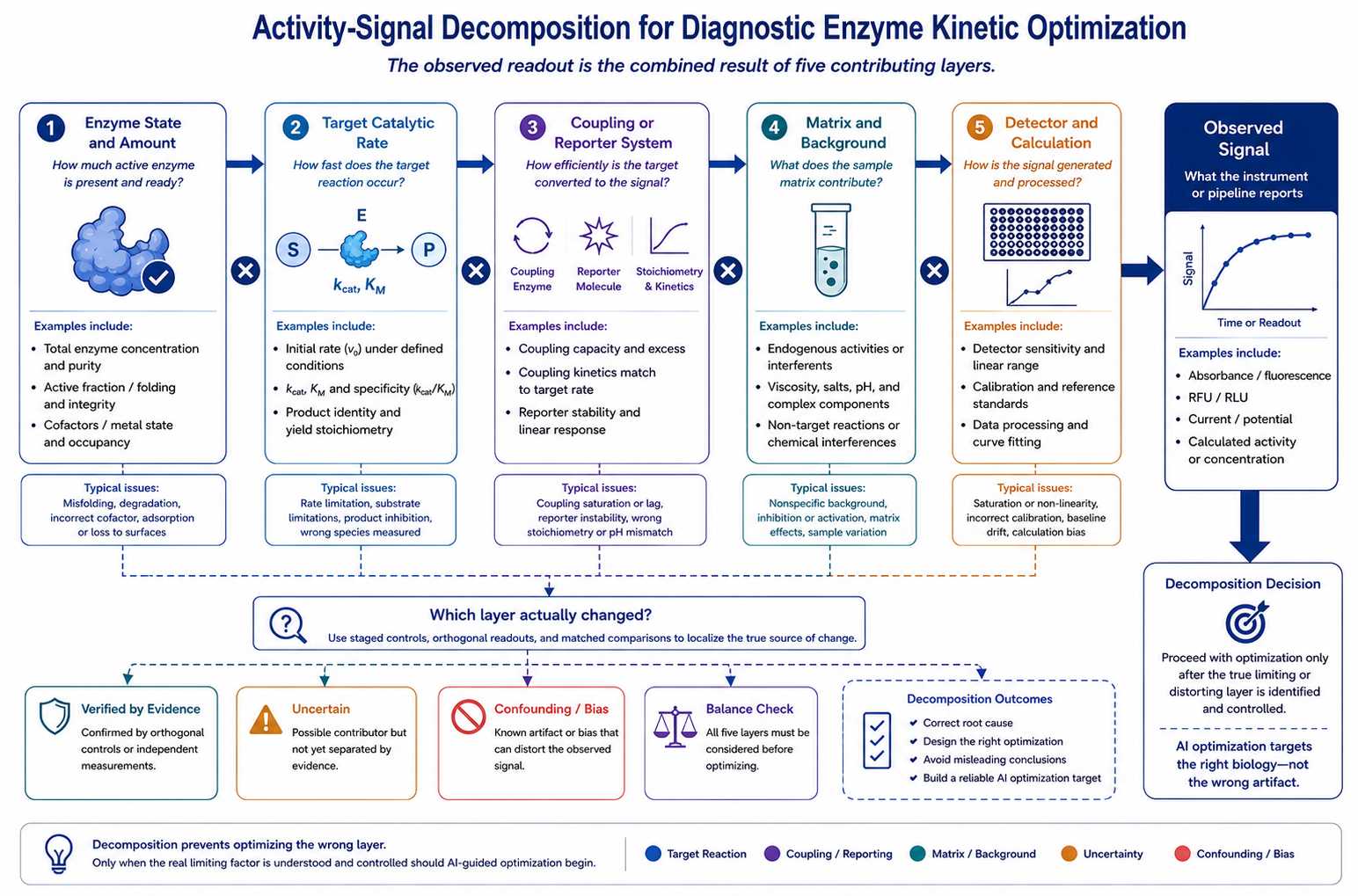 Fig 1. Activity-signal decomposition. The observed readout is separated into enzyme state, target catalytic rate, coupling or reporter behavior, matrix and background, and detector or calculation effects before it becomes an AI optimization target.
(Creative Enzymes Diagnostic)
Assay qualification begins with progress curves rather than a single convenient time point. Enzyme concentration and reaction time are varied to identify a region in which the readout responds predictably. Substrate consumption, product accumulation, reverse reaction, enzyme inactivation, coupling delay, and signal saturation are considered when selecting the analysis interval. Initial-rate measurements can reduce several of these complications, but an initial-rate assumption still has to be demonstrated under the chosen conditions.
Map target reaction, coupling steps, detected species, stoichiometry, and possible side reactions.
Establish time, enzyme amount, substrate conversion, and detector ranges that support the calculation.
Choose culture, total protein, purified protein, active enzyme, or starting-activity normalization to match the decision.
Use parent, blanks, no-enzyme, no-substrate, coupling-system, reference, and matrix controls as appropriate.
Separate within-run, plate, batch, preparation, day, and operator effects where they can change rank.
Fit a mechanism-appropriate equation, examine residual behavior and uncertainty, and state untested conditions.
Reporting discipline: the STRENDA Guidelines call for the catalytic entity, assay method, exact conditions, parameter units, analysis approach, and errors to be reported.1 The NIH Assay Guidance Manual likewise discusses initial-rate conditions, substrate depletion, assay linearity, and kinetic parameter estimation.2 We use these as scientific quality principles for traceable studies; they do not create regulatory approval or a universal acceptance criterion.
A common normalization trap: equal culture volume tests the combined effects of expression and catalytic performance. Equal total protein may still be confounded by purity. Equal purified-enzyme mass requires a defensible concentration method. Calculating kcat requires a credible molar concentration of catalytically relevant enzyme. The denominator is part of the claim and is recorded with every comparison.
The target is not automatically “maximize activity.” We write a kinetic target contract that identifies the intended reaction, sample state, substrate and cofactor ranges, temperature, pH, ionic environment, enzyme loading, allowed reaction time, detector, primary metric, protected properties, and advancement criteria. This prevents a candidate from winning at saturating substrate when the product needs low-substrate performance, or from winning in clean buffer while failing in the intended reagent.
| Measurement | Decision it can support | Requirements and cautions | Diagnostic interpretation |
|---|---|---|---|
| Initial rate or specific activity | Compare reaction rate in a defined early window, optionally normalized to protein or enzyme amount. | Demonstrate signal and time linearity, low enough substrate conversion, suitable blanks, and a documented normalization basis. | Useful for primary comparison, but one substrate condition does not establish a complete kinetic mechanism or application advantage. |
| Vmax | Estimate maximum fitted velocity under the chosen model and conditions. | Requires an informative substrate range, suitable model, nonlinear fitting, and enough data near saturation. It scales with enzyme amount. | Can support saturated-rate comparison; it is not transferable across methods, enzyme concentrations, or conditions without qualification. |
| kcat | Estimate turnover per catalytically relevant enzyme concentration under the fitted conditions. | Requires defensible molar enzyme concentration and Vmax. Inactive fraction, oligomeric state, active sites, or concentration bias can distort it. | Useful when saturated turnover limits the reaction, but it does not describe low-substrate behavior by itself. |
| Apparent Km | Describe the substrate concentration associated with the fitted rate response under the selected model. | Requires a substrate range that informs curvature and a model appropriate to the reaction. It is not automatically a binding dissociation constant. | May help place the operating substrate range, but “lower Km” is not always the correct performance goal. |
| kcat/Km | Compare catalytic efficiency in an appropriate low-substrate regime. | Depends on both fitted terms, enzyme concentration, model, substrate identity, and conditions; uncertainty should be carried through. | Often relevant when analyte or substrate is limited, but background and competing substrates must also remain acceptable. |
| Progress-curve or time-to-signal feature | Measure lag, slope, threshold time, completion, plateau, pausing, or other behavior inside the product's time window. | The feature must be robust to baseline, detector, reagent lots, and non-catalytic effects. A mechanistic kinetic model may or may not be appropriate. | Can be more product-relevant than a purified-enzyme constant, especially for amplification, coupled, cartridge, or biosensor systems. |
| Inhibition, cofactor, pH, or temperature response | Map how useful rate changes across environmental or reagent variables. | Change one or use a justified design of experiments; document all fixed components and interactions. Apparent parameters remain condition-dependent. | Supports an operating window and robustness decision, not a universal optimum. |
| Application-functional output | Determine whether the candidate improves the molecular, clinical-chemistry, reporter, or biosensor reaction. | Use representative reagents, matrices, targets, controls, instrument settings, and calculations; protect specificity and background. | Required to bridge biochemical activity to reagent value. It does not establish clinical performance or finished-product validation. |
Evaluate rate or progress-curve behavior inside the required time window, not only final conversion after an extended incubation.
Use low-substrate rate behavior, catalytic efficiency, background, and matrix conditions that represent the decision range.
Compare equal, verified enzyme input and test whether the candidate maintains application output across an enzyme titration.
Measure the response to substrate, product, salt, detergent, sample inhibitor, or other nominated stress rather than inferring tolerance from one point.
Confirm that the target enzyme, not the coupling enzyme or reporter chemistry, remains rate-determining across the comparison.
Map performance across the actual pH, temperature, cofactor, matrix, and timing design space and preserve the target reaction's specificity.
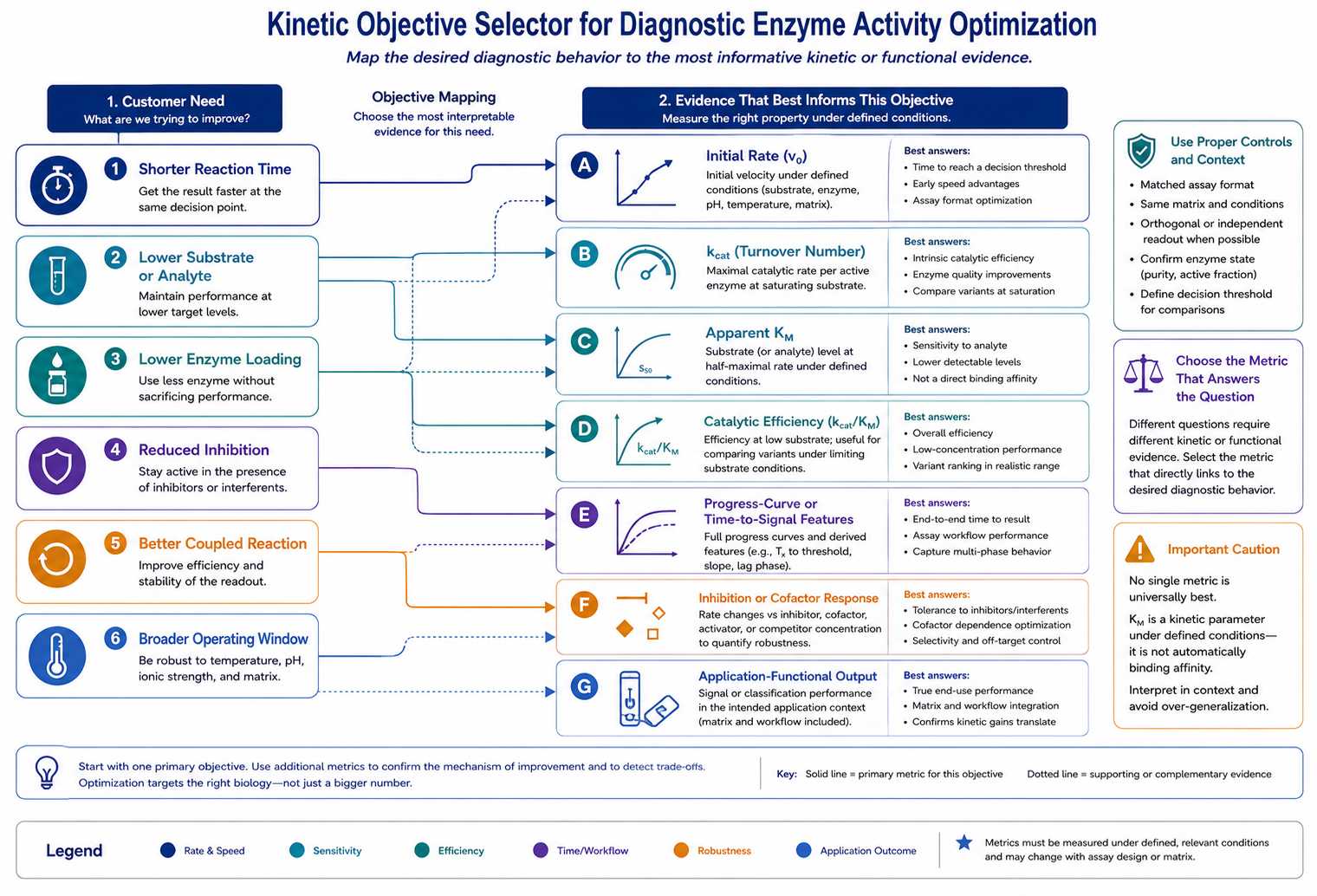 Fig 2. Kinetic objective selector. The desired diagnostic behavior is mapped to an interpretable rate, concentration-response, progress-curve, inhibition, cofactor, or application-functional measurement rather than a generic activity score.
(Creative Enzymes Diagnostic)
For a multi-substrate enzyme, varying only one substrate while holding another at an arbitrary concentration may yield apparent parameters that do not answer the project question. For allosteric, cooperative, processive, multi-step, or inhibited reactions, classical Michaelis-Menten treatment may be insufficient. The equation is selected from the reaction and the evidence, not imposed because it is familiar. Raw time courses, concentrations, conditions, fitted model, parameter estimates, errors, residuals, and exclusions are retained so the analysis can be reviewed or reused. EnzymeML and STRENDA DB illustrate why complete data and metadata are important for reproducible enzymology.3, 4
AI-assisted design begins after the target metric and measurement system are credible. Inputs can include the parent sequence, homologs, multiple-sequence alignment, available or predicted structures, substrate or cofactor structures, catalytic and binding annotations, mechanism knowledge, historical variants, raw activity data, kinetic parameters with conditions, expression and stability data, and protected diagnostic attributes. Depending on data readiness, analyses may combine protein language representations, conservation, structural contacts, substrate-aware models, physicochemical calculations, statistical sequence-function models, and active-learning or uncertainty-aware selection.
Adjust positioning of catalytic residues, substrate, metal, water, or cofactor only when the proposed change is compatible with the reaction mechanism and protected specificity.
Modify residues that organize catalytic groups, tune local polarity, or support the active-site geometry without directly contacting the substrate.
Investigate substrate entry, product release, nucleic-acid channel behavior, gating loops, steric barriers, or charged pathways that may limit useful throughput.
Evaluate local charge networks, pH dependence, metal or cofactor coordination, and electrostatic environments that may influence catalytic steps.
Consider conformational exchange, loop closure, processive movement, domain communication, and the balance between productive flexibility and structural order.
Use evolutionary, structural, covariance, and experimental evidence to test long-range sites that can influence catalysis, expression, or stability without assuming mechanism.
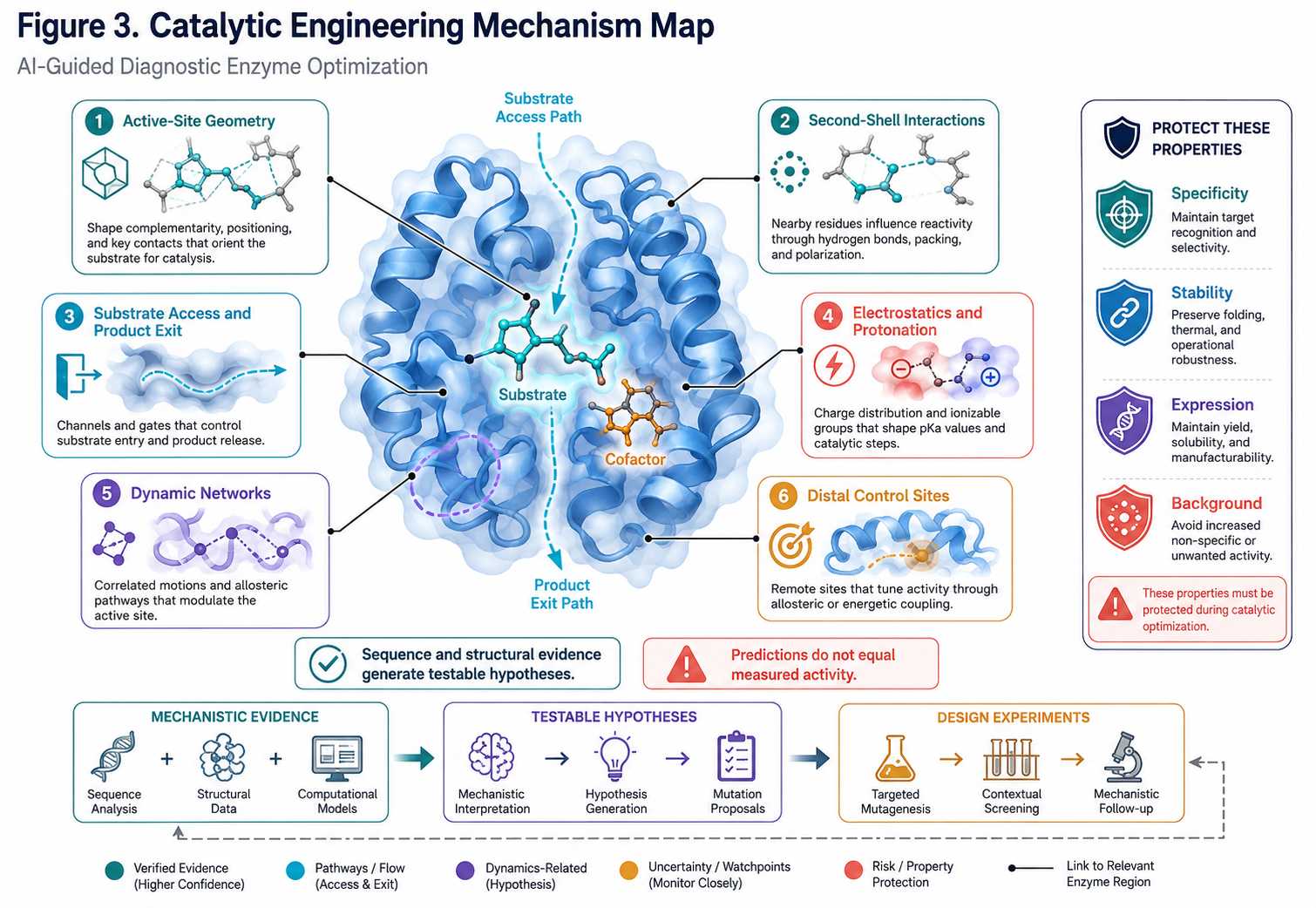 Fig 3. Catalytic engineering mechanism map. Activity hypotheses can arise from active-site geometry, second-shell organization, access and exit paths, electrostatics, conformational networks, and distal control sites.
(Creative Enzymes Diagnostic)
Activity is conditioned on both enzyme and substrate. Models that include substrate or catalytic-pocket information are an important direction, but available kinetic data remain limited and heterogeneous across enzymes, assay methods, conditions, and models.10–12 A predicted kcat, Km, catalytic-efficiency change, or residue importance is therefore a prioritization hypothesis. It is not reported as a measured property and cannot replace experimental tests with the client's substrate and reaction system.
More target activity is not useful if the enzyme creates background, loses fidelity, consumes a competing substrate, destabilizes the reagent, requires impractical cofactor conditions, expresses poorly, or fails after transfer into the intended matrix. Activity-stability tradeoffs have been measured directly in large variant datasets,8 and epistatic combinations can behave non-additively.6
We therefore define property-specific non-regression gates before the candidates are unblinded. These can include parent-relative unstressed activity, target/non-target behavior, stability, soluble expression, reagent background, matrix tolerance, processivity, fidelity, or manufacturability as relevant.
Screening is staged because the most mechanistic kinetic assays may be too material-intensive for every variant, while the fastest primary screen may be too distant from the intended reagent to select a lead. The candidate panel and assay cascade are designed together. A primary screen should be simple enough to execute consistently and close enough to the target property that its winners deserve more detailed study. Controls and reference variants occupy deliberate plate positions, and sequence, construct, expression unit, plate, well, raw signal, calculation, and decision remain traceable.
A screen at one substrate concentration cannot separately identify changes in turnover and substrate-response behavior. It can still be useful if that concentration represents the product decision and the screen is followed by kinetic characterization. Similarly, fitting every low-quality primary-screen curve can create false precision. We use the least complex analysis that supports the current gate and reserve deeper kinetic modeling for candidates with sufficient material and signal quality.
Machine-learning-guided directed evolution can use information from tested variants to select new sequences, and active learning can balance expected improvement with information gain and uncertainty.5, 6 The data composition matters: plate, batch, expression, and condition effects must not be mistaken for sequence effects. Negative and ambiguous variants are retained with failure codes rather than discarded, because they define important regions of the measured sequence-function landscape.
A candidate can appear improved at one optimized point yet be inferior across the reagent's actual operating range. We therefore use a condition-resolved fingerprint for selected candidates. The design is intentionally bounded: it selects the variables that can change product performance and maps enough levels to identify sensitivity, interactions, or rank reversals. The project does not claim a universal optimum outside the tested domain.
The cells represent planned comparisons, not performance data.
A compact design of experiments may be appropriate when interactions are expected. Detailed kinetic series are concentrated on conditions and candidates that can change the advancement decision.
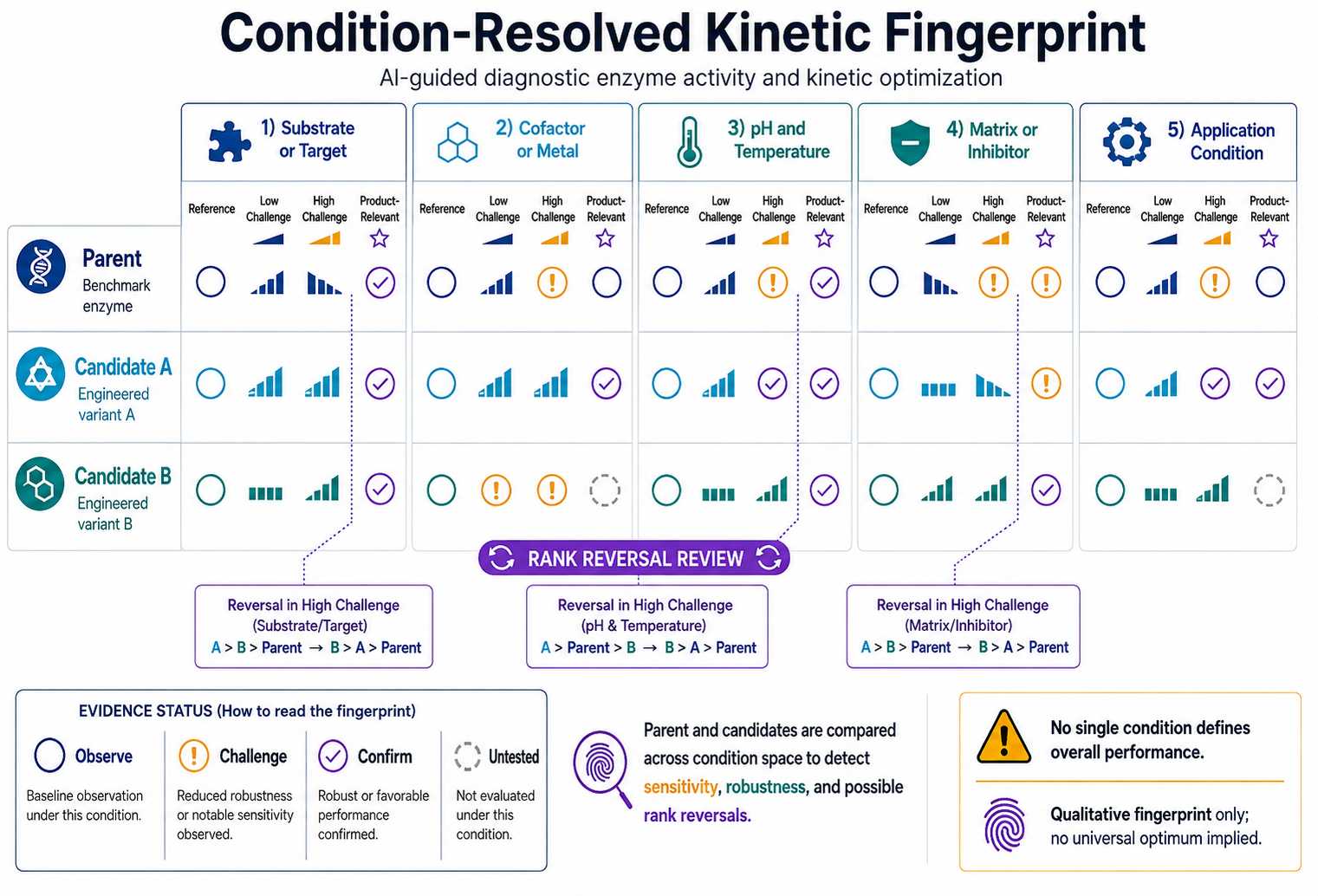 Fig 4. Condition-resolved kinetic fingerprint. Parent and candidates are compared across substrate, cofactor, pH, temperature, inhibitor, matrix, and product-relevant conditions to detect sensitivity and rank reversals.
(Creative Enzymes Diagnostic)
The exact axes depend on enzyme class. A polymerase may require nucleotide, magnesium, primer-template, salt, temperature, inhibitor, and processivity-related conditions. A reverse transcriptase may require RNA structure, primer, modified nucleotide, temperature, and inhibitor challenges. An oxidoreductase may require analyte, cofactor, oxygen or mediator, coupling reagent, pH, and matrix conditions. A ligase or nuclease may require end chemistry, substrate architecture, metal, competing nucleic acid, and reaction-time variables. The study is designed around the actual catalytic system rather than a generic enzyme panel.
Purified-enzyme kinetics can explain why a candidate changes, but the application assay determines whether the change is useful. The confirmation method is selected according to the enzyme's role in the reagent. It uses the intended or a justified representative substrate, reagent composition, timing, matrix model, instrument, controls, and calculation. A biochemical gain that does not transfer is documented as condition-limited rather than promoted as a lead.
Polymerases, reverse transcriptases, ligases, nucleases, helicases, recombinases, and related enzymes may be assessed for amplification, extension, ligation, cleavage, processivity, threshold time, yield, target range, inhibitor tolerance, or other system-specific behavior.
Fidelity, nonspecific signal, primer-dimer behavior, target selectivity, and matrix tolerance can remain protected gates. Related platform-specific work includes molecular diagnostic enzyme and master mix development.
Oxidases, dehydrogenases, hydrolases, transferases, lyases, and coupled enzymes may be assessed for initial-rate or endpoint behavior, analyte range, reaction completion, cofactor dependence, coupling balance, blank, interferents, and serum-, plasma-, or urine-related matrix effects.
See also the diagnostic enzyme product portfolio and enzyme activity and stability analysis.
Sensor enzymes may need strong response in a low-substrate regime, rapid signal establishment, mediator or oxygen compatibility, retained function after immobilization, and suitable performance under small-volume, diffusion-limited, temperature-variable, or whole-sample conditions.
Solution-phase kinetic rank may change after immobilization or integration, so the sensor architecture is represented as early as practical.
Reporter enzymes and cascades require a balance among target reaction rate, reporter capacity, coupling stoichiometry, background, dynamic range, reagent stability, and detector response. The reporter must not hide or create an apparent change in the upstream enzyme.
When multiple enzymes are co-optimized as one reagent, the project may transition to a system-development scope rather than independent single-enzyme ranking.
The page title refers to activity and kinetic performance, not clinical sensitivity or diagnostic accuracy. Improvements in an RUO or industrial-development model do not establish limit of detection, clinical sensitivity, clinical specificity, calibration traceability, shelf life, or regulatory suitability. Those claims require appropriate finished-reagent studies controlled by the sponsor or legal manufacturer.
A preliminary hit is re-expressed independently and compared with the exact parent. Sequence identity, construct, expression batch, purification state, concentration method, storage and handling history, plate position, raw data, processing version, and exception flags are traceable. The primary phenotype is repeated, the informative kinetic response is measured with a suitable substrate and condition series, and application function is tested. Orthogonal detection or product analysis may be used when the original signal is vulnerable to optical, electrochemical, coupling, or side-reaction artifacts.
Re-express, verify identity, and document purification, concentration, activity state, and preparation history.
Use the original qualified method, parent, references, blanks, and prespecified calculation.
Measure the substrate, cofactor, progress-curve, inhibition, or operating-window response that explains the gain.
Test specificity, fidelity, stability, expression, background, matrix tolerance, or other protected properties.
Evaluate the intended or representative reagent architecture and record untested product conditions.
Stopping is an evidence-based outcome. It protects later formulation, scale-up, and validation resources from a misleading biochemical hit.
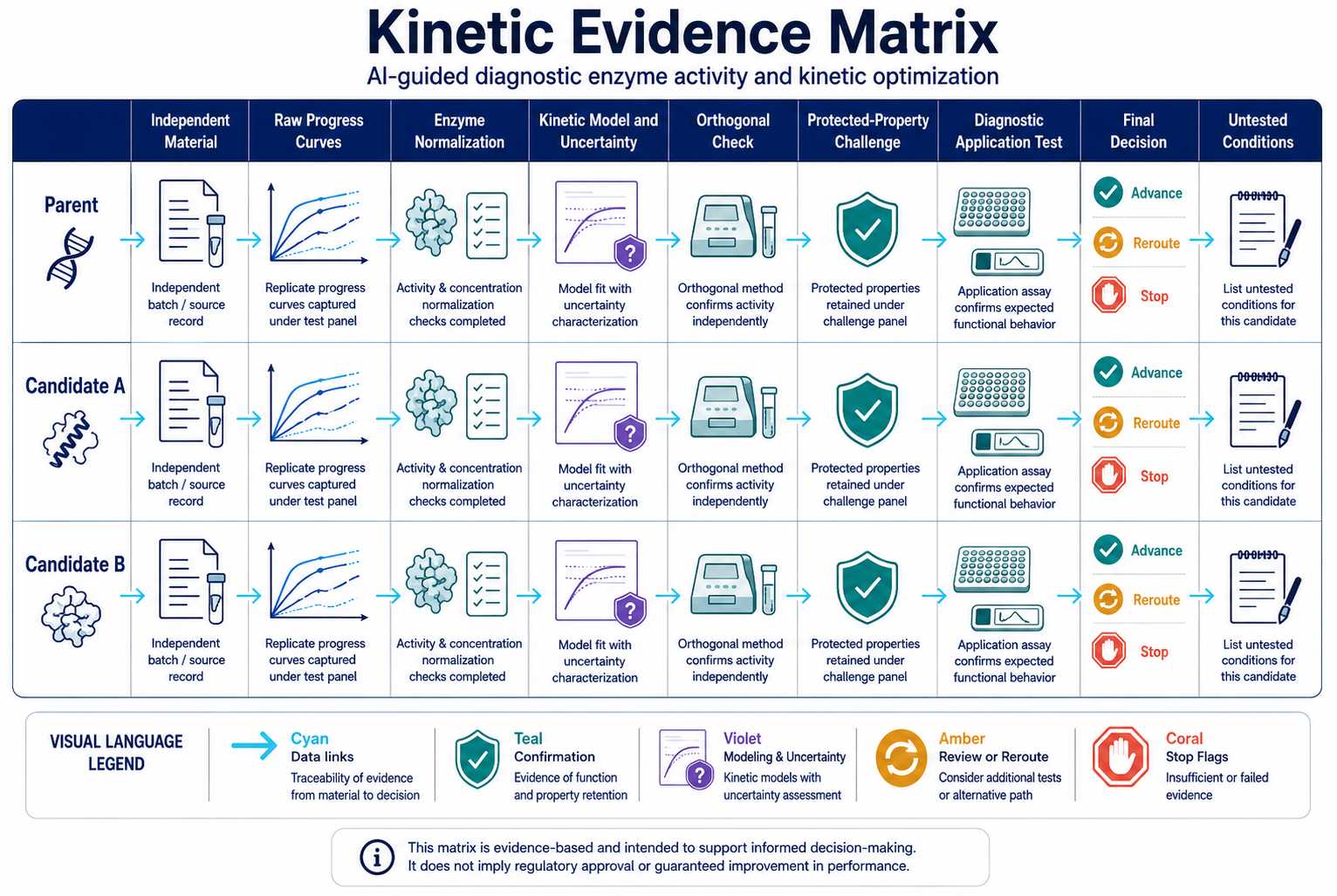 Fig 5. Kinetic evidence matrix. Each candidate is connected to raw progress curves, enzyme normalization, fitted response and uncertainty, orthogonal checks, protected-property challenges, and application-functional confirmation.
(Creative Enzymes Diagnostic)
The final candidate assessment describes what improved, under which conditions, relative to which parent and preparation, with which analysis, and with what uncertainty. It also lists conditions that were not tested. No fixed improvement factor, number of candidates, number of engineering rounds, enzyme-dose reduction, reaction time, or success rate is implied. Project criteria are agreed from the starting enzyme, assay capability, material constraints, intended reagent, and client development stage.
Best when the current activity value is difficult to interpret. We review the signal pathway, enzyme normalization, progress curves, controls, substrate and cofactor ranges, model assumptions, and connection to the diagnostic reaction. The output is an assay-repair and target-definition plan or a justified route away from sequence engineering.
Best when a suitable parent and measurable kinetic gap exist. The scope can include computational hypotheses, candidate selection, construct generation, expression, primary activity screening, focused kinetic characterization, and selected non-regression tests.
Best when biochemical activity must be co-optimized with matrix tolerance, reagent timing, specificity, fidelity, cofactors, formulation, or another system property. The primary and application assays are connected in one evidence and decision framework.
Not every listed input or deliverable is needed for every project. The statement of work identifies the enzyme and construct, assay and kinetic model, substrate and condition space, candidates and controls, material stage, application confirmation, protected properties, decision criteria, data package, and responsibilities. Creative Enzymes also offers standalone enzyme kinetics services, enzyme activity measurement, and broader AI-powered enzyme services.
No. Endpoint signal can change because of enzyme amount, soluble expression, coupling chemistry, background, substrate depletion, product response, detector saturation, or the selected reaction time. We first qualify the signal pathway and analysis window, then confirm important candidates with normalized rate, kinetic, or application-functional measurements.
There is no universal best target. kcat can be relevant when saturated turnover limits the reaction; kcat/Km can be informative in an appropriate low-substrate regime; apparent Km can help describe the substrate-response curve under stated conditions. Time-to-signal, processivity, inhibition tolerance, or application output may be more important for some diagnostic systems. The operating substrate range and reagent decision determine the metric.
No. Km is a kinetic parameter under a fitted mechanism and specified conditions, not automatically a binding dissociation constant. Lower apparent Km does not guarantee a useful change in turnover, specificity, background, product release, matrix performance, or the intended diagnostic reaction. It should be interpreted with the complete kinetic and functional profile.
A defensible kcat requires a credible molar concentration of catalytically relevant enzyme. Crude lysate, variable purity, inactive protein, uncertain oligomeric state, or inaccurate concentration can make the result misleading. Early screens may use other normalization strategies, but the claim and denominator are stated explicitly, and selected candidates can be confirmed with better-characterized material.
Sequence, evolutionary, structural, substrate-aware, and pretrained models can generate a cold-start candidate panel, but uncertainty is higher when no comparable phenotype data exist. Predictions prioritize tests; they do not establish measured kcat, Km, catalytic efficiency, or application performance. A diverse first panel and informative controls can generate project-specific sequence-function data for a later round.
No. Catalysis can be influenced by second-shell residues, substrate access or product exit paths, electrostatics, metal or cofactor coordination, loop and domain dynamics, and distal interaction networks. Active-site changes can also damage specificity or folding. Candidate selection combines mechanism, conservation, structure, substrate, experimental evidence, and protected-property constraints.
We map the coupling stoichiometry and time response, vary target and coupling components where appropriate, use coupling-system controls, and select conditions in which the reporter step has sufficient capacity and does not change candidate rank. Important hits may be checked with an orthogonal detector or direct product/substrate measurement when feasible.
Projects can be scoped for polymerases, reverse transcriptases, ligases, nucleases, recombinases, helicases, and other molecular diagnostic enzymes when a suitable parent, assay, and material strategy exist. Classical steady-state constants may not fully describe processivity, pausing, fidelity, target architecture, inhibition, or amplification behavior, so biochemical measurements are connected to an application-functional assay. See also AI-guided polymerase and reverse transcriptase engineering.
It may, but dose reduction must be demonstrated in the actual reagent context. An engineered candidate is compared across an enzyme titration using verified input and suitable controls. Background, target range, precision, specificity, stability, formulation, and matrix effects must remain acceptable. A biochemical fold-change alone is not a product-level dose recommendation.
The numbers are project-specific. The substrate range must inform the chosen model and operating regime, while the candidate count must leave room for parent repeats, references, controls, mechanism probes, diversity, and uncertainty picks. Material availability, assay precision, throughput, enzyme class, and application test cost determine the final design.
The project can generate traceable development data and method documentation as scoped, but an engineering assay is not automatically a validated QC release method or regulatory submission package. Method suitability, validation, specifications, stability, design controls, finished-product analytical and clinical validation, and regulatory strategy remain the responsibility of the sponsor or legal manufacturer.
Send us the parent sequence, intended catalytic reaction, current activity method, raw progress data, substrate and cofactor conditions, and the diagnostic-reagent behavior that needs to change. Creative Enzymes can help determine whether the next step is assay repair, kinetic characterization, AI-guided sequence engineering, application-integrated optimization, or another property-specific route.
Contact Us