
The central problem is not how many mutations a model can score. It is which sequence-defined variants deserve a limited number of synthesis, expression, and screening slots. Creative Enzymes' AI-Guided Diagnostic Enzyme Variant Design and Screening Service converts a parent enzyme, diagnostic performance objective, available sequence or structure evidence, and feasible assay throughput into a balanced candidate panel. The panel is built to test improvement hypotheses, preserve informative diversity, expose model uncertainty, and generate experimental evidence that can support the next engineering decision.
Scope and use boundary: this service supports research-use-only (RUO) and industrial diagnostic-reagent development. A model rank, engineered sequence, screening hit, or selected enzyme is not a finished consumer test, authorization for direct diagnosis, clinical validation, a therapeutic or food product, regulatory approval, or market authorization. The sponsor or legal manufacturer remains responsible for intended use, design controls, risk management, complete analytical and clinical validation, specifications, labeling, registration, and final product claims.
This service is appropriate when a project has a credible parent enzyme or target sequence, a measurable diagnostic performance gap, and insufficient capacity to test every plausible amino-acid combination. Examples include a polymerase that performs well in clean buffer but loses activity in an extraction-free matrix, an oxidoreductase that gives useful signal yet creates unacceptable substrate cross-reactivity, a reporter enzyme with adequate catalytic activity but poor thermal recovery, or a biosensor enzyme whose activity and expression cannot be improved by simply stacking individually favorable substitutions.
The team can build and test a defined panel, but the candidate space is far larger. Computational ranking, sequence diversity, mechanism hypotheses, and experimental design must work together to decide which variants enter the panel.
If the primary readout is saturated, unstable, confounded by enzyme concentration, or disconnected from the intended diagnostic function, assay feasibility should precede model training and variant ranking.
A project seeking new enzyme families without a usable starting sequence may require de novo discovery and enzyme mining before focused variant engineering.
AI guidance is useful only when the next experiment can distinguish better candidates from misleading ones. A high model score cannot separate catalytic improvement from increased soluble expression unless those effects are measured separately. It cannot show that a fluorescence gain reflects the intended product rather than reporter interference without a counter-assay. It cannot establish that performance in purified buffer will transfer into whole blood, saliva, lysate, swab eluate, dried chemistry, or a cartridge. The service therefore treats variant design and screening as one connected decision system.
Projects that need a broader route assessment can begin with AI-Driven Diagnostic Enzyme Engineering Services. When the primary question is a defined property rather than general variant selection, related routes include activity and kinetic performance optimization, specificity and cross-reactivity reduction, and thermostability and lyophilization-stability engineering.
A useful design brief defines what the enzyme must do, where it must do it, and what must not be sacrificed. The parent is not only a FASTA sequence. It is a reference construct, expression context, purification state, assay method, normalization rule, and performance baseline. If different historical datasets used different tags, hosts, enzyme concentrations, reagent lots, read times, substrates, or processing rules, they should not be merged as though they describe one consistent phenotype.
| Design-brief element | Why it changes variant selection | Typical evidence supplied by the client | Decision if evidence is incomplete |
|---|---|---|---|
| Parent identity and construct | Tags, truncations, linkers, signal peptides, cofactors, and expression host can change folding and measured function. | Sequence file, annotated construct, vector map, host, purification notes, reference material. | Freeze one reference construct or explicitly treat construct form as an experimental variable. |
| Primary phenotype | A model can only learn or optimize the measured label; a convenient surrogate may select the wrong biology. | Assay protocol, raw signals, processed outputs, controls, linear range, repeat data. | Perform an assay-readiness study or use a two-tier primary/application screen. |
| Non-regression constraints | Improved activity can accompany lower expression, increased cross-reactivity, poorer stability, or higher background. | Current specifications, failure thresholds, matrix limits, production constraints. | Keep these dimensions as explicit screens or advancement gates rather than hidden preferences. |
| Mutable and prohibited regions | Catalytic residues, metal-binding sites, interfaces, regulatory motifs, IP constraints, or client sequence rules may restrict the search. | Functional annotations, alignments, structures, known variants, prohibited substitutions. | Use a conservative eligibility map and include uncertainty-reduction variants before aggressive combinations. |
| Screening capacity | The number of build slots determines whether to emphasize focused mechanistic probes, broad exploration, or combinatorial testing. | Plate format, assay throughput, material requirement, available replicates, confirmation budget. | Design to the real experimental unit count, including controls and repeats, not the nominal plate size. |
Creative Enzymes can help translate a customer specification into this design brief as a scoped activity. Acceptance logic remains project-specific. Fixed fold-improvement promises, universal variant counts, or a generic number of design rounds would be misleading because the accessible sequence space, assay noise, epistasis, and required application evidence differ among enzymes and diagnostic systems.
The first computational output should not be a leaderboard. It should be a mutation eligibility map that records why each region is protected, interrogated, permitted, or handled as a construct-design variable. Evidence may include multiple-sequence alignments, family conservation, naturally occurring substitutions, predicted or experimental structures, active-site geometry, ligand or nucleic-acid proximity, domain boundaries, solvent exposure, flexible loops, interfaces, known post-translational features, and prior mutational data. Each evidence type answers a different question and carries uncertainty.
Residues directly implicated in catalysis, metal or cofactor coordination, buried-core packing, required interfaces, or indispensable binding motifs are normally excluded unless the project specifically tests them with suitable rescue and confirmation logic.
Second-shell residues, substrate-entry loops, electrostatic networks, flexible hinges, and uncertain interfaces may carry large effects. They merit focused probes rather than unrestricted randomization.
Surface residues, family-variable positions, homolog-supported substitutions, and regions with prior tolerance evidence may support broader exploration, provided expression and application function remain measured.
Signal peptides, tags, linkers, truncations, domain boundaries, codon context, and fusion partners can change apparent performance without changing intrinsic catalysis. They should be tracked separately from amino-acid fitness claims.
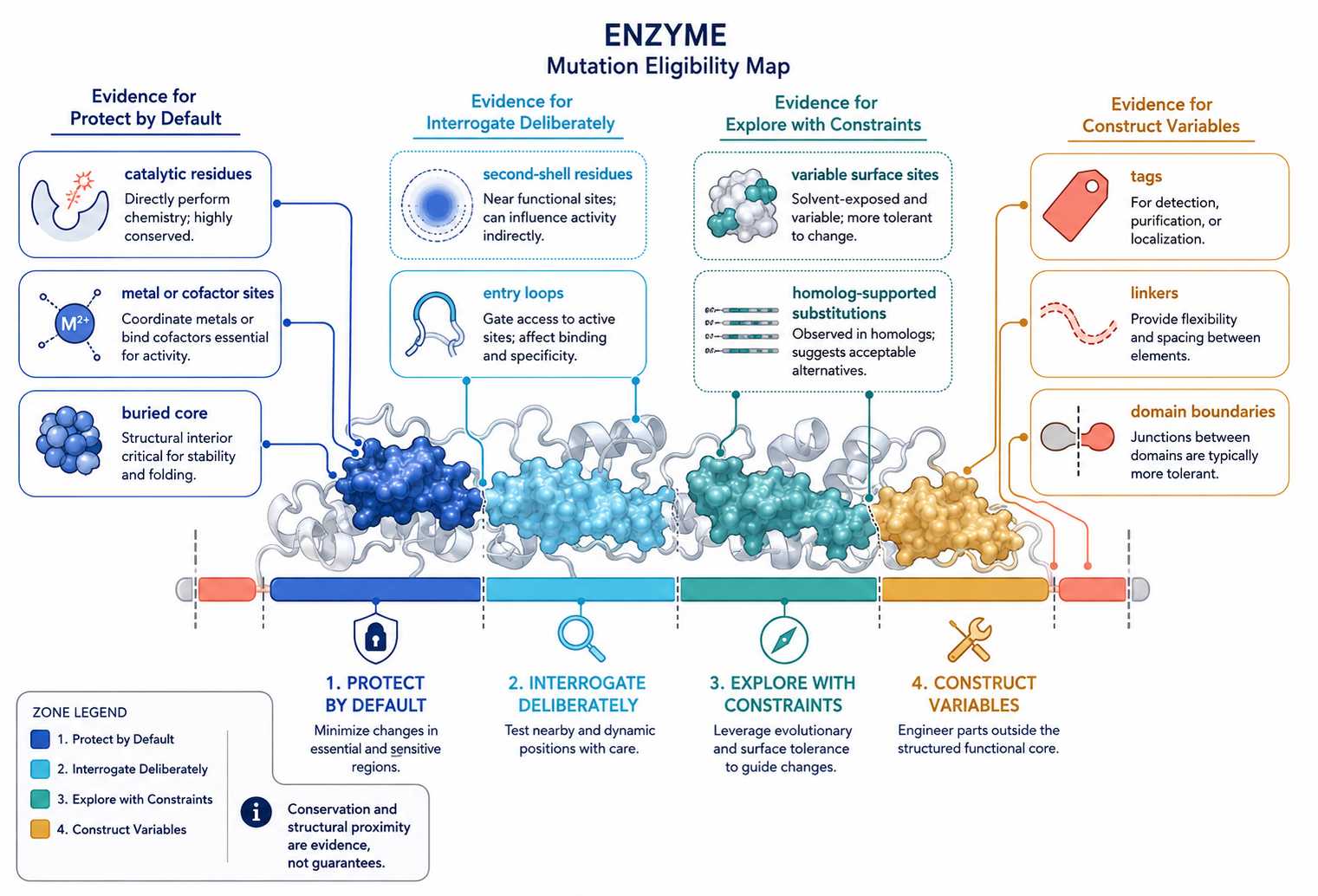 Fig 1. Mutation eligibility map. Catalytic and structural essentials are protected; uncertain functional zones are interrogated deliberately; tolerant positions are explored under sequence constraints; and construct variables are analyzed separately.
(Creative Enzymes Diagnostic)
Conservation is not an absolute veto and structural proximity is not proof of benefit. A highly conserved site may be useful to test when the diagnostic application differs sharply from natural selection, while a variable surface residue may still disrupt expression in a specific host. Experimental fitness landscapes also show that the best combination can contain a substitution that natural-sequence statistics alone would not prioritize. For this reason, Creative Enzymes can combine evolution-based, structure-based, physicochemical, language-model, historical-data, and expert-rule features as appropriate, while retaining a written rationale and uncertainty level for each candidate class.
Selecting only the highest predicted scores often fills a plate with closely related sequences and repeats the same model assumption. If the assumption is wrong, the entire experiment returns little new information. A more useful panel balances candidates expected to perform well with candidates that cover distinct sequence neighborhoods, test uncertain positions, reveal mechanisms, and verify the behavior of the assay and model.
Higher-confidence candidates that satisfy sequence constraints and score well across the primary objective and non-regression filters.
Diverse sequences that cover different mutation combinations, structural regions, or evolutionary solutions instead of clustering around one motif.
Variants chosen because their outcomes will clarify disputed positions, model disagreement, extrapolation limits, or possible epistatic interactions.
Single changes, reversions, deconvolutions, or paired substitutions that help distinguish additive from context-dependent effects.
Parent, process controls, known weak or inactive variants when justified, and reference materials needed to interpret plate and batch behavior.
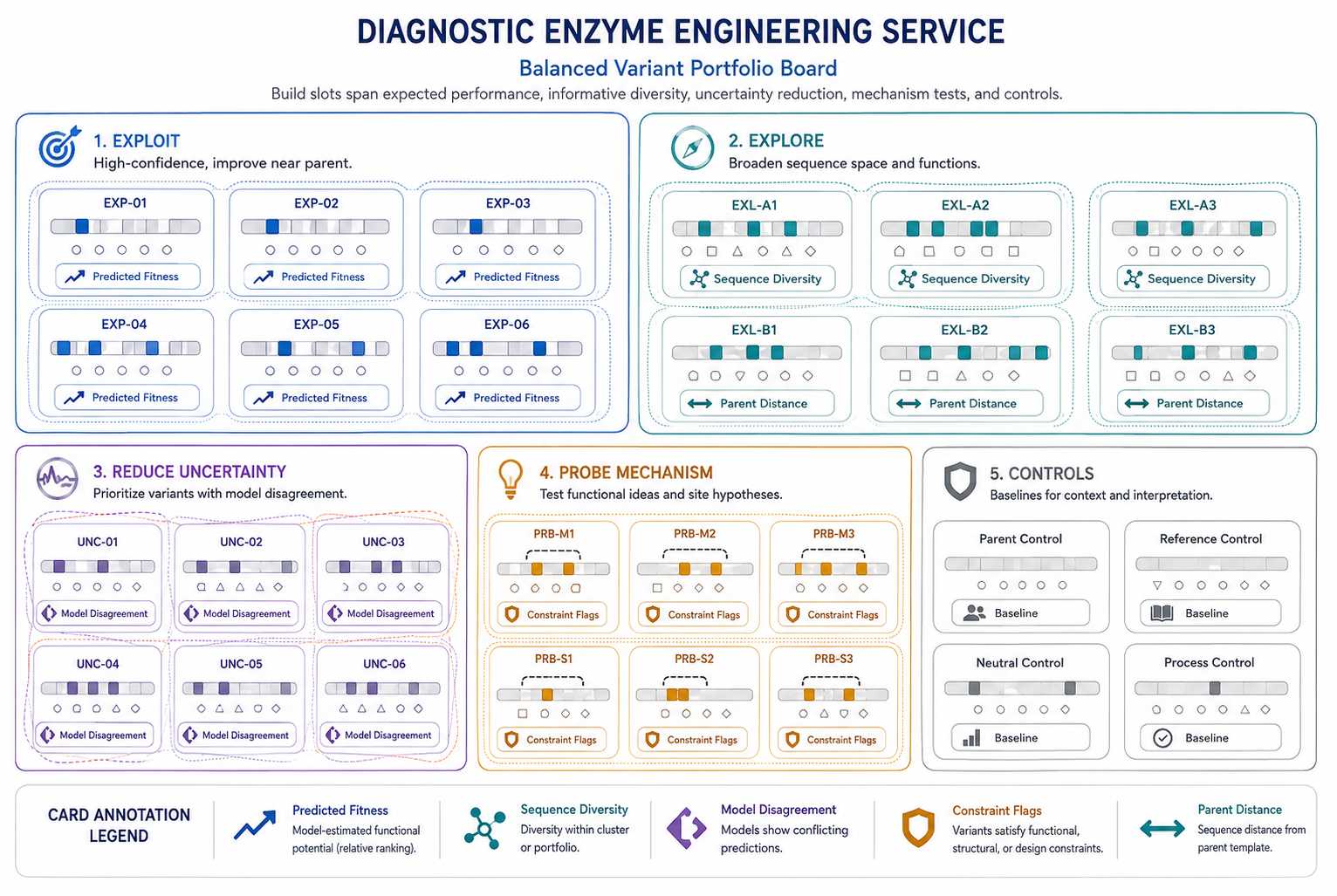 Fig 2. Balanced variant portfolio board. Build slots are allocated across expected performance, informative diversity, uncertainty reduction, mechanism probes, and controls instead of being filled by one opaque rank.
(Creative Enzymes Diagnostic)
Used when the project has a parent sequence but little reliable variant-function data. Natural homologs, sequence representations, structural hypotheses, physicochemical filters, and conservative rules can define a diverse first panel. The goal is to obtain useful sequence-function information as well as possible hits.
Used when historical variants have traceable sequences and comparable phenotypes. Models may prioritize recombinations or new mutations, but validation must guard against train-test leakage, assay drift, batch confounding, and overrepresentation of one sequence neighborhood.
Combines model-ranked candidates with expert hypotheses, structural probes, homolog-derived substitutions, diversity picks, and controls. This is often appropriate when historical data are useful but incomplete or were generated under a related rather than identical assay.
Panel composition is agreed before synthesis. A candidate table can include sequence identifier, parent distance, substitutions, design route, predicted metrics, uncertainty or model disagreement, constraint flags, diversity cluster, selection rationale, and planned assay tier. Predicted values are used for relative prioritization under their stated model and dataset; they are not represented as measured activity, stability, specificity, expression, or diagnostic performance.
A variant-design project can fail even when the computational candidates are sound. Incorrect sequence assembly, mixed clones, inconsistent tags, variable expression batches, edge effects, plate-position bias, or an untracked normalization change can corrupt the sequence-function relationship. The build and screening map should therefore be designed with the same care as the model.
Canonical amino-acid sequence, substitution list, parent version, and design rationale.
DNA sequence, vector, tag, linker, domain boundaries, host, and version-controlled annotation.
Sequence verification and defined acceptance or exception handling for the construct.
Culture or expression batch, processing history, soluble fraction, purification state, and protein amount.
Randomized or blocked positions, parent repeats, reference controls, blanks, and replicate assignment.
Raw signal, calculation version, normalization basis, QC flags, counterscreen, and decision status.
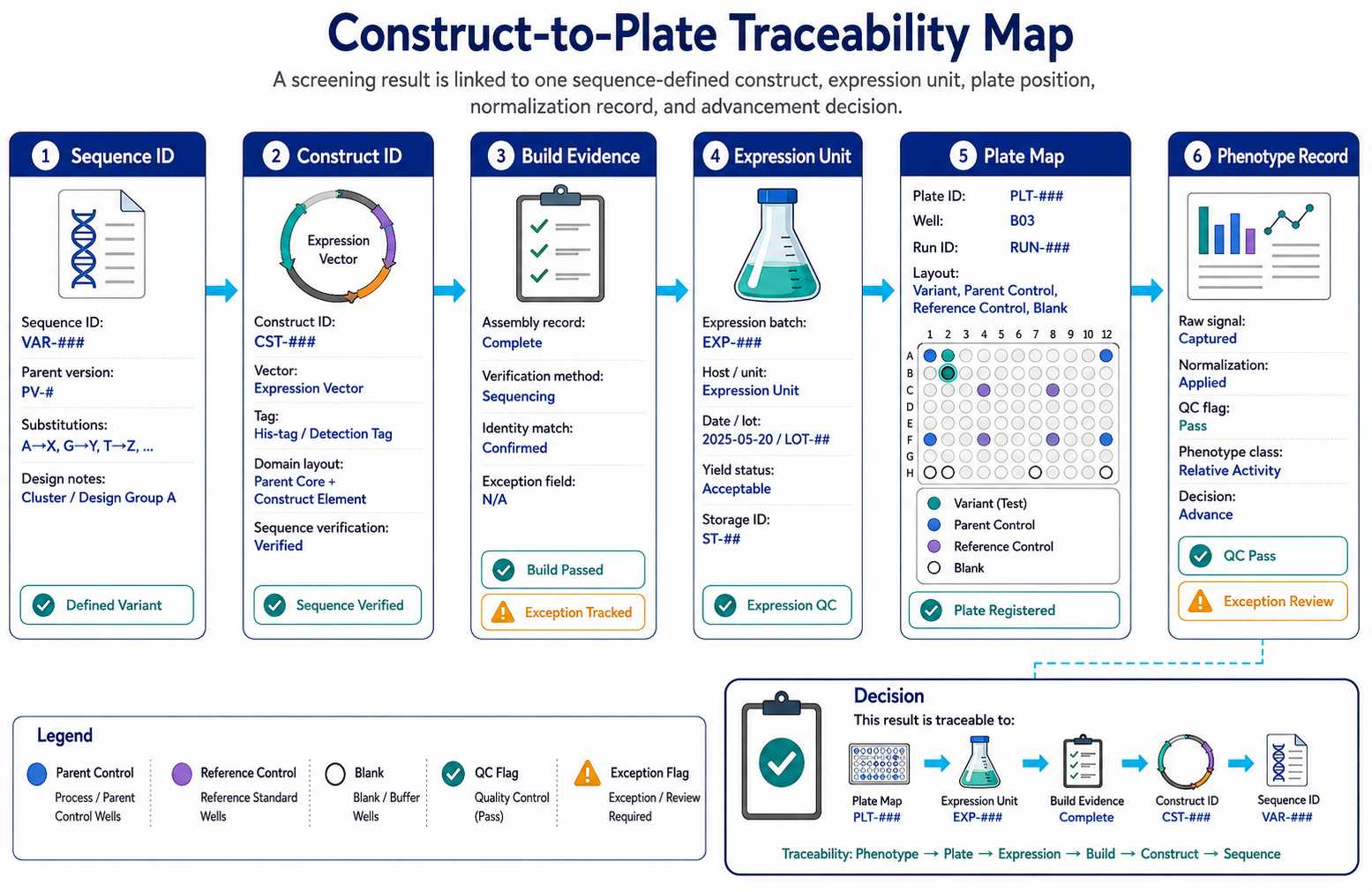 Fig 3. Construct-to-plate traceability map. A screening result is connected to one sequence-defined construct, expression unit, plate position, normalization record, and advancement decision.
(Creative Enzymes Diagnostic)
The nominal number of wells or reactions is not the number of unique variants that can be screened. Parent replicates, blanks, positive or external references, expression controls, matrix controls, and technical or biological repeats occupy experimental units. This is necessary. Parent measurements distributed across a plate or across processing batches reveal spatial drift and day effects. A no-enzyme control identifies reporter or substrate background. A deliberately weak or inactive control may help establish assay discrimination when scientifically justified. Control allocation is defined from the assay risk, not added after variant slots have already been promised.
Expression and catalytic performance should also be separated. Raw application signal per culture volume may be useful for discovering constructs with combined expression and function, but it does not show whether an amino-acid change improved intrinsic enzyme behavior. Conversely, activity normalized to purified protein can clarify catalytic effects while hiding a severe expression penalty. The project can retain both views when they support different product decisions. Expression and solubility problems that dominate the outcome may be transferred to AI-Guided Expression, Solubility and Manufacturability Optimization.
A screening cascade narrows candidates while preserving the measurements needed to explain rejection. The fastest primary assay should enrich useful candidates without becoming a substitute for the intended diagnostic context. For a nucleic-acid enzyme, a fluorescence endpoint may be appropriate for primary throughput, while secondary testing examines amplification kinetics, background, template range, inhibitor tolerance, or reaction-format compatibility. For a clinical chemistry enzyme, a surrogate substrate may support primary triage, while secondary assays test the intended analyte, coupled-reagent architecture, endogenous interferents, and the relevant sample matrix. For a reporter or conjugated enzyme, retained activity after labeling or immobilization may matter more than free-solution activity alone.
Confirm construct identity and flag sequence, assembly, or contamination exceptions before interpreting phenotype.
Measure soluble or recoverable enzyme, processing consistency, and gross aggregation or loss where relevant.
Use a dynamic, controlled assay to rank or classify activity without saturation and with a documented normalization rule.
Challenge specificity, background, matrix, substrate range, coupled chemistry, or platform behavior.
Re-express selected candidates and confirm the property with appropriate repeats and deeper characterization.
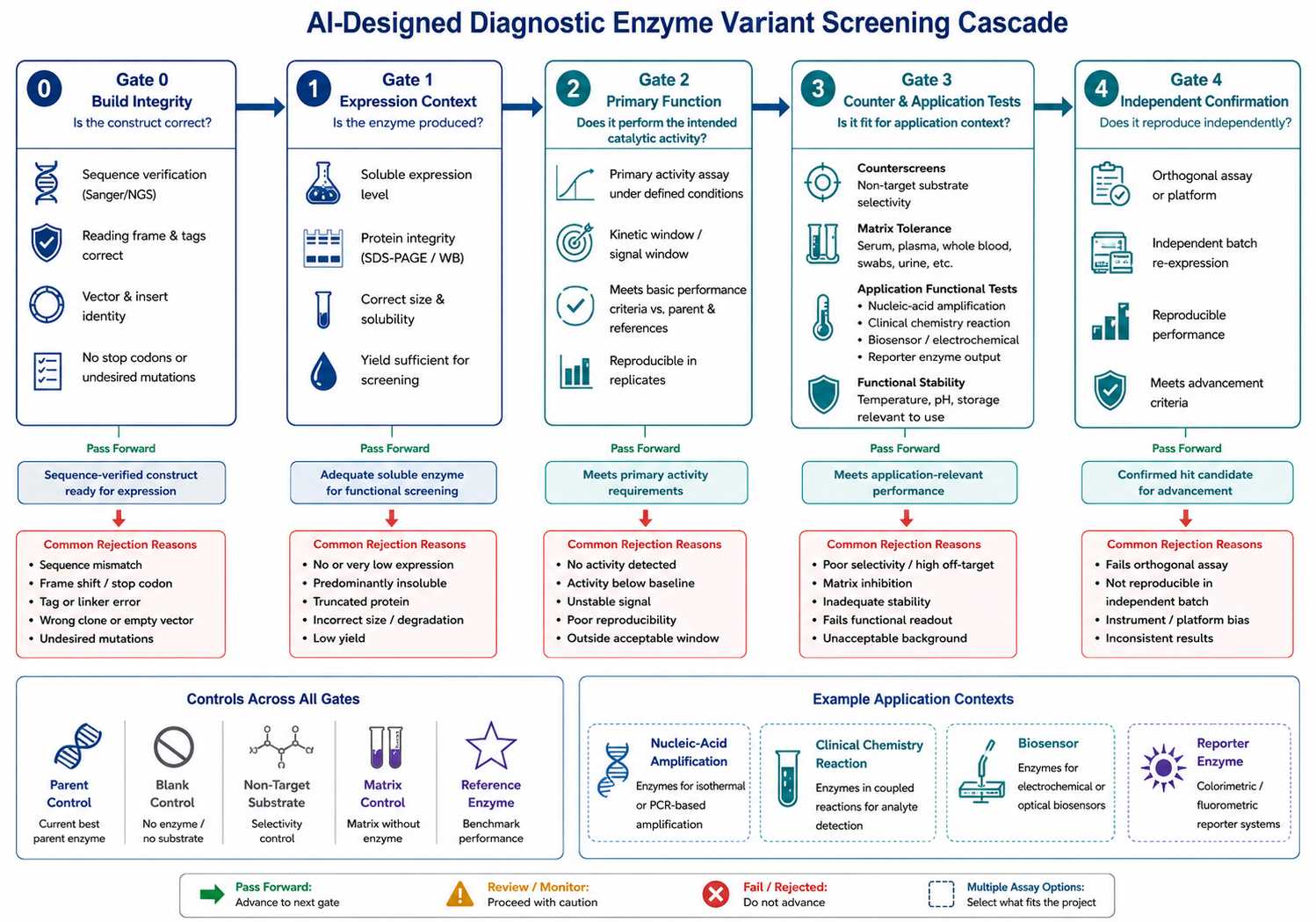 Fig 4. Diagnostic enzyme screening cascade. Sequence integrity and expression are separated from primary activity, counterscreens, application-functional testing, and independent hit confirmation.
(Creative Enzymes Diagnostic)
| Screening layer | Question answered | Useful controls or normalization | Common false conclusion |
|---|---|---|---|
| Expression and recovery | Was enough correctly processed enzyme available for a fair functional test? | Parent processed in parallel, soluble/total fraction, protein measurement, purification recovery where scoped. | Calling low signal a catalytic failure when the construct did not express or remain soluble. |
| Primary biochemical function | Does the variant alter the intended catalytic or binding-dependent readout under defined conditions? | Blank, parent, reference, linear-range check, enzyme-amount normalization, time-course or dose check as appropriate. | Calling a saturated endpoint or reporter artifact an activity improvement. |
| Specificity or counterscreen | Did the desired signal improve without unacceptable off-target conversion, background, or interference? | Non-target substrates, no-target control, no-enzyme control, reporter-only control, relevant interferents. | Advancing a broadly reactive variant that improves the primary signal but harms diagnostic discrimination. |
| Application-functional assay | Does the variant help the intended reagent architecture, sample matrix, device, or workflow? | Representative matrix, extraction chemistry, coupled components, instrument settings, parent and commercial/reference materials if appropriate. | Assuming purified-buffer performance transfers directly into the diagnostic system. |
| Robustness or stress challenge | Does performance persist across the agreed operating window or handling stress? | Temperature, pH, ionic strength, inhibitors, freeze-thaw, drying/reconstitution, or other project-specific stress controls. | Generalizing one condition into a stability, shelf-life, or platform-wide claim. |
Assay development, plate design, and acceptance criteria are configured to the enzyme and intended application. Where formal activity, stability, kinetics, or orthogonal characterization is needed, the project can connect to Enzymes Activity and Stability Analysis and Enzyme QC and QA. The service does not convert a discovery screen into validated release testing without a separate method-suitability and validation scope.
A first-pass winner is a candidate for confirmation, not yet an engineered lead. Selection pressure, noisy measurements, and ranking many variants create a tendency for the apparent top result to overestimate its reproducible advantage. Independent expression helps determine whether the result belongs to the sequence rather than the original culture, preparation, or plate. Orthogonal or deeper measurements help determine whether the primary readout represented the intended mechanism.
Verify calculation, QC flags, plate position, replicate behavior, and comparison with the parent.
Break the link between a promising result and one preparation-specific event.
Use a time course, enzyme titration, kinetic, orthogonal, or product-specific assay as appropriate.
Examine representative matrix, coupled components, device or reaction format, and relevant counterscreens.
Check expression, specificity, stability, background, or other properties that must remain acceptable.
Document what was tested, what remains unknown, and what the next development stage must bridge.
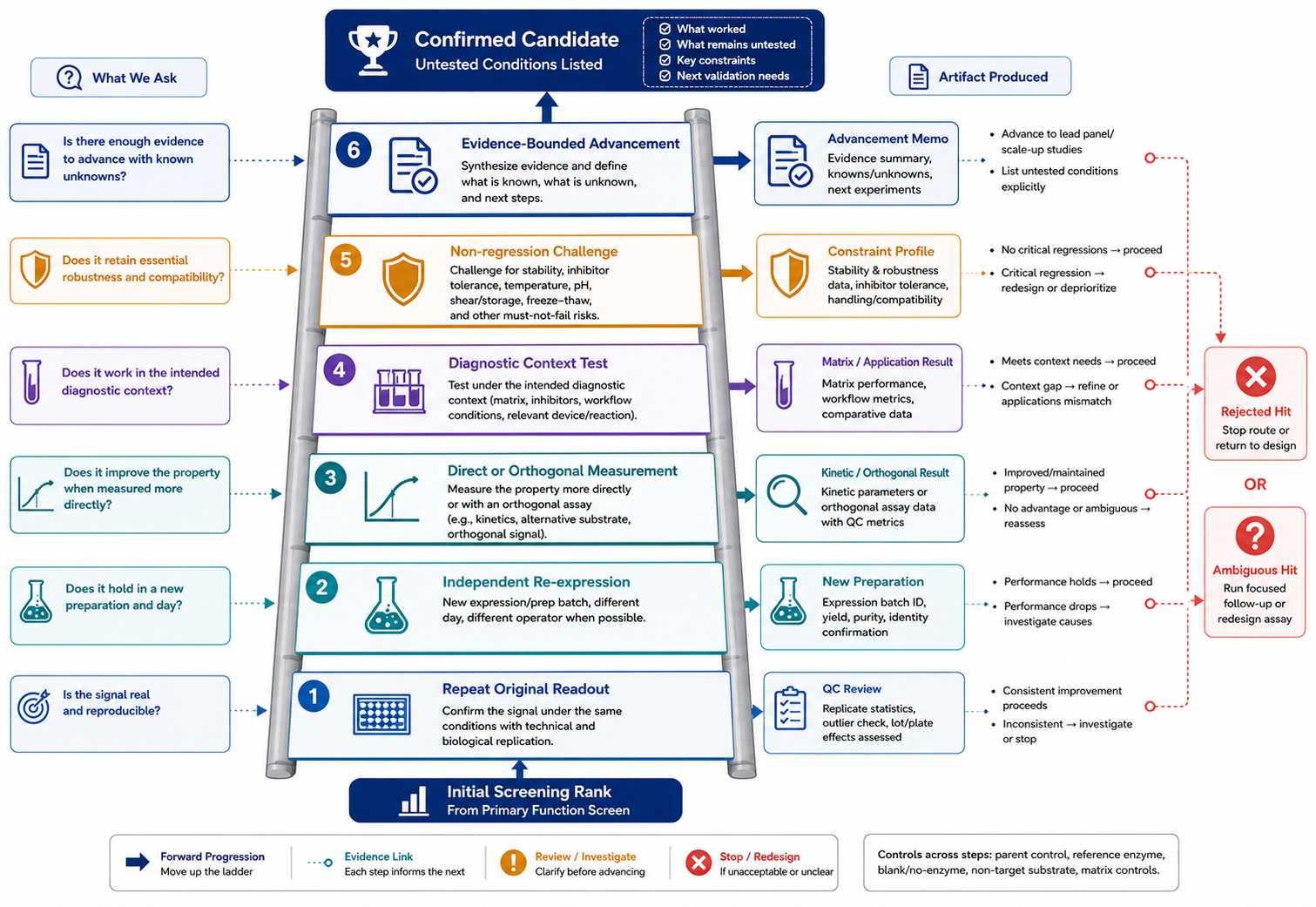 Fig 5. Hit confirmation ladder. Initial rank is followed by independent expression, more direct property measurement, diagnostic-context testing, non-regression challenges, and an evidence-bounded advancement decision.
(Creative Enzymes Diagnostic)
Epistasis is addressed explicitly. Individually favorable substitutions do not necessarily combine favorably, and the effect of one mutation may depend on the rest of the sequence. When a combinatorial candidate succeeds or fails unexpectedly, deconvolution, reversion, paired variants, or a deliberately balanced second panel may be used to locate the interaction. Negative and ambiguous variants remain valuable labels if their build and assay records are trustworthy. They can prevent the next model from repeatedly entering the same nonfunctional neighborhood.
If iterative learning is the central program, the confirmed data package can feed a Closed-Loop Design-Build-Test-Learn Enzyme Evolution Service. Projects that need to rescue or structure inconsistent historical datasets can use AI-Ready Experimental Dataset Design and Screening Data Analysis.
Suitable when the client will build and test candidates internally. The scope can include design-brief review, mutation eligibility mapping, candidate generation, constraint filtering, diversity analysis, model-supported prioritization, a balanced sequence panel, selection rationales, and a recommended screening design.
Adds sequence-defined construct preparation, expression or material generation, primary functional screening, agreed controls, QC flags, candidate comparison, and a recommendation for confirmation. Exact construct system, material state, and assay are project-specific.
Adds counterscreens, application-functional testing, independent re-expression, deeper activity or kinetic analysis, robustness challenges, and a transfer package for further engineering, formulation, scale-up, or validation-oriented work.
A candidate can transition to Comprehensive Enzymes Development and Validation, formulation and stability work, enzyme production and engineering, or a project-specific QC method program. Existing molecular diagnostic enzymes and kits may also provide reference starting materials where scientifically appropriate.
Yes, a cold-start design can be considered. Sequence-family information, natural homologs, predicted or experimental structure, physicochemical filters, known functional annotations, and pretrained sequence representations can generate hypotheses. The first panel should normally contain diversity and uncertainty-reduction candidates as well as higher-ranked variants because no project-specific model has yet learned the assay phenotype. Experimental results from that panel establish the evidence needed for later supervised or closed-loop design.
Not automatically. Selection can consider predicted performance, model uncertainty, sequence distance, diversity cluster, structural or evolutionary rationale, prohibited mutations, expression risk, and the information a candidate will add. A panel filled only with near-identical top scores can fail as one correlated group. The selection record explains why each candidate occupies a build slot.
There is no responsible universal number. The panel size depends on mutable positions, expected epistasis, available prior data, assay variability, expression and purification burden, experimental unit capacity, number of required controls, and confirmation plan. Creative Enzymes designs to the usable capacity after controls and repeats are included, not simply to a nominal plate format.
Potentially, if sequence identity, assay protocol, reference controls, raw signals, processing rules, and batch metadata are recoverable. Batch, day, operator, reagent lot, construct, and instrument effects should be examined before pooling. Data that cannot be made comparable may still guide hypotheses, but it should not be treated as one homogeneous training set. A bridging experiment with shared reference variants may be more reliable.
It can rank or propose untested combinations, but confidence depends on the training coverage, representation, extrapolation distance, model assumptions, and epistasis. Combined mutations can behave non-additively. Proposed combinations therefore require experimental construction and confirmation; deconvolution or paired probes may be included when the interaction itself matters.
Yes, when it provides the throughput and discrimination needed for triage, but the page treats it as one gate. Selected variants should move into an intended-substrate or application-functional assay and relevant counterscreens before a diagnostic-performance conclusion is made. The project records where the surrogate is known to differ from intended use.
The scope can include parallel expression, soluble-protein, recovery, or protein-amount measurements and can report both performance per expression unit and performance normalized to enzyme amount. Purified-protein or deeper kinetic analysis may be used for selected candidates. The correct interpretation depends on whether the product needs intrinsic catalytic improvement, manufacturability improvement, or both.
The failure is retained, not discarded as useless. It may reveal substrate bias, reporter interference, matrix sensitivity, coupling limitations, or a property trade-off. That result can revise the design brief, add a counterscreen, change the training label, or motivate a second panel that targets the failure mechanism. The primary rank is not allowed to override application evidence.
Yes, when the measurements and advancement rules are defined. Activity, specificity, expression, stability, inhibitor tolerance, and background may be handled as objectives, constraints, or sequential gates. The project should preserve individual property data instead of hiding all results inside one unexplained composite score. For strongly multi-parameter POCT constraints, see AI-Driven Multiparameter Enzyme Optimization for POCT Reagents.
No. Confirmation supports the stated construct, material, assays, conditions, and comparison. It does not establish clinical performance, shelf life, production-scale consistency, release specifications, or regulatory authorization. The legal manufacturer or sponsor must complete the development, analytical and clinical validation, design control, risk management, registration, labeling, and market-authorization activities required for the intended product.
Share the parent sequence and construct, target diagnostic function, current performance gap, known mutation constraints, available structure or historical screening data, assay throughput, and the evidence required to advance a candidate. Creative Enzymes can propose a design-only, design-and-screen, or confirmed-lead scope that connects sequence hypotheses to traceable constructs and application-relevant measurements.
RUO and industrial diagnostic-reagent development only. Variant predictions and screening hits do not constitute direct diagnostic use, clinical validation, therapeutic or food use, regulatory approval, or market authorization.
Contact Creative Enzymes