Background
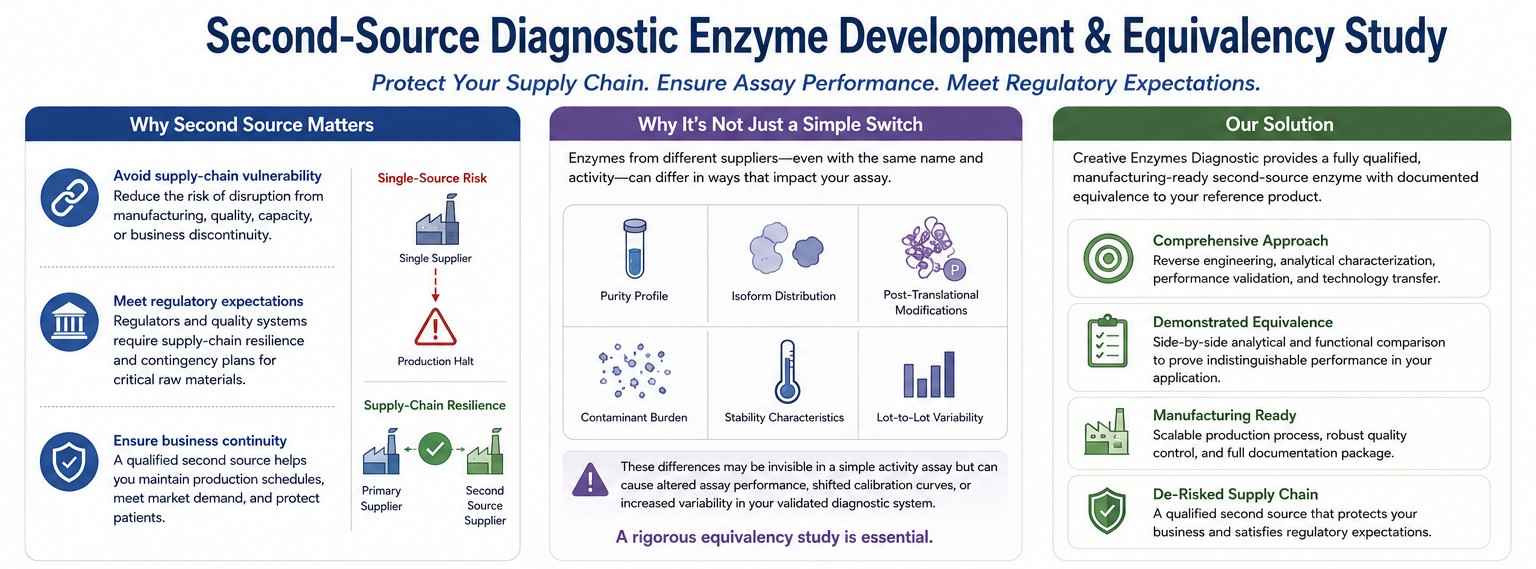
Diagnostic manufacturers depend on a reliable supply of high-quality enzymes to maintain production schedules, meet market demand, and comply with regulatory commitments. A single-source enzyme supplier creates significant supply-chain vulnerability: manufacturing disruptions, quality deviations, capacity constraints, or business discontinuity at the supplier can halt the diagnostic manufacturer's entire product line. Regulatory agencies increasingly expect IVD developers to demonstrate supply-chain resilience, and many quality management systems explicitly require contingency plans for critical raw materials.
Establishing a second source for a diagnostic enzyme is not as simple as purchasing an alternative product from another catalog. Enzymes from different suppliers—even those with the same nominal name and activity specification—can differ in purity profile, isoform distribution, post-translational modification state, contaminant burden, and stability characteristics. These differences may be invisible in a simple activity assay but can manifest as altered assay performance, shifted calibration curves, or increased lot-to-lot variability when integrated into a validated diagnostic system. A rigorous equivalency study is therefore essential to demonstrate that the second-source enzyme performs indistinguishably from the reference enzyme in the target diagnostic application.
Creative Enzymes Diagnostic offers a comprehensive Second-Source Diagnostic Enzyme Development and Equivalency Study service that delivers a fully qualified, manufacturing-ready enzyme alternative with documented analytical and functional equivalence to your reference product. Our integrated approach combines reverse engineering, analytical characterization, side-by-side performance validation, and technology transfer to provide a de-risked second source that protects your supply chain and satisfies regulatory expectations.
Reverse Engineering Strategy
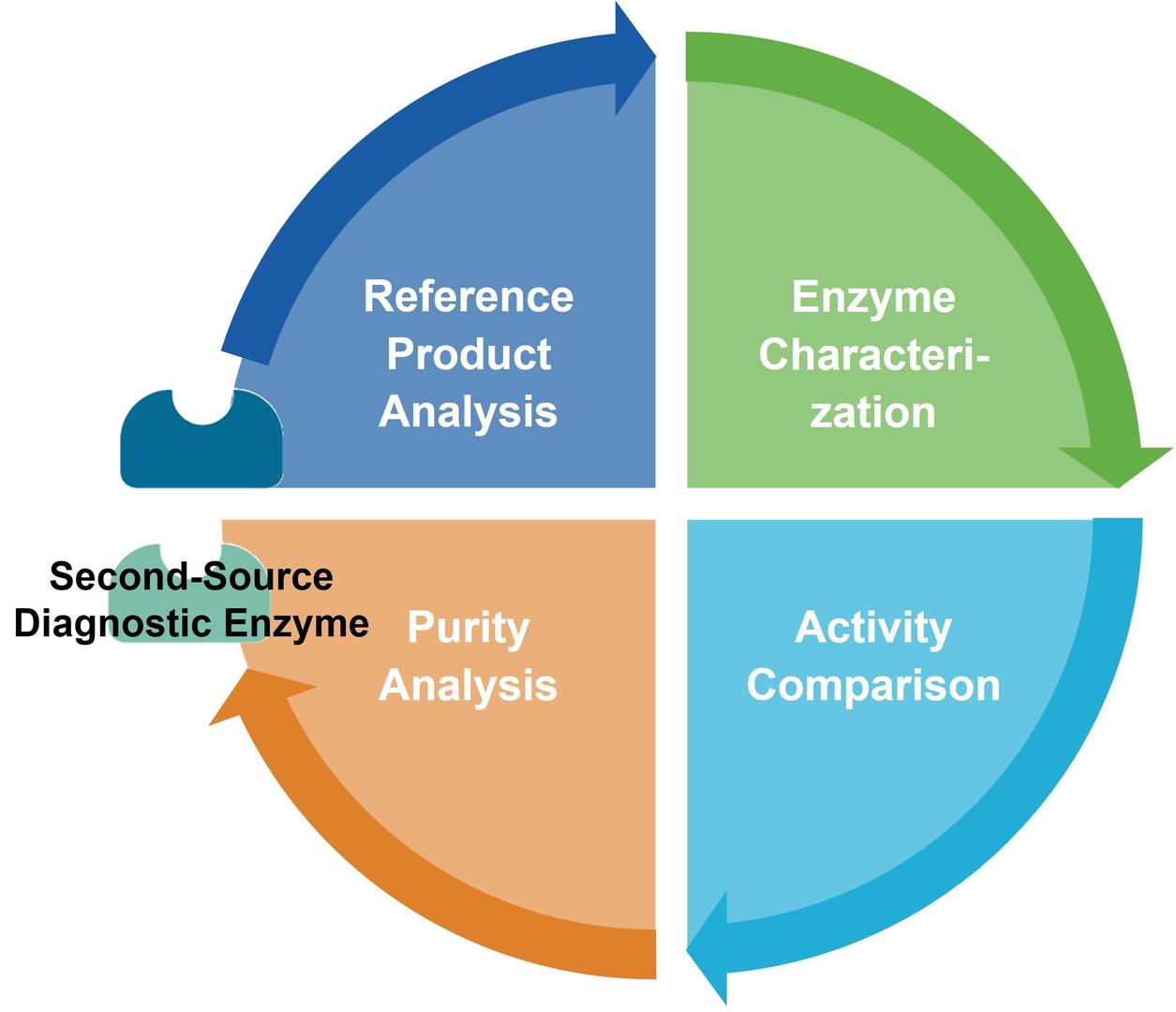
Our reverse engineering process systematically deconstructs the reference enzyme product to identify its critical quality attributes, manufacturing characteristics, and performance-determining features. This analysis provides the blueprint for developing a second-source enzyme that matches the reference in every dimension relevant to diagnostic performance.
Reference Product Analysis
- Comprehensive review of the reference product's Certificate of Analysis, technical data sheet, regulatory filings, and published literature to identify declared specifications, manufacturing host, expression system, and formulation composition
- Analysis of the reference product's packaging, labeling, and storage conditions to inform second-source product design and shelf-life strategy
- Assessment of the reference supplier's quality system, regulatory status, and supply chain structure to identify potential risk factors and define equivalency acceptance criteria
- Documentation of the reference product's intended use, assay integration requirements, and critical performance parameters to ensure that the equivalency study addresses all clinically relevant attributes
Enzyme Characterization
- Determination of the reference enzyme's molecular weight, isoelectric point, oligomeric state, and post-translational modification profile using SDS-PAGE, SEC-HPLC, IEF, and mass spectrometry
- Peptide mapping and N-terminal sequencing to confirm primary structure identity and identify any sequence variants, truncations, or modifications present in the reference product
- Metal ion and cofactor analysis by ICP-MS to quantify bound metal content (Mg2+, Mn2+, Zn2+, Ca2+) that may influence activity and stability
- Glycosylation profiling (for eukaryotic enzymes) by PNGase F digestion and glycan analysis to characterize N-linked and O-linked glycan structures that may affect activity, stability, or immunogenicity
Activity Comparison
- Side-by-side kinetic characterization of reference and second-source enzymes under identical conditions, measuring kcat, KM, kcat/KM, and specific activity to confirm catalytic equivalence
- Evaluation of activity across a range of pH, temperature, ionic strength, and buffer compositions to compare the operational windows and identify any condition-dependent performance differences
- Assessment of activity in the presence of the reference product's declared stabilizers, excipients, and formulation components to confirm compatibility and rule out formulation-specific inhibition or activation
- Statistical comparison of kinetic parameters using equivalence testing (two one-sided t-tests, TOST) with predefined equivalence margins to provide rigorous, regulator-acceptable evidence of similarity
Purity Analysis
- Comprehensive impurity profiling of the reference product by SDS-PAGE, Western blot, RP-HPLC, and SEC-HPLC to identify and quantify host cell proteins, degraded enzyme species, aggregates, and other process-related impurities
- Quantification of endotoxin, bioburden, and host cell DNA in the reference product to establish acceptance criteria for the second-source enzyme that match or improve upon the reference
- Assessment of nucleic acid contamination (for nuclease products) or protease contamination (for protease-sensitive applications) using highly sensitive functional assays
- Comparison of purity profiles between reference and second-source products using overlay chromatography and densitometry to confirm visual and quantitative equivalence of impurity patterns
Equivalency Study
The equivalency study is the core of our second-source qualification program. It goes beyond analytical similarity to demonstrate that the second-source enzyme performs indistinguishably from the reference in the diagnostic assay context, under conditions that replicate real-world clinical use.
Kinetic Parameters
- Detailed kinetic analysis of the second-source enzyme including KM, Vmax, kcat, and catalytic efficiency (kcat/KM) under the exact assay conditions of the target diagnostic platform
- Comparison of kinetic parameter ratios between reference and second-source enzymes, with acceptance criteria defined as 90–110% of reference values for KM and kcat, and statistical equivalence confirmed by TOST analysis
- Evaluation of substrate analog kinetics and inhibitor sensitivity (Ki) to confirm that the second-source enzyme maintains the same mechanistic features and regulatory properties as the reference
- Temperature and pH kinetic profiling to verify that the second-source enzyme exhibits the same activity optima and tolerance profiles as the reference under variable assay conditions
Stability
- Accelerated and real-time stability comparison of reference and second-source enzymes under identical storage conditions (liquid at −20°C, 4°C, 25°C; lyophilized at 25°C/60% RH) with activity measurement at matched time points
- Thermal stability comparison by differential scanning fluorimetry (DSF) and differential scanning calorimetry (DSC) to confirm equivalent Tm and unfolding thermodynamics
- Freeze-thaw stability assessment across 10 cycles to simulate shipping stress and confirm that the second-source enzyme maintains activity equivalent to the reference after temperature excursion
- Statistical analysis of stability data using degradation rate constants (k), half-life (t1/2), and Arrhenius modeling to predict shelf-life and confirm that the second-source meets or exceeds reference stability claims
Matrix Performance
- Side-by-side evaluation of reference and second-source enzymes in the target diagnostic assay format using clinical matrices (serum, plasma, urine, saliva, whole blood) across the analytical measurement range
- Assessment of matrix interference recovery: spiking known analyte concentrations into clinical matrices and comparing measured values between reference and second-source enzyme reactions to confirm equivalent matrix tolerance
- Evaluation of performance in challenging samples (hemolyzed, icteric, lipemic) to confirm that the second-source enzyme maintains the same resistance to endogenous inhibitors as the reference
- Correlation analysis (Passing-Bablok regression, Bland-Altman analysis) of assay results generated with reference versus second-source enzymes in a minimum of 50 clinical specimens to demonstrate method equivalence
Lot-to-lot Consistency
- Manufacture and testing of three independent production lots of the second-source enzyme to demonstrate batch-to-batch reproducibility and establish manufacturing process capability
- Comparison of lot-to-lot variability (CV) for the second-source enzyme against the reference product's historical variability data to confirm that the second source does not introduce additional inconsistency
- Statistical process control charting of critical quality attributes across lots to verify that the manufacturing process is in control and capable of producing consistent product over time
- Long-term stability monitoring of multiple lots to confirm that lot-to-lot consistency is maintained throughout the claimed shelf-life, with trending analysis to detect any drift in quality attributes
Service Workflow

Technology Transfer
Upon successful completion of the equivalency study, we provide comprehensive technology transfer support to integrate the second-source enzyme into the client's manufacturing workflow and quality system. This ensures a seamless transition from qualification to routine supply.
- Manufacturing documentation: Complete batch records, SOPs, and raw material specifications for the second-source enzyme production process, formatted for integration into the client's ISO 13485 or GMP quality system
- Analytical method transfer: Transfer of all validated analytical methods (identity, purity, potency, safety) with method validation data, reference standards, and training materials to enable independent QC testing at the client's facility or designated contract laboratory
- Regulatory support: Preparation of second-source qualification reports, comparability protocols, and regulatory submission documents aligned with FDA, EU IVDR, and ICH guidelines for raw material changes and supplier additions
- Change control management: Support for internal change control processes, including risk assessment, validation planning, and post-implementation monitoring to ensure compliance with the client's quality management system
- Ongoing supply agreement: Establishment of a long-term supply agreement with defined specifications, lead times, safety stock, and change notification protocols to ensure continuous, reliable supply of the qualified second-source enzyme
- Continued equivalency monitoring: Annual or periodic re-qualification studies to confirm ongoing equivalence between the second-source and reference products as both products evolve over time, with documentation of any drift and recommended corrective actions
FAQs
Q1. Why is a formal equivalency study necessary rather than simply qualifying an alternative commercial enzyme?
A1. Catalog enzymes from different suppliers, even with identical names and nominal activity specifications, can differ significantly in purity profile, isoform distribution, post-translational modifications, and contaminant burden. These differences may not affect a generic activity assay but can alter performance in a validated diagnostic system, leading to shifted calibration, changed precision, or failed QC. A formal equivalency study provides documented, statistically rigorous evidence that the second-source enzyme performs indistinguishably from the reference in the specific diagnostic context, satisfying both internal quality requirements and regulatory expectations for raw material qualification.
Q2. How long does a second-source development and equivalency study typically take?
A2. A standard program typically spans 12 to 16 weeks. This includes 3–4 weeks for reference product analysis and reverse engineering, 4–6 weeks for second-source enzyme development or sourcing and initial characterization, and 4–6 weeks for comprehensive equivalency testing and documentation. Projects requiring extensive protein engineering to match reference characteristics, or those involving complex multi-enzyme formulations, may extend to 20–24 weeks. Expedited timelines are available for supply-critical situations where the primary source is at risk of discontinuation.
Q3. What if the reference product is a proprietary enzyme with no publicly available sequence or manufacturing information?
A3. We have extensive experience with proprietary reference products where limited information is available. Our reverse engineering capabilities include de novo protein sequencing by mass spectrometry, gene identification by homology searching, and functional characterization to reconstruct the enzyme's critical attributes. While the process is more complex and may require iterative engineering, we have successfully developed second-source equivalents for numerous proprietary diagnostic enzymes where the original supplier provided no sequence or process data.
Q4. Do we need to revalidate our diagnostic assay when switching to the second-source enzyme?
A4. The extent of revalidation depends on the equivalency study results and the regulatory pathway of your diagnostic product. If the equivalency study demonstrates analytical and functional equivalence with high statistical confidence, a bridging study or limited revalidation may be sufficient rather than a full revalidation. For FDA-cleared or IVDR-registered products, we provide regulatory submission support to justify the raw material change with the equivalency data package. Our team works with your regulatory affairs group to determine the optimal validation strategy based on the product's classification and the magnitude of the change.
Q5. Can the second-source enzyme be manufactured at a different scale or in a different host than the reference?
A5. Yes, provided that the equivalency study demonstrates that differences in manufacturing scale or host do not affect the critical quality attributes or diagnostic performance. We have successfully developed second-source enzymes in alternative expression systems (e.g., switching from mammalian to yeast, or from E. coli to Pichia) where the post-translational modification requirements permit. Scale differences are addressed through process validation and lot-to-lot consistency studies. Any host-related differences (e.g., glycosylation patterns, HCP profiles) are characterized and evaluated for impact on assay performance during the equivalency study.
Q6. What ongoing support do you provide after the second-source enzyme is qualified and in production?
A6. We provide comprehensive post-qualification support including ongoing commercial supply with batch-to-batch consistency monitoring, annual re-qualification or equivalency verification studies, change control management for process or specification modifications, and regulatory documentation updates as needed. We also maintain a safety stock of qualified material to buffer against supply disruptions and offer expedited manufacturing for urgent orders. Our goal is to ensure that the second source remains a reliable, low-risk supply option throughout the product lifecycle.
Creative Enzymes Diagnostic combines analytical rigor, manufacturing expertise, and regulatory knowledge to deliver qualified second-source enzymes that protect your supply chain and maintain your diagnostic product's performance integrity. From reverse engineering to equivalency validation and ongoing supply, we provide the comprehensive second-source solution that modern diagnostic manufacturing demands.
Contact our business development team today to discuss your specific project needs!
Related Services

