Diagnostic enzyme matrix tolerance and interference studies
Find Where the Matrix Changes the Signal
An enzyme can meet its activity specification in a reference buffer and still underperform in the intended assay. Whole blood, serum, plasma, urine, saliva, swab media, extraction residues, formulation components and detection chemistry can change recovery, reaction rate, background or signal interpretation. Creative Enzymes designs paired interference and matrix-effect studies to determine what changes, where it changes and whether the effect matters within the intended decision range.
The service does more than compare buffer with matrix. We define the observed failure, build the smallest representative challenge set, pair control and test preparations, examine response across relevant analyte and interferent levels, and use stage-specific controls to distinguish sample-recovery loss from direct enzyme effects, detection interference and calculation artifacts. The conclusion is bounded to the tested matrix, concentrations, lots, platform and procedure.
Do Not Use “Matrix Effect” as a Catch-All Diagnosis
Four related terms often become mixed together during troubleshooting. Separating them prevents the wrong experiment and the wrong mitigation. A blocker may help an antibody-mediated interference but do nothing for optical absorbance. A new polymerase may tolerate heparin yet cannot restore target lost during extraction. A processed control may behave differently from native specimens even though the assay itself functions as designed.
IInterference
A non-target substance or process changes the reported result under specified conditions. The effect may be positive, negative, nonlinear or qualitative.
MMatrix effect
The surrounding physical and chemical environment changes analyte recovery, reaction behavior or detection response.
XCross-reactivity
A non-target compound, sequence or structure is recognized, amplified, bound or transformed by the assay system.
CCommutability
A processed or surrogate material behaves like relevant unprocessed specimens across specified measurement procedures.
CLSI EP07 provides a framework for chemical interference studies. CLSI EP14 addresses a narrower processed-sample commutability question and uses “matrix effect” in that context. Serum-versus-plasma equivalence, cross-reactivity and matrix-tolerance studies may require different designs. The project brief therefore names the actual question instead of citing a standard as a substitute for design.
Start from the Symptom and Walk Backward Through the Signal Path
The same apparent bias can arise at several locations. Low signal may reflect incomplete extraction, direct enzyme inhibition, analyte binding, fluorophore quenching or a calibration mismatch. High background may come from nonspecific chemistry, cross-reactivity, endogenous color or data-processing thresholds. We use a signal-pathway compass to keep competing explanations visible until controls remove them.
Sample and preparation zone
Collection tube, anticoagulant, transport medium, viscosity, cellular load, extraction, lysis, wash and elution can change what reaches the reaction.
Enzyme and reaction zone
pH, ionic strength, inhibitors, activators, cofactors, substrate competition and macromolecular binding can change catalytic or amplification behavior.
Detection zone
Absorbance, fluorescence, luminescence, electrochemistry, turbidity, particles and device optics can add, subtract or distort signal independently of enzyme activity.
Calculation and decision zone
Blank correction, calibration model, thresholding, normalization and qualitative cutoffs can magnify or conceal upstream changes.
Observed symptoms to record
Direction and magnitude of apparent bias
Analyte or target level where it appears
Whether the internal control also shifts
Whether dilution relieves or worsens the effect
Whether raw signal and reported result disagree
Specimen, lot, device or operator dependence
Timing, curve shape or reaction-rate change
Changes after storage or sample processing
Fig 1. Signal-pathway interference compass. A visible assay shift can originate before the enzyme reaction, within it, at signal detection or during result calculation. (Creative Enzymes Diagnostic)
Climb a Matrix Contrast Ladder Without Assuming Every Rung Is Equivalent
Reference buffer is useful because it establishes the enzyme's controlled behavior, but it is not an intended specimen. Synthetic or simulated matrices allow controlled factor changes but may not reproduce binding proteins, cellular material or native analyte presentation. Pools improve realism while hiding individual-sample heterogeneity. Individual specimens reveal that heterogeneity but introduce availability, ethical, sourcing and characterization constraints. Edge specimens test the domain boundary. We select rungs according to the decision and document what each can support.
Rung 1Reference buffer
Intrinsic response and analytical baseline under controlled composition.
Rung 2Simulated matrix
Controlled addition or removal of defined physical and chemical factors.
Rung 3Pooled material
Representative average matrix for screening and concentration challenges.
Rung 4Individual specimens
Between-specimen variation, rare interferents and matrix-dependent scatter.
Spiking is a preparation, not a guarantee of commutability. The spike source, solvent, added volume, equilibration, analyte presentation and matrix modification are recorded. Native and spiked analytes can behave differently. A useful study states whether it screens a mechanism, characterizes an effect or supports an intended-use claim.
Fig 2. Matrix contrast ladder. Each rung adds intended-use realism and biological variability, but also introduces assumptions that must be controlled and documented. (Creative Enzymes Diagnostic)
Build the Challenge Panel from the Assay Risk Map
CLSI EP37 and device-specific guidance can provide starting points, but a long generic list is not automatically a good study. We review intended specimen type, collection pathway, target chemistry, enzyme mechanism, detection mode, known raw materials and failure history. The final panel can contain one focused interferent, a family screen or a staged library in which initial screening triggers more detailed characterization.
Endogenous
Hemoglobin/hemolysate, bilirubin, lipids, proteins, binding factors, salts, cells, mucus or other specimen-native components.
Exogenous
Relevant medications, supplements, preservatives or environmental substances where intended use and evidence justify evaluation.
Collection and handling
Heparin, EDTA, citrate, tube additives, swab or transport medium, freeze-thaw, time-to-separation and residual cleaning materials.
Pair the Samples and Challenge the Relevant Decision Region
A useful interference experiment changes the suspected factor while holding other conditions as similar as practical. Control and test preparations are derived from the same source where feasible, receive matched handling and are distributed across runs so that position, day or instrument does not become the interferent. Replication is selected from method precision and the size of the effect the project needs to detect; it is not copied from another assay.
Illustrative paired design logic
Interferent level
Low / boundary analyte
Mid-range analyte
High / upper-range analyte
Control
Matched baselineDecision-region response without added challenge
Matched baselineReference recovery or signal
Matched baselineUpper-range behavior and hook check
Screen level
Paired challengeQualitative call, bias or detection shift
Paired challengeDirection and approximate magnitude
Paired challengeRange compression or saturation
Characterization series
Dose responseThreshold near the decision boundary
Dose responseProportional, nonlinear or recovery pattern
Dose responseHook, competition or detection-limit interaction
The analyte axis and interferent axis answer different questions. Multiple analyte levels show whether the consequence depends on decision region or signal range. Multiple interferent levels show whether an effect has a threshold, slope, plateau or reversal. When individual specimens are important, specimen identity becomes another planned factor rather than unstructured noise.
Controls are selected to remove specific ambiguity
Control or contrast
Question answered
Limitation if absent
Paired unchallenged preparation
What changed when the interferent or matrix factor was introduced?
Source-material variation can be mistaken for interference
Matrix-matched blank
Does the matrix itself generate signal or change baseline?
Background cannot be separated from analyte response
Pre-process spike or internal process control
Was material recovered through extraction, lysis, wash and transfer?
Sample-preparation loss may look like enzyme inhibition
Post-process reaction control
Does the reaction mixture inhibit the enzyme or amplification step?
Extraction and reaction effects remain confounded
Orthogonal or raw-signal readout
Is the result shift catalytic, optical, fluorescent or computational?
The reported result can conceal the physical mechanism
Positive and negative decision controls
Are qualitative calls and invalid-control logic operating as intended?
Bias may be numerically small but decision-relevant
Reference and candidate reagent lots
Is tolerance intrinsic to the matrix or lot-dependent?
A formulation or enzyme-lot effect may be generalized incorrectly
Fig 3. Interference response fingerprints. Concentration series can distinguish no decision-relevant effect from proportional bias, thresholds, hook-like behavior, nonlinearity and specimen-specific variation. (Creative Enzymes Diagnostic)
Read the Shape of the Effect, Not Only One Percent Difference
Interference is rarely summarized well by one extreme challenge and one average. We inspect raw signal, calculated result, paired difference and control behavior over the tested domain. Quantitative assays may use absolute or relative bias, confidence intervals, regression or response-surface views as appropriate. Qualitative assays may need invalid rates, agreement by target level and decision-region analysis. The technical boundary is predefined from intended use and method performance; a statistically detectable difference is not automatically meaningful, and a nonsignificant result does not prove equivalence.
Flat within boundary
No decision-relevant change across the tested challenge domain, with valid controls.
Proportional bias
Effect increases with interferent or analyte level and may support a bounded claim or mitigation.
Threshold effect
Response remains stable until a concentration region where recovery or call changes rapidly.
Hook or reversal
Very high analyte or component levels compress or reverse the expected signal relation.
Nonlinear interaction
Direction or magnitude depends on another factor such as pH, sample dilution or target level.
Specimen-specific scatter
A pool appears acceptable while individual matrices expose binding, antibody or composition differences.
Reports identify the tested concentrations and sample states. “No interference” is avoided as an unbounded claim; a more accurate conclusion is that no decision-relevant effect was observed within the tested conditions and study capability.
Platform Chemistry Changes the Interference Question
Biochemical and coupled-enzyme assays
Separate catalytic bias from optical bias
Hemoglobin, bilirubin and lipids can change absorbance, turbidity or scattering while also affecting enzyme reactions. Coupled assays add another layer: the primary enzyme, auxiliary enzyme, cofactor regeneration, chromogen and detector can respond differently.
Useful contrasts may include blank spectra, reaction slopes, alternate readout wavelengths, direct product measurement and individual component omission. Intrinsic kinetics can be investigated through activity and kinetic characterization.
PCR, qPCR, dPCR and isothermal amplification
Localize extraction, polymerization and fluorescence effects
Blood components, heparin, humic substances, salts, detergents, alcohols and extraction carryover can reduce template recovery, inhibit polymerases or quench fluorescence. A pre-extraction control and a post-extraction reaction control do not answer the same question.
Dilution can relieve inhibition while lowering target concentration. Purification can remove inhibitors while losing nucleic acid. Inhibitor-tolerant polymerase or buffer changes require reconfirmation of sensitivity, specificity and multiplex balance.
Immunoassays and enzyme labels
Track binding, label chemistry and nonspecific signal
Heterophile antibodies, rheumatoid factor, biotin, binding proteins, complement, high analyte, endogenous enzymes and sample viscosity can alter immune-complex formation or label response. The direction depends on assay architecture.
Blocking reagents, sample dilution, alternate antibody pairs and orthogonal platforms can help investigate mechanism, but each intervention can change sensitivity or calibration and must be verified.
POCT, biosensors and microfluidics
Include surface, flow and device constraints
Small volumes magnify pipetting, evaporation, surface adsorption, hematocrit, viscosity, membrane flow and reconstitution differences. Electrochemical or optical detectors can respond to the matrix independently of the enzyme.
The study can compare benchtop reaction, device-free detection and integrated cartridge performance to determine whether the raw enzyme, formulation or physical platform owns the failure.
Use a Failure-Localization Switchboard
Adding more controls is useful only when each control changes one uncertainty. We arrange controls at pathway boundaries, then read which signal first diverges. This converts “matrix intolerance” into a smaller technical statement that can guide a targeted action.
Station 1Input recovery
Pre-process spike, mass balance or orthogonal recovery check tests collection and preparation.
Station 2Enzyme reaction
Post-process control, reaction slope or alternate substrate tests catalytic inhibition or activation.
Station 3Signal detection
Blank spectrum, fluorophore control or alternate detector tests optical, fluorescent or electrochemical distortion.
Station 4Reported result
Raw-signal recalculation, calibration comparison and threshold review test the decision layer.
Fig 4. Failure-localization switchboard. Stage-specific controls identify the first point of divergence and prevent downstream signal loss from being assigned automatically to the enzyme. (Creative Enzymes Diagnostic)
Examples of bounded interpretations
Pre-process control falls; post-process control passes
The main effect is consistent with recovery or preparation loss rather than direct reaction inhibition. Confirm the extraction or sample-handling step.
Both target and post-process control shift
A reaction-level or detection-level effect is plausible. Raw kinetics, fluorescence and orthogonal readouts help separate them.
Raw reaction is stable; calculated result shifts
Review blank correction, calibration, normalization or decision threshold before changing the enzyme.
Pool passes; individual specimens scatter
Investigate heterogeneity, binding, antibodies, viscosity or other individual matrix properties. Do not claim broad tolerance from the pool alone.
Match the Mitigation to the Located Mechanism—and Test Its Trade-Off
A mitigation is not successful because one interfered sample improves. It must preserve the required response elsewhere. Dilution may reduce inhibitors but move a low target below detection. A blocker may reduce nonspecific signal but also bind assay antibodies or analyte. A new buffer may improve polymerase tolerance while changing primer specificity or enzyme stability. A detector adjustment may remove spectral overlap while altering calibration. We treat mitigation as a new hypothesis that requires reconfirmation.
01Locate
Identify the first divergent station and plausible mechanism.
02Select
Choose the smallest targeted intervention.
03Challenge
Repeat the paired concentration or specimen study.
04Check trade-offs
Review sensitivity, background, range, specificity and stability.
05Bound the claim
State where the mitigation works and what remains unresolved.
Located problem
Candidate interventions
Trade-offs to reconfirm
Sample or extraction loss
Collection change, lysis/cleanup adjustment, process control, recovery-compatible carrier or revised sample input
Target yield, bias, contamination, total workflow and specimen coverage
Detection capability, specificity, kinetics, multiplex balance and stability
Optical or fluorescent distortion
Blank correction, alternate wavelength/fluorophore, time-resolved readout, cleanup or detector configuration
Calibration, dynamic range, background and device compatibility
Antibody-mediated/nonspecific signal
Blocker, antibody-pair change, assay architecture, sample pretreatment or alternate platform
Analyte recovery, sensitivity, specificity, matrix breadth and lot control
Matrix/calibrator mismatch
Matrix-matched calibration, commutable material review, standard addition or revised calculation model
Traceability, commutability, range, operational complexity and transfer
Surface or device interaction
Surface treatment, flow adjustment, reagent localization, mixing or physical-format change
Manufacturability, volume tolerance, reconstitution and integrated-device performance
Fig 5. Mitigation evidence loop. A corrective action is accepted only after the identified effect improves and decision-relevant performance remains acceptable across the reconfirmation domain. (Creative Enzymes Diagnostic)
How Creative Enzymes Structures the Evaluation
Projects can start as a focused investigation of one suspected interferent or as a broader matrix-tolerance characterization. We stage the work so that a failed screen becomes a characterization question rather than an automatic rejection.
Project stage
Technical work
Decision output
Failure definition
Record symptom, raw signal, intended specimen, analyte region, procedure, lots and available controls
Testable interference statement and competing mechanisms
Risk and matrix map
Review specimen composition, collection/handling, reaction chemistry, detector and decision algorithm
Justified challenge library and matrix ladder
Feasibility and pairing
Prepare matched controls/challenges, assess homogeneity, background and workable concentration range
Study-ready preparation and control logic
Screening
Test prioritized challenges at decision-relevant analyte levels under controlled execution
No observed effect within scope, or trigger for characterization
Characterization
Build concentration response, specimen comparison and stage-localization evidence
Direction, threshold, affected domain and likely mechanism
Mitigation and confirmation
Evaluate targeted intervention plus sensitivity, background, range and other trade-offs
Bounded mitigation, residual risk and next development step
Transfer
Define controlled materials, system suitability, calculation, report fields and change triggers
Inputs for method qualification, QC monitoring or release-package development
Observed symptom, raw data and affected specimens or lots
Analyte range, qualitative cutoff or decision region
Known/suspected interferents and realistic concentration context
Current blanks, internal controls, calibrators and reference method
Available pooled, individual, simulated or processed matrices
Decision to support: troubleshooting, characterization, lot qualification or routine control
Configurable project outputs
Interference and matrix-risk assessment
Challenge-panel, concentration and analyte-level rationale
Matrix and sample-preparation record
Paired study design and run-control plan
Raw-signal, recovery, bias or qualitative agreement summaries
Dose-response and specimen-variability visualizations
Stage-localization evidence and mechanism hypotheses
Investigation of failed controls or unexpected patterns
Mitigation screening and trade-off confirmation where scoped
Bounded conclusion, residual risks and transfer recommendations
Deliverables identify whether evidence is exploratory, characterization-level or prepared for a separate qualification/validation step. Creative Enzymes does not convert RUO analytical data into clinical performance claims, product authorization or release responsibility.
Frequently Asked Questions
1. What is the difference between assay interference and a matrix effect?
Interference is the observed effect of a non-target substance or process on the reported result under specified conditions. Matrix effect is broader and describes how the surrounding sample environment changes recovery, reaction or detection. A matrix effect can be produced by multiple interacting components rather than one identified interferent. We define the operational question before selecting the experiment.
2. Can you simply compare enzyme activity in buffer and serum?
That comparison is a useful first contrast but rarely localizes the cause. Serum can change analyte binding, enzyme activity, optical signal and calibration simultaneously. We add matrix blanks, paired spikes, stage-specific controls, dilution or orthogonal readouts as needed to identify which part of the pathway changed.
3. Which interferents should we test?
The panel is selected from intended specimen, population/use context, collection and transport materials, sample preparation, enzyme chemistry, detection platform and known failure history. CLSI EP37 and device-specific sources can provide starting points, but they do not replace a project risk assessment or justify every concentration automatically.
4. Do you test hemolysis, icterus and lipemia?
They can be included when relevant to the intended specimen and measurement procedure. The study must define how the HIL material was prepared, which analyte levels were challenged, how bias is assessed and whether the interferent also changes blank or detector response. Results remain assay- and configuration-specific.
5. Why test more than one analyte concentration?
Interference can have different consequences near a qualitative cutoff, in the middle of a quantitative range and near saturation or a hook region. Multiple analyte levels reveal whether the effect is proportional, threshold-dependent, nonlinear or decision-specific. The selected levels come from intended use rather than a fixed template.
6. Is one high interferent concentration enough?
A high-level challenge can screen for an effect. If a shift is observed—or if the claim requires a boundary—a concentration series is usually more informative because it can locate onset, slope, plateau or reversal. The highest tested level also needs a defensible relationship to realistic or worst-case use conditions.
7. How do you distinguish PCR extraction loss from polymerase inhibition?
A control introduced before extraction can follow recovery through sample preparation, while a control added after extraction challenges the amplification/detection mixture. Comparing both, along with target behavior and raw amplification/fluorescence data, helps localize the first divergence. Control design must remain representative of the target process.
8. Does diluting a sample prove that an inhibitor is present?
Improvement after dilution is consistent with a concentration-dependent matrix effect but is not proof of a specific inhibitor. Dilution also lowers target concentration and changes matrix composition. We compare expected dilution behavior, control response and detection capability before calling dilution an acceptable mitigation.
9. Can a blocker eliminate heterophile or rheumatoid-factor interference?
A blocker can reduce some antibody-mediated effects, but not all interfering antibodies respond to the same reagent. The blocker can also alter desired binding or sensitivity. We evaluate the suspected samples or challenge material with matched controls and reconfirm recovery, background and decision-region performance.
10. How is a meaningful interference limit established?
The decision boundary should reflect intended use, analyte decision region, method precision, downstream consequence and any applicable sponsor or regulatory requirement. It is declared before final interpretation. A small statistically detectable difference may be technically irrelevant, while uncertainty around a qualitative cutoff may be critical.
11. Can simulated or pooled matrices replace individual specimens?
They can support controlled screening and reduce biological variability, but they may not reproduce native analyte presentation or rare specimen-specific interferents. The appropriate combination depends on the claim and project stage. We document commutability assumptions and use individual or edge specimens when heterogeneity is central to the question.
12. Can the study support a regulatory submission?
The study can generate analytical evidence and documentation that a sponsor may use within a broader development program. Applicability depends on device type, intended use, jurisdiction, method state and study controls. The sponsor or legal manufacturer remains responsible for validation strategy, clinical evidence, submission content and regulatory interaction.
Use and responsibility boundary: Creative Enzymes provides configurable analytical development and testing support for research-use and industrial diagnostic raw-material programs. Conclusions are limited to the tested matrices, interferents, concentrations, analyte or target levels, reagent lots, platforms, procedures and decision criteria. The sponsor or legal manufacturer remains responsible for intended-use claims, clinical validation, final specifications, product release, labeling, regulatory submissions, registration and market authorization. This service is not intended for personal treatment, self-testing, direct administration or human consumption.
Bring the Failure Pattern, the Matrix and the Decision Region
To scope an interference study, share the enzyme or reagent role, assay platform, intended specimen, collection and preparation workflow, observed signal symptom, analyte range or cutoff, suspected interferents, current controls and available matrix materials. We will translate that context into a paired challenge design, stage-localization plan and bounded interpretation.


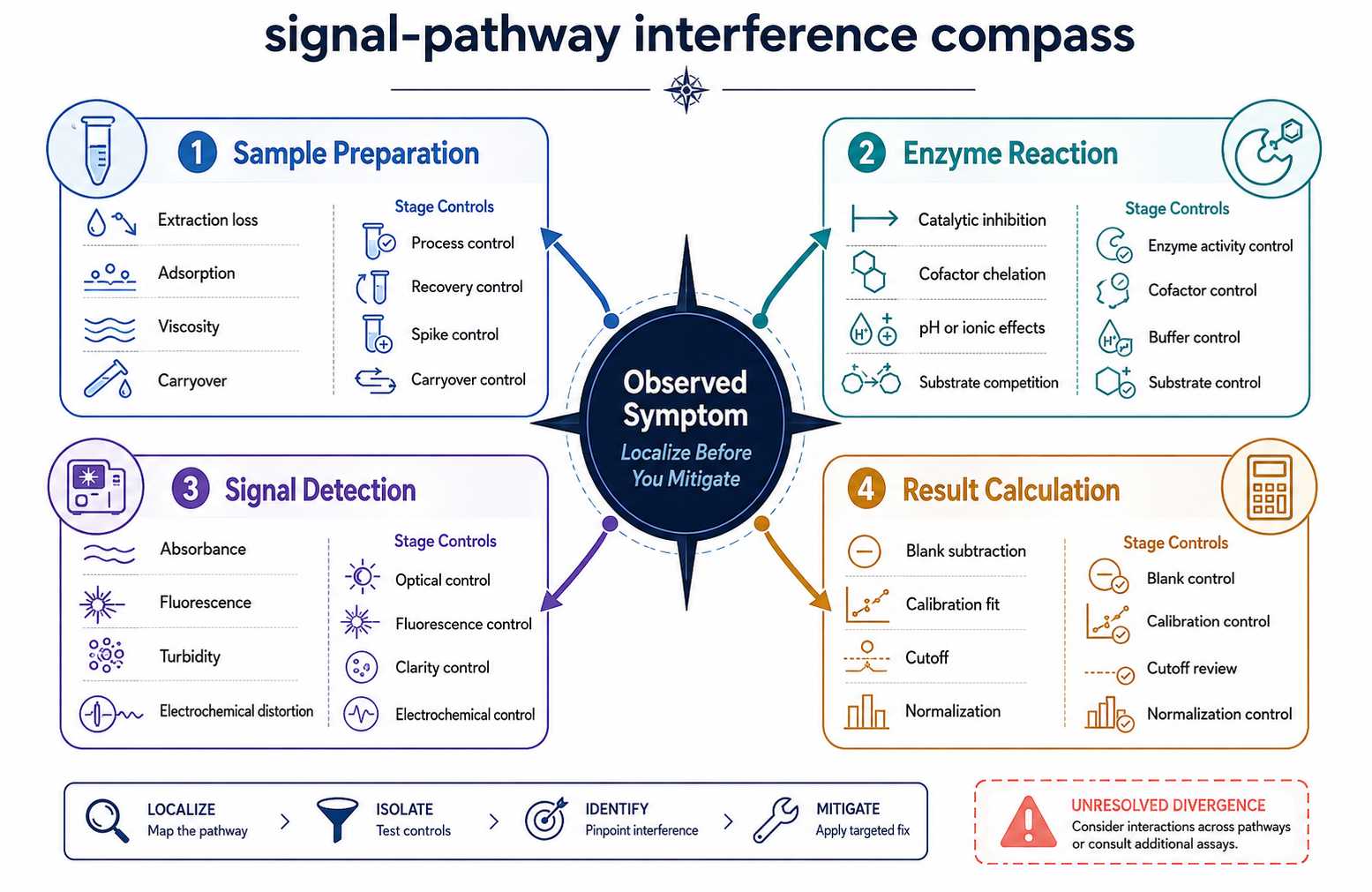 Fig 1. Signal-pathway interference compass. A visible assay shift can originate before the enzyme reaction, within it, at signal detection or during result calculation.
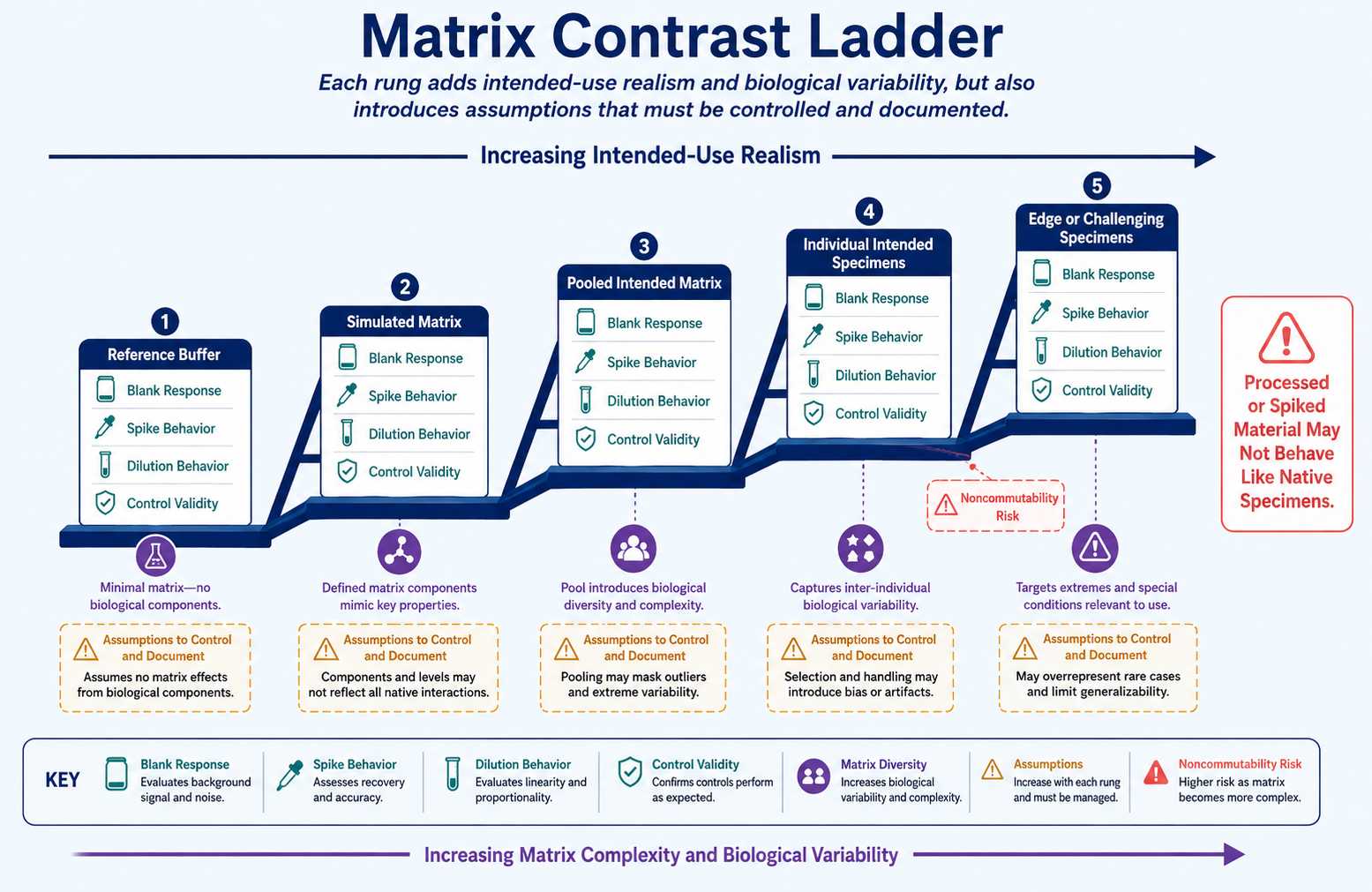 Fig 2. Matrix contrast ladder. Each rung adds intended-use realism and biological variability, but also introduces assumptions that must be controlled and documented.
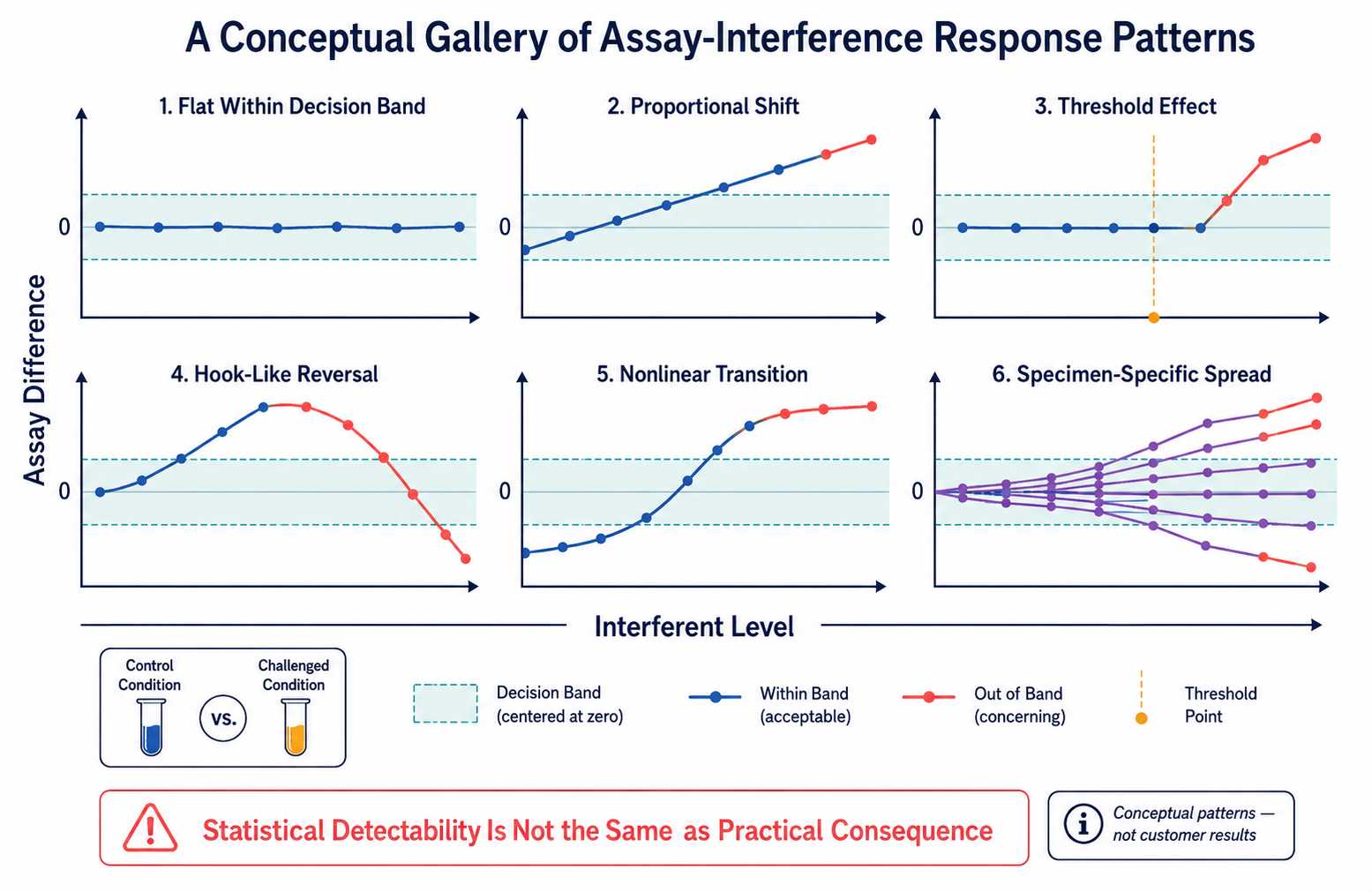 Fig 3. Interference response fingerprints. Concentration series can distinguish no decision-relevant effect from proportional bias, thresholds, hook-like behavior, nonlinearity and specimen-specific variation.
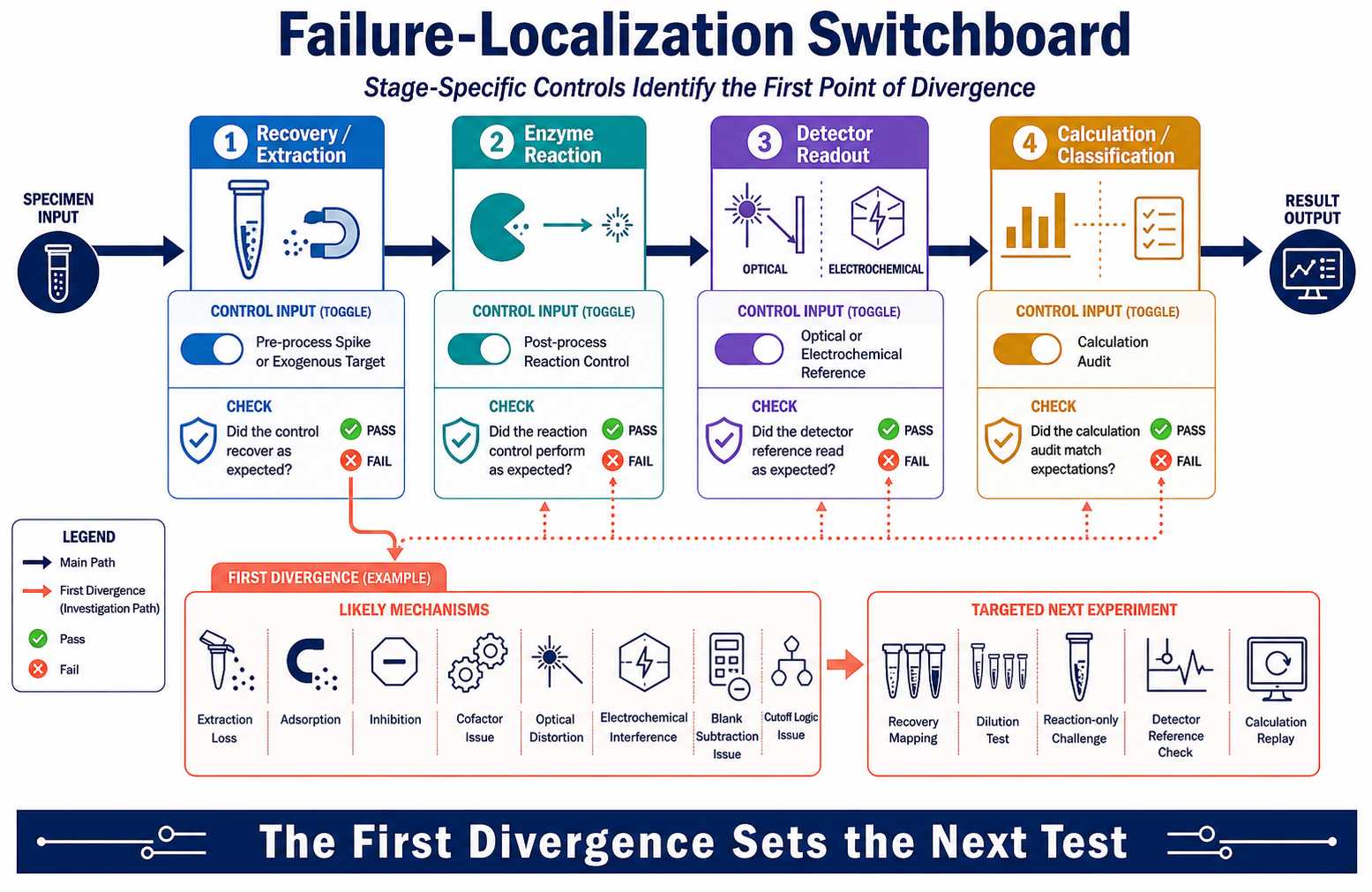 Fig 4. Failure-localization switchboard. Stage-specific controls identify the first point of divergence and prevent downstream signal loss from being assigned automatically to the enzyme.
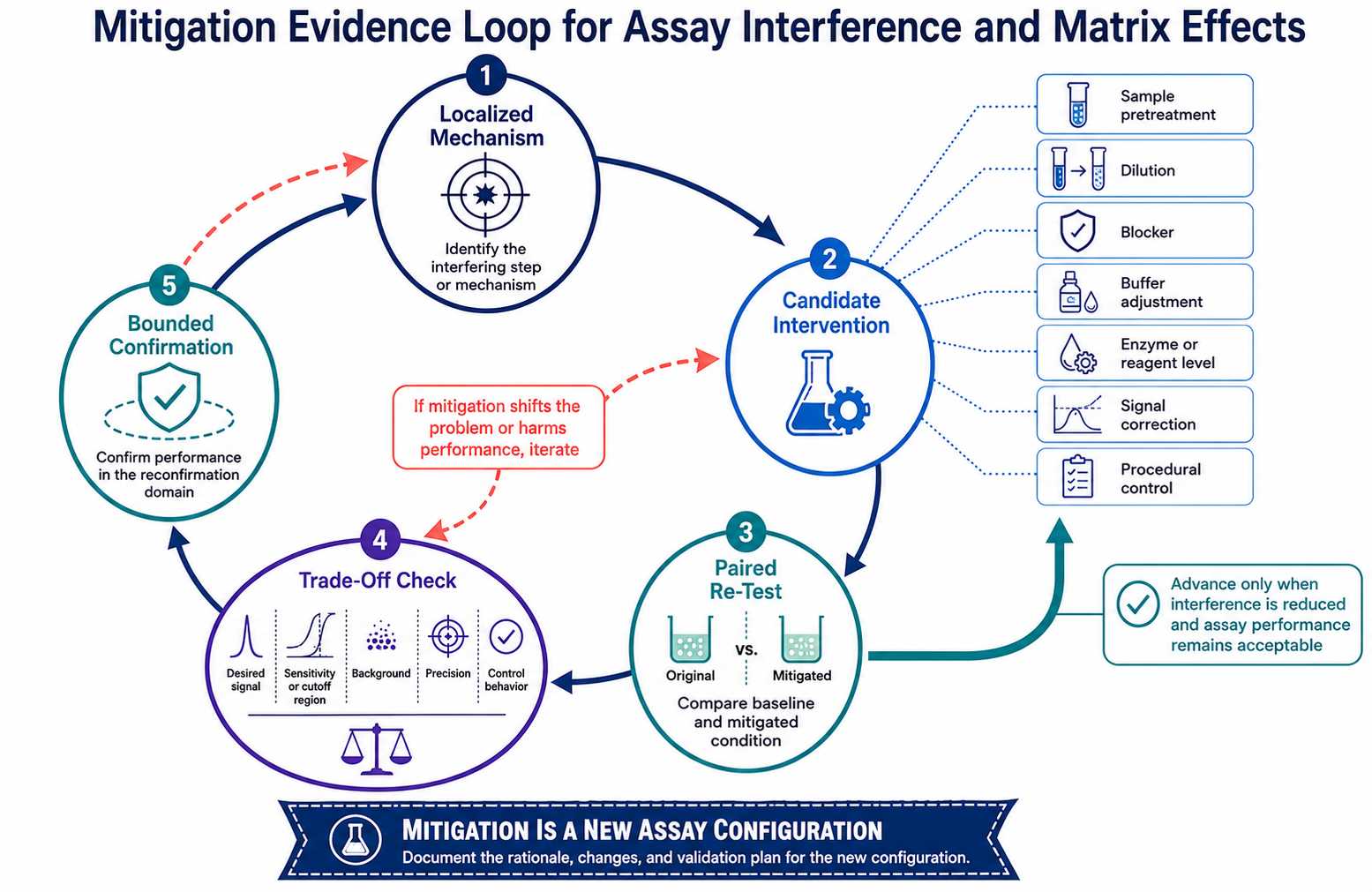 Fig 5. Mitigation evidence loop. A corrective action is accepted only after the identified effect improves and decision-relevant performance remains acceptable across the reconfirmation domain.