Residual Host Cell Protein, DNA and Endotoxin Testing Support
Residual Host Cell Protein, DNA and Endotoxin Testing Support
Diagnostic enzyme process-residual control
Make Each Residual Result Defensible—not Merely Detectable
Residual host cell protein (HCP), host-cell DNA and endotoxin are often grouped under “purity,” but they are not one analytical problem. They arise differently, respond to different methods and fail for different reasons in concentrated or formulated enzyme samples. Creative Enzymes configures testing around the host, process stage, sample matrix and decision you need to make, then documents the controls that show whether the reported signal is trustworthy.
HCP questionWhich proteins remain?
Measure a heterogeneous population, assess immunoassay coverage where relevant and identify persistent proteins when total HCP alone is insufficient.
DNA questionWas host DNA recovered?
Connect extraction, host-specific amplification, inhibition control and the stated reporting basis before interpreting a low result.
Endotoxin questionDoes the matrix distort response?
Use dilution and positive product control evidence to evaluate inhibition or enhancement for the selected reagent system.
Start with the decision, not a test name. A development team locating a clearance failure, a QC group qualifying incoming enzyme, and a reagent manufacturer building a release specification may all request “HCP testing,” yet they need different samples, controls, reporting bases and levels of method qualification. We define the decision and tested configuration before selecting the analytical route.
Three Residuals Have Three Analytical Identities
Residuals originate upstream but become visible—or remain hidden—through the interaction of purification, formulation and analytical method. Treating them as three entries in a generic menu can produce numbers that look comparable while answering different questions. Our first task is to build a residual “passport”: what is being measured, where it came from, why it matters to the intended diagnostic reagent and what evidence makes the result interpretable.
P
Host Cell Protein
A changing population of host-derived proteins rather than a single analyte. Abundance, immunoreactivity, physicochemical behavior and interactions with the target enzyme can all affect detection and clearance.
Primary question
Total population, individual identity, or both?
Typical blind spot
Weakly immunoreactive proteins, limited antibody coverage or a persistent low-abundance protein.
Process meaning
Co-purification, product association, polishing performance or process drift.
D
Host-Cell DNA
Fragments of the production host genome carried through the process. The analytical result depends on DNA recovery, target sequence, fragment state and whether sample components inhibit amplification.
Primary question
How much recoverable host DNA is present on the agreed basis?
Typical blind spot
Low extraction recovery or PCR inhibition interpreted as absence.
Process meaning
Cell disruption burden, nuclease treatment, clarification or downstream clearance.
E
Endotoxin
Biologically active lipopolysaccharide from Gram-negative bacteria measured through a response system. Buffer composition, protein concentration, surfactants, chelators and other components can suppress or enhance that response.
Primary question
Can the selected BET route quantify endotoxin in this material?
Typical blind spot
Failed positive product control, unsuitable dilution or an assumed universal limit.
Process meaning
Water, raw-material, equipment or bioburden-related process control and clearance.
Fig 1. Three residual passports for diagnostic-enzyme materials. HCP, host DNA and endotoxin share a process origin but require different analytical objects, controls and interpretation. (Creative Enzymes Diagnostic)
Define the Sample Before Defining the Assay
A residual result belongs to a physical sample, not to an enzyme name in the abstract. An in-process pool can contain concentrations and interferents that disappear after polishing. A purified enzyme may later be diluted into glycerol, salts, detergents, preservatives or a master mix that changes method behavior. A lyophilized pellet also needs a defined reconstitution procedure. We record the stage, formulation, protein or activity concentration, storage history, available volume and intended denominator before feasibility work begins.
Match sampling to the decision
Clearance question: collect stage-matched in-process samples across a purification sequence.
Qualification question: test the exact incoming or final-bulk configuration used by the diagnostic-reagent team.
Release question: define a controlled sampling point and configuration that can be reproduced routinely.
Species or cell line, intracellular or secreted expression, lysis conditions and relevant raw materials.
2
Manufacturing stage
Harvest, clarified feed, capture pool, intermediate, polished bulk, formulated bulk or final research reagent.
3
Physical configuration
Liquid, frozen, lyophilized, air-dried, bead or pellet; reconstitution and sampling instructions.
4
Reporting denominator
Per millilitre, milligram of total protein, defined activity unit, reaction unit, device or other agreed basis.
5
Decision context
Process development, supplier qualification, investigation, trend monitoring, specification development or release support.
When the question is broad molecular purity rather than these targeted residuals, we route the work to diagnostic enzyme purity analysis. When a process change or new lot must be compared with a reference, the residual values can become part of a batch-to-batch consistency validation panel.
Select a Method Route from the Information Needed
Platform selection is not a contest in which the most complex instrument always wins. A high-throughput immunoassay may be the correct HCP tool for process monitoring, while LC–MS/MS may be needed to identify a persistent protein. qPCR may be appropriate for a defined host sequence, while dPCR can be useful for partition-based quantification or particular calibration questions. LAL-based and recombinant-reagent endotoxin routes each require evidence that the product matrix permits the intended measurement. We recommend a route only after considering expected range, sample volume, matrix, turnaround needs, method maturity and required decision confidence.
HCP route
Population measurement and identity
ImmunoassayEfficient total-HCP monitoring when host/process relevance, antibody coverage and sample behavior are adequate.
LC–MS/MSOrthogonal identification and, with a suitable strategy, quantification of individual proteins.
Decision triggerUse one or both depending on process stage, coverage risk and whether an individual HCP matters.
DNA route
Recovery plus amplification
qPCRHost-targeted quantification using an appropriate standard curve, controls and defined extraction workflow.
dPCRPartition-based measurement that may support specific sensitivity, calibration or robustness needs.
Decision triggerPlatform choice never removes the need to prove extraction recovery and control inhibition.
Endotoxin route
Biological-response suitability
LAL-based BETGel-clot or photometric/kinetic formats selected according to the project and material.
Recombinant reagentsrFC or recombinant cascade options considered with supplier validation and material-specific suitability.
Decision triggerDilution, positive product control and applicable decision limit determine the workable test conditions.
Fig 2. Method-fitness triptych. The primary and orthogonal route is selected from the analytical question, matrix and decision—not from the analyte name alone. (Creative Enzymes Diagnostic)
Make the Matrix Reveal Whether the Number Is Real
A low residual value can mean low residual content, but it can also mean poor recovery, inaccessible epitopes, amplification inhibition or suppressed endotoxin response. Conversely, nonspecific binding, contamination or enhancement can inflate a result. Method-suitability evidence is the bridge between the instrument output and a defensible report. The exact acceptance logic is defined for the method and project; the diagram below shows the evidence roles rather than universal limits.
The matrix truth test
Native sample
Measures the apparent residual under the selected preparation, dilution and analytical conditions.
Spiked sample
Tests whether a known addition can be recovered in the presence of the enzyme matrix.
Dilution series
Reveals nonparallel behavior, changing recovery, hook effects or relief from inhibition.
Process blank
Separates sample-derived signal from buffer, consumable, reagent or handling contamination.
System controls
Confirm standards, negative controls, extraction controls, reaction controls and run validity.
Reportable result = measured response + demonstrated sample recovery + valid controls + stated calculation and normalization basis
Suitability may require adjustment of dilution, extraction chemistry, blocking conditions, sample load, plate conditions or reagent system. A change is not accepted merely because it produces the desired value; it must preserve the analytical question and remain documented. If no workable condition is established, the outcome is a method limitation or development requirement—not a fabricated “pass.”
Fig 3. Matrix truth test. A residual result becomes reportable only when native response is interpreted with recovery, dilution behavior, blanks and system controls. (Creative Enzymes Diagnostic)
Three Analytical Workbenches, Configured Independently
The modules below show how we translate each residual into a project plan. They are configurable and can be commissioned separately. We do not assume that every diagnostic enzyme needs all methods or that every project needs a fully mature release procedure on day one.
HCPHost Cell Protein: Total Population, Coverage and Persistent Identities
A total-HCP immunoassay is useful only to the extent that its antibodies recognize relevant proteins and the sample permits binding and detection. Early in development, a generic or platform assay may provide efficient process trending. As the process and expression system mature, coverage assessment, process-specific reagents or orthogonal LC–MS/MS can become relevant. We evaluate what the sponsor needs to learn before recommending that additional complexity.
Question
Evidence route
Controls and checks
Interpretation boundary
How does total HCP change across purification?
Suitable total-HCP immunoassay across stage-matched samples and dilutions
Standard curve, blanks, spike recovery, dilutional parallelism and sample-specific range
Result reflects immunoreactive HCPs recognized under the assay conditions
Does the antibody population cover relevant process proteins?
Coverage assessment using representative host/process material; orthogonal evidence where appropriate
Representative antigen source, negative/isotype controls and documented comparison basis
A percentage or image alone does not prove that every consequential HCP is detected
Which HCP persists after polishing?
Discovery or targeted LC–MS/MS, potentially alongside ELISA
Process blanks, digestion/QC controls, database definition and identification criteria
Identification and quantification depend on sample preparation, dynamic range and method sensitivity
Could a residual protein affect stability or function?
Targeted follow-up and application-linked testing
Appropriate controls and orthogonal confirmation
Detection alone does not prove causality; connect with activity, stability or interference evidence
We report whether the HCP result is a total immunoreactive estimate, an individual-protein identification, a targeted quantity or a process trend. We avoid implying that a single ELISA number describes the entire residual proteome. When time-dependent loss is suspected, the study can connect with diagnostic enzyme stability and shelf-life testing.
DNAResidual Host-Cell DNA: Extraction, Host Target and Inhibition Control
Residual-DNA analysis begins before amplification. Concentrated proteins, salts, detergents, chelators, glycerol and formulation components can change lysis, binding, wash, elution or amplification. We therefore treat sample preparation and qPCR or dPCR as one measurement procedure. The host, target sequence, standard or reference material, expected fragment context and reporting denominator are defined in the method record.
Method element
Development question
Evidence to retain
Common failure interpretation
Extraction
Does the workflow recover DNA from this enzyme matrix over the relevant range?
Matrix spike recovery, extraction blank, volume and concentration factors
A low native value with poor recovery is inconclusive
Host-specific target
Is the sequence appropriate for the host and residual-DNA question?
Primer/probe rationale, specificity checks and reference material identity
A mismatched or unrepresentative target can bias the estimate
Amplification
Does the extract inhibit or alter the measurement?
Internal amplification or inhibition control, dilution behavior and run controls
Delayed or failed control response indicates that the native result needs investigation
Calibration and range
Can the procedure support the required reporting interval?
Curve or partition performance, replicates, blank behavior and stated limits
“Detected” and “quantified” are not interchangeable
Normalization
What denominator makes the result usable?
Protein/activity concentration, sample mass or volume, dilution factors and calculation record
Values on different bases should not be compared directly
qPCR and dPCR answer related but not identical measurement questions. dPCR can reduce dependence on an external calibration curve in the amplification stage, but it does not eliminate extraction loss, target selection, contamination control or matrix inhibition. Method choice remains conditional on the sample and decision.
BETEndotoxin: Reagent Route, Dilution and Inhibition/Enhancement
Endotoxin methods measure a biological response to endotoxin rather than direct lipopolysaccharide mass. The appropriate route may use an established LAL-based BET format or recombinant reagents such as rFC or a recombinant cascade. Current USP and FDA materials recognize recombinant options while retaining the requirement to verify suitability for the intended material and conditions of use.
Design item
What we establish
Why it matters
Applicable decision limit
Sponsor-defined, intended-use and jurisdiction-aware requirement where applicable
Maximum valid dilution and reporting logic cannot be set without the relevant limit and sample basis
Reagent and format
Gel-clot, photometric/kinetic LAL-based or recombinant-reagent route as appropriate
Different response systems and supplier packages require route-specific verification
Sample dilution
A working dilution that reduces interference while retaining required sensitivity
Over-dilution can make the test unable to support the decision; under-dilution may suppress or enhance response
Positive product control
Recovery of a defined endotoxin spike in the test sample
Demonstrates whether the product matrix inhibits or enhances the response under test conditions
Interference risks
Potential effects of formulation components and, when relevant, glucan-sensitive pathways
Unexpected response patterns need method-specific investigation rather than automatic acceptance
Units and calculation
EU result, dilution factors, denominator and reporting limit
Endotoxin units should not be treated as a universal mass conversion
For RUO diagnostic-enzyme raw materials, a parenteral drug-product limit does not automatically apply. We ask what the enzyme will enter, whether an internal requirement already exists, whether the project is developmental or routine, and which party owns the final specification. The resulting report identifies the tested conditions and does not convert analytical support into an unqualified regulatory claim.
Trace the Residual Back to the Process
An endpoint value tells you what was found in one sample; it does not explain how the process got there. For process development or investigation, stage-matched sampling can reveal whether a residual is cleared as expected, plateaus, reappears or becomes difficult to measure after formulation. The map should be tailored to the actual enzyme expression and purification process rather than copied from a biologics template.
Harvest / lysate
Establish the initial burden, host context and sample dilution needs.
Clarification / capture
Track early removal and identify high-matrix conditions that challenge the method.
Intermediate step
Compare clearance direction with step purpose and recovery of the target enzyme.
Polishing / bulk
Look for persistent HCP, recoverable host DNA or endotoxin introduced or retained downstream.
Formulated reagent
Confirm that formulation does not mask the residual and report the final use-relevant basis.
Clearance is a pattern, not one reduction factor. Valid comparisons require suitable results at both stages, documented volume or concentration changes and an agreed calculation basis. A result below quantification may support a bounded estimate, but it should not be substituted with zero. If the analytical method changes across stages, bridging evidence may be needed before claiming a process trend.
Fig 4. Process-clearance river. Stage-matched testing connects the final residual result to removal, persistence, reintroduction or analytical masking across the production process. (Creative Enzymes Diagnostic)
How We Resolve Results That Do Not Agree
Discordant data are often the most informative part of a project. We do not average incompatible results or select the preferred number. Instead, we examine what each method actually measures, whether its controls passed and whether the sample was tested on the same basis.
Low native result + poor spike recovery
Treat the result as matrix-limited. Adjust preparation or dilution, evaluate an alternative route, and repeat suitability before interpreting content.
Review antibody coverage, protein identity, method sensitivity and whether the proteins are immunoreactive. The methods may be complementary rather than contradictory.
DNA result changes after sample dilution
Investigate extraction and amplification inhibition, target behavior and calculation factors. Select a reportable condition within the qualified range.
Endotoxin positive product control fails
Do not report the native result as a clean pass. Evaluate permitted dilution, formulation effects, reagent route and the sensitivity required by the project limit.
Do not assume causality. Examine activity, stability, unintended enzyme activities and downstream matrix effects using the appropriate linked service.
A Project Is Built Around an Evidence Question
Creative Enzymes can support a focused one-analyte investigation or a coordinated three-residual package. The scope is staged so that feasibility and suitability are established before unnecessary sample is consumed or routine testing is promised.
01Question lock
Define the analyte, sample stage, intended use and decision.
02Matrix dossier
Review host, process, formulation, concentration and available volume.
03Route selection
Choose primary and optional orthogonal methods with control logic.
04Feasibility
Find workable preparation, dilution, range and recovery conditions.
05Controlled study
Test samples, stages or lots under the agreed procedure.
06Decision transfer
Report limitations and recommend investigation, trending or release next steps.
Where an existing method is already available, we can assess transfer readiness and identify matrix-specific gaps. Where no suitable method exists, the work can continue through custom analytical method development and qualification. The depth of qualification is matched to use: exploratory process work, a comparability study and routine batch release do not require identical evidence packages.
Inputs We Request and Deliverables You Can Use
Useful sponsor inputs
Production host or cell line and relevant genomic reference information
Expression location, lysis and clarification description
Purification and formulation-stage map
Exact sample composition, concentration, configuration and storage history
Available volume and allowable preparation or dilution
Expected residual range or historical data, if available
Existing methods, kit information, standards and control records
Intended reporting basis and any sponsor-defined alert or acceptance criteria
Decision to support: development, investigation, qualification, trending or release
Downstream assay and known interference concerns
Configurable project outputs
Method-selection and sample-preparation rationale
Feasibility or suitability data, including applicable recovery and dilution evidence
Analyte results with units, calculation basis and stated reporting limits
Run-control summary and documented exceptions or deviations
Stage-to-stage clearance or lot-comparison tables where scoped
HCP identity or coverage evidence when an orthogonal module is commissioned
Residual-DNA extraction and inhibition-control record
Endotoxin positive product control and suitability record
Interpretation tied to the tested samples and decision question
Recommendations for method refinement, process investigation or ongoing control
A deliverable can support subsequent CoA specification and release testing package development, but the sponsor remains responsible for final product requirements, release decisions and regulatory use. We clearly distinguish exploratory, qualified and routine-control data in the report.
Application Patterns for Diagnostic-Enzyme Programs
Recombinant PCR and amplification enzymes
Host DNA may be especially important when the downstream workflow amplifies nucleic acid. The host target, extraction blank and control for amplification inhibition need explicit attention.
NGS workflow enzymes
Residual nucleic acid and proteins may affect sensitive library-preparation systems. Detection alone should be separated from demonstrated workflow interference.
Biochemical diagnostic enzymes
HCPs with unwanted catalytic activity or stability effects may matter more than a generic total-protein number. Functional follow-up can use activity and kinetic characterization.
Enzyme-antibody conjugate components
Residual proteins or endotoxin may behave differently after conjugation or formulation. Test the relevant stage and avoid extrapolating from unconjugated bulk without evidence.
POCT and dried reagent formats
Reconstitution, low sample volume and concentrated excipients can alter recovery. Define the extraction or reconstitution procedure as part of the tested configuration.
Industrial diagnostic raw materials
Specifications should be linked to process capability and the customer's use—not imported automatically from therapeutic products with a different exposure route.
Creative Enzymes also supports enzymes production and engineering and provides molecular diagnostic enzymes and kits. When testing reveals a persistent process-related residual, analytical evidence can be discussed alongside process and purification options without assuming that testing alone solves the manufacturing cause.
Every Conclusion Retains Its Evidence Chain
A useful result must remain auditable after it leaves the analytical bench. Our residual decision record connects the reported value with method fitness, sample identity and the action it supports. This prevents a development result from being reused later as though it were a routine release method without bridging work.
IdentitySample, stage, lot, configuration and reporting denominator
Method fitnessPreparation, dilution, recovery, controls and applicable range
ResultValue or bounded statement with units, limits and exceptions
DecisionProcess action, follow-up, trend use or transfer recommendation
Fig 5. Residual decision record. Each HCP, DNA or endotoxin conclusion remains linked to sample identity, suitability evidence, reporting limits and the action it is qualified to support. (Creative Enzymes Diagnostic)
Frequently Asked Questions
1. Can you test HCP, host-cell DNA and endotoxin as one package?
Yes, they can be coordinated under one project, but each analyte retains its own sample-preparation, control, suitability and reporting logic. We first confirm that the available volume and configuration can support the proposed modules. A combined report can align sample identities and process-stage interpretation without pretending that the three methods share one acceptance rule.
2. Is there one acceptable HCP, DNA or endotoxin limit for every diagnostic enzyme?
No. A meaningful limit depends on intended use, material stage, analytical capability, process knowledge, downstream risk and any applicable sponsor or jurisdictional requirement. Therapeutic or parenteral limits should not be imported automatically into an RUO diagnostic raw material. We can generate evidence to support limit development, but the sponsor or legal manufacturer owns the final specification.
3. When should we use HCP ELISA versus LC–MS/MS?
ELISA is often efficient for total-HCP process monitoring when its antibodies and range are suitable. LC–MS/MS can identify individual proteins and provide evidence independent of immunoreactivity, which may help with persistent HCPs, coverage gaps or process investigations. Some projects benefit from both. The choice depends on the question, development stage, matrix, expected abundance and required sensitivity.
4. Does a low HCP ELISA result prove that no host proteins remain?
No. It supports a statement about proteins recognized and measured under that assay's conditions. Antibody coverage, epitope accessibility, sample dilution and matrix effects matter. We report the method boundary and may recommend coverage assessment or orthogonal MS when the residual-protein risk cannot be addressed by total immunoreactivity alone.
5. Why is DNA extraction part of the quantitative method?
The amplification instrument measures target copies in the recovered extract, not all DNA originally present in the enzyme sample. If recovery is low or variable, the final result can be biased. Matrix spike recovery, extraction blanks, volume factors and inhibition controls show whether the workflow supports the intended quantitative statement.
6. Is dPCR automatically better than qPCR for residual host-cell DNA?
No. dPCR can be useful for particular sensitivity, calibration or partition-based measurement needs, while qPCR remains suitable for many host-specific assays. Neither platform eliminates sample-extraction losses, target-selection issues or inhibition. We choose the platform after defining the reporting need and demonstrating performance in the sample matrix.
7. Can you use recombinant Factor C for endotoxin testing?
Recombinant reagents can be considered. USP General Chapter <86> describes rFC and recombinant cascade approaches, and FDA's March 2026 guidance update accommodates recombinant reagents. The supplier's validation package and material-specific suitability still need review. We do not claim that recognition of a method makes it suitable for every enzyme formulation.
8. What happens if the endotoxin spike recovery fails?
The native result is not treated as an unqualified pass. We examine dilution, sample concentration, formulation components, selected reagent route, working range and the sensitivity needed for the applicable decision limit. If a suitable condition cannot be established, we document the limitation and propose method development or an alternative route.
9. Can you calculate process clearance from in-process samples?
Yes, when the stages are defined, results are suitable at each stage and the volume or concentration changes needed for the calculation are available. Values below quantification require bounded treatment rather than substitution with zero. If different methods or sample preparations are used across stages, bridging may be required before interpreting the trend.
10. What does “below the limit of quantification” mean?
It means the procedure did not support a reliable numerical quantity below the stated level under the tested conditions. It does not mean the analyte is absent. The report distinguishes not detected, detected but not quantified and quantified results as supported by method definitions, blanks and controls.
11. Can residual testing explain a downstream assay failure?
It can identify a plausible residual and establish its level, but detection alone does not prove that it caused the failure. Where causality matters, we can connect the finding to targeted activity, stability or matrix/interference testing with appropriate controls and concentration levels.
12. Can the method become a routine release test?
Potentially. A development method must first show that it is suitable, sufficiently robust and transferable for the intended routine use. The required qualification, controls, system suitability, reference materials, documentation and change management are scoped separately. Our CoA and release-package development service can support that transition.
Use and responsibility boundary: Creative Enzymes provides configurable analytical development and testing support for research-use and industrial diagnostic raw-material programs. Project evidence is limited to the tested samples, configurations, methods, conditions and decision criteria. The sponsor or legal manufacturer remains responsible for intended-use claims, final specifications, clinical validation, product release, regulatory submissions, registrations and market authorization. This service is not intended for personal treatment, self-testing, direct administration or human consumption.
Bring Us the Sample Context, Not Just the Test Name
To scope a residual-testing project, send the production host, sample stage and formulation, available volume, expected range, intended reporting basis and the decision the data must support. We will use that information to propose an analyte-specific route, suitability controls and a report structure that remains honest about what the data can—and cannot—conclude.


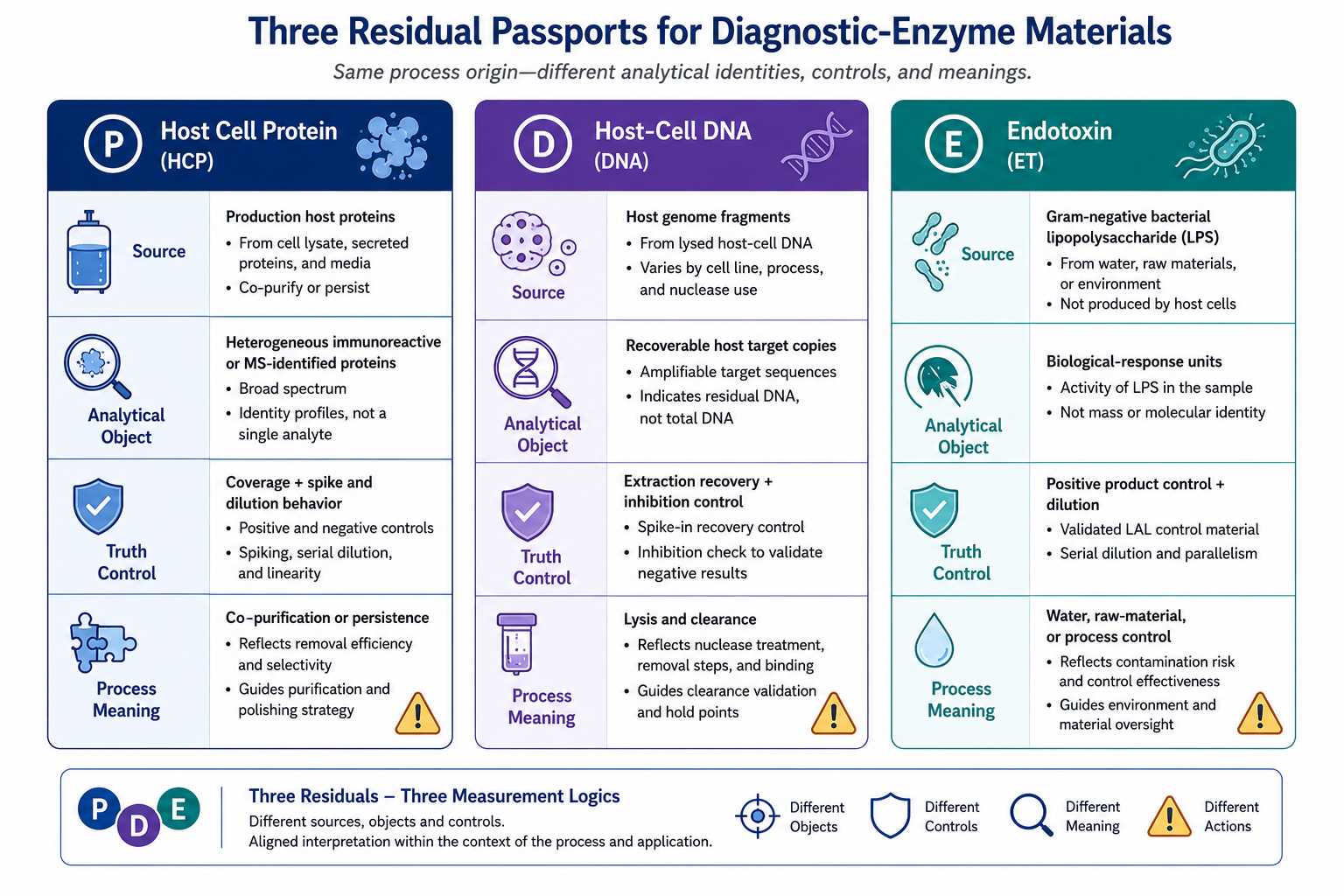 Fig 1. Three residual passports for diagnostic-enzyme materials. HCP, host DNA and endotoxin share a process origin but require different analytical objects, controls and interpretation.
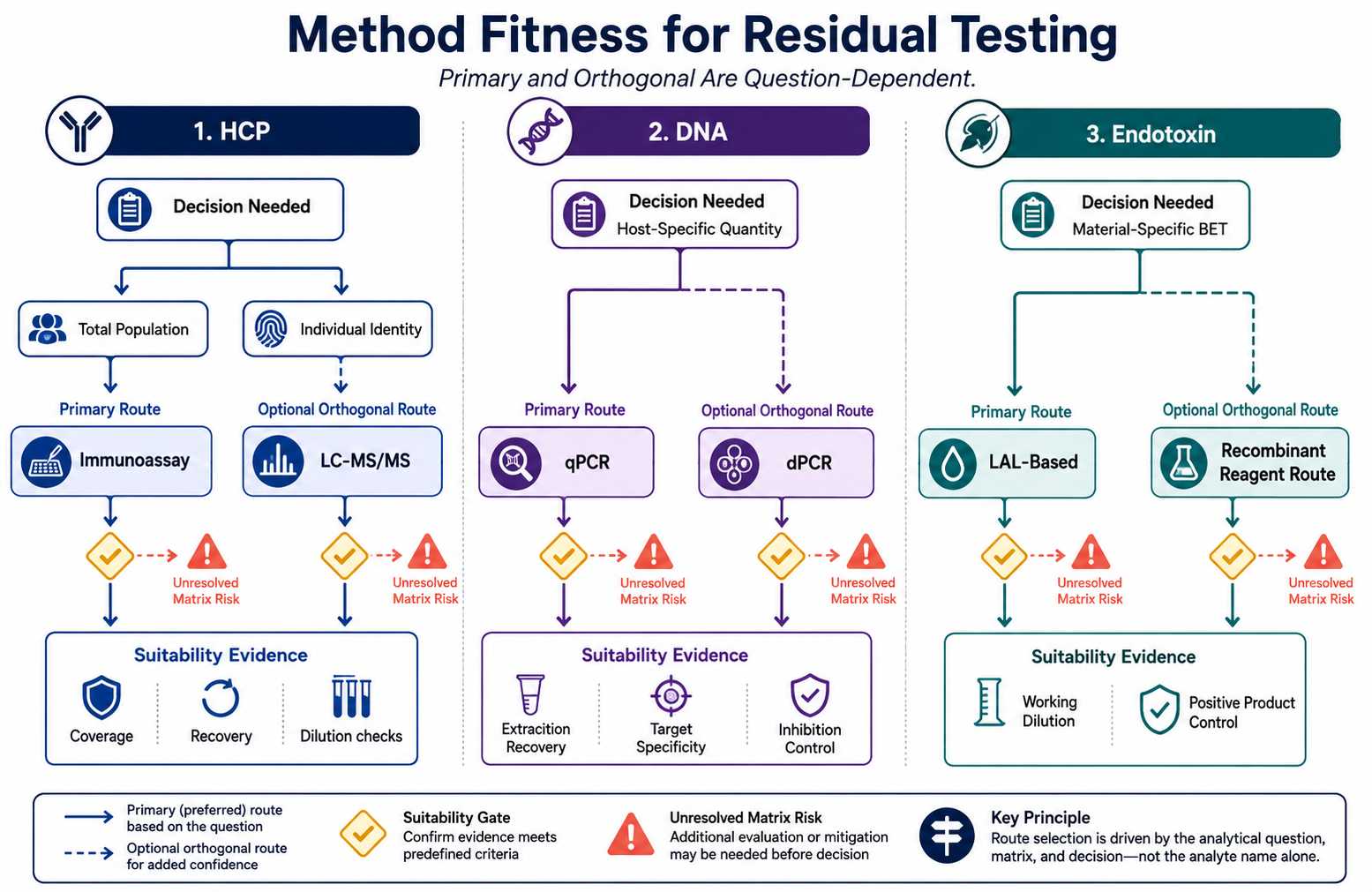 Fig 2. Method-fitness triptych. The primary and orthogonal route is selected from the analytical question, matrix and decision—not from the analyte name alone.
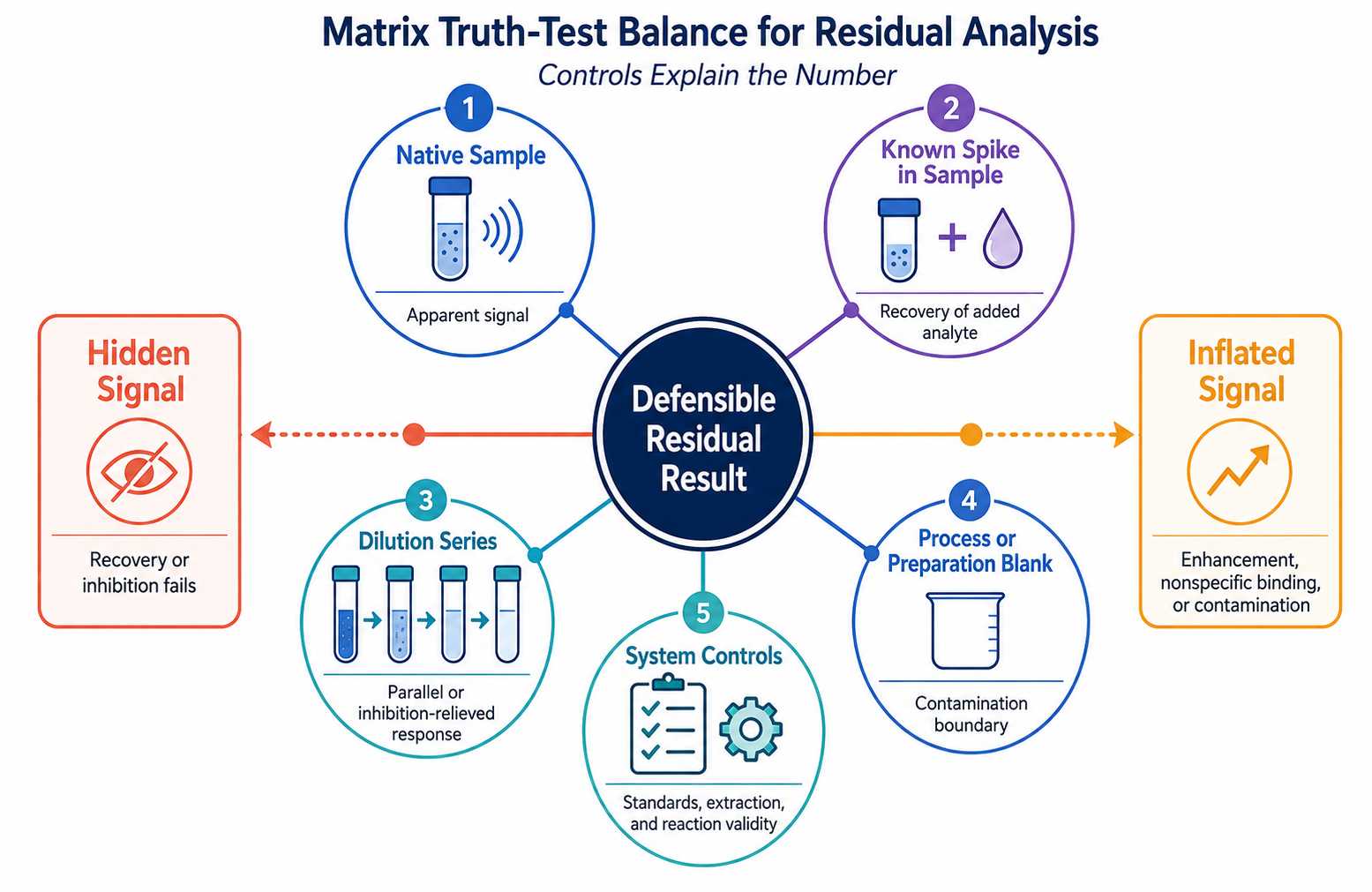 Fig 3. Matrix truth test. A residual result becomes reportable only when native response is interpreted with recovery, dilution behavior, blanks and system controls.
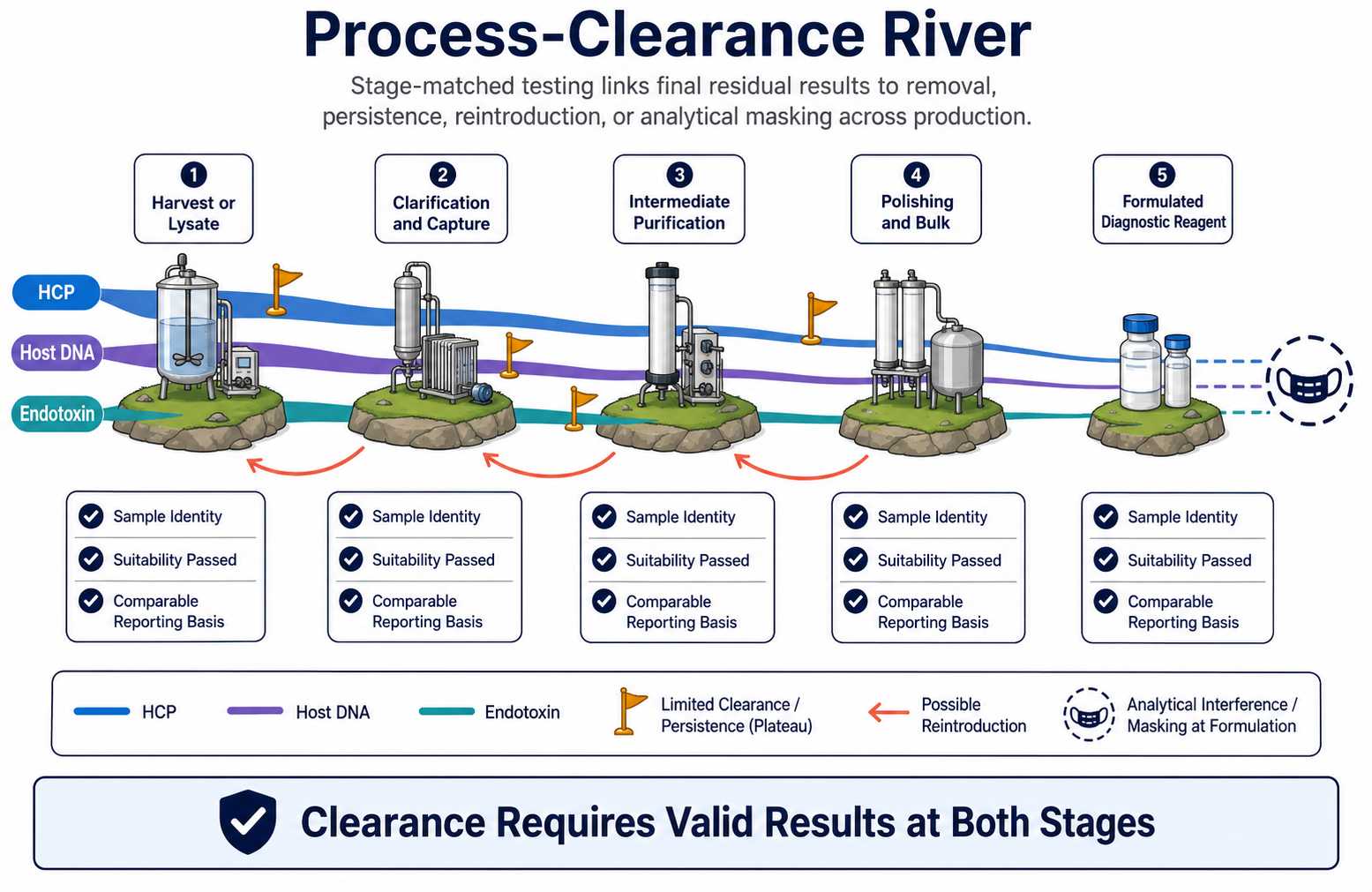 Fig 4. Process-clearance river. Stage-matched testing connects the final residual result to removal, persistence, reintroduction or analytical masking across the production process.
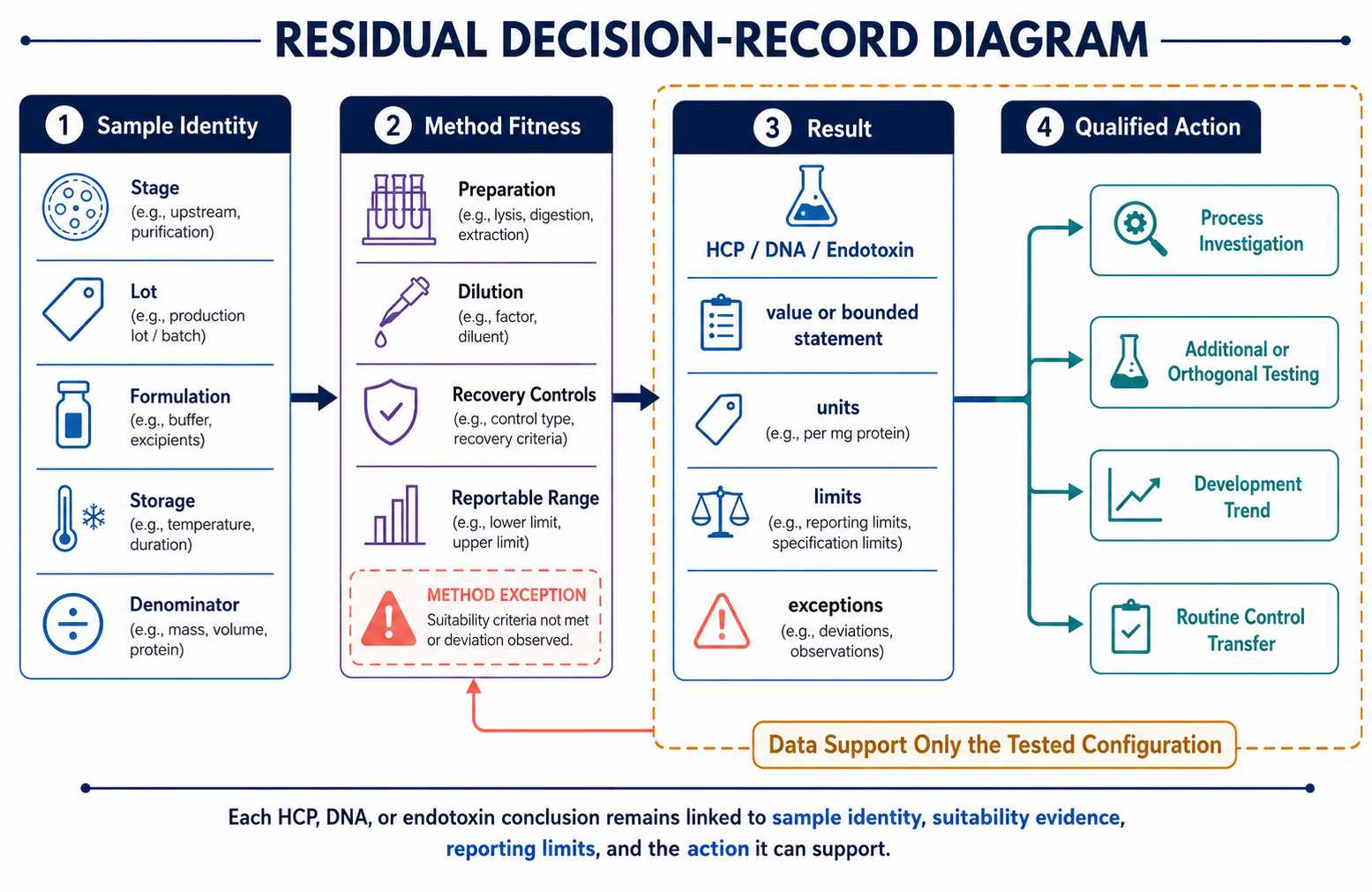 Fig 5. Residual decision record. Each HCP, DNA or endotoxin conclusion remains linked to sample identity, suitability evidence, reporting limits and the action it is qualified to support.