
A strong expression band is not a manufacturability result. The relevant output is reproducible, recoverable, application-compatible enzyme activity from a defined construct and process.
Creative Enzymes provides AI-guided and experiment-led support for diagnostic enzyme expression, solubility, active-fraction recovery, purification, and scale readiness. A program can investigate the nucleotide sequence, construct architecture, host and cellular compartment, vector, culture and induction conditions, harvest, lysis, purification, concentration, formulation interface, and scale-dependent behavior. Most outputs are intended for research use. Selected projects may support industrial diagnostic reagent raw-material development under an agreed scope; an optimized clone or process is not a finished diagnostic product and does not establish regulatory authorization.
Expression optimization often begins with a misleading objective: make more protein. More total protein can be useful, but it can also increase inclusion bodies, overload folding machinery, amplify proteolysis, reduce host fitness, create heterogeneous material, or produce a large mass of soluble but inactive enzyme. A manufacturing-oriented program therefore starts by defining the output that matters for the diagnostic application and by stating how each intermediate yield will be measured.
For a polymerase, reverse transcriptase, ligase, nuclease, Cas effector, reporter enzyme, or sample-processing enzyme, the most useful metric may be recovered active units per culture volume, active enzyme concentration after purification, specific activity after formulation transfer, or useful reaction capacity per batch. The denominator matters. Milligrams per liter, units per milligram, percent soluble, percent monomer, step recovery, and application signal answer different questions. No one metric should silently substitute for another.
The target profile identifies the exact enzyme sequence or allowed sequence space, required molecular activity, intended assay, host or source restrictions, tag status, cofactor or modification needs, material format, anticipated concentration, application buffer, storage interface, contaminant risks, scale objective, and evidence needed for the next decision. A protein used as an upstream manufacturing tool may tolerate a removable tag or a broader residual profile than an enzyme added directly to a one-pot molecular diagnostic mix. A nuclease used in NGS processing may require a different contamination-control strategy from a chromogenic reporter enzyme used in a biochemical assay.
Before proposing mutations or changing hosts, we reconstruct where material and activity are lost. The chain begins with the sequence-confirmed construct and continues through culture, harvest, fractionation, purification, concentration, storage, and application-buffer transfer. At each step, mass and activity are measured with methods appropriate to the decision. A loss map prevents the project from treating unrelated phenotypes as one problem.
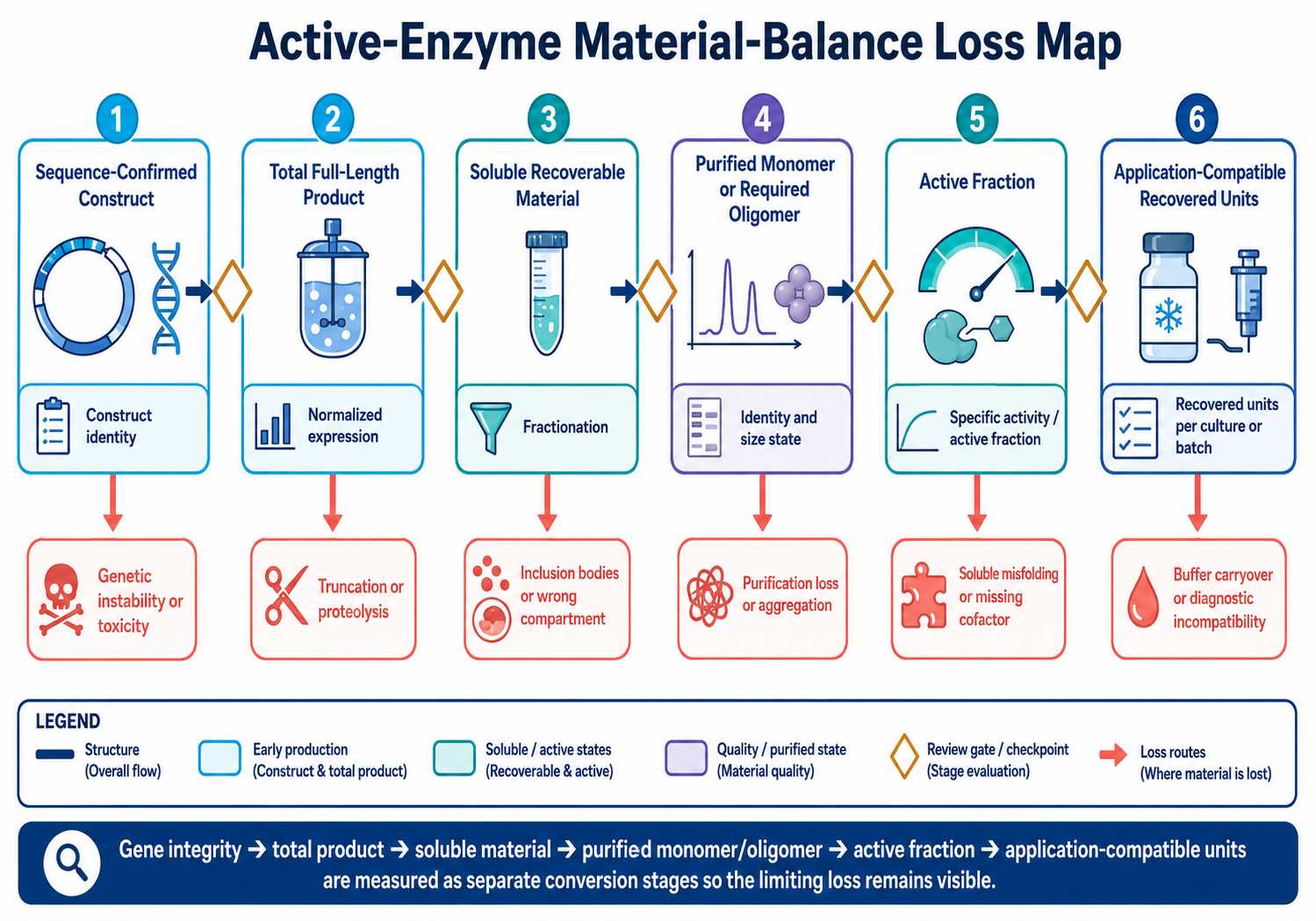 Fig 1. Active-enzyme material-balance loss map. Gene integrity, total product, soluble material, purified monomer, active fraction, and application-compatible units are measured as separate conversion stages so the limiting loss remains visible.
(Creative Enzymes Diagnostic)
A gel band can estimate an apparent molecular species but may not establish identity, intactness, concentration, oligomeric state, or activity. Soluble-fraction measurements can be distorted by incomplete lysis, inconsistent centrifugation, viscosity, retained membranes, or precipitation during sample handling. Protein concentration can include inactive target, host proteins, nucleic acids, fusion partners, or degradation products. The measurement plan is therefore proportional to the claim.
| Question | Useful evidence | Common interpretation error | Decision enabled |
|---|---|---|---|
| Was full-length target produced? | Sequence-confirmed construct, total and fractionated gel or immunodetection, and identity analysis as scoped. | Calling any band at the expected size the intact target. | Continue to folding analysis or redesign transcription, translation, boundaries, or host burden. |
| Is the product soluble? | Matched total/soluble/insoluble fractions with controlled lysis and normalized loading. | Equating detectable soluble protein with high recovery or native folding. | Choose culture, tag, construct, compartment, chaperone, or sequence interventions. |
| Is purified material monomeric? | Size-exclusion chromatography, light-scattering or related orthogonal analysis, concentration and hold-time series as appropriate. | Using a clear solution or SDS-PAGE purity as proof of monomeric native material. | Change purification, concentration, buffer, construct, or protein surface. |
| How much protein is active? | Specific activity plus active-site, burst, stoichiometric inhibitor/substrate, or other active-fraction measurement when the chemistry permits. | Assuming the total protein concentration equals active enzyme concentration. | Distinguish more mass from more functional enzyme and normalize application studies correctly. |
| Does the process preserve diagnostic utility? | Defined application assay with positive/negative controls, process blanks, representative partners, and matched enzyme units. | Attributing buffer carryover or contaminant effects to intrinsic enzyme performance. | Advance, reformulate, repurify, or return to the expression system. |
Low recovered activity is not a diagnosis. The same endpoint can arise from weak transcript production, translation-initiation structure, codon context, toxic overexpression, an incorrect domain boundary, missing cofactors, inclusion bodies, soluble misfolding, proteolysis, purification loss, aggregation, or inhibition in the activity assay. We use the available evidence to select a small set of discriminating experiments before expanding the design space.
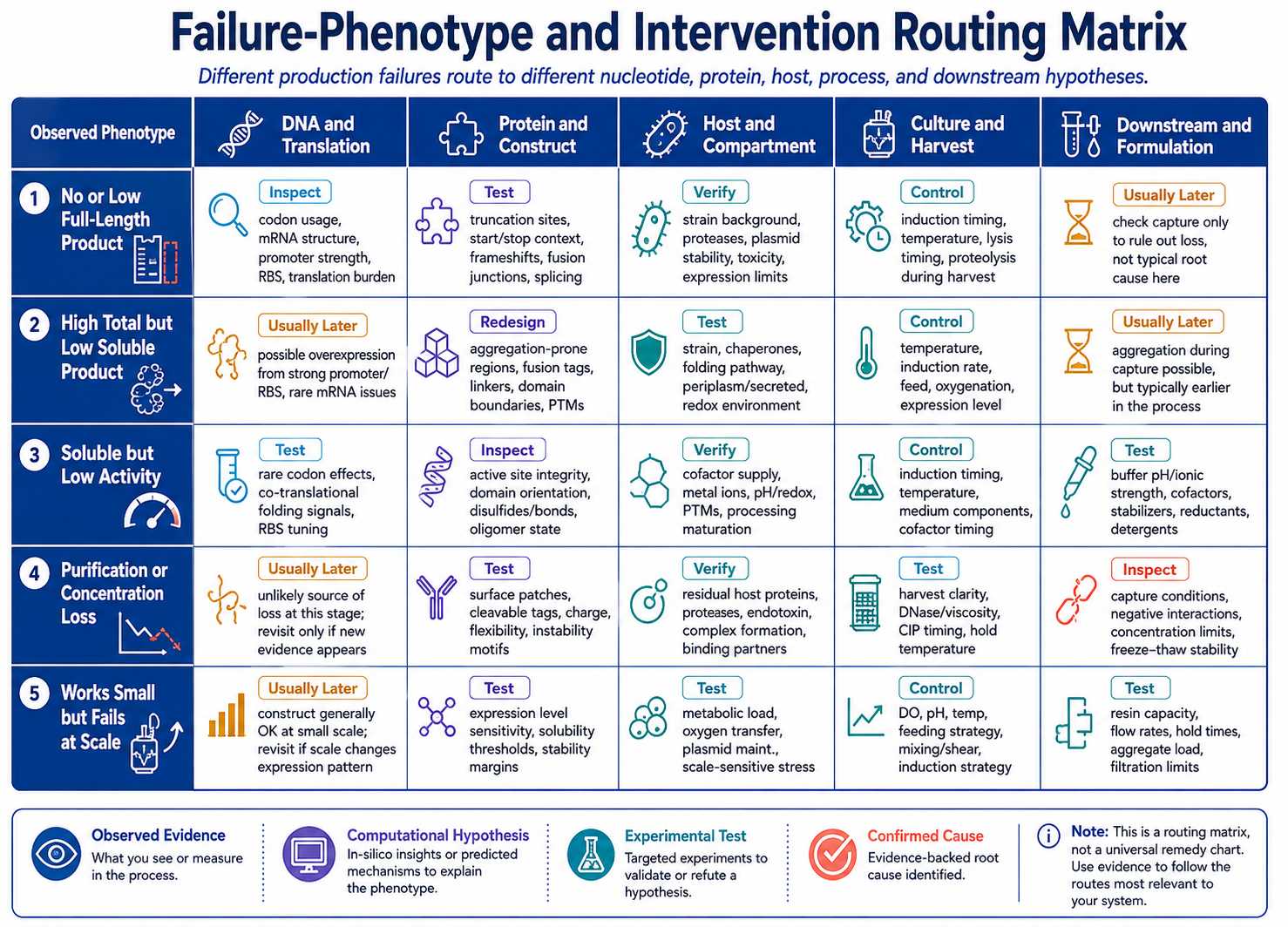 Fig 2. Failure-phenotype and intervention routing matrix. No expression, insolubility, low active fraction, purification loss, and scale failure are routed to different nucleotide, protein, host, process, and downstream hypotheses.
(Creative Enzymes Diagnostic)
AI-guided optimization is most useful when it narrows a defined, testable design space. We do not combine every model score into an unexplained rank. Nucleotide models, protein language models, structural calculations, solubility predictors, aggregation predictors, evolutionary conservation, and prior experimental data describe different evidence. Their outputs remain attached to the exact sequence, construct, host, and proposed experiment.
Sequence-based solubility models such as SoluProt and NetSolP demonstrate that machine learning can support prioritization, but their reported performance is dataset- and host-specific. A score is therefore a prior, not a soluble-expression specification. Translation-initiation tools address nucleotide accessibility; they do not establish correct folding. Structure- and evolution-guided protein design can suggest stabilizing or solubilizing mutations; those mutations still require expression and functional testing because stability, solubility, activity, specificity, and oligomerization can trade off.
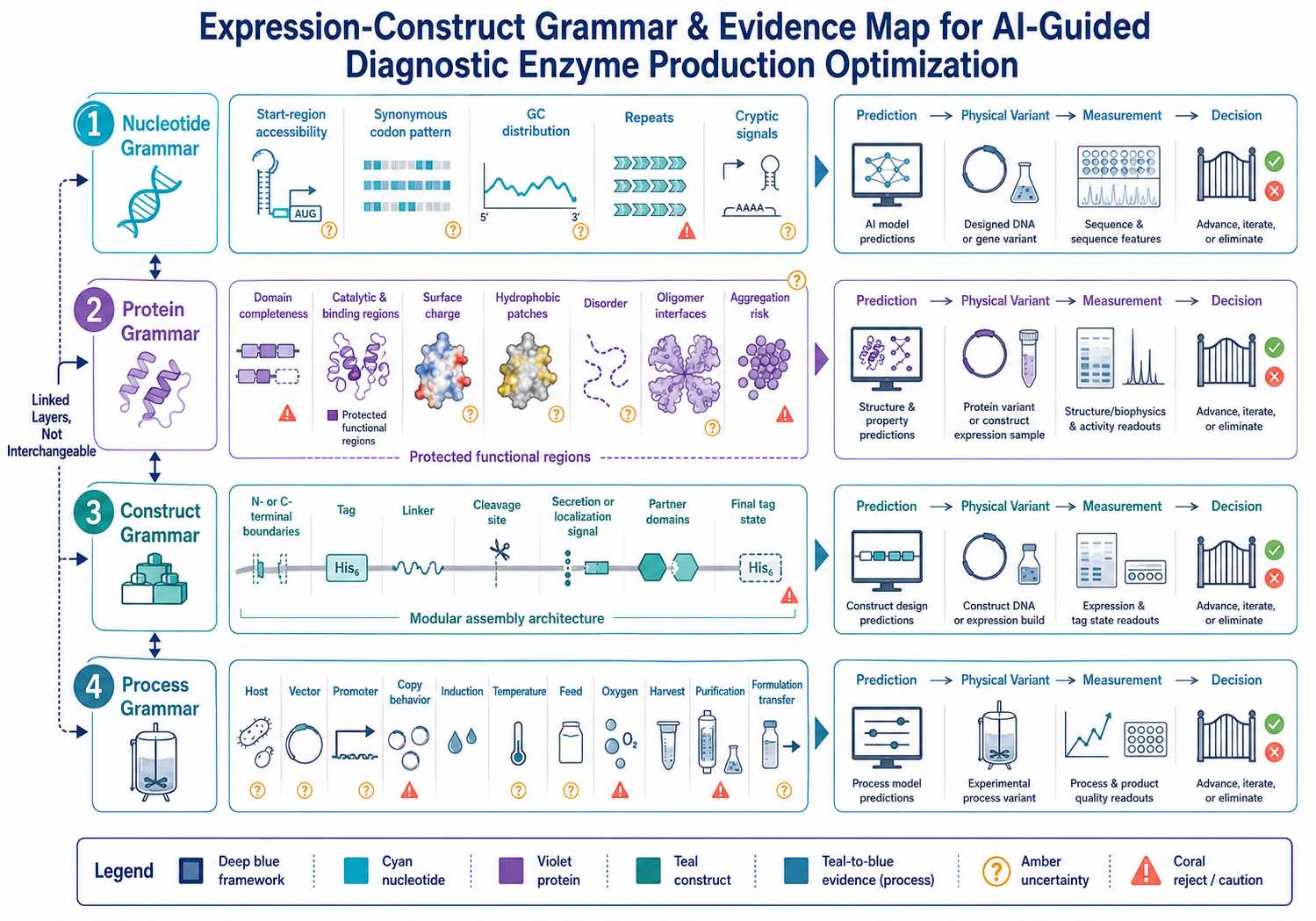 Fig 3. Expression-construct grammar and evidence map. Nucleotide, protein, construct, and process variables are modeled as linked but non-interchangeable design layers, each with a corresponding experimental test.
(Creative Enzymes Diagnostic)
Protein-sequence changes are considered only after the project defines which residues and structural relationships must be protected. These may include catalytic residues, metal- or cofactor-binding sites, primer/template or substrate contacts, substrate channels, guide-RNA contacts, oligomer interfaces, conformational switches, post-translational sites, domain linkers, and specificity-determining regions. Surface mutations that improve a computational solubility score are not automatically safe if they change electrostatics near a nucleic-acid substrate or a partner-enzyme interface.
A compact physical panel can compare a wild-type or current construct, synonymous variants, boundary/tag variants, host/process variants, and carefully selected protein variants. This factorial separation prevents a successful result from being attributed to the wrong intervention. Where historical screening data are sufficiently consistent, active learning or Bayesian experiment design can propose the next panel; otherwise, a transparent DoE or balanced screening matrix is often more defensible.
Host selection starts with the biochemical requirements of the enzyme. E. coli can be appropriate for many diagnostic enzymes because it supports rapid microbial expression and a broad construct/process design space, but it may be unsuitable when required folding, disulfide formation, secretion, processing, glycosylation, complex assembly, toxicity, or cofactor loading cannot be reproduced. Yeast, insect, mammalian, cell-free, periplasmic, secreted, or alternative microbial routes may be considered when justified by the target molecule and intended process.
The initial screen is designed to produce information, not merely identify the highest band. Each condition records biomass or culture output, target expression, soluble distribution, integrity, purification behavior, specific activity, active recovery, and relevant failure observations. Positive expression and activity controls separate a target-specific failure from a platform or assay failure. Process blanks and host-only controls help detect background nuclease, protease, reporter, optical, or matrix effects.
When the intended product is a component of a premix, purified enzyme is eventually evaluated with its partners. Expression optimization should not absorb full formulation development, but the selected process cannot leave a buffer or contaminant profile that makes the intended mix impractical. Connected projects can proceed to lyophilized and ambient-stable reagent development or other scoped application programs after an appropriate enzyme material is established.
Soluble protein can be misfolded, partially folded, incorrectly oligomerized, cofactor-deficient, proteolyzed, tag-dependent, or inactive. Conversely, an insoluble fraction may contain a recoverable enzyme, but refolding is justified only if the process can be reproduced and the recovered material meets the functional and downstream requirements. The program therefore classifies material by both physical state and molecular activity.
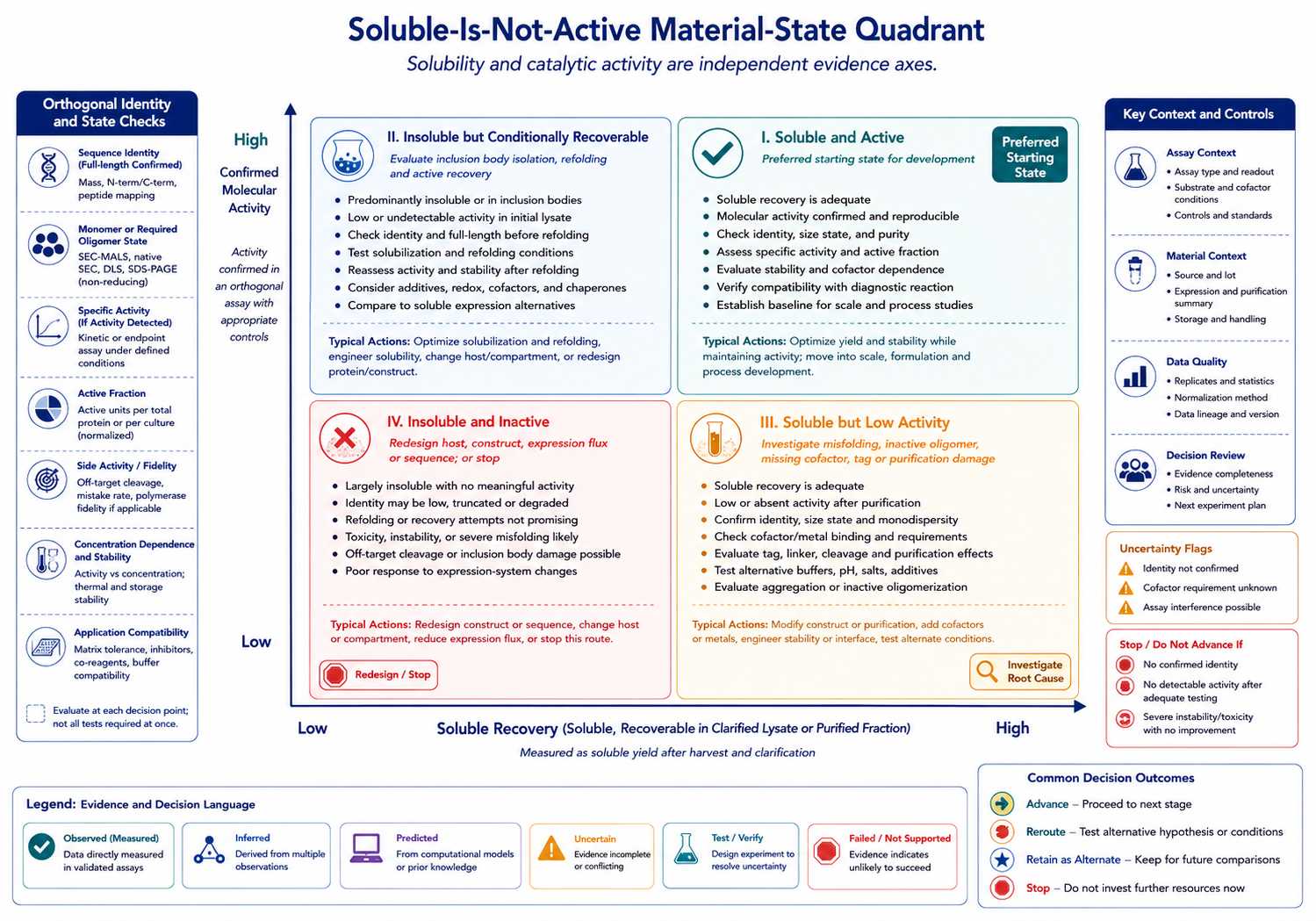 Fig 4. Soluble-is-not-active material-state quadrant. Solubility and catalytic activity are treated as independent evidence axes so inactive soluble material and conditionally recoverable insoluble material are not misclassified.
(Creative Enzymes Diagnostic)
Purification development records total target mass and activity before and after each operation. Capture selectivity, binding capacity, elution conditions, tag removal, polishing, concentration, buffer exchange, filtration, hold time, temperature, and freeze-thaw exposure can change both recovery and material state. Step yield by mass and step yield by active units are compared. An operation that improves apparent purity while discarding most active enzyme may be analytically attractive but manufacturing-poor.
The impurity panel is defined by the diagnostic use and process. It can include host-cell proteins, host or plasmid nucleic acid, endotoxin where relevant, protease, nuclease, affinity ligand, fusion-tag remnants, aggregates, fragments, process additives, salts, detergents, reducing agents, imidazole, and other carryover. Universal limits are not assumed. Acceptance criteria depend on the material's role, dose into the reaction, assay sensitivity to the residual, downstream dilution, and the legal manufacturer's quality and risk framework.
After active material exists, method development and release-oriented characterization can connect to Enzymes QC & QA, enzyme activity and stability analysis, or a project-specific analytical program. Expression optimization establishes a credible process and material; it does not replace complete QC method validation, supplier qualification, or finished-product validation.
A plate or flask condition is a discovery instrument, not a miniature manufacturing process. Changes in mixing, gas transfer, heat removal, pH control, dissolved oxygen, feed delivery, induction gradients, foam, biomass history, harvest delay, lysis energy, clarification load, chromatography residence time, and concentration can alter expression and active recovery. A scale-echo plan identifies which small-scale variables represent the intended larger process and which cannot.
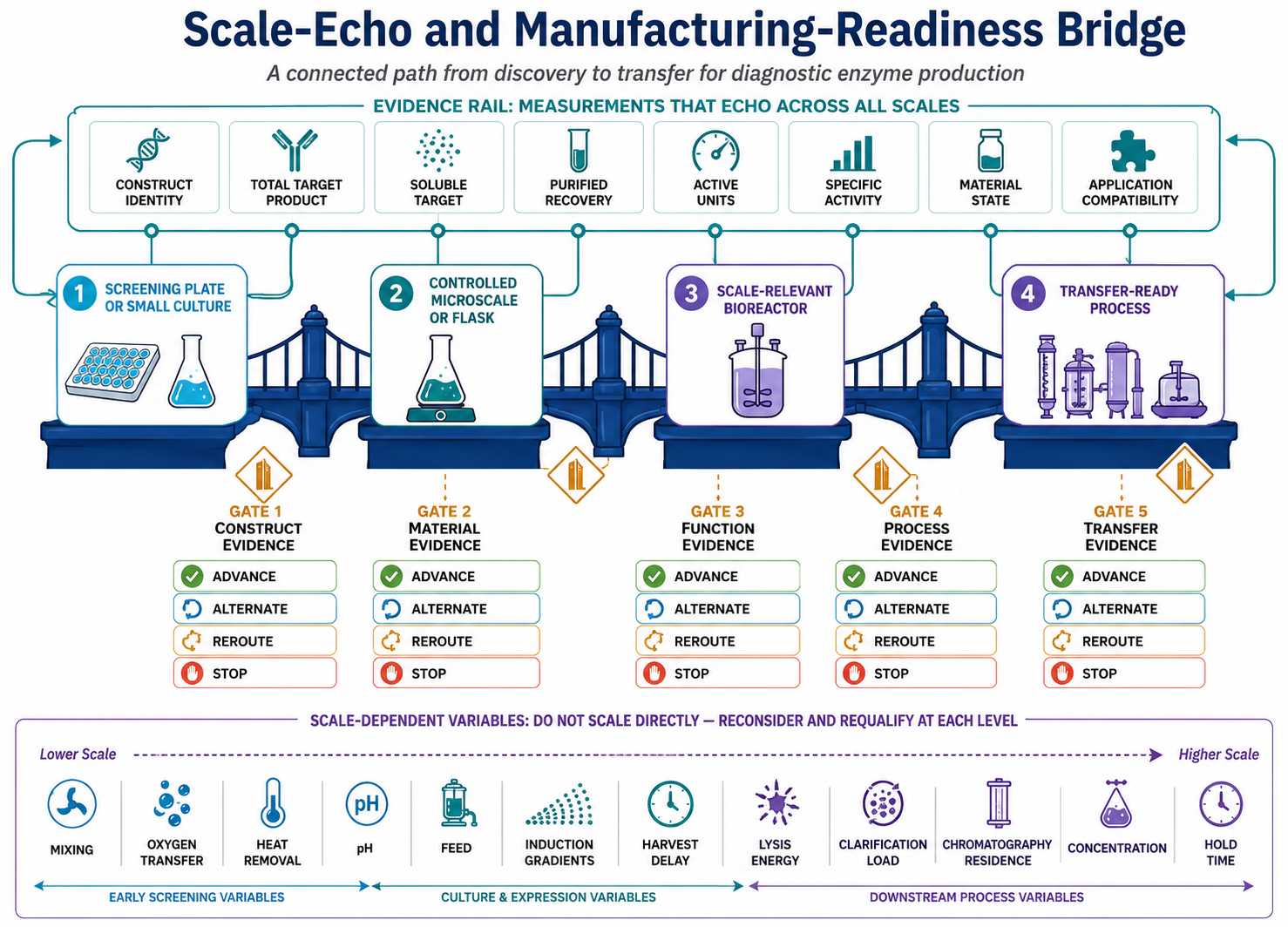 Fig 5. Scale-echo and manufacturing-readiness bridge. Screening, controlled small-scale work, scale-relevant confirmation, and transfer readiness use linked material and activity measures while exposing variables that do not scale directly.
(Creative Enzymes Diagnostic)
A candidate may be advanced, retained as an alternate, rerouted to sequence engineering, transferred to formulation, or stopped. A higher-producing construct can remain an alternate if its active fraction, impurity burden, purification complexity, stability, or scale response is poor. A lower mass yield can be preferred when it produces more active units through a simpler and more reproducible process. The project documents the tradeoff rather than hiding it in a composite score.
The deliverable is more than purified protein. A useful package allows another qualified team to understand what was built, why it was selected, how it was produced, where losses occurred, which measurements support the decision, and what remains untested. Exact contents depend on scope, ownership, and project stage.
Depending on the decision, the selected material can proceed to closed-loop design-build-test-learn evolution, second-source and sequence-equivalency engineering, formulation, application-system development, analytical methods, or broader enzyme development and validation. A production route that changes the protein sequence may also require renewed activity, specificity, stability, and application assessment.
Program size depends on the number of plausible causal layers, construct and host breadth, expression difficulty, analytical readiness, activity-assay throughput, downstream complexity, material quantity, scale gap, and required transfer evidence. We do not promise a universal soluble-yield improvement or manufacturing scale. The scope is designed around the next defensible decision.
Expression describes production of the target protein, often first measured as total product. Solubility describes its distribution into a defined soluble fraction under specified harvest and lysis conditions. Manufacturability is broader: it asks whether a defined construct and process can reproducibly deliver recoverable, active, appropriately controlled material through scale, purification, formulation, testing, and transfer. High expression or solubility alone does not establish manufacturability.
AI and statistical models can rank sequence, translation-initiation, solubility, stability, aggregation, localization, and construct hypotheses. Their performance depends on the training data, host, assay definition, sequence family, and experimental context. We use predictions to prioritize an interpretable physical panel; soluble expression, active fraction, and application performance still require experiments.
Sometimes a synonymous redesign helps, but low expression can also reflect start-region structure, vector context, promoter or copy behavior, transcript stability, toxicity, domain boundaries, proteolysis, host limitations, or an unsuitable detection method. Codon usage is one part of the nucleotide design. The appropriate response depends on evidence that localizes the bottleneck.
Soluble material can be misfolded, partially folded, incorrectly oligomerized, cofactor-deficient, proteolyzed, chemically damaged, tag-interfered, or present in an inactive conformational state. The assay may also be inhibited by the purification buffer or contaminants. Specific activity and, where feasible, active-fraction measurements are needed to distinguish soluble mass from active enzyme.
A tag can improve expression or solubility for some proteins and worsen it for others. Tag position, size, linker, cleavage, final product state, purification route, activity, oligomerization, and application interference must be considered. A tagged soluble fusion is not automatically equivalent to active untagged enzyme. We normally compare interpretable tag and boundary alternatives with a relevant control.
Yes. A program can evaluate synonymous gene design, construct boundaries that preserve the allowed protein, vector and promoter architecture, host or strain, expression compartment, chaperone or cofactor support, culture conditions, harvest, lysis, purification, and formulation interface. Whether these are sufficient depends on the cause of the production failure.
Sequence engineering is considered when evidence points to intrinsic instability, aggregation-prone surfaces, problematic interfaces, proteolytic sensitivity, poor folding, or a property that process changes cannot solve. Catalytic residues, substrate contacts, cofactors, specificity regions, oligomer interfaces, and required processing are protected. Designed variants are tested for both production behavior and molecular function.
There is no universal best host. Selection depends on protein origin, folding complexity, size, disulfides, oligomerization, cofactors, required processing or post-translational modification, toxicity, secretion, contamination risks, scale, downstream route, and intended material. E. coli may be appropriate for many enzymes; yeast, insect, mammalian, cell-free, periplasmic, secreted, or alternative microbial routes are considered when the molecular and process requirements justify them.
Some enzymes can be recovered from inclusion bodies, but feasibility is target- and process-specific. The route must evaluate inclusion-body isolation, solubilization, refolding, aggregation, active recovery, reproducibility, purification, process burden, and application compatibility. Refolding is not automatically preferable to redesigning the construct, host, or expression flux.
The method depends on enzyme chemistry. Options can include active-site titration, burst amplitude, stoichiometric inhibitor or substrate binding, covalent probe labeling, calibrated binding plus turnover, or another orthogonal approach. When direct active-fraction measurement is not feasible, specific activity and controlled material comparisons are used with clearly stated limits.
We track mass and active units through capture, wash, elution, cleavage, polishing, concentration, buffer exchange, filtration, holds, and storage. pH, salt, cofactor, reducing environment, detergent, additives, temperature, concentration, surface exposure, residence time, and shear are varied according to the suspected mechanism. The chosen route balances purity, recovery, material state, activity, residuals, simplicity, and scale relevance.
The small-scale model should reproduce or deliberately bracket the variables that drive the larger process. These may include biomass state, induction trajectory, oxygen transfer, mixing, pH, temperature, feed, harvest time, lysis, clarification load, chromatography residence, and hold conditions. Scale relevance is demonstrated through linked measurements and independent confirmation, not assumed from vessel volume.
Yes, but the objectives are measured separately. A design can increase mass while reducing active fraction, or improve specific activity while reducing production yield. We use multi-objective decision rules that include recovered active units, material quality, process burden, and application behavior. Catalytic optimization that requires a broader variant campaign may be scoped as a connected engineering service.
A negative program can still deliver the exact constructs and conditions tested, material and activity balances, failed-expression labels, purification behavior, assay methods, raw data, model/design records, causal boundaries, rejected routes, and recommended redesign, host change, re-mining, or stop decision. We do not relabel detectable protein as a manufacturing success.
No automatic status follows from optimization. The evidence applies to the tested sequence, construct, host, process, material, methods, scale, and conditions. Routine supply, specifications, method validation, stability, change control, quality agreements, supplier qualification, finished-assay validation, and regulatory responsibilities require additional work by the appropriate manufacturer or sponsor.
Send us the exact sequence and construct, current host and process, total and soluble expression evidence, purification and activity data, intended diagnostic use, material format, scale objective, and the next decision your team must make. Creative Enzymes can propose a staged route from loss localization and AI-guided design to active-enzyme recovery, scale-relevant confirmation, and a reconstructable transfer package.
Contact Creative Enzymes