Background
Diagnostic enzymes are the catalytic engines of in vitro diagnostic (IVD) assays, and their performance under non-physiological conditions is often the limiting factor in assay design, manufacturing, and shelf-life. Many diagnostic platforms require enzymes to maintain activity at elevated temperatures during thermal cycling (PCR, LAMP, RPA), operate across broad pH ranges in multi-analyte panels, or survive lyophilization and extended ambient-temperature storage in point-of-care (POC) kits. Wild-type enzymes, evolved for narrow physiological conditions, frequently fail to meet these demands, resulting in assay failure, high lot-to-lot variability, and costly cold-chain logistics.
Thermostability and pH tolerance are particularly critical for diagnostic-grade enzymes. Thermal denaturation not only reduces catalytic activity but can also expose hydrophobic residues, leading to aggregation and loss of batch consistency. pH sensitivity restricts assay formulation flexibility, forcing developers to compromise buffer conditions that might otherwise optimize signal generation or analyte stability. An enzyme engineered for enhanced thermostability and broad pH tolerance can unlock assay designs that would be impossible with wild-type counterparts, while simultaneously reducing manufacturing costs and simplifying supply chain requirements.
Creative Enzymes Diagnostic offers a dedicated Thermostability and pH Tolerance Engineering service that applies structure-guided protein engineering, computational modeling, and rigorous stability profiling to develop enzyme variants with dramatically improved resilience. Our engineered enzymes maintain robust activity under thermal stress, across acidic to alkaline pH ranges, and through lyophilization cycles—delivering the reliability and consistency that diagnostic manufacturers require.
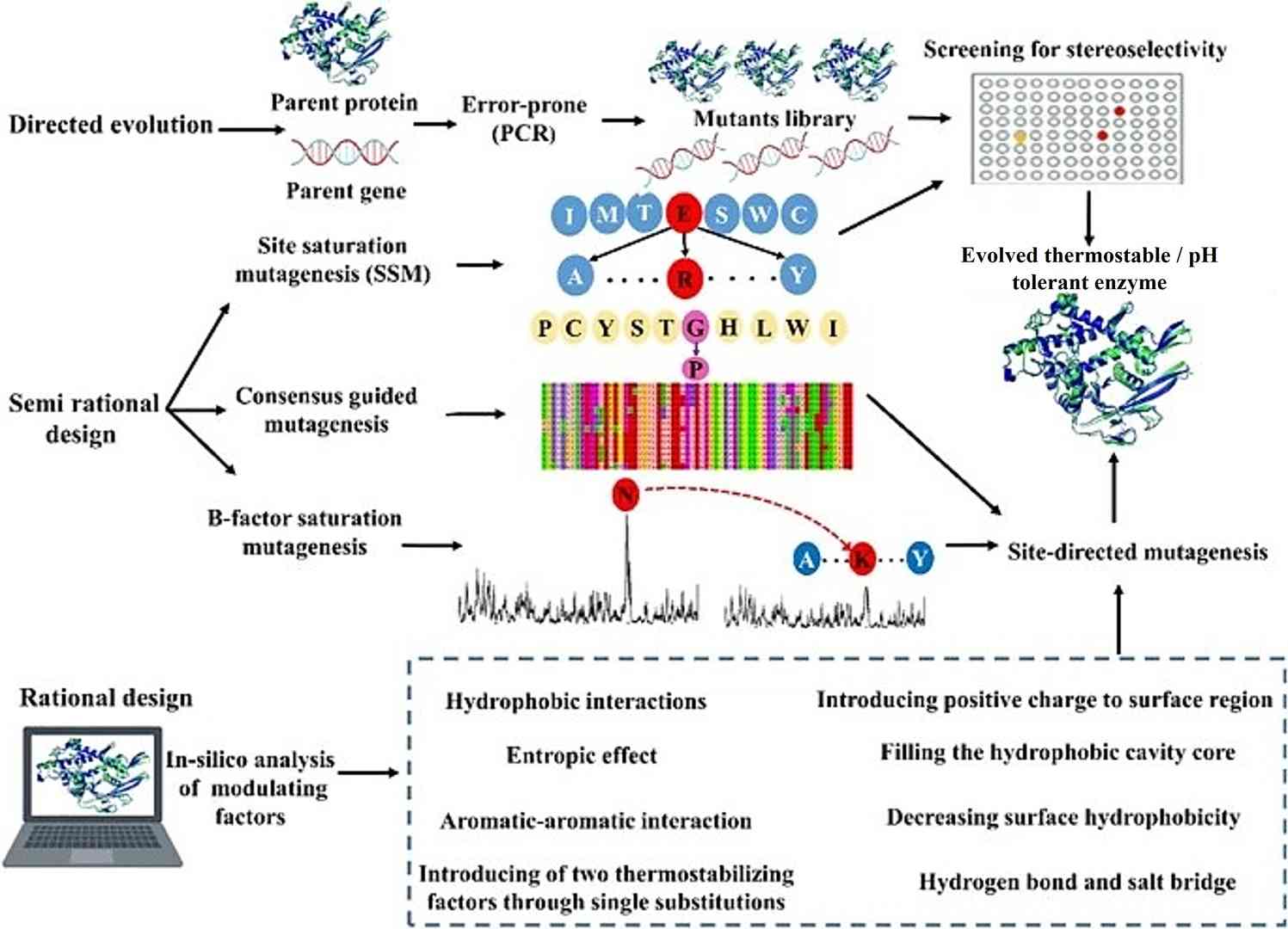 Figure 1. Thermostability and pH tolerance engineering of industrial enzymes through structure modification. (Adapted from Nezhad et al., 2022)
Engineering Strategy
Our engineering approach integrates multiple rational and semi-rational strategies, each selected based on the enzyme's structural features, the magnitude of improvement required, and the specific diagnostic application. We combine computational predictions with experimental validation to identify mutations that stabilize the native fold without compromising catalytic function.
Structure-guided Engineering
- High-resolution structural analysis using X-ray crystallography, cryo-EM, or AlphaFold-predicted models to identify flexible loop regions, unstable secondary structure elements, and solvent-exposed hydrophobic patches that predispose the enzyme to thermal denaturation
- Rosetta and molecular dynamics (MD) simulations to predict the energetic consequences of candidate mutations on protein stability, including ΔΔG calculations for folding free energy changes
- Targeted mutation of residues in structurally strained regions (e.g., β-turns, loop-helix junctions) to introduce stabilizing interactions such as additional hydrogen bonds, salt bridges, or improved hydrophobic core packing
- Validation of predicted stabilizing mutations by experimental thermal shift assays and activity retention measurements under thermal challenge conditions
Surface Charge Engineering
- Systematic mapping of surface electrostatic potential to identify regions of excessive positive or negative charge density that can drive pH-dependent conformational changes or intermolecular aggregation
- Introduction of surface charge substitutions (e.g., Asp→Glu, Lys→Arg) to modulate the enzyme's isoelectric point (pI) and expand the pH range over which the protein maintains native charge distribution and solubility
- Design of surface salt bridge networks that stabilize the folded state across a broad pH spectrum by maintaining electrostatic interactions even as individual residues titrate
- Evaluation of surface charge variants for reduced aggregation propensity at the target formulation pH and improved colloidal stability during long-term storage
Disulfide Bond Engineering
- Computational identification of cysteine pairs with optimal geometry (Cα-Cα distance, Cβ-Sγ angle, strain energy) for de novo disulfide bond introduction, using algorithms such as MODIP, DbD, or Rosetta disulfide modeling
- Strategic placement of engineered disulfide bonds to rigidify flexible domains, tether mobile loops to stable secondary structures, or cross-link subunit interfaces in multimeric enzymes
- Assessment of disulfide bond impact on redox sensitivity, ensuring that engineered bonds are stable under reducing assay conditions and do not introduce unwanted intermolecular cross-linking during expression
- Combination of disulfide engineering with other stabilization strategies to achieve additive or synergistic improvements in thermal tolerance and conformational rigidity
Consensus Design
- Multiple sequence alignment of homologous enzymes across phylogenetically diverse organisms to identify evolutionarily conserved residues and consensus sequences associated with intrinsic stability
- Back-to-consensus mutagenesis, substituting non-consensus residues in the target enzyme with the most frequently occurring amino acid at each position across the alignment
- Identification of thermophile-specific sequence signatures (e.g., increased Pro content, reduced Asn and Gln content, enhanced ion-pair networks) and their transplantation into mesophilic diagnostic enzymes
- Validation that consensus mutations do not disrupt active site geometry or substrate binding, with kinetic characterization to confirm maintenance or improvement of catalytic efficiency
Stability Evaluation
Every engineered variant undergoes a comprehensive stability evaluation protocol designed to quantify improvements across the full spectrum of conditions relevant to diagnostic manufacturing and use. Our evaluation goes beyond simple melting temperature measurements to assess functional stability under realistic stress scenarios.
Thermal Stability
- Differential scanning fluorimetry (DSF) and differential scanning calorimetry (DSC) to determine melting temperature (Tm) and enthalpy of unfolding (ΔH), providing thermodynamic parameters that quantify the stability improvement
- Thermal inactivation kinetics at multiple temperatures to calculate activation energy of denaturation (Ea) and half-life (t1/2) under thermal challenge, directly relevant to PCR cycling and shipping stress
- Activity retention assays after exposure to temperatures exceeding the target assay's thermal cycling profile (e.g., 95°C for Taq polymerase variants, 65°C for reverse transcriptases)
- Assessment of thermal reversibility by cooling and re-measuring activity to distinguish reversible unfolding from irreversible aggregation, a critical distinction for assay reproducibility
pH Stability
- Broad-range pH profiling (typically pH 4.0–10.0) to determine the pH optimum and the width of the activity plateau, quantified as the pH range over which the enzyme retains >80% of maximal activity
- pH-dependent conformational stability assessment by circular dichroism (CD) spectroscopy and DSF across the pH range, identifying pH values at which secondary or tertiary structure begins to destabilize
- Long-term incubation at target formulation pH with periodic activity measurement to detect slow pH-induced denaturation, deamidation, or aggregation that may not be apparent in short-term assays
- Evaluation of pH tolerance in complex buffer matrices containing common assay components (Tris, MOPS, phosphate, Good's buffers) to confirm stability under formulation-relevant ionic strength and buffer species
Shelf-life
- Accelerated degradation studies at elevated temperature (37°C, 45°C, 55°C) following Arrhenius modeling to predict real-time shelf-life at intended storage temperatures (4°C, −20°C, or ambient)
- Real-time stability monitoring under recommended storage conditions with predefined pull points for activity, purity, and aggregation assessment over 6-, 12-, and 24-month intervals
- Statistical analysis of degradation kinetics to establish expiration dating with defined confidence intervals, supporting regulatory submissions and product labeling claims
- Compatibility assessment with common stabilizers (glycerol, trehalose, BSA, betaine) and their optimization for the engineered variant to maximize shelf-life extension
Lyophilization Stability
- Formulation screening of excipient combinations (sugars, polyols, polymers, salts) to identify lyoprotectant formulations that maintain enzyme activity and structural integrity after freeze-drying and reconstitution
- Evaluation of freeze-thaw tolerance across multiple cycles to simulate shipping temperature excursions and identify variants resistant to ice-crystal-induced denaturation and interfacial stress
- Assessment of reconstitution kinetics, solubility, and aggregation after lyophilization, with particle size analysis and turbidity measurement to confirm absence of insoluble aggregates
- Long-term stability of lyophilized product at elevated temperature and humidity (stress testing) to validate ambient-temperature shelf-life claims for POC and resource-limited settings
Applications
Engineered thermostable and pH-tolerant enzymes enable diagnostic applications that are impractical or impossible with wild-type enzymes. Our stabilized variants have been successfully deployed across a broad range of diagnostic platforms and use cases.
- PCR and isothermal amplification: DNA polymerases and reverse transcriptases with enhanced thermostability enable faster thermal cycling, higher annealing temperatures for improved specificity, and reliable performance in multiplex reactions. Isothermal enzymes (Bst DNA polymerase, RPA recombinases) engineered for elevated-temperature operation accelerate reaction kinetics and reduce time-to-result.
- Lyophilized reagent kits: Enzymes stabilized for lyophilization eliminate cold-chain requirements, reduce shipping costs, and extend shelf-life at ambient temperature—critical for POC diagnostics, home testing, and distribution to resource-limited regions.
- Multi-analyte panels with unified buffer systems: pH-tolerant enzymes enable the design of assay panels where multiple enzymes operate optimally in a single buffer formulation, simplifying kit design, reducing component count, and improving lot-to-lot consistency.
- High-temperature sample processing: Thermostable proteases and nucleases enable integrated sample lysis and target amplification in closed-tube formats, reducing hands-on time and contamination risk in molecular diagnostics.
- Automated high-throughput platforms: Enhanced stability reduces enzyme degradation during extended on-board instrument storage and repeated freeze-thaw cycles, minimizing calibration frequency and improving walk-away automation reliability.
- Extreme environment diagnostics: Field-deployable assays for environmental monitoring, biodefense, and veterinary diagnostics require enzymes that function after exposure to temperature extremes, desiccation, and prolonged storage without refrigeration.
FAQs
Q1. How much improvement in thermostability can typically be achieved through engineering?
A1. The magnitude of improvement depends on the starting enzyme, its structural plasticity, and the engineering strategies applied. Typical projects achieve Tm increases of 5–15°C, with some variants showing improvements exceeding 20°C. For functional thermal stability, half-life at elevated temperature can be extended by 10- to 100-fold. The specific target is defined during project scoping based on the diagnostic application's requirements.
Q2. Will improving thermostability or pH tolerance compromise catalytic activity?
A2. Our engineering strategy explicitly selects for mutations that stabilize the native fold without perturbing the active site architecture. While some trade-offs between stability and activity are theoretically possible, our structure-guided approach minimizes this risk by avoiding mutations in catalytic and substrate-binding residues. In many cases, enhanced stability actually improves apparent activity under assay conditions by reducing the population of partially unfolded, inactive enzyme. Kinetic characterization (kcat, KM) is performed on all engineered variants to confirm that catalytic efficiency is maintained or improved.
Q3. Can you engineer enzymes for stability in specific formulation buffers?
A3. Yes. We can tailor the engineering campaign to the client's intended formulation, screening variants directly in the target buffer matrix rather than in standard assay buffers. This approach ensures that the selected variant is stable not just in vitro but in the exact chemical environment it will encounter in the final product, including proprietary stabilizer cocktails, surfactants, and preservatives.
Q4. What is the typical timeline for a thermostability and pH tolerance engineering project?
A4. A standard project, from structural analysis through variant validation, typically spans 8 to 12 weeks. This includes 2–3 weeks for structural analysis and computational design, 3–4 weeks for library construction and screening, and 3–4 weeks for hit validation and stability profiling. Projects requiring iterative rounds of evolution or extensive formulation optimization may extend to 16–20 weeks. Expedited timelines are available for urgent programs.
Q5. Do you provide stability data suitable for regulatory submissions?
A5. Yes. All stability studies are designed and documented in accordance with ICH Q1A(R2) guidelines for stability testing of new drug substances and products, adapted for IVD reagents. Data packages include study protocols, raw data, statistical analysis, shelf-life projections with confidence intervals, and formal study reports suitable for inclusion in regulatory submissions (510(k), PMA, IVDR technical documentation).
Q6. Can you support scale-up production of the engineered variant?
A6. Yes. Our integrated enzyme production platform provides seamless scale-up from milligram research quantities to gram or kilogram manufacturing batches. The optimized expression construct, fermentation conditions, and purification protocol developed during the engineering project are directly transferable to our production team. We deliver the engineered enzyme with a comprehensive Certificate of Analysis, batch records, and manufacturing documentation suitable for diagnostic-grade raw material qualification.
Creative Enzymes Diagnostic combines deep protein engineering expertise, advanced computational modeling, and rigorous stability characterization to deliver enzyme variants that thrive under the demanding conditions of modern diagnostic applications. From PCR thermal cycling to lyophilized POC kits, our thermostability and pH tolerance engineering service provides the catalytic reliability your assay demands.
Contact our business development team today to discuss your specific project needs!
References
- Nezhad NG, Rahman RNZRA, Normi YM, Oslan SN, Shariff FM, Leow TC. Thermostability engineering of industrial enzymes through structure modification. Appl Microbiol Biotechnol. 2022;106(13-16):4845-4866. doi:10.1007/s00253-022-12067-x
Related Services

