
Explores structure, activity, impurities, formulation and application behavior. It may contain valuable data that are not appropriate for every-lot testing.

A certificate of analysis is useful only when every reported field can be traced to a defined product requirement, representative sample, controlled analytical procedure, valid run, justified acceptance criterion and authorized review. Creative Enzymes develops configurable specification and release-testing packages for diagnostic-enzyme raw materials and reagent programs—so the lot-specific COA communicates a decision supported by evidence rather than a collection of convenient test results.
Many release problems begin when “the COA” is used to mean the specification, method, raw-data report and final authorization at the same time. These records are connected, but they are not interchangeable. Separating their jobs makes version control, review and customer communication much clearer.
Explores structure, activity, impurities, formulation and application behavior. It may contain valuable data that are not appropriate for every-lot testing.
Defines the tests, controlled procedure references and acceptance criteria that the material is expected to meet.
Defines sample preparation, standards, reagents, instrument conditions, system suitability, calculation and reporting.
Connects the tested sample and lot to run validity, results, exceptions, review and disposition under the sponsor’s quality system.
Communicates selected lot-specific results or conformance statements without replacing the underlying controlled evidence.
ICH Q6A provides a useful conceptual definition of a specification as a list of tests, references to analytical procedures and acceptance criteria. Its direct scope is synthetic drug substances and products, so we do not treat it as an IVD raw-material rule. The principle is still valuable: a specification is one part of an overall control strategy, not a complete characterization dossier.
A release panel should not begin with the assays a laboratory happens to own. It begins with what variability could matter to the user’s reagent or manufacturing process. That requirement is translated into a measurable attribute, then linked to a procedure, sampling basis, criterion, decision rule and record. If a link cannot be justified, the team can decide whether to develop evidence, retain the item as informational or remove it from routine release.
What downstream function or risk needs control?
Which property represents that requirement?
How is the attribute measured reproducibly?
What material represents the lot?
Which boundary and decision rule apply?
Were the run, result and exceptions acceptable?
What is communicated to the customer?
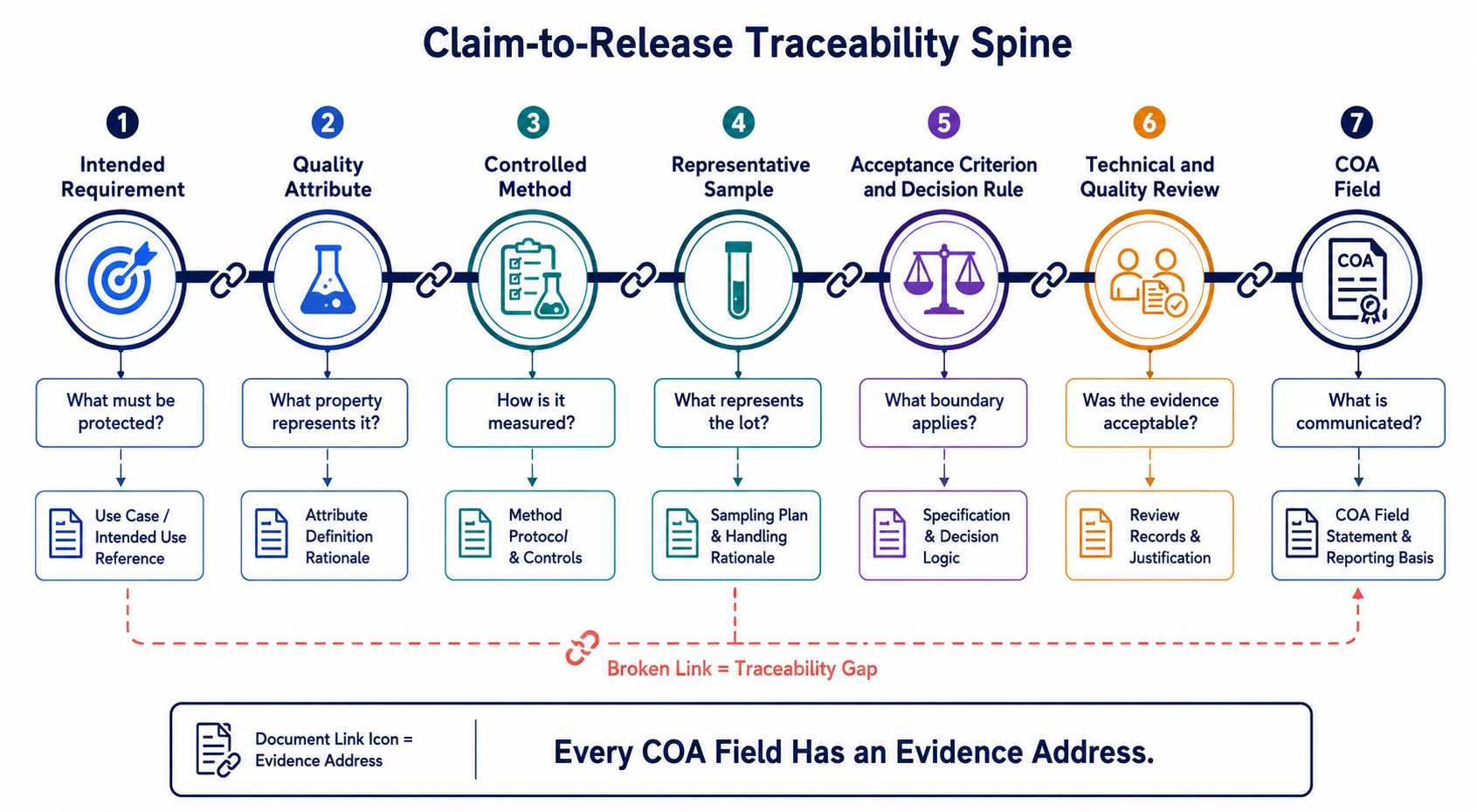 Fig 1. Claim-to-release traceability spine. A COA field is defensible when it remains linked to the use requirement, attribute, controlled method, representative sample, decision rule and reviewed evidence.
(Creative Enzymes Diagnostic)
Diagnostic enzymes can generate a long list of measurable properties. Routine release is strongest when each property has an explicit control role. Some attributes directly decide lot disposition; some are tested periodically to confirm an established process; some are detailed characterization tools; and others are activated only after a defined change or signal. These roles may change as the product and process mature.
Purity testing can be developed through our diagnostic enzyme purity analysis service; activity definitions and kinetic behavior through activity and kinetic characterization; and HCP, host DNA or endotoxin questions through residual testing support. This release-package service integrates selected outputs into a controlled decision framework.
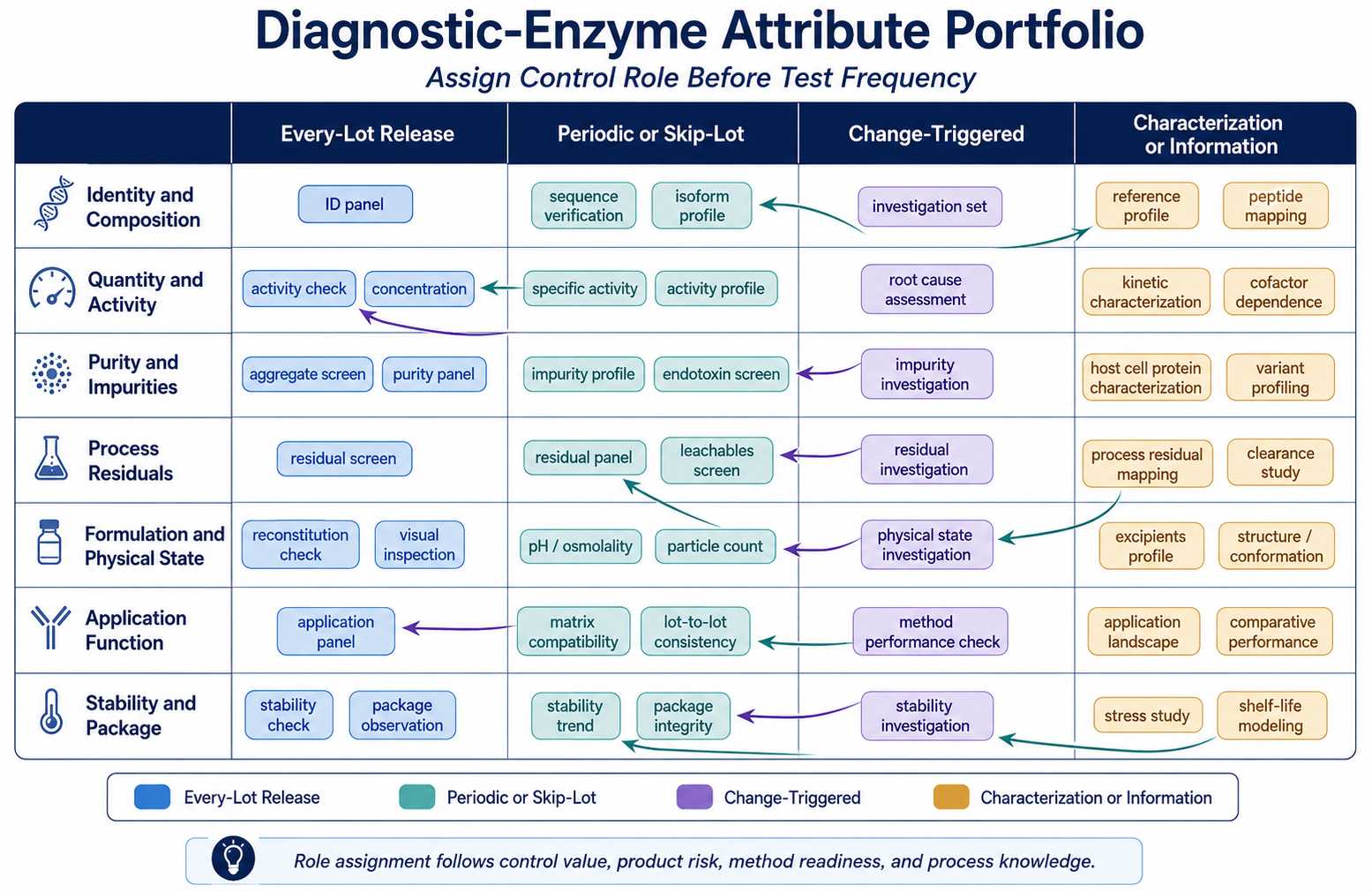 Fig 2. Diagnostic-enzyme attribute portfolio. Test frequency follows control value, product risk, method readiness and process knowledge—not the length of the characterization report.
(Creative Enzymes Diagnostic)
A development specification does not need to pretend it is permanent. Naming its maturity state prevents exploratory targets from becoming uncontrolled commercial promises and prevents a routine specification from changing silently whenever a new lot is tested.
Used to compare prototypes, methods or process conditions. The target may be broad and explicitly non-release.
Anchored to intended use and early data, with assumptions and evidence gaps recorded.
Linked to a controlled method and representative evidence for engineering, pilot or supplier-qualification decisions.
Approved within the sponsor’s quality system, connected to disposition, change control and customer communication.
Moving between states may require additional representative lots, stability data, method qualification, reference-material control, process capability, downstream functional evidence or customer agreement. The page does not prescribe a universal lot count. Evidence sufficiency depends on the consequence of an incorrect decision and the variability sources that the program must cover.
Not every result needs a two-sided numerical range. Some attributes protect against insufficient activity, some against an excessive impurity, some against drift in composition, and some require a qualitative or functional outcome. The criterion form should match the scientific failure and the action that follows.
A minimum may control adequate activity or recovery; a maximum may control an impurity, residual or background. The noncritical side should not be restricted without reason.
Useful when both low and high values can damage downstream performance, such as concentration, pH or a physical-format attribute.
Identity, absence/presence, pattern, appearance or functional classification requires an unambiguous procedure and interpretation rule.
Functional response may be tied to a decision region, reference material or system control rather than a transferable absolute number.
| Evidence input | Question it answers | Common misuse to avoid |
|---|---|---|
| Intended-use or customer requirement | What change would materially affect the downstream reagent, process or assay? | Copying a catalog limit without confirming equivalent use conditions. |
| Analytical performance | Can the procedure distinguish acceptable from unacceptable material near the boundary? | Setting a limit tighter than the method can support or ignoring unit/reference changes. |
| Representative manufacturing data | What variation does the controlled process produce across relevant lots, sites and scales? | Using a small, selected set as proof of permanent capability. |
| Stability data | How far can an attribute move during the proposed storage interval and package configuration? | Using release results alone to assign expiry or retest claims. |
| Functional or application evidence | Does the proposed boundary protect the performance that matters to the user? | Assuming intrinsic activity or purity alone predicts every platform. |
| Risk and decision consequence | What is the cost of false acceptance, false rejection or an ambiguous result? | Treating all attributes as equally critical or using statistical significance as the criterion. |
Where a conformity statement is needed, the project can declare how measurement uncertainty is considered. ILAC G8 illustrates decision-rule concepts for ISO/IEC 17025 laboratories, but it does not create one mandatory guard band for diagnostic enzymes. Creative Enzymes does not claim laboratory accreditation through this service. The selected rule must fit the method, risk, contract and applicable quality framework.
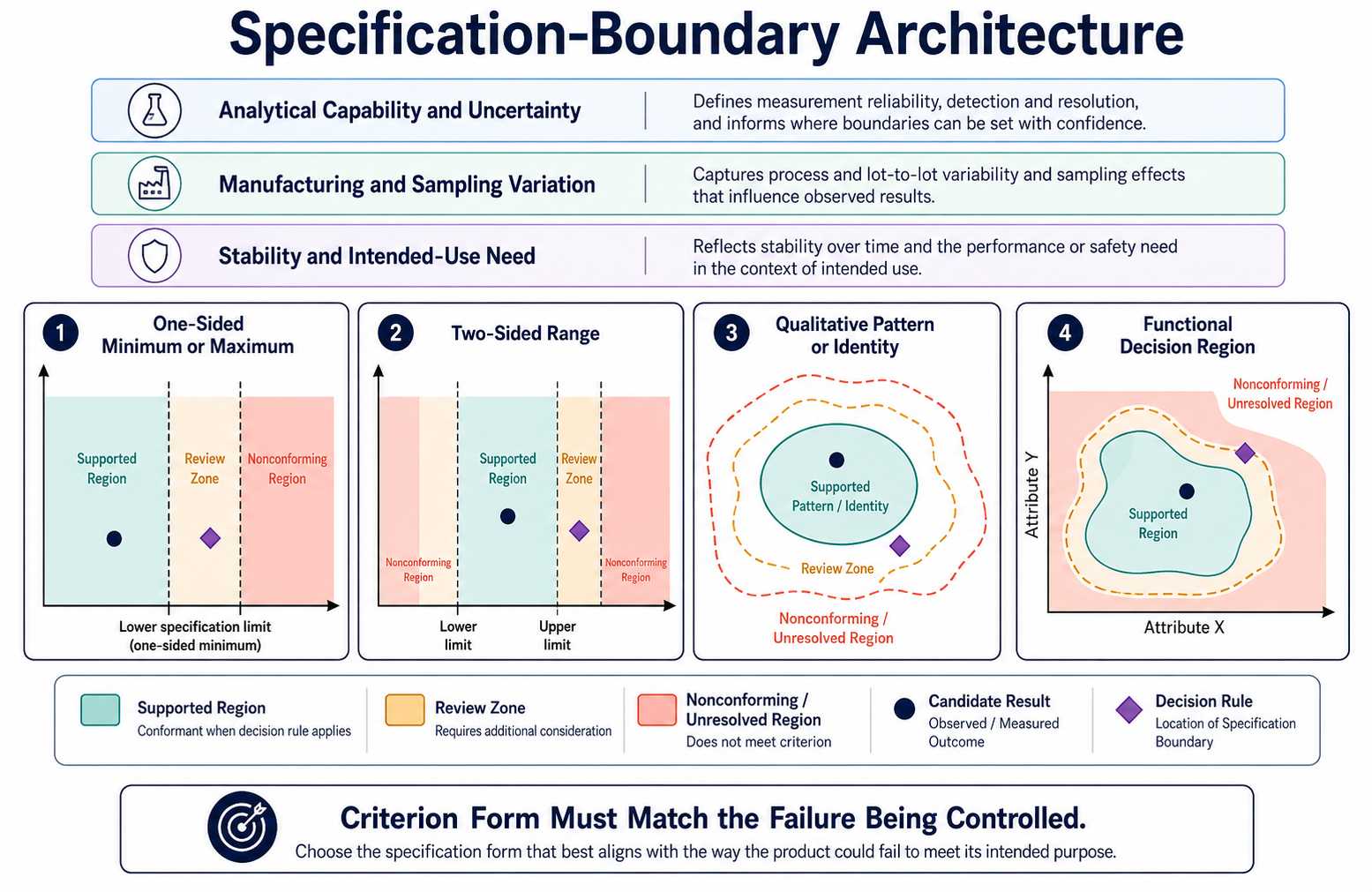 Fig 3. Specification-boundary architecture. The criterion form, analytical capability and decision rule must agree before a result can support a conformance statement.
(Creative Enzymes Diagnostic)
A method can be scientifically interesting yet unready for release. Before routine use, the package identifies the exact analytical purpose and confirms that the controlled procedure can support the boundary under the laboratory, sample and product conditions in which it will be used. When a new or product-specific procedure is required, work can connect to custom analytical method development and qualification.
Method number, version, owner, effective state and approved deviations are unambiguous.
Lot, container, fill location, pooling, storage, thawing, preparation and replicates are defined.
Standard lot, assignment, traceability, substrate, reaction conditions and enzyme unit are controlled.
Blank, controls, calibration and system-suitability rules separate an invalid run from a nonconforming lot.
Precision, selectivity, range, robustness and uncertainty are understood where they matter near the criterion.
Training, equipment equivalence, reagents, calculations and receiving-laboratory evidence are documented.
“Activity: pass” is not portable if the substrate, temperature, pH, incubation time, reference material, detection mode, blank correction or calculation changes. We define the measurand and reporting basis before setting a criterion. For coupled reactions, the limiting component and auxiliary-enzyme controls are recorded. For PCR or isothermal enzymes, unit assignment and application performance may require separate tests because an intrinsic activity assay cannot automatically predict amplification, inhibitor tolerance or multiplex balance.
The release claim applies to a lot, while the measurement is performed on one or more samples. The package defines when a bulk sample is appropriate, how filled-container variation is represented, whether pooling is permitted, how lyophilized units are selected, what constitutes a reserve sample and how shipping or thaw history is controlled. A valid result from an unrepresentative or unidentified sample cannot establish lot conformity.
The evidence packet is the reviewable bridge between laboratory execution and lot disposition. Its exact contents depend on the sponsor’s quality system and the service scope, but the record should make it possible to reconstruct what was tested, whether the run was valid, how the result was calculated and why the reported status was assigned.
Electronic worksheets, LIMS exports or calculations can be incorporated when their intended use, access, review, version and data integrity controls are defined by the responsible organization. A PDF certificate is not the raw-data archive.
A declared run-validity requirement fails or a documented assignable laboratory event prevents interpretation. The lot has not automatically failed; the invalidity must be supported before an approved repeat.
A valid result falls outside the approved criterion. The original result remains part of the record while the defined investigation and disposition route proceeds.
The result may meet the specification but differs meaningfully from process history, stability expectation or a related attribute. It can trigger review without being mislabeled as OOS.
A manufacturing, sampling, storage, method or record deviation may affect the lot even when the numerical test passes. Its impact is assessed separately.
FDA’s OOS guidance addresses pharmaceutical production rather than diagnostic-enzyme raw materials, but one principle is broadly useful: an unexpected original result should not be erased by ad hoc retesting. We help define project-appropriate rules for immediate assessment, hypothesis-driven repeats, resampling, cross-functional review and record retention. The sponsor approves and operates the final procedure.
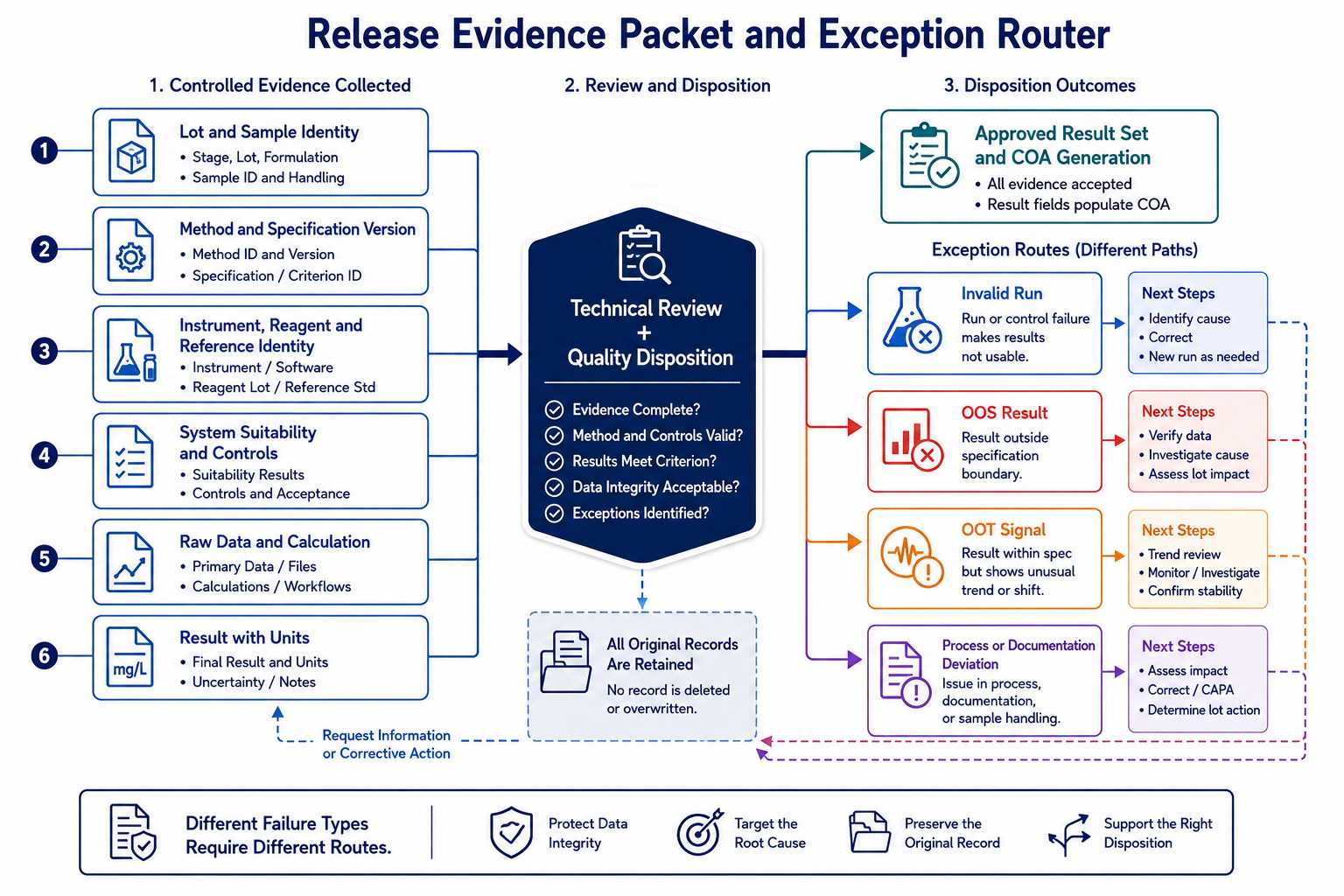 Fig 4. Release evidence packet and exception router. Lot disposition follows reviewed sample, method, control and result evidence; invalid runs, OOS results, OOT signals and deviations take different paths.
(Creative Enzymes Diagnostic)
The COA should let the recipient identify the material, understand what specification version governed the lot and interpret each reported result without exposing uncontrolled working data. The field set can be adapted to product format, customer agreement, intended use and jurisdiction. The following blueprint is a design aid, not a claim that every field is legally required for every RUO or industrial raw material.
Supplier/manufacturer identity as applicable; product name, catalog or material code, grade, lot/batch, formulation or concentration, package/size and document number/version.
Manufacture, test, release, expiry or retest dates where supported; storage, transport or handling statements linked to approved evidence.
| Test / attribute | Method reference | Specification | Lot result | Unit / status |
|---|---|---|---|---|
| Product-specific identity | Controlled procedure and version | Defined qualitative criterion | Actual interpretation or approved status | Qualitative |
| Enzyme concentration or activity | Controlled unit-assignment procedure | Approved one- or two-sided criterion | Reportable result with declared rounding | Defined unit |
| Purity or selected impurity | Controlled analytical procedure | Approved limit/range | Actual result or justified conformance statement | Defined basis |
| Functional application check | Product/platform-specific procedure | Approved response rule | Actual result, ratio or status as agreed | Defined output |
| Informational value | Controlled or referenced method | Not a release criterion, clearly labeled | Observed value | Informational |
Defines whether listed release requirements were met, how external tests or open exceptions are handled, and whether a separate certificate of conformance is used.
Authorized role, issue date, controlled electronic signature or equivalent, page control, supersession and contact or verification mechanism.
A qualitative “Pass” may be appropriate for identity, appearance or a defined functional interpretation. For quantitative tests, an actual result often supports supplier monitoring and downstream risk assessment; however, reporting precision should not exceed method capability. If a result is omitted, rounded, reported as below a limit or replaced by a conformance statement, that convention is defined and applied consistently. Tests performed by calculation, reduced-frequency testing or an external laboratory should not be presented as if they were newly measured by the issuing laboratory unless the approved system supports that statement.
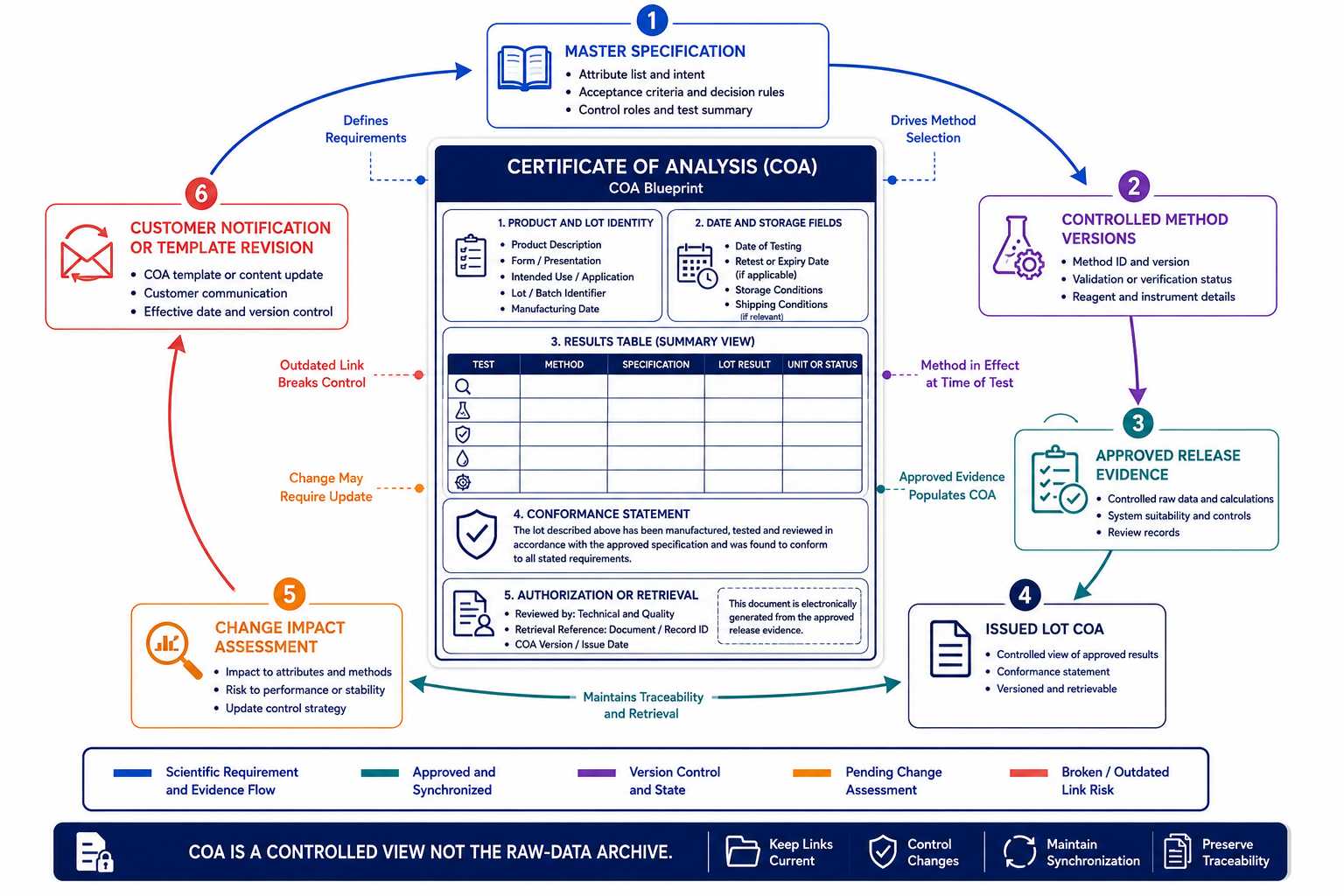 Fig 5. COA blueprint and lifecycle loop. The lot certificate is a controlled view of approved evidence and must stay synchronized with the master specification, methods, stability basis and change process.
(Creative Enzymes Diagnostic)
A release system becomes unreliable when a method, reference standard, product formulation or customer requirement changes in isolation. We can map change triggers and required impact assessments so the correct documents move together.
Process, host, formulation, method, site, package, standard or customer requirement.
Attributes, comparability, stability, sampling, method performance and supply commitments.
Targeted bridging, qualification, stability, lot comparison or functional confirmation.
Specification, method, worksheet, training, release record and COA template.
Sponsor disposition, effective date, inventory transition and agreed customer communication.
Formulation or storage changes may require stability and shelf-life testing. Process or site changes may need batch-to-batch consistency validation. Application sensitivity to matrix or component changes can be assessed through assay interference and matrix-effect evaluation. Production-stage findings can connect with enzyme production and engineering or expression and purification support.
Develop a core specification, test panel, release record and CoA template for Creative Enzymes or another raw-material supplier, with controlled customer variants and notification triggers.
Translate supplier documentation into identity/risk verification, periodic testing, supplier monitoring and discrepancy routes under the customer’s quality system.
Define sample transfer, method ownership, laboratory responsibilities, report content, technical review and final disposition when testing is divided across organizations.
A supplier COA can reduce duplicate testing, but it does not eliminate the customer’s responsibility to qualify the supplier and decide what verification is needed. Conversely, a customer-specific test should not be added to a supplier COA without agreement on method, sample, limit, data access, change control and cost of an exception.
| Work package | Technical activities | Decision output |
|---|---|---|
| Current-state audit | Review product definition, draft COA/specification, methods, lots, stability, process controls, deviations, customer agreements and applicable quality framework. | Gap map separating missing evidence, document inconsistency and unnecessary tests. |
| Attribute and risk mapping | Connect intended-use needs and failure modes to identity, activity, purity, residual, formulation, functional and stability attributes. | Attribute portfolio with proposed control role and rationale. |
| Method and sample readiness | Assess procedure version, measurand/unit, standards, system suitability, precision near limits, transfer state and sample representativeness. | Method-readiness matrix and development/qualification actions. |
| Criterion development | Integrate intended-use boundaries, representative lot data, analytical capability, stability, process knowledge and decision consequence. | Proposed acceptance criteria, reporting convention and decision rules. |
| Release workflow design | Define sample receipt, execution, calculations, technical review, exception routing, disposition interface, record retention and external-test handling. | Release-testing plan, evidence-packet index and responsibility map. |
| COA and controlled templates | Design product/lot fields, result table, conformance language, authorization, versioning and customer-specific variants. | Draft master COA, specification table and supporting templates. |
| Pilot and handoff | Exercise the package with representative data or a suitable pilot lot, resolve gaps and define change triggers, training and periodic review. | Implementation-ready package for sponsor approval and controlled deployment. |
Outputs are labeled according to their maturity and intended use. A draft specification or template becomes effective only through the sponsor’s approved quality system. Testing can be scoped separately for development or routine support; no release is implied until the responsible organization completes its review and disposition.
The specification is the controlled set of tests, procedure references and acceptance criteria for the product. The certificate of analysis is a lot-specific communication generated from approved results evaluated against the applicable specification. Changing a COA layout does not change the underlying specification unless the controlled master documents and approvals also change.
The panel depends on product identity, format, manufacturing process, intended downstream use, failure risk and customer agreement. It may include identity, concentration, defined activity, purity, selected impurities or residuals, formulation/physical properties and functional performance. Not every characterization test belongs on every-lot release, and no universal diagnostic-enzyme panel applies to all products.
Actual quantitative results can support customer monitoring and technical interpretation, but reported precision must match method capability. “Pass” can be appropriate for qualitative attributes or an agreed conformance statement. The convention should be defined by test type, quality agreement and use; underlying approved data remain traceable even when the certificate reports a status.
We first define the activity unit, substrate, reaction conditions, reference material, detection mode, calculation and downstream requirement. The boundary can then integrate method performance, representative lot data, stability behavior, process capability and functional consequence. A limit copied from another enzyme or method is not defensible unless the measurement and intended use are demonstrably comparable.
There is no universal number. The evidence must represent relevant sources of process, method, material, scale and stability variation and be proportionate to decision risk. Early provisional criteria may use limited development data with explicit assumptions; controlled routine criteria usually need broader evidence and ongoing review. More lots do not repair a biased method or unrepresentative sampling.
Only if it is fit for the release decision and controlled for routine use. The procedure needs an unambiguous measurand, sample preparation, reference/control system, system suitability, calculation, reportable range, decision-region performance and version. Complex characterization methods may be better suited to periodic or change-triggered use while a justified routine surrogate controls every lot.
System suitability asks whether the analytical run is valid—for example, whether controls, calibration or instrument response meet predefined requirements. The product specification asks whether a valid lot result meets the material criterion. A failed system-suitability test prevents interpretation; it does not by itself prove the product failed.
The decision rule should be declared before routine testing. Depending on method, risk, contract and quality framework, it may use the reported result directly, include a guard band or require another predefined action near the boundary. Selective rounding or ad hoc repetition is not an adequate rule. We document how uncertainty and reporting precision affect the conformance statement.
Not automatically. First determine whether the original run was invalid through documented evidence. If the run was valid and the result is outside specification, it remains part of the record while the approved investigation proceeds. Any repeat, resampling or orthogonal test should answer a stated hypothesis and follow a predefined procedure; the sponsor makes the final disposition.
Yes, when sample identity, shipment/handling, method and laboratory responsibility, report content, raw-data availability, review, exception communication and final disposition are defined. The COA should not imply that the issuing organization performed a test if the approved arrangement relies on an external report without appropriate attribution or control.
It can include a date when supported by a product-, package- and condition-specific stability program and approved by the responsible organization. A release result alone cannot establish shelf life. Relevant work can connect with diagnostic enzyme stability and shelf-life testing, including real-time confirmation and change assessment.
The service can organize analytical evidence and controlled documentation for a defined development or supplier-quality context. Applicability depends on product classification, intended use, jurisdiction, quality system, manufacturing role and contractual requirements. Creative Enzymes does not confer FDA clearance, CE marking, GMP release, QP certification, laboratory accreditation or submission acceptance; the sponsor or legal manufacturer retains those responsibilities.
To scope the project, share the product and format, intended downstream use, current specification and COA, manufacturing stage, candidate attributes, activity-unit definition, available methods and method status, representative lot and stability data, sampling/packaging approach, customer or market requirements, external-testing arrangements and any recurring release exceptions. We will map the evidence gaps and propose a specification, release and COA package sized to the actual decision.
Discuss Your Release Package