
Point-of-care testing (POCT) and biosensor systems move diagnostic measurement closer to the patient, production line, field site, or other location where an immediate decision is needed. These platforms often use microliter-scale samples, compact fluid paths, dry reagent deposits, rapid reaction windows, and portable readers. Their convenience depends on reagent systems that can produce reliable results without the tightly controlled environment and extensive liquid-handling infrastructure of a central laboratory.
Reagent behavior in a POCT device is shaped by more than biochemical activity. Whole-blood viscosity and hematocrit can alter sample flow; proteins and cells can foul membranes or electrodes; a dry reagent may not rehydrate uniformly; and ambient temperature or humidity may change reaction speed and signal intensity. Adhesives, plastics, electrode coatings, membranes, and desiccants can also interact with active ingredients. Consequently, a formulation that performs well in a tube or microplate may fail when deposited into the final strip, sensor, or cartridge.
Through our IVD reagent and kit contract manufacturing service, Creative Enzymes Diagnostic provides POCT and Biosensor Reagent Formulation services that connect assay chemistry with device materials, sample transport, dry-storage requirements, reader characteristics, and real-world operating conditions. We support formulation development, matrix management, deposition and drying studies, signal optimization, device integration, prototype testing, stability assessment, and scale-up preparation for rapid diagnostic platforms.
 Figure 1. Electrochemical biosensors for point-of-care testing. (Kim et al., 2024)
POCT reagent development begins with the intended testing scenario rather than with a generic buffer recipe. We define how the user will collect and apply the sample, how the device will transport and condition it, how quickly the result must appear, and how the signal will be interpreted. This use-context assessment establishes the practical boundaries for formulation and device integration.
Analytical Requirements
Use-Environment Requirements
Each device architecture creates a different physical and chemical environment for the reagent. Our formulation programs are configured around the platform's sample path, active surface, signal mode, and manufacturing method.
Strip, Membrane, and Dry-Chemistry Formats
Sensor, Cartridge, and Microfluidic Formats
Decentralized tests often accept specimens with minimal preparation, making the sample interface a critical part of reagent design. We evaluate how viscosity, cells, proteins, salts, pH, endogenous color, and potential interferents affect flow, reaction kinetics, recognition, and signal generation. The formulation and device may then be adjusted together to condition the sample before measurement.
Whole-blood assays must account for hematocrit, cell separation, hemolysis, clotting, anticoagulants, and reduced effective plasma volume. Development may involve red-cell separation materials, anticoagulant compatibility, spreading agents, lysis chemistry, filtration, or algorithms that compensate for matrix-dependent response. Plasma and serum tests may require control of protein adsorption, complement effects, lipemia, bilirubin, and sample-to-sample viscosity.
Alternative specimens can vary widely in pH, ionic strength, viscosity, microbial burden, and target concentration. Swab and extraction buffers must release the target while remaining compatible with downstream enzymes, antibodies, nucleic acid reactions, or sensor surfaces. For urine and saliva, buffer capacity, nonspecific adsorption, mucins, particulates, and variable dilution may need to be managed within the device.
Potential solutions are selected according to the assay mechanism and device limitations:
 Figure 2. Sample matrix of POCT and biosensor reagents. (Adapted from Park et al., 2022)
POCT formulations must deliver sufficient biochemical activity while supporting rapid transport, controlled rehydration, and stable signal generation in a confined device. We screen active ingredients and excipients in both bench reactions and device-relevant materials, then optimize the formulation around the dominant source of variability.
Active Reaction Components
Functional Excipients
Rapid tests must reach a stable, interpretable signal within a narrow time window. We adjust reagent loading, substrate availability, binding kinetics, buffer capacity, and transport rate to avoid both slow signal development and premature saturation. For quantitative sensors, the response is optimized across the intended range so that high-concentration samples do not exhaust reagents or exceed the reader's measurable window.
Small reaction volumes increase the impact of evaporation, surface adsorption, local concentration gradients, and incomplete mixing. We assess reagent distribution, contact angle, capillary behavior, surface-to-volume ratio, and the order in which the sample encounters each component. When necessary, reagents are divided among separate zones so that sample conditioning, target recognition, washing, amplification, and detection occur in a controlled sequence.
 Figure 3. (Top) Schematic illustration for fabricating the molecular imprinting system that contains the biorecognition sites and (bottom) the example of natural biorecognition system; enzyme–substrate complex (left) and antigen–antibody reaction (right); the biomimetic functional similarity of the MIP biosensing system is comparable to natural antibodies. (Adapted from Park et al., 2022)
A POCT reagent cannot be optimized independently of the materials that contain or transport it. Nitrocellulose, glass fiber, cellulose, polymers, adhesives, electrode inks, hydrogels, and molded plastics may bind proteins, alter enzyme activity, contribute extractable substances, or change fluid movement. We screen relevant materials early so that incompatibilities are identified before the device design is fixed.
Membrane and Porous-Material Evaluation
Sensor and Cartridge Evaluation
 Figure 4. Various types of immunoassay-based benchtop-scale POCT devices. (Adapted from Park et al., 2022)
Many POCT products rely on reagents stored as dried films, spots, beads, pellets, or membrane deposits. Drying can protect the device from leakage and simplify operation, but it can also denature enzymes, alter antibody binding, aggregate particles, redistribute salts, or create a deposit that dissolves unevenly. The formulation and drying process must therefore be developed together.
We evaluate sugars, polyols, amino acids, polymers, proteins, surfactants, antioxidants, and other protective excipients for activity retention during drying and storage. Depending on the device, studies may address passive air drying, controlled-convection drying, vacuum drying, lyophilization, or dried-bead preparation. Process parameters are selected to limit thermal and interfacial stress while producing a reproducible deposit.
Dispense volume, reagent concentration, line width, droplet placement, drying rate, and substrate absorbency determine the amount and spatial distribution of active reagent. We assess deposit uniformity and functional response rather than relying only on nominal loading. For multi-zone devices, the position and release sequence of conditioning, conjugate, amplification, and detection reagents are coordinated with sample flow.
Dry reagents must dissolve or release rapidly without creating concentrated pockets, precipitates, or delayed background. Testing examines rehydration time, residual material, particle migration, conjugate release, local pH, and activity recovery. Formulation changes may be combined with membrane treatment, pad selection, flow geometry, or reagent-zone redesign.
The detection chemistry must be matched to the reader, device geometry, and intended decision point. We optimize signal magnitude, development time, background, dynamic range, and persistence according to whether the result is visually interpreted or instrument measured.
Optical Detection
Electrochemical Detection
Bench chemistry is transferred into representative devices as early as practical. Prototype integration reveals interactions among formulation, sample flow, component placement, reader settings, and user operation that cannot be predicted from solution testing alone. Iterative device testing is used to distinguish chemistry limitations from material, fluidic, or reader limitations.
Although full usability validation is a separate activity, formulation development should anticipate realistic operating variation. We can examine the effects of under- or over-applied sample, incomplete mixing, delayed buffer addition, timing variation, device orientation, and common handling deviations. The resulting data can guide reagent tolerance, internal control design, workflow simplification, and instructions for use.
POCT products may be transported or stored outside tightly controlled laboratory conditions. We evaluate how temperature, humidity, light, oxygen, vibration, and package opening affect reagent activity, flow, signal, and device validity. The study design reflects the proposed storage claim, geographic distribution, packaging configuration, and use environment.
Stability Conditions
Packaging Considerations
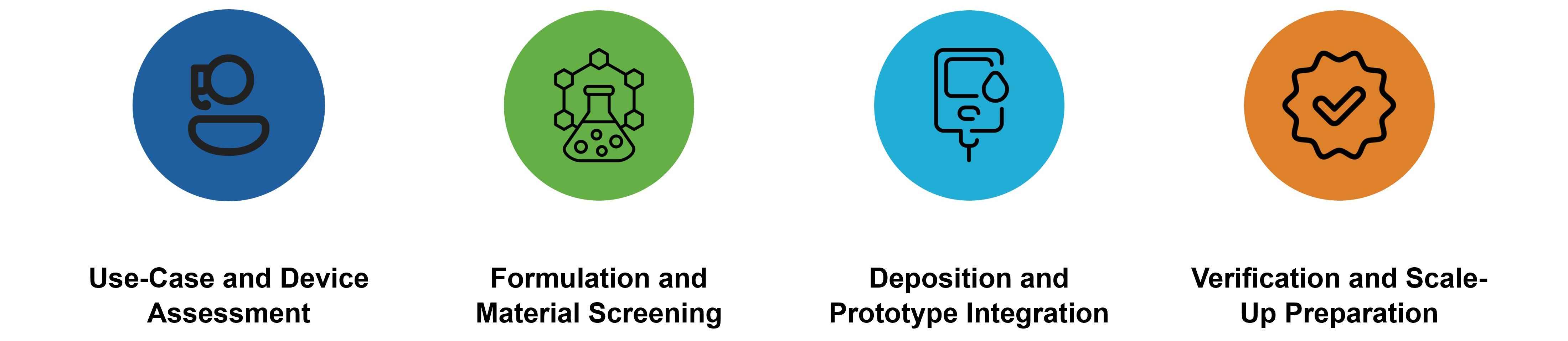
Deliverables are configured according to the platform and project stage. A typical POCT or biosensor formulation program may include:
| Item | Description |
|---|---|
| Use-Case and Device Compatibility Assessment | Review of the intended specimen, result type, operating environment, device materials, fluid path, reader, storage conditions, and principal formulation risks. |
| Optimized POCT Reagent Formulation | Recommended active components, buffers, stabilizers, blockers, surfactants, mediators, preservatives, and critical preparation conditions. |
| Matrix and Interference Strategy | Findings on sample variability, major interferents, conditioning requirements, and formulation or device measures used to control matrix effects. |
| Deposition and Drying Recommendations | Recommended loading concentration, dispense volume, reagent placement, drying approach, protective excipients, and rehydration conditions. |
| Integrated Prototype Devices | Development-stage strips, sensors, cartridges, reagent pads, or other prototype units prepared in the agreed configuration. |
| Performance and Robustness Data | Results from agreed analytical range, precision, specificity, interference, timing, sample-volume, matrix, environmental, and device-variation studies. |
| Stability and Packaging Recommendation | Available stability data and recommendations for storage, pouch or container configuration, desiccant, transport, open-pouch use, and further shelf-life studies. |
| Scale-Up and QC Plan | Critical raw material, formulation, deposition, drying, assembly, and functional testing parameters for pilot production and lot-release planning. |
Q1. At what stage should POCT reagent formulation begin?
Q2. Can you optimize reagents for an existing strip, sensor, or cartridge?
Q3. How do you address hematocrit effects in whole-blood POCT assays?
Q4. Can liquid reagents be converted into a dry-reagent format?
Q5. Do you support both optical and electrochemical biosensors?
Q6. What materials or information should we provide at project initiation?
Creative Enzymes Diagnostic integrates reagent chemistry, enzyme and recognition-reagent expertise, dry-format development, matrix evaluation, and device-oriented testing to support practical POCT and biosensor products. By developing the formulation within the actual sample path and use environment, we help clients reduce device-integration risk and establish a reproducible foundation for pilot manufacturing.
Contact our business development team today to discuss your POCT or biosensor reagent formulation needs!
