
IVD reagent performance can depend heavily on a small number of critical raw materials. A discontinued enzyme, changed antibody source, inconsistent substrate, extended lead time, or supplier process change can interrupt production or alter assay behavior. Replacing that material based only on a matching name or specification sheet creates significant risk because materials with similar stated properties may perform differently in the complete diagnostic system.
Through our IVD reagent and kit contract manufacturing service, Creative Enzymes Diagnostic provides supply chain replacement and raw material equivalency studies for diagnostic reagents and kits. We help clients identify replacement candidates, define fit-for-purpose comparability criteria, characterize material differences, evaluate assay-level performance, adjust formulations when necessary, confirm stability and manufacturability, and document controlled implementation.
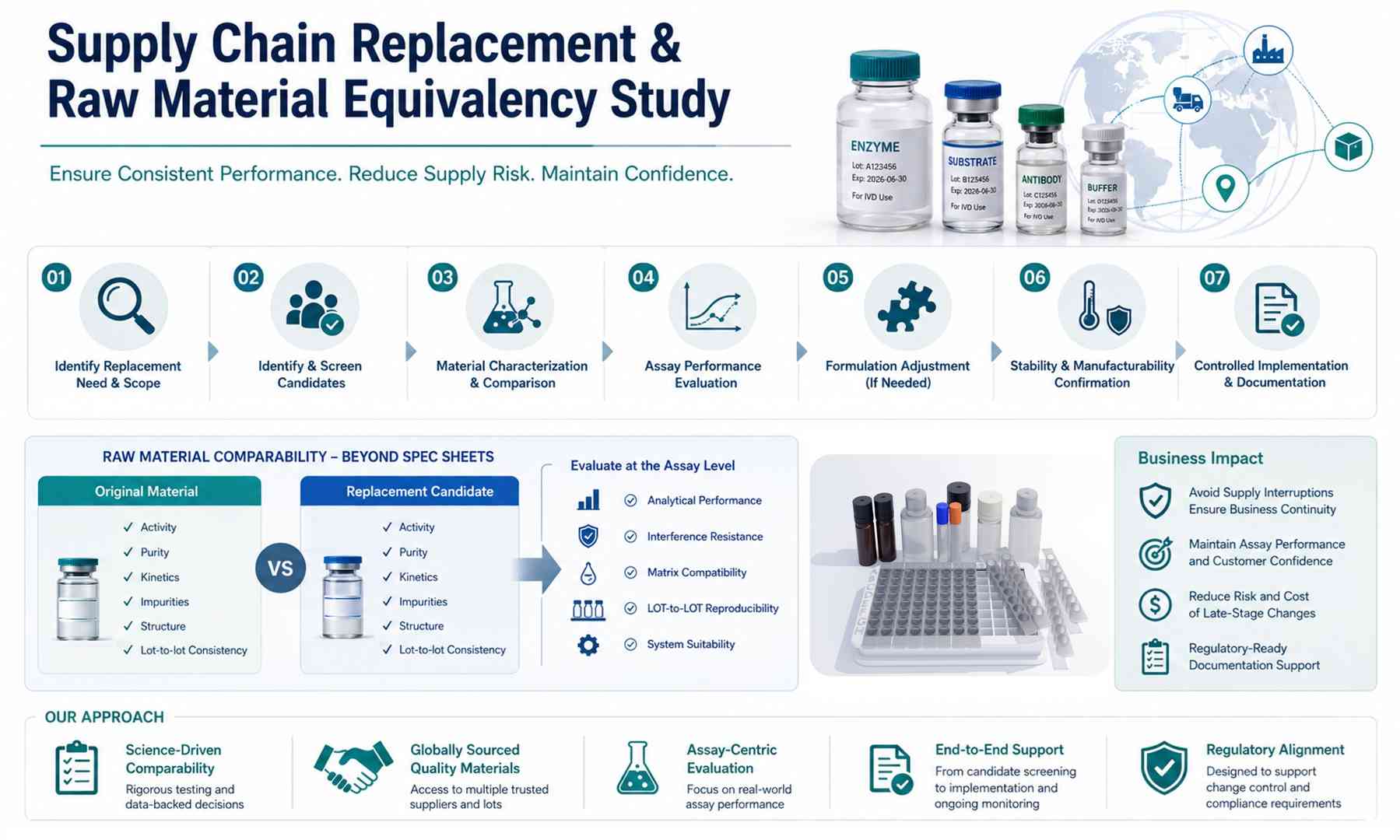
A replacement study may be reactive, such as responding to a discontinuation, or proactive, such as qualifying a second source before disruption occurs. The study scope depends on the material's function, the degree of change, historical variability, assay sensitivity, product maturity, and available inventories of the current material.
Supply-Driven Triggers
Quality- and Change-Driven Triggers
Equivalency must be defined according to the material's actual function in the assay. A buffer salt may be assessed mainly by chemical properties, while an enzyme, antibody, membrane, or nanoparticle usually requires substantial functional testing.
| Material Category | Examples of Critical Differences |
|---|---|
| Diagnostic Enzymes | Specific activity, isoform, substrate selectivity, inhibitor tolerance, cofactor dependence, formulation, stability, and contaminating activities. |
| Antibodies and Antigens | Affinity, epitope recognition, specificity, conjugation behavior, matrix response, aggregation, concentration, and production source. |
| Substrates and Signal Reagents | Purity, background, reaction rate, light sensitivity, oxidation state, spectral behavior, solubility, and lot stability. |
| Buffers and Excipients | Grade, water content, counter-ion, pH contribution, impurities, preservative content, conductivity, and compatibility with active components. |
| Particles, Membranes, and Sensor Materials | Particle size, surface chemistry, binding capacity, flow rate, pore structure, background, mediator response, and material extractables. |
| Containers and Packaging Components | Material composition, adsorption, moisture barrier, light protection, closure performance, evaporation, and reagent-contact compatibility. |
Not every material change requires the same study depth. We assess how the material contributes to target recognition, catalytic conversion, signal generation, stabilization, fluid transport, calibration, or packaging. The risk assessment also considers the amount used, available specifications, supplier history, assay tolerance, and whether the material can be adjusted without changing the product configuration.
Material Risk Factors
Product Risk Factors
The outcome defines the comparison attributes, sample panel, number of candidate and reference lots, statistical approach, acceptance criteria, and implementation evidence. High-risk materials are evaluated at both the material and finished-assay levels.
Candidate search begins with a functional requirement profile rather than a product name alone. Supplier data are reviewed for material source, production method, grade, purity, concentration, activity definition, formulation, storage, shelf life, scale availability, lot controls, and change-notification practices.
Specifications from the current and candidate materials are aligned to identify true matches, unreported attributes, and differences in test methods or units. For enzymes, for example, activity values cannot be compared directly unless the substrate, buffer, pH, temperature, reaction time, and unit definition are compatible. For antibodies, concentration alone does not establish equivalent binding behavior.
Small-scale experiments eliminate unsuitable candidates before a full equivalency study. Candidates may be tested in the current formula at matched mass, concentration, activity, or functional input. Key outputs such as signal, blank, kinetics, recovery, flow, binding, amplification, or control response are compared with the existing material. Candidates requiring major redesign can then be separated from those suitable for direct or adjusted replacement.
Characterization is selected according to the material and identified risk. Supplier certificates provide useful information but may not include the attributes that drive assay performance. Independent or comparative testing helps explain why a candidate succeeds or fails and supports suitable incoming specifications.
Physicochemical Characterization
Functional Characterization
An equivalency study is designed to show whether the proposed material maintains the attributes that matter for the finished assay. The current material or an approved reference lot is tested alongside the candidate under matched manufacturing, analytical, and sample conditions. Acceptance criteria are established before testing and should reflect meaningful product performance, not only analytical noise.
A single candidate lot may not represent routine supply. When material variability is a significant risk, the study includes multiple candidate lots and, where practical, more than one current-material lot. This helps distinguish systematic supplier differences from normal lot variation and supports realistic incoming acceptance criteria.
The candidate material is evaluated within the finished reagent or kit because small material differences may be amplified by the complete reaction. The exact test panel depends on the product and risk assessment.
Core Performance
Robustness and Compatibility
Results are reviewed for both statistical agreement and practical impact. A small average difference can still be important if it is concentrated near a cutoff, affects the low end of the range, or creates a systematic calibration shift.
Some candidates are functionally suitable but are not true drop-in replacements. Differences in concentration, activity, carrier buffer, salt, stabilizer, particle surface, or moisture content may require adjustment. A bridging study determines whether limited changes can restore equivalent finished-product performance without unnecessary reformulation.
If the required change alters the product more broadly, the project scope can be expanded from material equivalency to controlled product redevelopment. The distinction is documented so that the evidence package matches the actual extent of change.
Initial comparability does not prove that the replacement will behave the same throughout shelf life or routine manufacture. The candidate is assessed under relevant storage, handling, and process conditions, with the study depth based on material and product risk.
Stability Confirmation
Pilot Manufacturing Confirmation
Approved replacement is implemented through controlled updates to the bill of materials, supplier list, material specification, incoming inspection, manufacturing instructions, analytical methods, stability plan, and related records. The timing of inventory transition is planned to prevent unintended mixing of old and new materials.
Where both sources remain active, the control strategy defines whether they can be used interchangeably or require source-specific adjustment. Initial production lots may receive enhanced testing, and performance is trended to confirm that the study conclusion remains valid under routine supply. Future supplier changes are evaluated against the attributes identified during the equivalency program.
| Item | Description |
|---|---|
| Material Criticality and Supply Risk Assessment | Evaluation of material function, product impact, supplier risk, replacement urgency, study depth, and affected products or processes. |
| Candidate Material Shortlist | Comparison of potential suppliers and materials, with specification gaps, availability, functional-screening results, and selection rationale. |
| Comparative Characterization Report | Physicochemical and functional comparison of current and candidate materials, including relevant lot-to-lot findings. |
| Equivalency Study Protocol | Predefined materials, reagent batches, sample panel, replicates, performance tests, comparison methods, and acceptance criteria. |
| Assay Equivalency Data Package | Results for agreed sensitivity, precision, range, calibration, cutoff, recovery, interference, robustness, controls, and discrepancies. |
| Bridged Formulation or Usage Recommendation | Recommended concentration, activity normalization, formulation adjustment, process change, or source-specific instruction where required. |
| Stability and Manufacturing Confirmation | Available stress, real-time, in-use, processing, pilot-batch, yield, filling, and finished-product comparison data. |
| Implementation and Change-Control Package | Approved supplier and material specifications, document updates, inventory-transition plan, monitoring recommendations, and final conclusion. |
Q1. Is matching the supplier specification enough to establish raw material equivalency?
Q2. Can you identify an alternative if the original material is already unavailable?
Q3. How many candidate lots should be included?
Q4. What if the new material does not work at the same concentration?
Q5. Is long-term stability required before the replacement can be introduced?
Q6. Can the same equivalency study support several diagnostic kits?
Creative Enzymes Diagnostic combines diagnostic raw material expertise, assay development, analytical characterization, formulation optimization, and pilot manufacturing to support controlled supply chain replacement. By linking supplier attributes to finished-assay performance, we help clients qualify practical alternatives without treating materially different sources as equivalent by name alone.
Contact our business development team today to discuss your diagnostic raw material replacement or equivalency study needs!
