
When an isothermal assay is slow, variable, matrix-sensitive, or positive in the no-template control, which event actually loses the reaction race: target access, primer invasion, strand-displacement synthesis, enzyme-to-enzyme handoff, signal generation, or suppression of background?
Creative Enzymes develops and optimizes enzymes and multi-enzyme systems for LAMP, RT-LAMP, recombinase polymerase amplification (RPA), RT-RPA, and other scoped isothermal amplification mechanisms. A project can combine mechanism triage, scaffold selection, AI-guided variant design, component-ratio studies, expression and purification, biochemical measurements, kinetic amplification screens, target and no-template challenge panels, formulation compatibility, and transfer-oriented evidence. Most outputs are intended for research use. Selected programs may support industrial molecular diagnostic reagent raw-material development under an agreed scope; they are not finished tests and do not establish regulatory authorization.
A constant incubation temperature does not make the underlying biochemistry simple. Productive amplification must begin from the correct target, generate an extendable intermediate, expose or invade the next binding site, displace an existing strand, recycle the amplification structure, and create a measurable signal. At the same time, primers can interact with one another, enzymes can extend unintended structures, detection components can generate background, and high product concentrations can contaminate later reactions.
The useful performance window is therefore defined by two clocks. The target-positive clock should start within an agreed range across representative inputs and conditions. The background clock should remain sufficiently later, lower, or absent within the intended read time. An enzyme variant that shortens both clocks by the same amount may not improve the assay. A formulation that delays every reaction may look cleaner while losing low-input performance. We retain both trajectories and the product identity rather than ranking variants by the first threshold time alone.
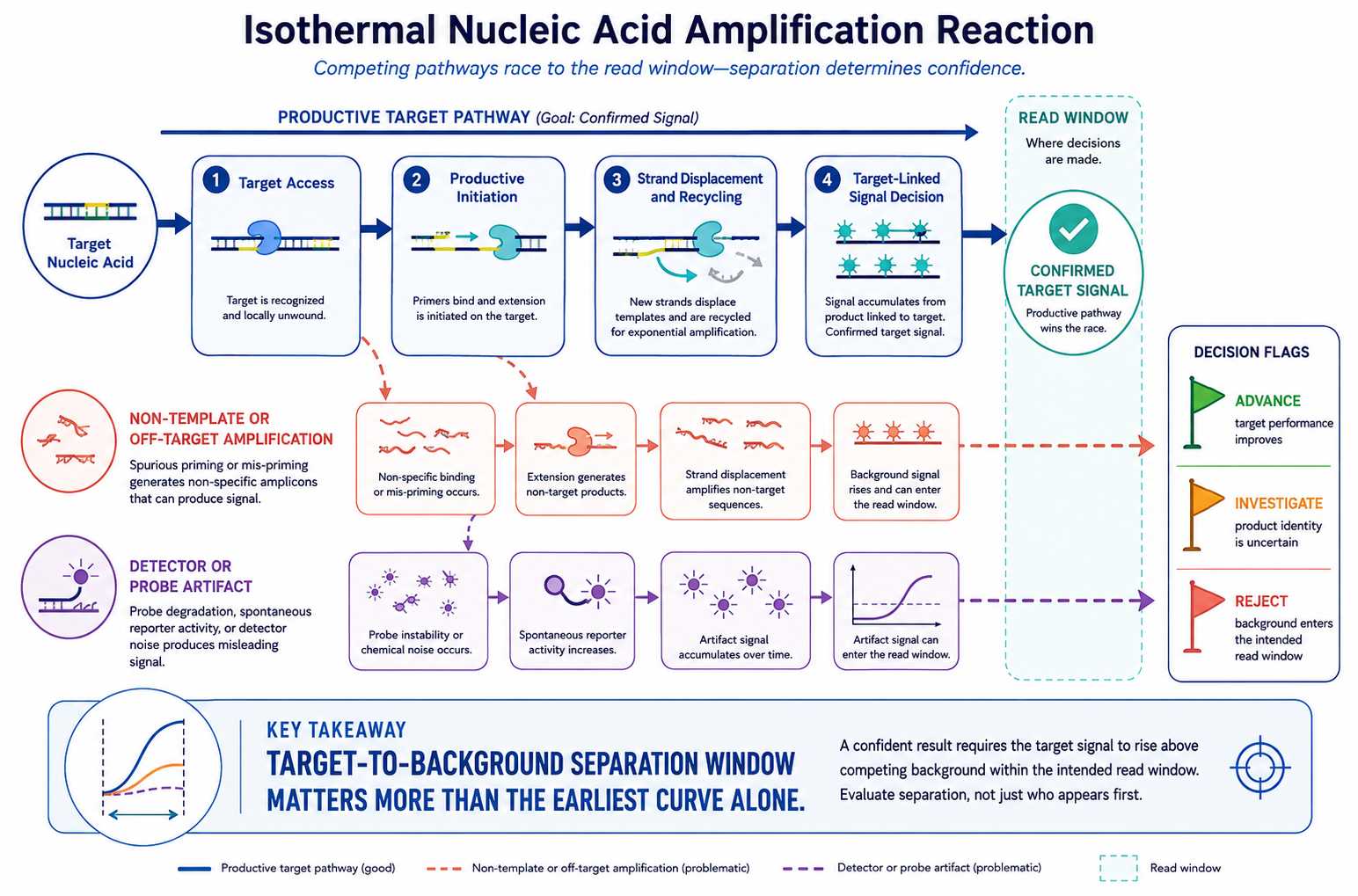 Fig 1. Isothermal amplification reaction race. Target access, productive initiation, displacement and recycling, signal generation, and competing background paths are measured as linked events rather than reduced to a single polymerase speed value.
(Creative Enzymes Diagnostic)
Before engineering begins, source-triage experiments can compare enzyme lots, primer sets, target templates, reaction temperatures, magnesium activation, detection formats, matrices, and component omission or substitution. These experiments determine whether the next investment should be sequence engineering, enzyme-team rebalancing, primer or probe redesign, formulation development, sample preparation, or a different isothermal mechanism.
Different isothermal technologies solve template opening and amplification in different ways. LAMP builds self-recycling stem-loop structures using a complex primer set and a strand-displacing polymerase. RPA uses recombination proteins to place primers on duplex DNA, an SSB to stabilize displaced strands, and a strand-displacing polymerase to extend them. HDA uses a helicase to separate strands. SDA and NEAR couple strand-displacement synthesis with nicking. RCA and MDA rely on highly processive strand-displacing polymerases acting on circular or multiply primed templates.
The service is not limited to one commercial enzyme family, but feasibility depends on access to sequences, constructs, substrates, detection reagents, licensing or design restrictions supplied by the client, and an assay that can distinguish useful function from background. The mechanism router below clarifies which enzyme classes and failure modes belong in the initial scope.
| Platform lane | Core enzymatic event | Engineering or selection targets | System variables that can reorder variants | Key background or failure check |
|---|---|---|---|---|
| LAMP / RT-LAMP | Primer-driven formation and recycling of stem-loop products through strand-displacement synthesis | Strand displacement, extension rate, RT activity, temperature range, inhibitor tolerance, dUTP compatibility, storage behavior | Primer set, betaine or additives, magnesium, dNTPs, temperature, detection chemistry, RT pairing, pyrophosphate handling | No-template onset, product identity, off-target panel, target-to-background time gap |
| RPA / RT-RPA | Recombinase-mediated primer targeting followed by SSB-supported displacement synthesis | Recombinase loading and search, SSB interaction, polymerase compatibility, RT activity, temperature tolerance, component stability | Protein ratios, ATP/regeneration, crowding, magnesium activation, mixing, addition order, primer/probe design, nuclease detection | Primer noise, baseline probe cleavage, protein precipitation, unequal reaction start, non-target recombination |
| HDA | Helicase-driven duplex opening with coordinated polymerase extension | Helicase turnover, polymerase speed and displacement, SSB compatibility, common temperature and buffer window | ATP, helicase/polymerase ratio, SSB, salt, amplicon design, temperature, secondary structure | Incomplete opening, primer-independent products, enzyme competition, ATP depletion |
| SDA / NEAR | Nicking creates a renewable extension site that drives strand displacement | Nicking specificity and turnover, polymerase displacement, recognition-site compatibility, heat and formulation behavior | Nicking-site design, enzyme ratio, dNTP or modified nucleotide, magnesium, temperature, reporter system | Off-target nicking, background extension, exhausted nicking cycle, detection uncoupling |
| RCA / MDA | Long, processive strand-displacement synthesis on circular or multiply primed templates | Processivity, strand displacement, fidelity, temperature, inhibitor tolerance, bias, exonuclease behavior | Template circularization, primer protection, random-primer composition, contamination, branch resolution, product use | Template-independent amplification, amplification bias, primer degradation, noncircular template carryover |
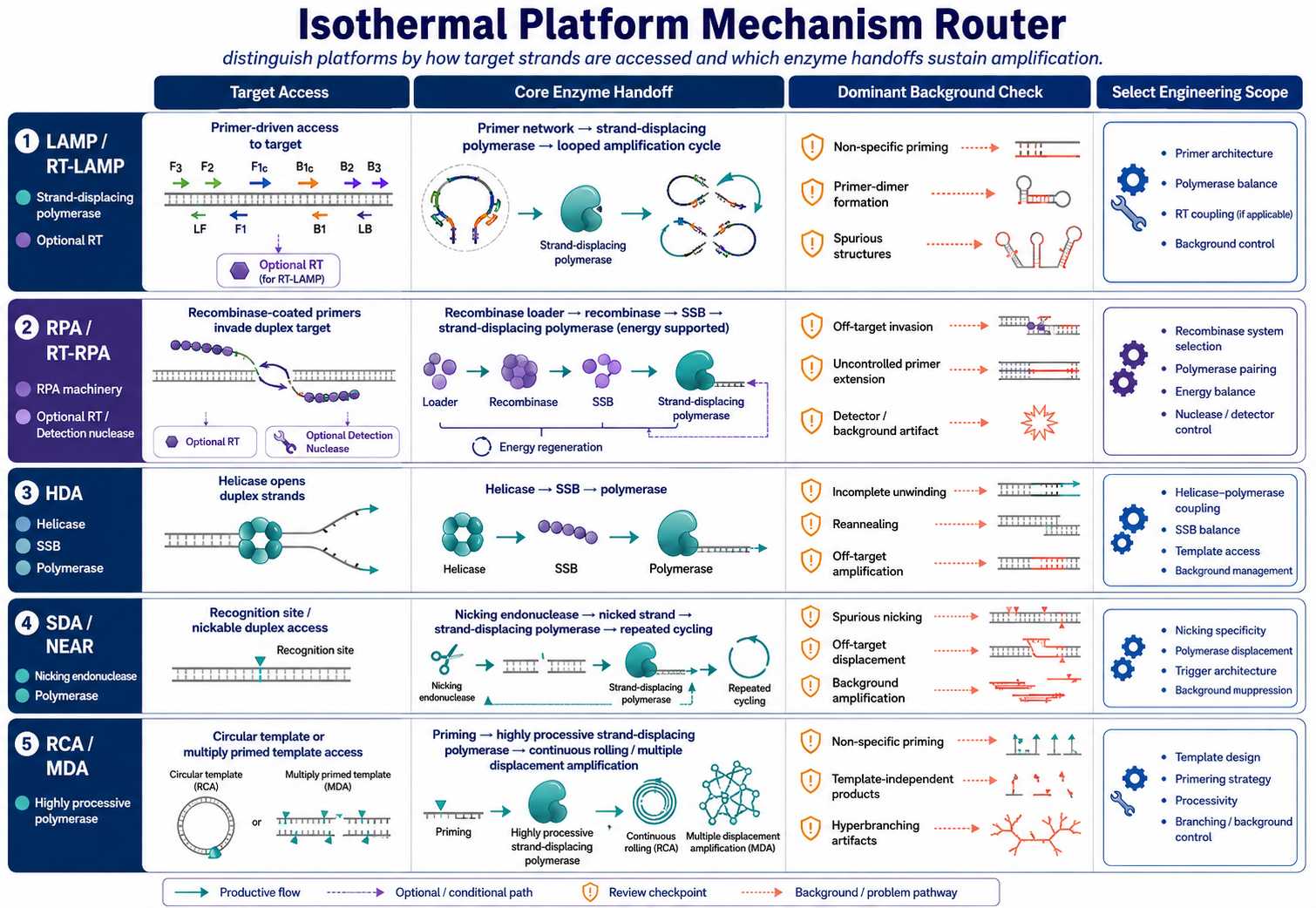 Fig 2. Isothermal platform mechanism router. LAMP, RPA, HDA, SDA/NEAR, and RCA/MDA are separated by how target strands are accessed and which enzyme handoffs sustain amplification, preventing a one-polymerase-fits-all development plan.
(Creative Enzymes Diagnostic)
Projects centered on complete LAMP or RT-LAMP formulation, primer-set optimization, and application validation can also use our LAMP and RT-LAMP reagent development service. Projects centered on digital partitioning can connect to digital PCR and digital LAMP reagent development. This page focuses on the enzymes and enzyme-team interactions that enable those systems.
Isothermal amplification often becomes strongly nonlinear after initiation. A threshold time can be convenient, but it merges target binding, initiation lag, polymerase extension, product topology, dye or probe response, and analysis settings. It also hides whether the no-template control has moved closer to the target-positive reaction. We build a kinetic fingerprint that preserves the measurements needed for the actual decision.
For LAMP, the fingerprint can include target amplification time, no-template amplification time, target-to-background interval, melt or anneal profile where appropriate, product size or sequence confirmation, endpoint yield, replicate success, and behavior across primer sets. Kinetic studies of LAMP show why this matters: target invasion during initiation can control reaction timing, so a polymerase with higher bulk activity may not address the limiting step. A useful screen can therefore include defined initiation substrates or multiple target architectures alongside complete LAMP reactions.
For RPA, the curve can be influenced by recombinase filament formation, homology search, strand exchange, SSB binding, polymerase extension, ATP regeneration, magnesium activation, mixing, and probe-cleavage kinetics. Late fluorescence can reflect a change in detection-enzyme balance rather than increased amplicon production. We can pair real-time readouts with direct product analysis or alternative detection to distinguish amplification from reporter behavior.
The central question is whether one component is intrinsically limiting or whether the team is mismatched. A sequence change can improve an isolated activity yet impair partner binding, common-buffer performance, dry-formulation stability, or the timing required for the next enzyme. For that reason, we test relevant candidates both in a direct biochemical assay and in a recombined system in which partners can be exchanged or titrated.
The original RPA mechanism couples recombinase-driven primer targeting to strand-displacement synthesis. A practical development system may include a recombinase mediator, SSB, energy regeneration, magnesium activation, optional RT, and a probe-processing enzyme. These steps can be studied in modules, but the final ranking must come from the complete relay. For example, increasing SSB can stabilize displaced strands but can also change primer or template access; changing recombinase concentration can affect filament formation and background; a polymerase with high isolated activity may be poorly matched to the invasion intermediate.
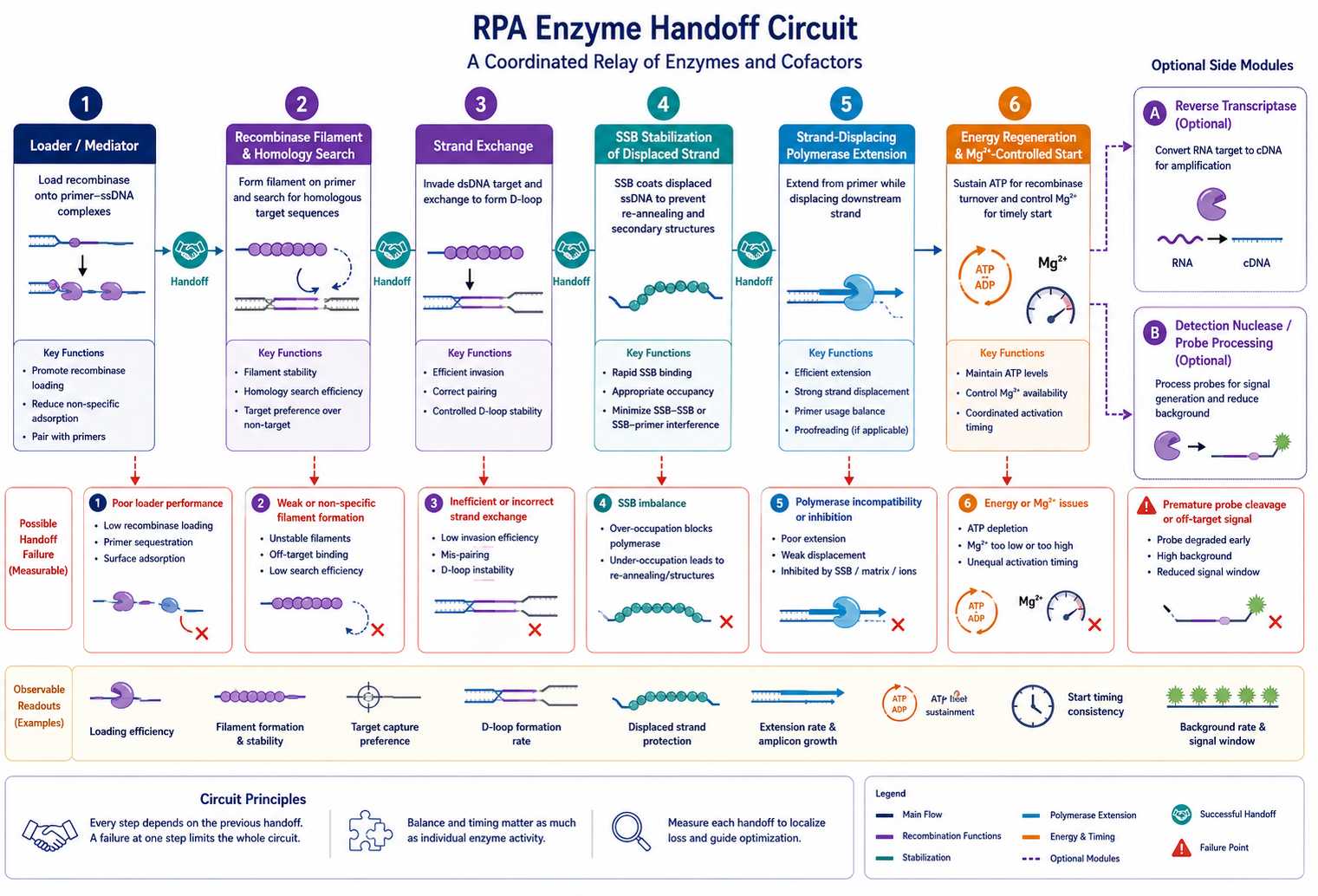 Fig 3. RPA enzyme handoff circuit. Primer loading, recombinase search and exchange, SSB stabilization, polymerase extension, energy regeneration, and optional RT or detection nuclease are treated as a coordinated relay with measurable handoff failures.
(Creative Enzymes Diagnostic)
Other platforms receive the same handoff analysis. In HDA, the helicase, SSB, and polymerase must share a temperature, salt, ATP, and substrate window. In SDA or NEAR, the nicking enzyme must create sites at a rate compatible with polymerase extension and strand displacement. In RCA, processivity and branch displacement may be useful, while proofreading exonuclease can affect unprotected primers. The target product profile is written around the chosen template topology and detection method.
AI-guided isothermal optimization has two interacting search spaces. The first contains enzyme sequences, domains, fusions, homologs, and mutations. The second contains component ratios, primer or probe architecture, temperature, buffer, energy chemistry, matrix, detection, and storage format. A candidate that performs best in one formulation may not remain best after magnesium, crowding agent, RT, SSB, or detection nuclease changes.
We therefore separate sequence proposals from system conclusions. Sequence and structure models can prioritize positions associated with thermostability, nucleic-acid interaction, conformational dynamics, partner interfaces, expression, or known catalytic motifs. Homolog mining can identify different starting behaviors. Once project data are available, supervised or active-learning models can learn local sequence-function relationships. The models rank experiments; they do not prove enzyme performance.
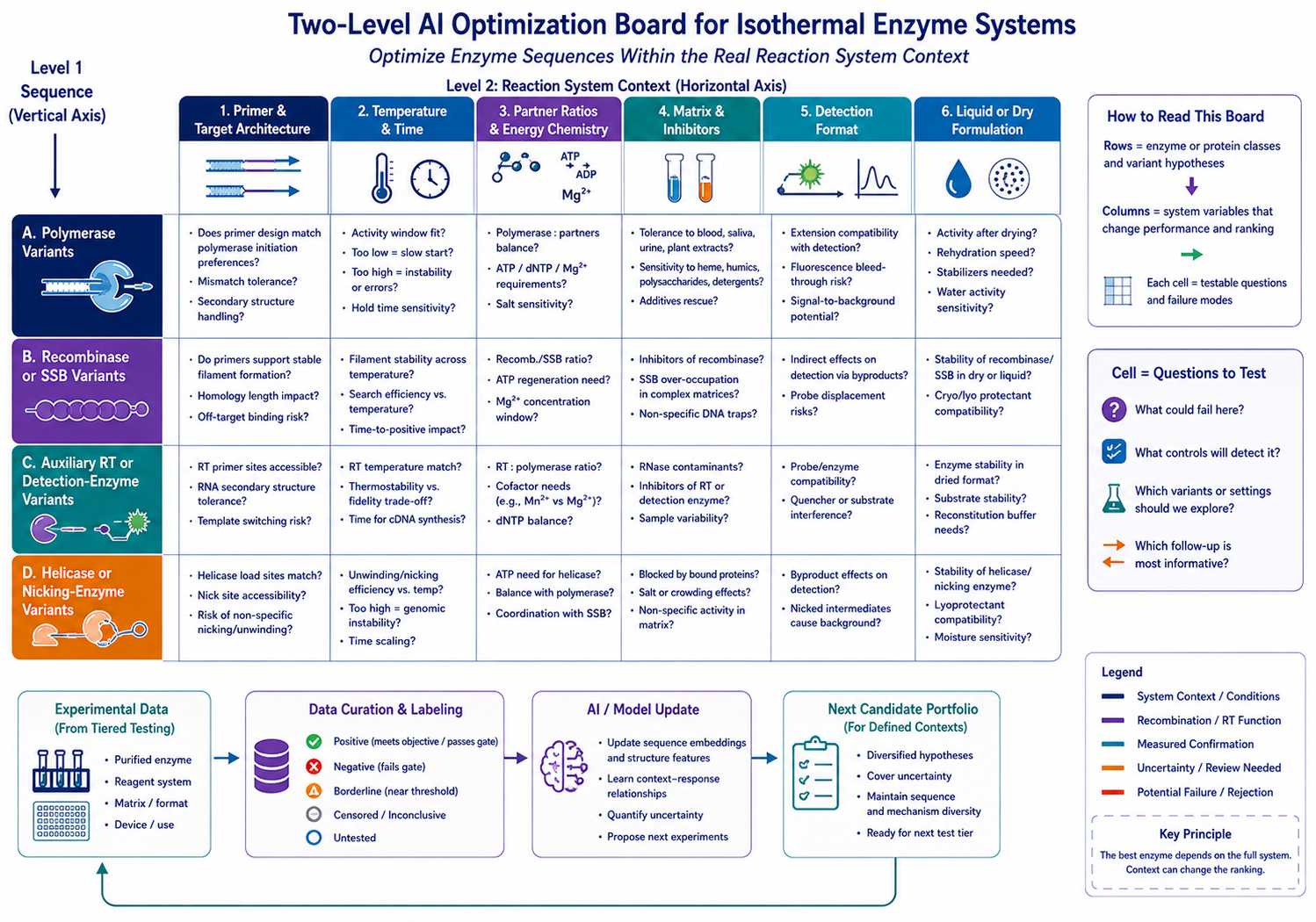 Fig 4. Two-level AI optimization board. Polymerase, recombinase, SSB, RT, nuclease, helicase, or nicking-enzyme hypotheses are tested across primer, temperature, partner-ratio, matrix, detection, and formulation contexts that can change variant ranking.
(Creative Enzymes Diagnostic)
A candidate portfolio can include high-confidence exploit designs, sequence-diverse explore designs, stabilizing or expression-rescue combinations, parent and comparator controls, and variants chosen to distinguish competing mechanisms. Negative, borderline, and censored results are retained. If an enzyme is inactive, poorly expressed, precipitated, or measured outside the detector range, that label is not converted into a normal quantitative value for model training.
The project can connect to our AI-guided diagnostic enzyme variant design and screening service when the sequence campaign is the primary scope, or to activity and kinetic performance optimization when the central need is a qualified kinetic method. Polymerase and RT questions that are not specific to an isothermal platform can be handled through molecular diagnostic polymerase and reverse transcriptase engineering.
A screening campaign is only as useful as the decision it reproduces. A simple fluorogenic substrate may enable high throughput but fail to represent strand invasion, complex primer structures, protein partners, or the product topology of the final system. We use a tiered strategy in which material quality and direct enzyme function support interpretation, while complete-reaction measurements decide application fit.
Polymerase candidates can first be compared for extension, strand displacement, processivity, reverse-transcription activity where applicable, inhibitor response, dUTP compatibility, and thermal durability. Complete LAMP testing then uses target and no-template reactions across multiple primer sets or target structures. Variables can include polymerase concentration, temperature, magnesium, dNTPs, betaine or other additives, RT pairing, pyrophosphatase, UDG workflow, detection dye or probe, and read time. Product identity is checked when nonspecific amplification or detector ambiguity could affect selection.
Primer-generated background is not automatically an enzyme defect. A highly active polymerase may expose a weak primer design by extending transient structures. We can determine whether the right decision is to reduce low-temperature or nonspecific extension, improve target initiation, change the primer set, add a warm-start control, modify the detection scheme, or narrow the read window. The output records which lever changed the target/background separation.
RPA candidates can be studied through controlled substitutions and component titrations. Recombinase, loader, SSB, and polymerase materials are normalized and recombined so that one component can be varied while others remain defined. The screen can examine primer loading, homology-dependent extension, component ratios, ATP and regeneration chemistry, crowding, magnesium activation, mixing, reaction temperature, optional RT, and probe-processing enzymes. Complete reactions include target, no-template, non-target, and probe-only or component-omission controls as relevant.
Addition order and start synchronization are part of the method. Magnesium can activate the reaction immediately; premature probe exposure or unequal mixing can create baseline and replicate artifacts. Protein-rich and crowded reactions can also interfere with downstream gel or lateral-flow analysis. We separate amplification performance from post-amplification detection and specify cleanup or dilution where the chosen readout requires it.
HDA studies can map the common operating window of helicase, SSB, and polymerase and determine whether ATP depletion, duplex opening, or extension limits the reaction. SDA or NEAR studies can compare nicking turnover with displacement synthesis and assess recognition-site or nucleotide restrictions. RCA/MDA studies can evaluate circular-template dependence, processivity, branch displacement, proofreading behavior, primer protection, template-independent amplification, and amplification bias. The screen is designed around the intended product, not a generic endpoint fluorescence response.
Not every project should proceed to a large mutation campaign. The reaction evidence may show that an existing enzyme is adequate but used at an unfavorable ratio, that a primer set creates background faster than the target, that two individually strong enzymes are incompatible, or that the chosen platform mechanism cannot meet the temperature, matrix, detection, or product-format requirement.
Decision gates are agreed before expensive downstream work. A first gate may ask whether the assay source has been localized. A second may ask whether target/background separation improves across more than one target. A third may require independent material, formulation compatibility, and a representative matrix. The number of gates, candidates, and design rounds is project-specific; no outcome or fixed timeline is promised.
When direct-sample tolerance is central, the program can connect to direct PCR and extraction-free enzyme-system development. When drying or ambient storage is central, the enzyme team can transition into lyophilized enzyme formulation development or the planned AI-assisted thermostability and lyophilization-stability engineering service. Intrinsic enzyme stability and complete dry-reagent stability are treated as separate evidence.
A transferable lead is not simply the sequence with the earliest curve. Lead confirmation connects exact enzyme identity and material state to the mechanism, the enzyme-team composition, the kinetic fingerprint, product identity, challenge conditions, formulation, and manufacturability. Independent expression or preparation can be included to show that the result follows the candidate rather than a single material batch.
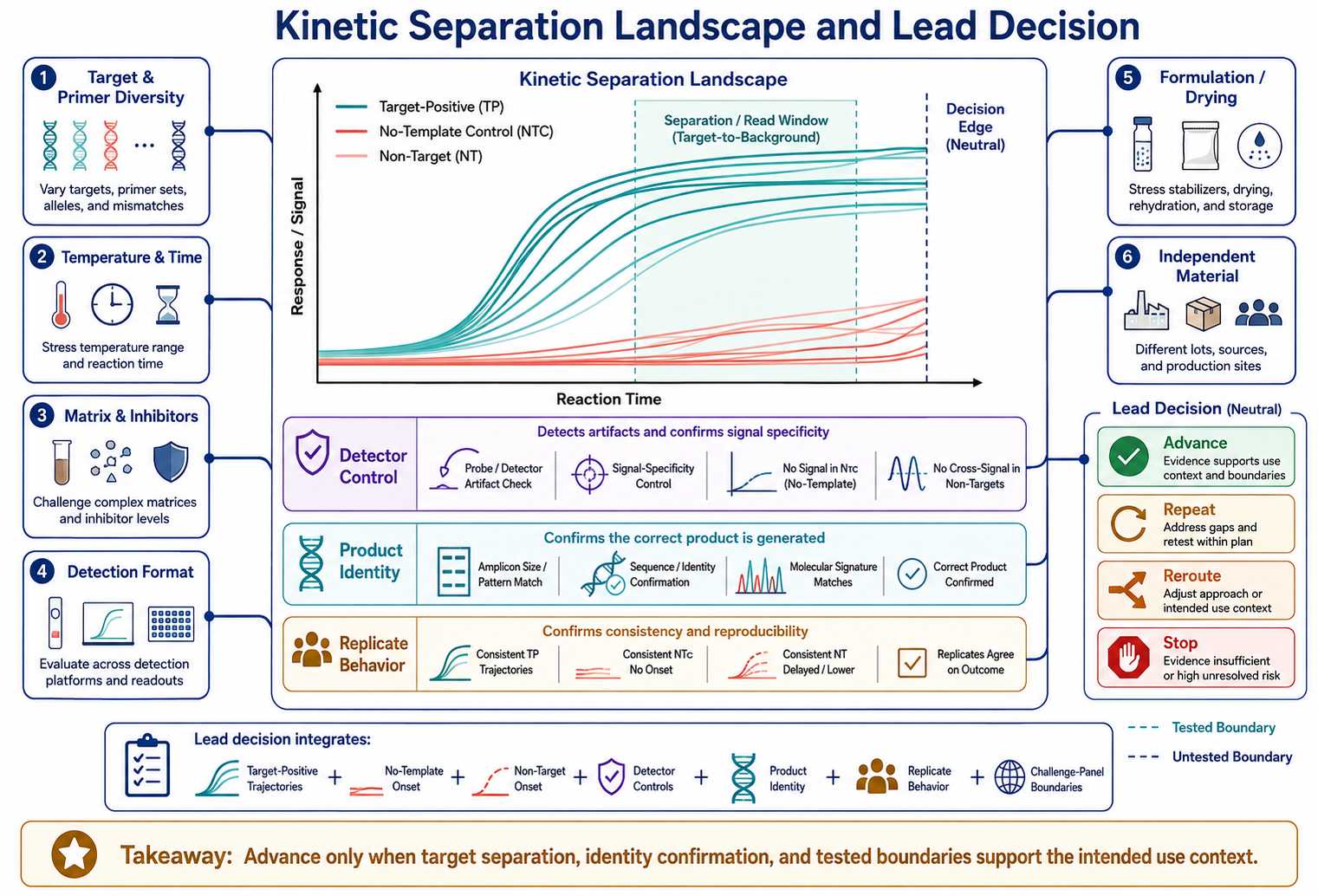 Fig 5. Kinetic separation landscape and lead decision. Target-positive trajectories, no-template and non-target onset, detector controls, product identity, replicate behavior, and challenge-panel boundaries are combined before an isothermal enzyme or multi-enzyme system advances.
(Creative Enzymes Diagnostic)
Manufacturability can include soluble expression, purification behavior, protein-protein aggregation or precipitation, concentration feasibility, nuclease contamination, activity recovery, lot comparability, and storage-buffer compatibility. RPA proteins require particular attention to common-buffer and concentrated-component behavior because an enzyme can be individually stable yet incompatible in a combined core mix. If expression or production becomes the dominant limitation, work can connect to the planned AI-guided expression, solubility, and manufacturability optimization service.
Depending on scope, deliverables can include the mechanism and source-triage report; target product profile; starting-scaffold assessment; computational hypothesis and candidate list; sequence and construct records; expression and purification results; direct-function and handoff assays; component-ratio or design-of-experiments results; raw and processed amplification data; target/background kinetic fingerprints; product-confirmation results; challenge-passport data; formulation and stability observations; lead recommendation; and transfer or next-round plan. Deliverables are defined in the statement of work and do not constitute finished-device validation.
Some clients have a defined Bst or RPA component and a qualified screen. Others have only an unexplained late LAMP reaction, early no-template amplification, unstable RPA fluorescence, or a system that works in buffer but fails in the target matrix. The engagement begins at the first unresolved decision rather than assuming that sequence engineering is always required.
Creative Enzymes can connect the project to our broader AI-driven diagnostic enzyme engineering services, comprehensive enzyme development and validation, enzyme activity and stability analysis, and diagnostic-enzyme product portfolio. If the downstream signal uses CRISPR/Cas detection, the enzyme interface can be coordinated with the planned AI-assisted CRISPR/Cas diagnostic enzyme engineering support page rather than treating Cas activity as an ordinary amplification reporter.
The primary focus is enzyme and multi-enzyme system optimization. A project can include application-functional amplification screens, component ratios, formulation compatibility, and representative challenge testing because these are needed to select useful enzymes. Complete LAMP or RT-LAMP primer, formulation, and application development can be connected to the dedicated reagent-development service. Scope boundaries are documented before work begins.
AI can prioritize Bst homologs, mutations, domains, or fusions using sequence, structure, evolutionary information, prior variants, and stability or function models. A predicted candidate still requires expression, direct-function measurement, and LAMP testing. Target initiation, primer architecture, background amplification, additives, temperature, and detection can change the ranking, so sequence scores alone do not establish a faster or more useful LAMP enzyme.
Time to amplification merges target initiation, extension, product topology, detector response, and analysis settings. A more active polymerase may also accelerate no-template or off-target products. We pair target timing with no-template and non-target onset, target-to-background separation, product identity, replicate failure, endpoint behavior, and challenge conditions.
Potentially, if polymerase extension of unintended primer structures is a verified driver and a screen can preserve target initiation while suppressing background. However, non-template amplification can also originate in primer design, temperature, reaction time, magnesium, additives, contamination, or detection. Source-triage experiments determine whether enzyme engineering, warm-start control, primer redesign, formulation, or a combined solution is appropriate.
Some strand-displacing polymerases have measurable RNA-template activity and can support one-enzyme RT-LAMP under suitable conditions. A separate RT-plus-polymerase system may perform better for another target or structured RNA. We compare the desired target range, operating temperature, cDNA initiation, downstream LAMP, background, formulation, and storage requirements rather than assuming one architecture is universally superior.
A scoped program may include recombinase, recombinase loader or mediator, SSB, strand-displacing polymerase, RT, or a detection nuclease. The relevant engineering and screening strategy depends on access to sequences and materials and on a method that isolates the component's contribution. ATP regeneration, crowding, magnesium, and component ratios are evaluated because they can change the apparent performance of every enzyme.
SSB helps stabilize displaced single-stranded DNA, but its concentration can also influence recombinase and polymerase access, primer-template interactions, nonspecific binding, and reaction composition. The best concentration is system-dependent. We can titrate SSB with recombinase, loader, polymerase, primer, and buffer variables and measure target and background behavior together.
Yes. Rebalancing can be the correct first route when the enzymes are intrinsically functional but mismatched in concentration, timing, buffer, energy chemistry, or detection. A component-ratio study can also generate the system context needed for later sequence engineering. We separate sequence-level and system-level effects so that a formulation rescue is not misreported as an intrinsic enzyme improvement.
Projects can be considered when the required enzyme classes, substrates, controls, and functional readouts are available. HDA may involve helicase, SSB, and polymerase; SDA or NEAR may involve a nicking enzyme and strand-displacing polymerase; RCA/MDA may focus on processive strand displacement, fidelity, bias, exonuclease behavior, and circular-template dependence. Feasibility and IP constraints are reviewed project by project.
Yes, with named matrices or inhibitors and controls that separate intrinsic enzyme tolerance from buffer protection, target release, adsorption, optical interference, and detection effects. Representative material is important because tolerance to one inhibitor or collection medium does not establish universal direct-sample compatibility.
Dry-format development can be included or transferred into a dedicated formulation program. Enzymes that are stable in liquid or after a thermal challenge may still lose function during freezing, drying, storage, or rehydration. Multi-enzyme RPA systems can also develop precipitation or compatibility problems when concentrated or dried. The dry process and complete-reaction recovery require separate evidence.
There is no fixed number. Candidate count and rounds depend on the starting evidence, enzyme family, number of components, assay throughput, material requirements, target difficulty, challenge panel, and budget. A mechanism-triage or ratio study may resolve the decision without a large library. Each iterative round has an agreed review gate.
No. The service provides research and development evidence for enzymes, raw materials, and reagent systems under an agreed scope. The legal manufacturer or sponsor remains responsible for intended use, design control, complete analytical and clinical validation, risk management, registration, labeling, and market authorization.
Share the amplification mechanism, enzyme components, sequences or current raw materials, primer and probe system, target and no-template curves, representative matrices, operating temperature, detection format, and the failure you need to resolve. Creative Enzymes can help determine whether the next step should be mechanism triage, component rebalancing, focused enzyme engineering, multi-enzyme co-optimization, formulation work, or a different isothermal platform route.
Contact Creative Enzymes