
A diagnostic enzyme can fail a stability study at several different moments, and those failures do not call for the same engineering response. Creative Enzymes' AI-Assisted Thermostability and Lyophilization Stability Engineering Service first locates whether functional loss occurs during liquid heat exposure, freezing, water removal, dry storage, or reconstitution. We then use sequence, structure, physicochemical, evolutionary, and experimental evidence to prioritize stability hypotheses and test engineered candidates against the parent in paired, application-relevant stress studies. The result is not merely a higher predicted stability score; it is a traceable assessment of whether a sequence-defined enzyme retains the function the diagnostic reagent actually needs.
Scope and use boundary: this service supports research-use-only (RUO) and industrial diagnostic-reagent development. An AI-ranked mutation, engineered enzyme, thermal result, lyophilization-recovery result, or selected candidate is not a finished consumer test, authorization for direct diagnosis, clinical validation, a therapeutic or food product, regulatory approval, or market authorization. The sponsor or legal manufacturer remains responsible for intended use, complete analytical and clinical validation, design controls, risk management, specifications, stability claims, labeling, registration, and final product release.
“Poor lyophilization stability” is a description of an outcome, not a mechanism. The same low post-reconstitution activity can arise because the enzyme was already unstable in the liquid feed, because freeze concentration or an ice interface damaged it, because dehydration altered its conformation, because residual moisture and mobility enabled degradation during storage, or because reconstitution was incomplete. An assay artifact can produce the same apparent result. Sequence engineering is most valuable when the experiment can show that the enzyme itself contributes to the failure.
Loss appears during a controlled liquid thermal challenge or across several reasonable formulations, and the parent shows sequence- or structure-linked liabilities. A stability-focused variant program may be the direct route.
Activity is acceptable in liquid controls but collapses only under one freeze-drying formulation, cycle, container, or reconstitution condition. Begin with lyophilized enzyme formulation development.
Variants rank differently across formulations or drying conditions. A controlled crossover study can identify whether an engineered enzyme, a better protection system, or the combination deserves advancement.
Time, temperature, buffer, concentration, cofactors, substrates, and interfaces determine whether soluble, catalytically competent enzyme remains.
Ice formation can concentrate solutes, shift local pH, expose protein to interfaces, and change molecular crowding. Freeze rate and fill geometry matter.
Water removal changes hydration and molecular interactions. Collapse, incomplete drying, or crystallization of formulation components may alter protection.
Residual moisture, temperature, oxygen, light, chemical liabilities, and solid-state mobility can drive gradual loss that a fresh-cake test will miss.
Mixing, diluent, time, concentration gradients, bubbles, and insoluble or soluble aggregates can determine the recovered signal in the final assay.
Early failure mapping uses a parent reference and a small set of intentionally separated stress conditions. Where practical, an unstressed liquid control is compared with freeze-thaw-only material, freshly lyophilized and reconstituted material, and material stored in the dry state. Sampling after each stage is not always technically or physically feasible, so the exact control scheme is selected around the process. The purpose is to avoid spending an engineering budget on a sequence problem that is actually a fill-volume, cycle, formulation, container, or analytical-method problem.
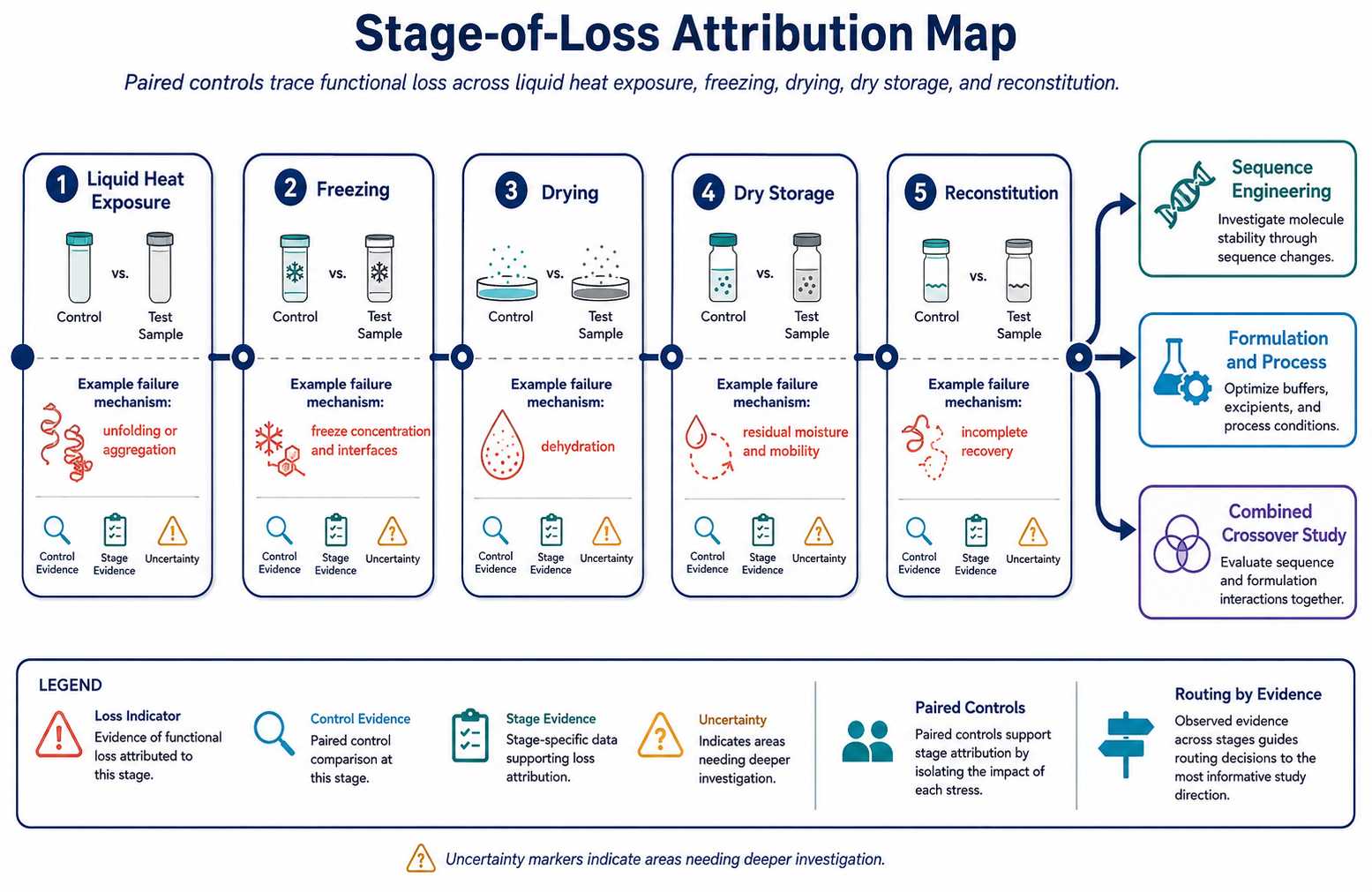 Fig 1. Stage-of-loss attribution map. Paired controls trace functional loss across liquid heat exposure, freezing, drying, dry storage, and reconstitution before the project is routed to sequence engineering, formulation and process optimization, or a combined study.
(Creative Enzymes Diagnostic)
Why this separation matters: classic experimental work showed that freezing- and drying-induced denaturation can be distinguished and may respond to different protective conditions.9 Later reviews of protein freeze-drying likewise describe formulation, cycle, container, residual moisture, and solid-state behavior as connected variables.8, 11 These principles support stage-specific investigation, but they do not establish which mechanism is operating in a particular diagnostic enzyme without project data.
Thermostability can refer to resistance to unfolding, retention of catalytic activity after heating, a longer functional half-life at a chosen temperature, delayed aggregation, or tolerance of repeated temperature excursions. Lyophilization stability can refer to activity recovery immediately after drying, reconstitution behavior, resistance to freeze-thaw, or retention over dry storage. These measures answer different questions. A project should state the decision endpoint, stress condition, sample state, normalization rule, reference, and non-regression constraints before variants are designed.
| Endpoint | Question it can answer | Important method controls | What it does not establish alone |
|---|---|---|---|
| Thermal transition or unfolding onset | Does the enzyme show a shifted conformational response under one defined analytical condition? | Buffer composition, dye or detection mode, scan rate, concentration, aggregation behavior, and reference interpretation. | Catalytic activity after heat exposure, lyophilization recovery, storage life, or performance in a diagnostic matrix. |
| Residual activity after a heat challenge | How much defined catalytic function remains after a stated time-temperature exposure? | Equal active or total enzyme input, cooling/recovery protocol, substrate regime, initial-rate window, blanks, and parent controls. | Mechanism of loss, dry-state behavior, or whether activity changes arise from expression or purity differences. |
| Functional half-life or inactivation curve | How quickly does function decline at a defined temperature and solution state? | Multiple time points in the informative range, consistent sampling, assay linearity, and suitable kinetic model qualification. | A universal shelf-life claim or behavior at unrelated temperatures and formulations. |
| Aggregation, turbidity, or soluble recovery | Does stress generate insoluble material or reduce soluble enzyme recovery? | Concentration, interfaces, centrifugation or filtration rules, particle method, and mass/activity normalization. | Whether soluble enzyme is catalytically correct or specific in the application reaction. |
| Fresh lyophilization recovery | What function is recovered immediately after a defined freeze-drying cycle and reconstitution? | Matched pre-lyo control, fill, formulation, cycle, container, cake handling, diluent, reconstitution time, and dilution correction. | Dry-storage stability, robustness to shipping excursions, or the precise stage that caused loss. |
| Dry-storage retention | Does a lyophilized preparation retain function under stated packaging and storage conditions? | Time zero, storage temperature and humidity, closure, residual moisture or related solid-state data, intervals, and application assay. | Real-time shelf life unless the study design and duration support it; accelerated conditions are not automatically equivalent to intended storage. |
| Application-functional performance | Does the candidate still support the intended amplification, detection, signal-generation, or coupled reaction? | Relevant reagent composition, matrix, controls, target range, interference conditions, and a prespecified calculation. | Clinical performance, regulatory suitability, or finished-product validation. |
The primary endpoint should be close enough to the intended reagent function to prevent a false win. For a polymerase, for example, a general activity assay may support screening, but an amplification curve, yield, sensitivity-related model system, or inhibitor challenge may be needed to confirm application relevance. For an oxidoreductase or reporter enzyme, product formation, background, cofactor dependence, coupling balance, and matrix effects may matter. Creative Enzymes can connect stability work with enzyme activity and stability analysis and with broader enzyme development and validation as scoped.
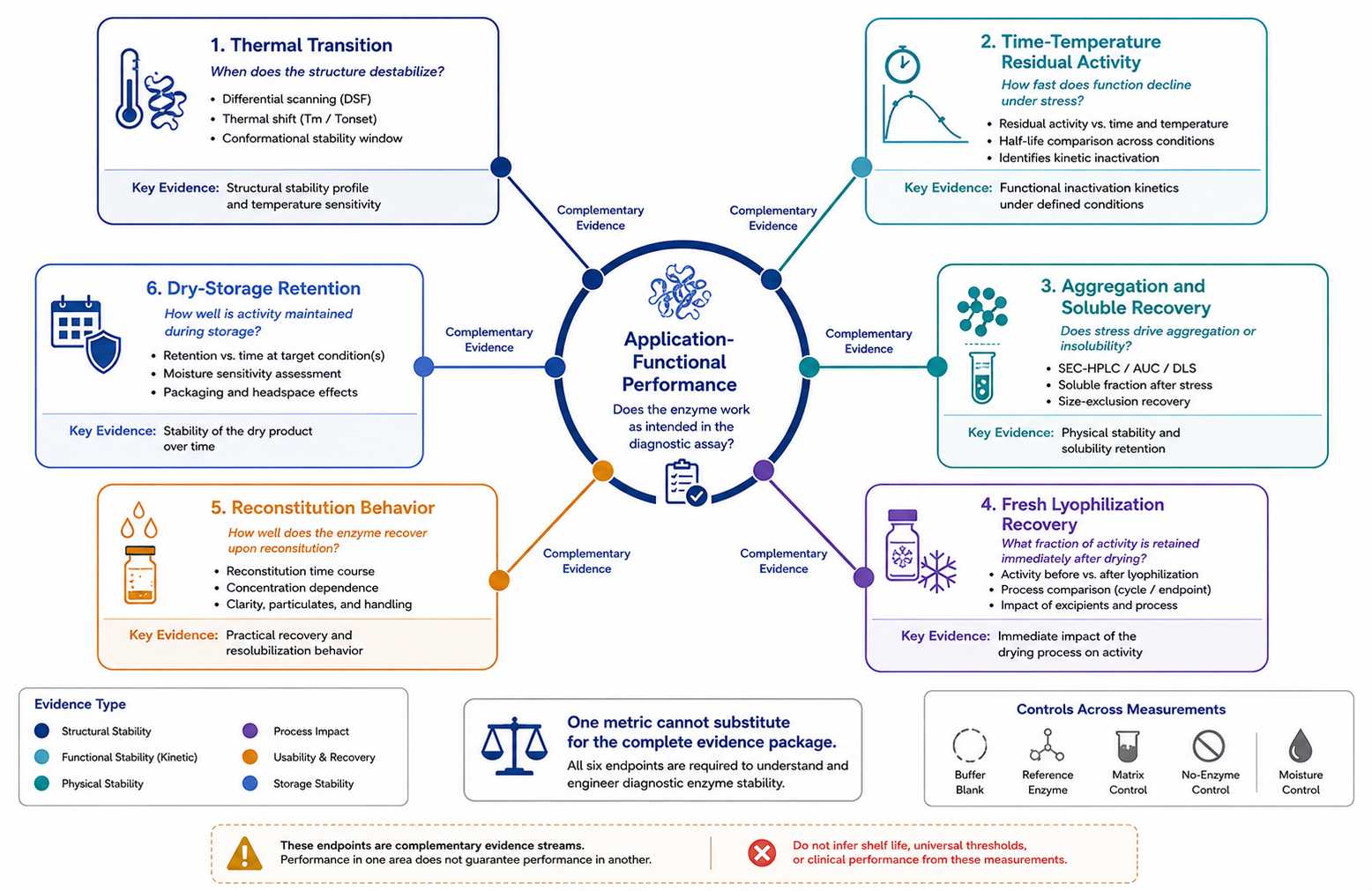 Fig 2. Stability endpoint constellation. Thermal transition, functional inactivation, aggregation, fresh lyophilization recovery, reconstitution, and dry-storage retention are related evidence streams, not interchangeable names for one property.
(Creative Enzymes Diagnostic)
Once a sequence contribution is plausible and the endpoint contract is defined, AI-assisted engineering can focus the candidate space. Inputs may include the parent amino-acid sequence, homologs, multiple-sequence alignment, available or predicted structures, domain and cofactor annotations, known active-site and binding residues, historical variants, expression data, thermal or lyophilization measurements, and intended assay constraints. Depending on data readiness, the analysis may combine protein language representations, conservation, statistical sequence relationships, structural energy calculations, local flexibility, residue contacts, surface properties, aggregation or chemical-liability heuristics, and experimentally learned sequence-function models.
The output of this analysis is a hypothesis ledger: candidate substitutions or combinations, their proposed mechanism, supporting evidence, uncertainty, predicted risks, and the experiment needed to challenge the hypothesis. Computational thermostability methods and data-driven enzyme engineering have supported successful stabilizing designs in specific protein systems,1–4 but no model score is treated as a measured increase in diagnostic-enzyme performance.
Fill cavities, reduce unfavorable packing, or improve local hydrophobic complementarity while avoiding steric strain and buried polarity. Core substitutions may be powerful but can disrupt folding or catalytic dynamics.
Reduce excessive local flexibility in loops, termini, or linkers when that mobility contributes to unfolding or proteolytic liability. Functional conformational motion must remain available.
Strengthen compatible hydrogen-bond, salt-bridge, or aromatic networks. Geometry, protonation, local dielectric environment, and assay pH are considered rather than counting contacts alone.
Evaluate geometrically plausible covalent constraints where the expression environment, redox state, folding pathway, and functional movement are compatible. A predicted bridge is not assumed to form correctly.
Reduce exposed hydrophobic or aggregation-prone regions and adjust surface charge patterns when supported by the enzyme's solution behavior. Changes are screened for nonspecific interactions and substrate effects.
Review oxidation-, deamidation-, hydrolysis-, isomerization-, or cleavage-prone contexts when they plausibly affect the intended stress. Removing one liability must not create another or alter an essential residue.
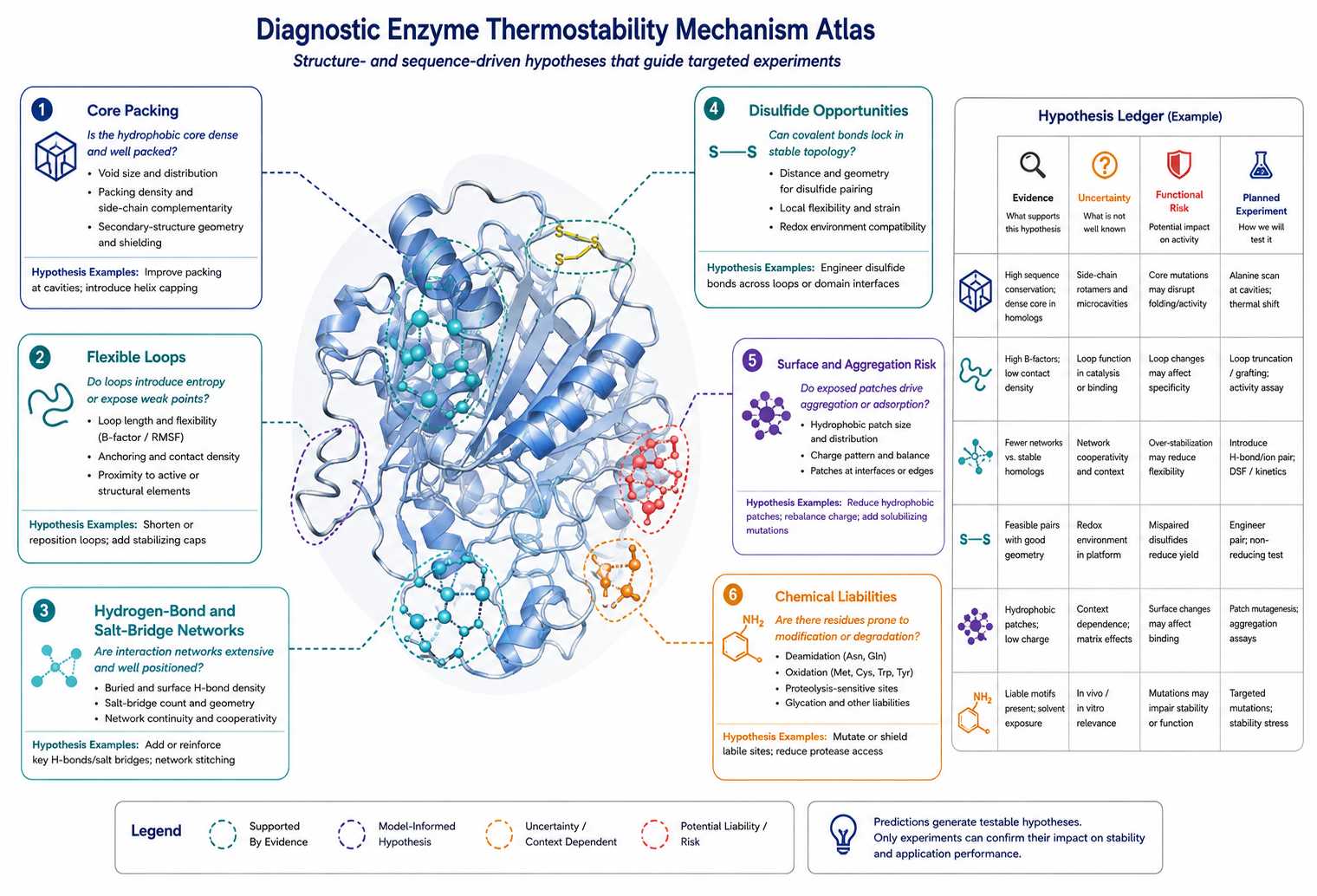 Fig 3. Thermostability mechanism atlas. Sequence and structural evidence can generate testable hypotheses around packing, flexibility, interaction networks, covalent constraints, surface behavior, aggregation risk, and chemical liabilities.
(Creative Enzymes Diagnostic)
Stabilizing changes are not necessarily additive. A combination can perform better, worse, or simply differently from its component substitutions because residues interact through structure, dynamics, folding, and catalytic state populations. AI-aided combinatorial engineering and statistical sequence methods can help prioritize combinations, but published improvements remain specific to their proteins, datasets, assays, and conditions.2, 7 We therefore include informative single substitutions or deconvolution variants where appropriate and preserve negative results for the next design decision.
A thermally robust candidate is not a lead if its unstressed activity is too low, its apparent gain comes only from higher expression, or it introduces unacceptable background or cross-reactivity. Candidate advancement can therefore require minimum parent-relative function under unstressed conditions, acceptable expression or normalization evidence, retained substrate behavior, and performance in one or more representative reagent conditions. The actual criteria are project-specific and agreed before data are reviewed.
When activity or kinetics is the dominant property rather than a protected constraint, the project may be paired with AI-guided activity and kinetic performance optimization.
This service can use the general design and build controls described in AI-guided diagnostic enzyme variant design and screening, but its candidate composition is stability-specific. Build slots are not filled only by the highest predicted melting-temperature change. The panel is constructed to compare mechanisms, preserve functional constraints, investigate model disagreement, and establish whether the observed phenotype is reproducible.
Substitutions selected to test a defined packing, flexibility, interaction, surface, or chemical-liability hypothesis and to make the result interpretable.
Higher-order candidates chosen with structural distance, sequence covariance, predicted interactions, and functional constraints in mind, rather than naive stacking.
Candidates from distinct regions or mechanism classes reduce dependence on one model and can reveal different stability–activity tradeoffs.
The exact parent, benchmark variants when available, neutral or risk controls, and component variants allow plate, batch, and combination effects to be interpreted.
Each candidate can be documented by sequence ID, construct ID, parent version, substitutions, design route, evidence sources, protected-residue checks, predicted stability direction, uncertainty, predicted liabilities, diversity cluster, and planned test tier. If historical measurements are used for modeling, we examine whether sequences, constructs, assay conditions, enzyme concentration, expression batches, and calculations are comparable. Data leakage, duplicated variants, inconsistent parent definitions, or confounding between plate/batch and sequence can create convincing but non-transferable rankings.
The number of candidates is determined by the client's build and test capacity, model confidence, sequence diversity, required controls, and assay throughput. There is no universal minimum or optimal library size. A smaller information-rich panel can be appropriate for an expensive lyophilization or application assay, while a larger preliminary panel may be useful when a high-throughput thermal or activity screen is reliable. Candidate count, rounds, acceptance gates, and material scale are scoped rather than assumed.
Engineered candidates should be expressed and tested with enough control to distinguish a sequence effect from a production or assay artifact. Depending on the project, early screening may use crude, partially purified, or purified material, but the normalization rule must match the decision. Equal culture volume can favor highly expressed variants; equal total protein can remain confounded by purity; equal enzyme mass requires a suitable concentration method; equal starting activity can answer a different question about stress tolerance. We define the denominator explicitly and advance important candidates to independent expression and confirmation.
Establishes starting activity, background, and relevant analytical attributes under a defined solution condition.
Tests time-temperature functional retention without the additional stresses of freezing and drying.
Isolates freezing-related loss when the process and sampling design allow a matched comparison.
Measures recovery after one fully documented formulation, cycle, container, and reconstitution procedure.
Adds storage interval and condition to determine whether fresh recovery is sustained.
The contrast does not prove a molecular mechanism by itself. It prioritizes follow-up such as aggregation analysis, thermal characterization, residual moisture or solid-state investigation, activity normalization, or formulation/process study.
Not every project needs every test. A polymerase intended for a dry molecular-diagnostic mix may prioritize amplification efficiency, time-to-signal, yield, low-copy reproducibility, inhibition tolerance, and nonspecific amplification after thermal or drying stress. A dehydrogenase in a clinical chemistry reagent may prioritize activity recovery, kinetic range, cofactor behavior, coupling balance, background, and matrix interference. A reporter or biosensor enzyme may need signal stability, substrate specificity, background, and reconstitution kinetics. The assay panel is designed around the enzyme's role rather than copied across enzyme classes.
Where useful, supporting measurements can include thermal shift or unfolding behavior, soluble recovery, size or aggregation-related analysis, spectroscopic or structural indicators, moisture-related measurements, cake appearance, reconstitution time, pH, and relevant chemical characterization. These methods support the functional result; they are not automatically included, and none substitutes for the intended reaction. Enzyme QC and QA support can be connected when identity, purity, lot consistency, or release-oriented methods are required.
Lyophilization robustness is an interaction among enzyme sequence, enzyme concentration, buffer and excipients, freeze-drying cycle, fill and container, residual moisture, storage, reconstitution, and final assay composition. Testing each new enzyme in an unrelated “best” formulation makes sequence comparisons difficult. Conversely, holding a clearly unsuitable formulation constant can reject a useful engineered enzyme. A compact crossover design can expose the direction of these effects before a large optimization program begins.
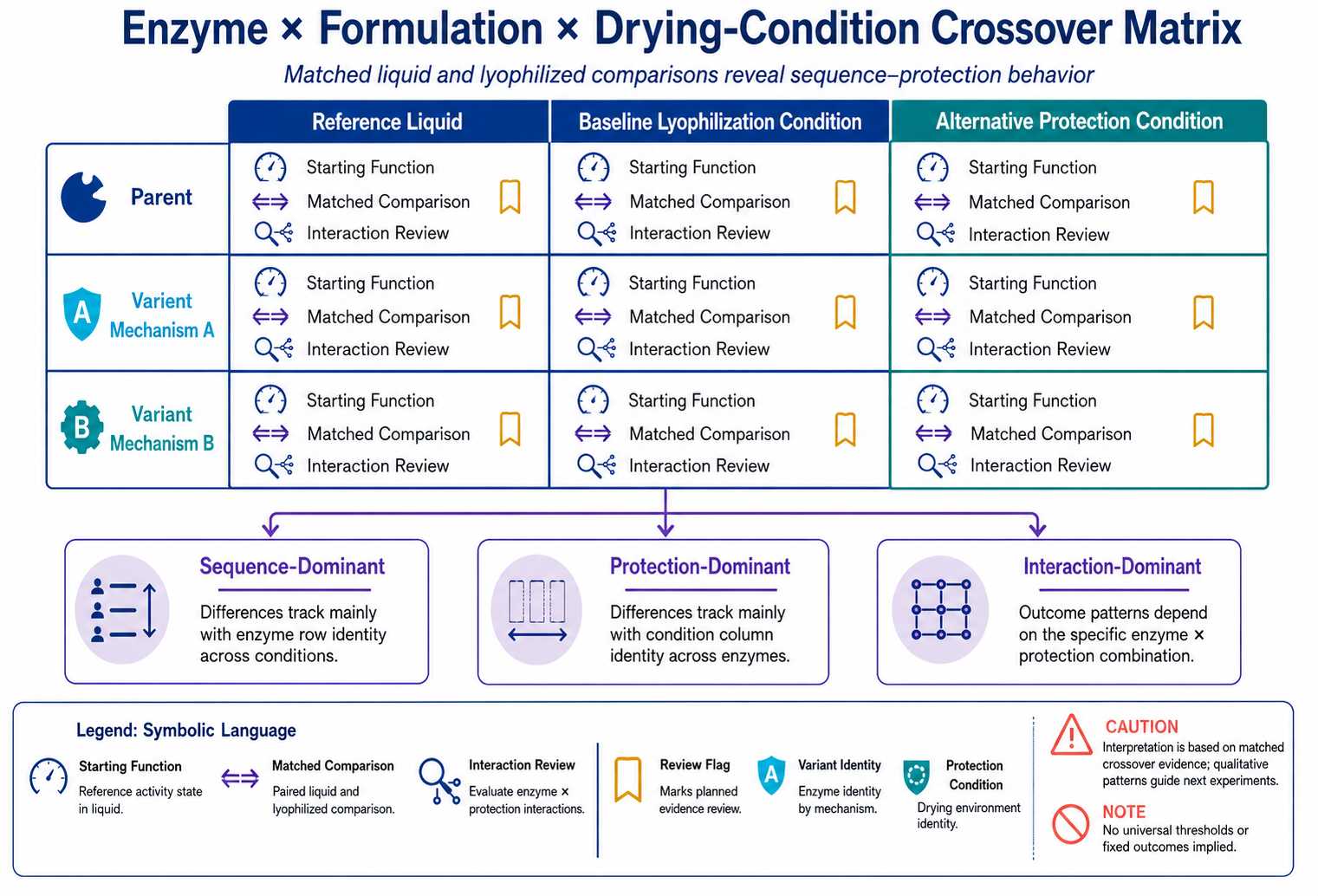 Fig 4. Enzyme × formulation × drying-condition crossover. A controlled matrix separates parent and variant behavior under matched liquid and lyophilized conditions and reveals sequence–protection interactions.
(Creative Enzymes Diagnostic)
A variant outperforms the parent under the same liquid and lyophilized conditions, retains unstressed function, and confirms on independent material. The candidate can move to broader formulation/process and application validation.
Parent and variants respond primarily to formulation or cycle changes, with little reproducible sequence separation. Resources may be better directed to formulation development and process controls.
Variant ranking changes across formulations or cycles. The enzyme and protection system should be co-developed, with enough replication and controls to avoid selecting a condition-specific artifact.
This experiment is not a full factorial formulation or cycle-development program. It is a route-finding design. When excipient compatibility, collapse behavior, residual moisture, cake structure, reconstitution, cycle parameters, or packaging dominate, the work can transition to lyophilized and ambient-stable diagnostic reagent development. The term “ambient-stable” is treated as an evidence-backed product goal, not a claim inferred from fresh lyophilization recovery.
A preliminary hit is a reason to repeat the experiment, not a final lead. Important candidates are advanced through progressively more decision-relevant gates. Independent re-expression reduces the chance that the result came from a culture, purification, concentration, or plate artifact. Orthogonal or supporting measurements help determine whether activity retention is accompanied by soluble recovery and acceptable physical behavior. A defined freeze-drying and reconstitution repeat confirms that fresh recovery is reproducible. Dry-storage intervals begin to establish whether the gain persists. Finally, the candidate is tested in the relevant reagent architecture and matrix model.
Verify sequence identity and produce independent material with a documented construct, host, purification state, and concentration method.
Repeat the informative thermal or freeze-drying stress against parent and controls using prespecified calculations and replicate handling.
Investigate activity, aggregation or soluble recovery, and suitable thermal or structural evidence to understand the phenotype.
Compare time-zero lyophilized material with defined dry-storage intervals and documented container and environmental conditions.
Confirm retained diagnostic-reagent function, background, specificity, matrix tolerance, and other target-product constraints.
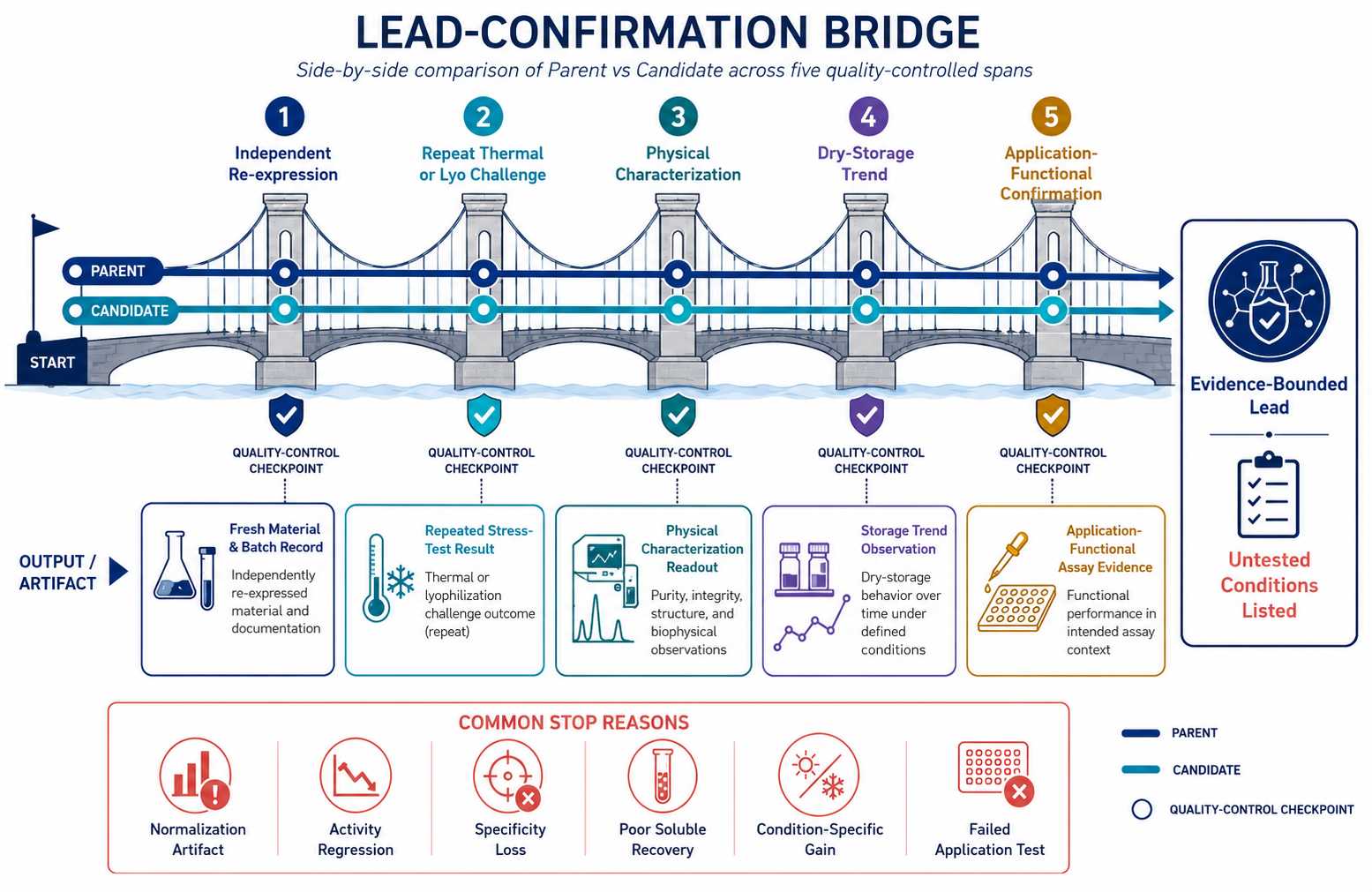 Fig 5. Lead-confirmation bridge. Stability candidates progress from independent material and repeat stress testing through physical characterization, fresh and stored lyophilized performance, and application-functional confirmation.
(Creative Enzymes Diagnostic)
Advancement is based on the complete evidence package. A candidate may be stopped because its stability gain disappears after activity normalization, because it loses specificity, because expression or solubility is unacceptable, because the improvement is confined to one nonrepresentative buffer, or because it does not survive the intended lyophilized-reagent context. These are useful outcomes: they prevent an attractive but misaligned stability number from entering scale-up or product development.
No universal threshold is implied. Acceptance criteria depend on the enzyme, assay, starting baseline, storage and shipping concept, formulation, material stage, analytical variation, and intended product requirements. Accelerated thermal or dry-storage studies can help compare candidates and investigate degradation, but they do not automatically establish real-time shelf life. The client remains responsible for the final stability program, specification setting, finished-product validation, and regulatory claims.
Best when the stage of loss is unclear. We review the enzyme, reagent, historical data, formulation and process history, assay method, and target profile; design paired controls; and identify whether sequence engineering, formulation/process work, analytical method repair, or a combined program is justified.
Best when intrinsic or sequence-linked instability is supported. The scope can include computational hypothesis generation, stability-focused candidate selection, construct generation, expression, biochemical and thermal testing, and nominated lyophilization challenges.
Best when sequence and protection interactions are expected. A controlled set of variants and formulation/process conditions is evaluated before leads enter deeper formulation and cycle development.
Not every listed input or deliverable is required in every project. The final statement of work identifies the enzyme and construct, formulation and process conditions, analytical methods, candidate and control strategy, material quantity, decision criteria, data package, and responsibilities. Creative Enzymes' broader AI-driven diagnostic enzyme engineering services can route projects that have not yet determined whether stability, activity, specificity, expression, or another property is the limiting factor.
AI and computational methods can rank hypotheses using sequence, evolutionary, structural, physicochemical, and experimental evidence. They cannot guarantee that a mutation will increase measured stability, preserve activity, express correctly, or perform in a lyophilized diagnostic reagent. We use predictions to allocate experiments and then compare engineered candidates with the parent under defined functional and stress assays.
No. A thermal transition can be useful supporting evidence, but it does not by itself establish retained catalytic activity after heat exposure, resistance to aggregation, lyophilization recovery, dry-storage performance, or function in the intended assay. The project defines a constellation of endpoints anchored to application-functional performance.
This page focuses on engineering the enzyme sequence and demonstrating whether sequence-defined variants improve thermal and lyophilization-related robustness. Lyophilized Enzyme Formulation Development focuses on the protection system and process, including buffer/excipient choices, freezing and drying conditions, reconstitution, and related evidence. A crossover study can determine whether one route or a combined program is appropriate.
Potentially. If the loss is formulation- or process-dominant, changes to excipients, buffer, concentration, cycle, container, or reconstitution procedure may be more effective than sequence engineering. Failure attribution is included specifically to avoid unnecessary mutation work. The appropriate route depends on experimental evidence.
When the material and process permit an interpretable control scheme, freeze-thaw-only and fully lyophilized samples can help distinguish incremental loss. An unstressed liquid reference and a freshly lyophilized time-zero reference are also important. The feasible sampling design depends on the enzyme, formulation, equipment, fill, and analytical method, and the contrasts do not prove a molecular mechanism without follow-up evidence.
Yes. Enzyme catalysis often depends on conformational dynamics and precise active-site interactions, so a change that favors one stable state can impair turnover, substrate binding, specificity, or product release. That is why unstressed activity, application function, specificity, expression, and other non-regression gates are built into the candidate strategy.
Projects can be scoped for polymerases, reverse transcriptases, ligases, nucleases, recombinases, helicases, reporter enzymes, and other diagnostic-reagent enzymes when a suitable parent, assay, and material-handling strategy exist. The exact endpoints differ by enzyme class and intended reaction. Please see our molecular diagnostic enzymes and kits area for related product context.
There is no fixed number. The design depends on sequence uncertainty, mechanism diversity, build and expression capacity, material availability, assay throughput, required controls, formulation/process variables, and the cost of the application test. The scope states the candidate count, conditions, replicates, and advancement gates before work begins.
Not automatically. Accelerated studies can compare candidates and support degradation investigation under stated conditions, but extrapolation requires a justified model and an appropriate stability program. Fresh lyophilization recovery is also not a shelf-life claim. The sponsor or legal manufacturer remains responsible for real-time and accelerated stability design, packaging, specifications, finished-product validation, and labeled storage claims.
We first examine the measurement system, including signal range, enzyme normalization, controls, replicate behavior, plate or batch effects, and connection to the intended function. Method repair, a different screening tier, or an initial feasibility study may be needed before model-guided selection. Unreliable phenotype labels cannot be rescued by a more complex model.
Transfer can be included as a follow-on scope. A useful package can document the selected sequence and construct, expression and purification history, analytical methods, critical material handling, nominated formulation/process conditions, and remaining risks. Additional scale-up, lot comparability, QC/QA, formulation, stability, and finished-reagent validation are normally required.
Send us the parent sequence, enzyme function, current stability observations, intended reagent format, and any liquid, freeze-thaw, lyophilization, reconstitution, or storage data. Creative Enzymes can help define whether the next experiment should target the enzyme sequence, the protection system and process, the analytical method, or a controlled combination of these levers.
Contact Us