
A polymerase or reverse transcriptase is useful only when it completes the intended molecular diagnostic reaction. We therefore begin with the primer-template system, target range, thermal program, detection chemistry, sample context, formulation, and manufacturing constraints--not with a generic request for a "faster" or "more stable" enzyme.
Creative Enzymes provides project-specific engineering support for DNA polymerases and RNA-dependent DNA polymerases used as research and industrial molecular-diagnostic reagent raw materials. A program can include starting-scaffold assessment, sequence and structural analysis, AI-guided candidate prioritization, focused library design, expression and purification, biochemical characterization, reaction-functional screening, master-mix compatibility studies, and lead-transfer documentation. Most outputs are for research use only. Work on industrial raw materials is performed under an agreed development scope and does not make the resulting enzyme or reagent a finished diagnostic device.
A request such as "improve our polymerase" is not yet an engineering specification. The same parent enzyme can behave differently when the amplicon length changes, GC content rises, a probe is added, extension time is shortened, dUTP replaces dTTP, crude sample enters the tube, or glycerol and salts are changed for a concentrated master mix. Reverse transcriptase performance likewise depends on RNA integrity, secondary structure, primer type, template abundance, reaction temperature, inhibitors, desired cDNA length, and whether the cDNA will be quantified, amplified, or sequenced.
Our first task is to locate the limiting function. A poor RT-qPCR curve may originate in reverse transcription, DNA amplification, primer/probe behavior, reagent compatibility, fluorescence analysis, or an interaction among them. Low signal in direct PCR may reflect intrinsic polymerase inhibition, sequestration of template, optical quenching, or insufficient sample lysis. An enzyme-engineering program is opened only after the project has a defensible enzyme-related hypothesis or an explicit exploratory objective.
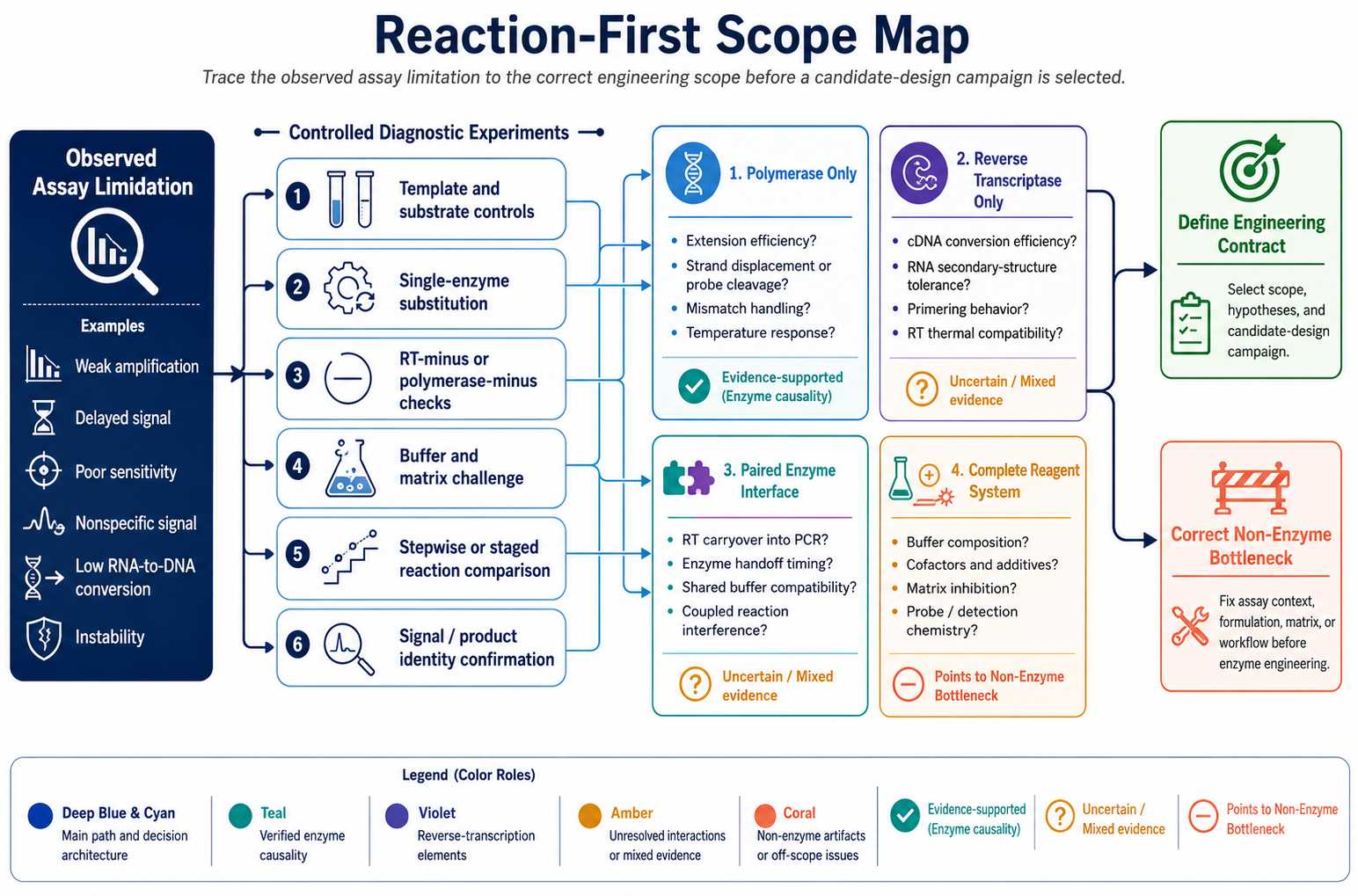 Fig 1. Reaction-first engineering scope map. The observed assay limitation is traced to polymerase, reverse transcriptase, the paired-enzyme interface, or the complete reagent system before a candidate-design campaign is selected.
(Creative Enzymes Diagnostic)
The scope decision also prevents duplication across adjacent programs. Requests centered on strand displacement and constant-temperature amplification can be routed to our planned AI-guided LAMP, RPA, and isothermal enzyme optimization service. Requests centered on multiplex competition, reagent balance, or fluorescence-channel interactions may be better handled through multiplex qPCR enzyme-system optimization. When the principal problem is a crude specimen, the enzyme work can be integrated with direct PCR and extraction-free system development.
Polymerases and reverse transcriptases are both template-directed nucleic-acid polymerases, but their useful target profiles are not interchangeable. A hydrolysis-probe qPCR polymerase may need controlled 5-prime nuclease activity as well as rapid, reproducible extension. A high-fidelity endpoint or library-amplification polymerase may instead prioritize low error rate and low sequence bias. A reverse transcriptase for low-input viral RNA may prioritize sensitivity and inhibitor tolerance; an RT for long or structured RNA may require a different balance of thermostability, processivity, and template interaction.
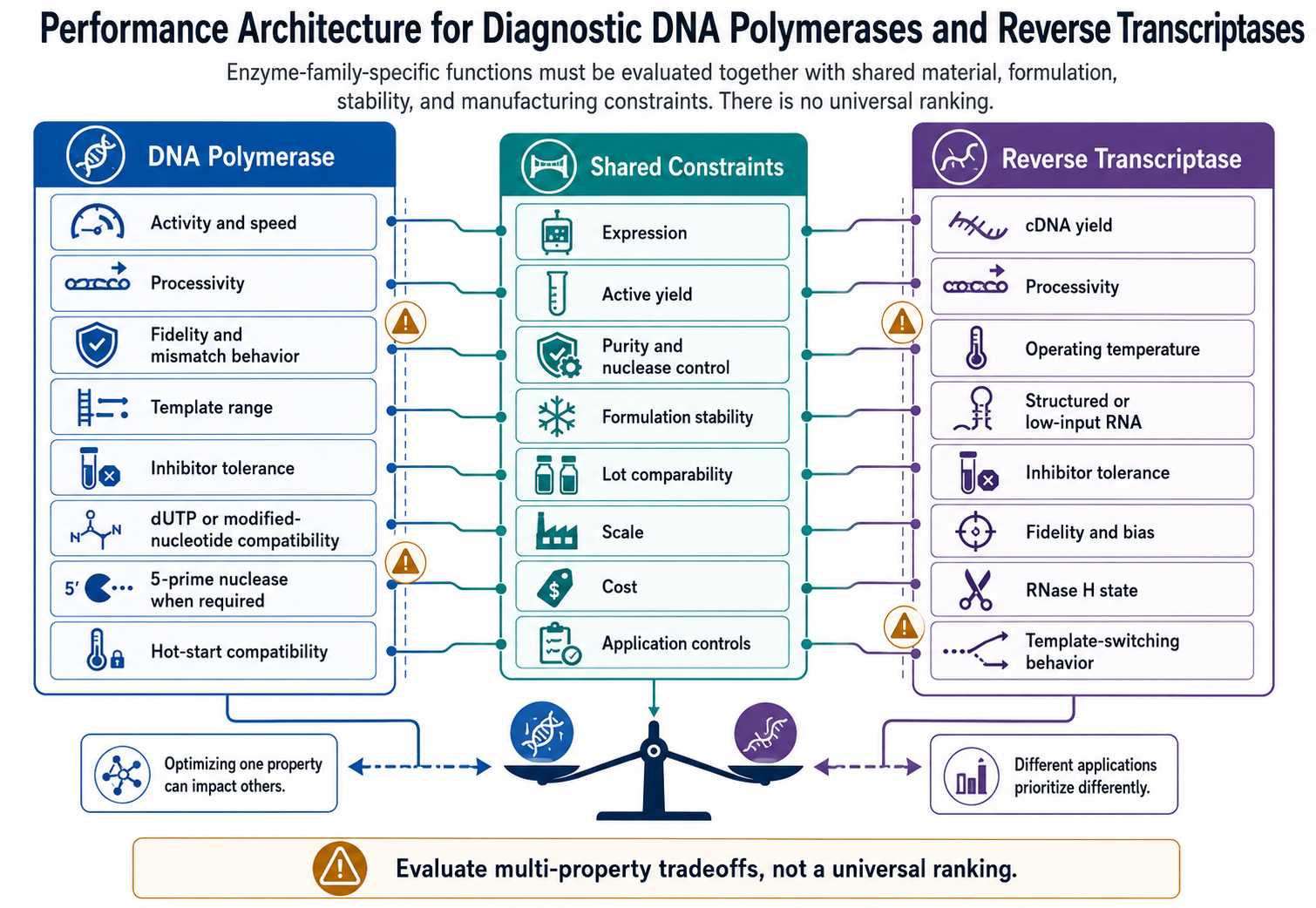 Fig 2. Polymerase and reverse-transcriptase performance architecture. Enzyme-family-specific functions are evaluated together with shared material, formulation, stability, and manufacturing constraints that determine whether a biochemical hit can become a useful reagent raw material.
(Creative Enzymes Diagnostic)
Maximum fidelity is not automatically the best target for every diagnostic amplification. A stringent proofreading polymerase can have different extension kinetics, end chemistry, probe compatibility, or mismatch behavior from a Taq-like enzyme. Conversely, a polymerase that readily extends mismatched primer termini may be undesirable when allele discrimination is important. The project should specify the error or mismatch behavior that is relevant to the assay, the comparator method, and the acceptable effect on sensitivity and speed.
The same principle applies to RT properties. Reduced RNase H activity often supports longer cDNA synthesis because the RNA template is not degraded prematurely, but RNase H state should be treated as a workflow variable rather than a universal quality ranking. High-temperature reverse transcription can relax RNA secondary structure, yet the useful temperature window must be measured in the actual buffer and primer-template system. Template switching may enable particular library-construction strategies but can introduce unwanted products or bias in another workflow.
| Requested improvement | Useful direct measurements | Important paired checks | Common false conclusion to avoid |
|---|---|---|---|
| Faster PCR cycling | Extension-rate studies, amplification across amplicon lengths, Cq and endpoint yield under shortened steps | Specificity, efficiency, thermal durability, incomplete products, instrument ramp assumptions | A lower Cq at one enzyme concentration proves a generally faster polymerase |
| Direct-sample tolerance | Dose-response to named inhibitors and representative matrices; matched extracted versus crude samples | Fluorescence quenching, template accessibility, buffer rescue, sample lysis, replicate failure rate | Any matrix improvement is an intrinsic enzyme effect |
| Higher RT processivity | Trap-based processivity, full-length cDNA distribution, long-template recovery, time course | Template structure, reassociation, enzyme concentration, fidelity, bias, product inhibition | Long endpoint product alone establishes single-binding-event processivity |
| Improved structured-RNA response | Defined RNA structures or panels, temperature series, target-position effects, cDNA yield | Primer annealing, RNA integrity, sequence bias, inhibitor effects, downstream PCR compatibility | A high reaction temperature guarantees unbiased reverse transcription |
| Better hydrolysis-probe qPCR | Amplification and probe-cleavage readouts, fluorescence kinetics, efficiency and linearity | 5-prime nuclease activity, probe sequence, quenching chemistry, background cleavage, multiplex competition | Polymerase extension activity alone predicts probe-assay performance |
| dUTP/UDG workflow compatibility | Amplification with dUTP-containing nucleotide systems and the intended carryover-control sequence | UDG inactivation conditions, polymerase activity, thermal steps, shelf-life interaction | Acceptance of dUTP in a simple assay validates the complete contamination-control workflow |
Starting-scaffold selection can have as much influence on project efficiency as the later mutation strategy. A client may bring a licensed sequence, an existing production enzyme, a promising homolog, or only a desired application. We can compare sequence families, domain organization, known catalytic motifs, available structures, expression history, freedom-to-operate constraints supplied by the client, and preliminary functional data. Candidate homologs can be tested when the original scaffold lacks several fundamental requirements.
For polymerases, the choice may distinguish Taq-like enzymes, proofreading family-B polymerases, engineered fusion architectures, or other application-relevant scaffolds. For RTs, retroviral, group-II-intron, retron, and other RNA-dependent DNA polymerase families offer different starting behaviors. Scaffold selection is not a claim that one family is universally superior; it is a way to align inherited properties with the target reaction and reduce the number of changes required.
Hot-start performance deserves an explicit scope note. Sequence engineering can influence low-temperature activity, thermal activation, or interactions with an inhibitory partner, but commercial hot-start control can also be achieved through antibodies, aptamers, reversible chemical modification, or formulation mechanisms. We can study the enzyme contribution and compatibility with a selected control approach; we do not assume that a sequence-only solution is the correct route.
AI-guided design is most useful when it produces a diverse set of mechanistic hypotheses that can be falsified by experiments. Depending on available information, analysis may use homologous sequence alignments, conservation, covariation, predicted or experimental structures, language-model embeddings, stability estimates, interface geometry, prior mutational data, and client screening results. Residues essential to catalysis or binding can be constrained, while uncertain regions can be explored conservatively or through a dedicated sublibrary.
Polymerase hypotheses may involve the fingers, palm, thumb, O-helix, template-primer path, nucleotide channel, proofreading domain, DNA-binding fusion, or distal networks that influence conformational transitions. RT hypotheses can include the fingers, palm, thumb, connection region, RNase H domain, template-primer contacts, insertions characteristic of a scaffold family, and distal positions affecting folding or dynamics. A structural neighborhood suggests where to test; it does not prove that a mutation will improve activity.
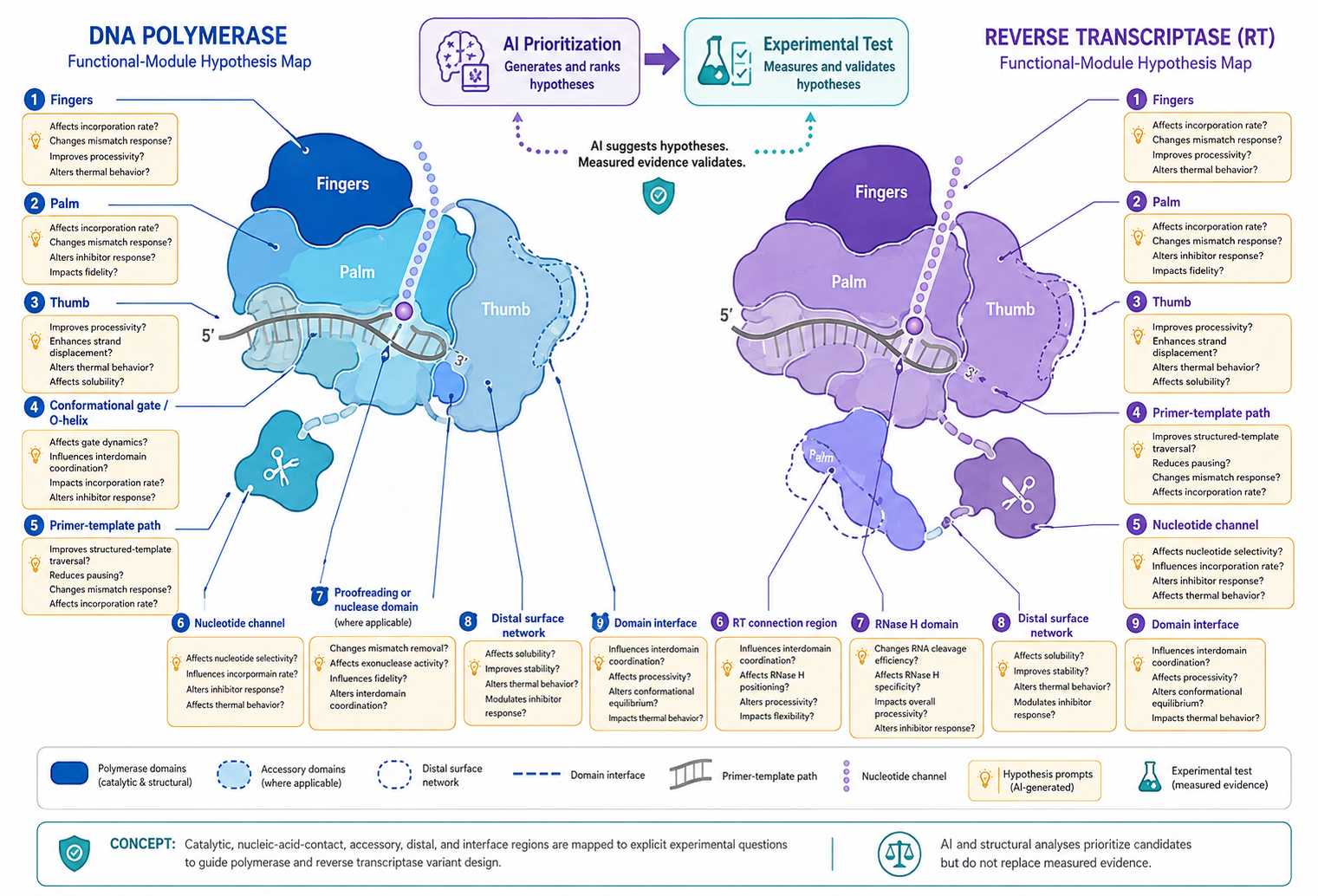 Fig 3. Functional-module hypothesis map. Catalytic, nucleic-acid-contact, accessory, distal, and interface regions are connected to explicit experimental questions; AI and structural analyses prioritize candidates but do not replace measured evidence.
(Creative Enzymes Diagnostic)
When project-specific data are sparse, we use pretrained sequence and structure information with conservative rules, physical plausibility checks, and designed controls. After screening results accumulate, models can be updated to learn the local sequence-function landscape. Negative and borderline variants are retained because they help locate failure boundaries. Censored measurements, below-detection responses, and plate or lot effects are labeled rather than converted into artificial numerical certainty.
Ranking the top AI scores and synthesizing only those sequences creates a fragile experiment. Closely related candidates may fail for the same reason, and a model can be confidently wrong outside its training domain. We instead design a portfolio that balances predicted performance, mechanistic diversity, sequence distance, manufacturability, and information value. The exact number of candidates depends on assay throughput, construct complexity, material requirements, and budget; no universal library size is promised.
Combinatorial variants are chosen with epistasis in mind. A mutation that helps inhibitor tolerance may reduce fidelity or expression; a stability mutation may permit a catalytically useful but destabilizing change. We therefore avoid assuming that single-site effects add linearly. Small factorial or designed combinations, sequence-diverse model proposals, and decomposition of promising multi-mutants can identify which changes are necessary and which merely travel with the signal.
Every designed candidate receives a traceable record: parent sequence, exact substitutions, construct version, rationale class, model inputs and version where relevant, protected or blocked regions, and planned assays. This provenance lets the client distinguish a computational suggestion from a synthesized construct, an expressed material, and a confirmed lead.
An informative screen matches the engineering question closely enough to rank useful variants, yet remains reproducible and affordable enough to run across the candidate set. Before screening, we qualify the response range, precision, controls, and likely sources of interference. Purified enzyme is preferred for high-confidence functional comparison when crude lysate composition could dominate the result, although an early expression-stage screen may be used for triage if its limitations are understood.
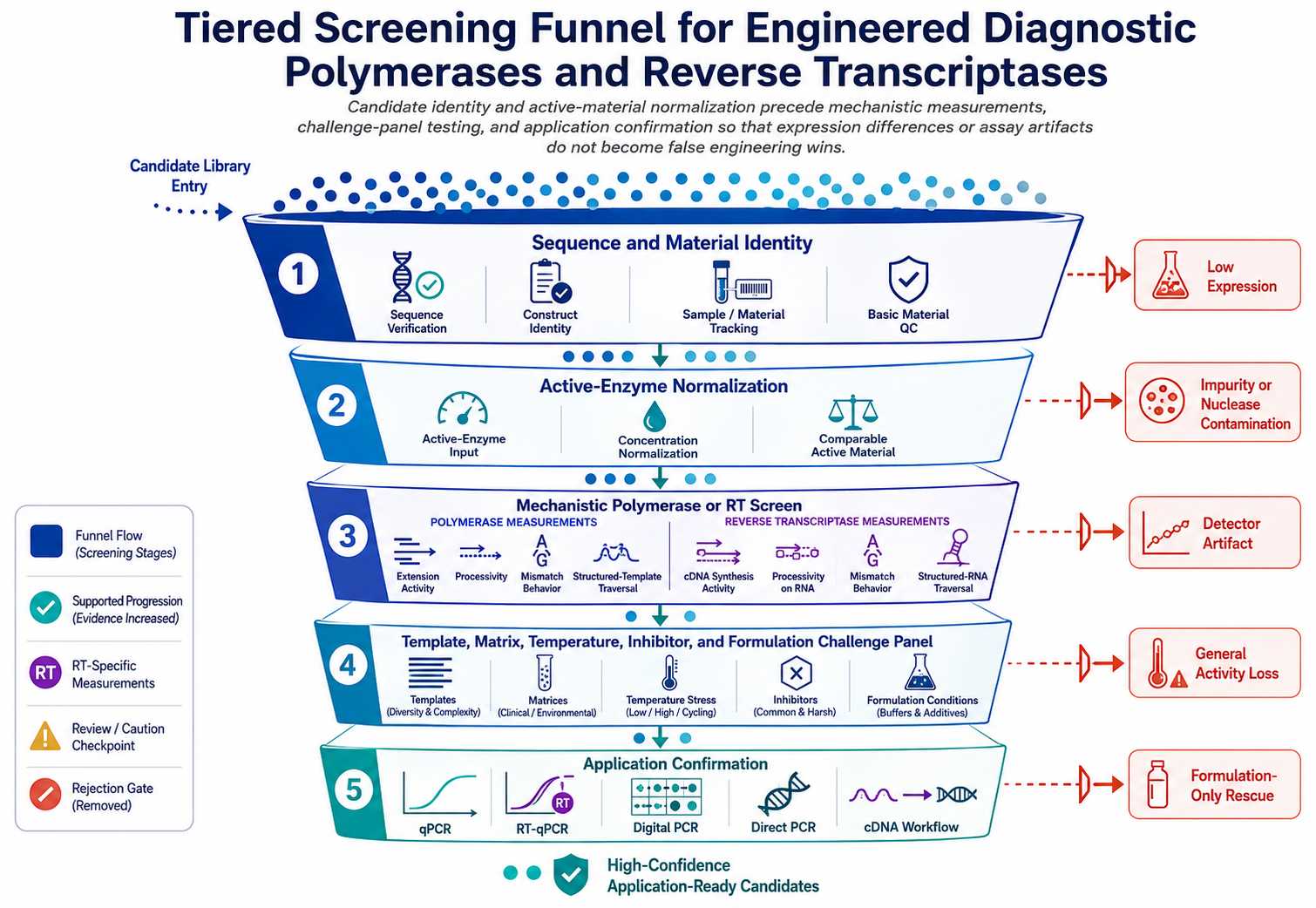 Fig 4. Tiered polymerase and RT screening funnel. Candidate identity and active-material normalization precede mechanistic measurements, challenge-panel testing, and application confirmation so that expression differences or assay artifacts do not become false engineering wins.
(Creative Enzymes Diagnostic)
Depending on the goal, polymerase studies can include primer extension, time courses, processivity assays, fidelity measurements, mismatch panels, amplicon families, GC and length challenges, inhibitor titration, nucleotide-substitution studies, thermal pre-challenge, probe-cleavage response, background amplification, and complete qPCR or digital-PCR performance. A result obtained at excess enzyme is interpreted differently from one retained across an enzyme dilution series. A lower Cq is not automatically better if nonspecific amplification, baseline behavior, endpoint yield, or replicate failure worsens.
For direct-sample programs, intrinsic enzyme tolerance is separated from formulation protection and optical interference. Whole blood, for example, can influence polymerase activity, template accessibility, and fluorescence through different components. Relevant controls can include purified versus crude template, matrix dose-response, enzyme swaps, reporter-independent product analysis, extraction controls, and buffer-matched conditions. This distinction supports better decisions about whether to engineer the enzyme, change the buffer, modify sample pretreatment, or combine approaches.
RT measurements can include total cDNA yield, target-position recovery, full-length product distribution, processivity under a trap, reaction-rate time course, operating-temperature profile, structured-RNA panel, input dilution, inhibitor challenge, fidelity, template switching, sequence bias, and performance with gene-specific, random, or oligo(dT) priming. Downstream qPCR can be useful but may conceal RT differences because the amplification step compresses or reshapes the cDNA distribution. Orthogonal product analysis or multiple target positions may therefore be included.
For one-step RT-qPCR, the two enzymes are evaluated as a coupled system. RT concentration and buffer components can affect the subsequent PCR; the RT incubation and inactivation steps can change polymerase behavior; and the target RNA may create primer competition or structure-dependent effects. The screen can compare the RT alone, polymerase alone, recombined pairs, and the complete formulation to locate beneficial and adverse interactions.
Application confirmation is not an afterthought. It is the point at which a mechanistic improvement is tested against the conditions that motivated the project. We select targets and challenges that represent the intended design space rather than relying on a single easy amplicon or synthetic template. The panel can include multiple sequences, target concentrations, negative materials, matrices, instruments, and reagent lots, with the exact level determined by development stage.
Key decisions may involve amplification efficiency, Cq or partition classification, linearity, low-copy detection, background, fluorescence kinetics, probe-cleavage behavior, multiplex compatibility, thermal cycling speed, and dUTP/UDG workflow fit.
For a broader premix program, connect enzyme engineering to PCR and qPCR enzyme premix development or digital PCR reagent development.
Relevant endpoints can include cDNA conversion across RNA inputs and structures, target-position recovery, RT incubation time, carryover into PCR, sensitivity, efficiency, background, and stability of the combined reagent architecture.
Projects requiring complete reagent integration can continue through one-step RT-qPCR master mix development.
The challenge set is built around named specimen components, collection media, pretreatment, target release, matrix loading, fluorescence effects, and failure frequency. Intrinsic polymerase tolerance is distinguished from buffer and sample-processing effects.
The enzyme campaign can operate as one workstream within direct PCR and extraction-free enzyme-system development.
Depending on intended use, the study can assess full-length recovery, template bias, fidelity, structured or modified RNA, long templates, low input, template switching, and compatibility with downstream amplification or adapter workflows.
Library-oriented work can be coordinated with NGS library preparation enzyme-system development.
Application testing uses development-stage evidence and defined materials; it does not by itself establish the analytical or clinical performance of a finished IVD. MIQE 2.0 emphasizes transparent reporting of qPCR and RT-qPCR experimental details. Consistent with that principle, our reports can record enzyme lot and concentration, template and input, primers/probes, nucleotide and magnesium conditions, additives, thermal protocol, instrument, analysis rules, controls, replicate structure, and exclusions needed to interpret the result.
A promising sequence is not yet a transferable enzyme raw material. Lead confirmation uses independently prepared material where appropriate, repeats critical measurements, and challenges the candidate against the protected-property contract. The goal is to show that the observed benefit follows the sequence and remains visible at the material quality, concentration, and reaction conditions relevant to the next development stage.
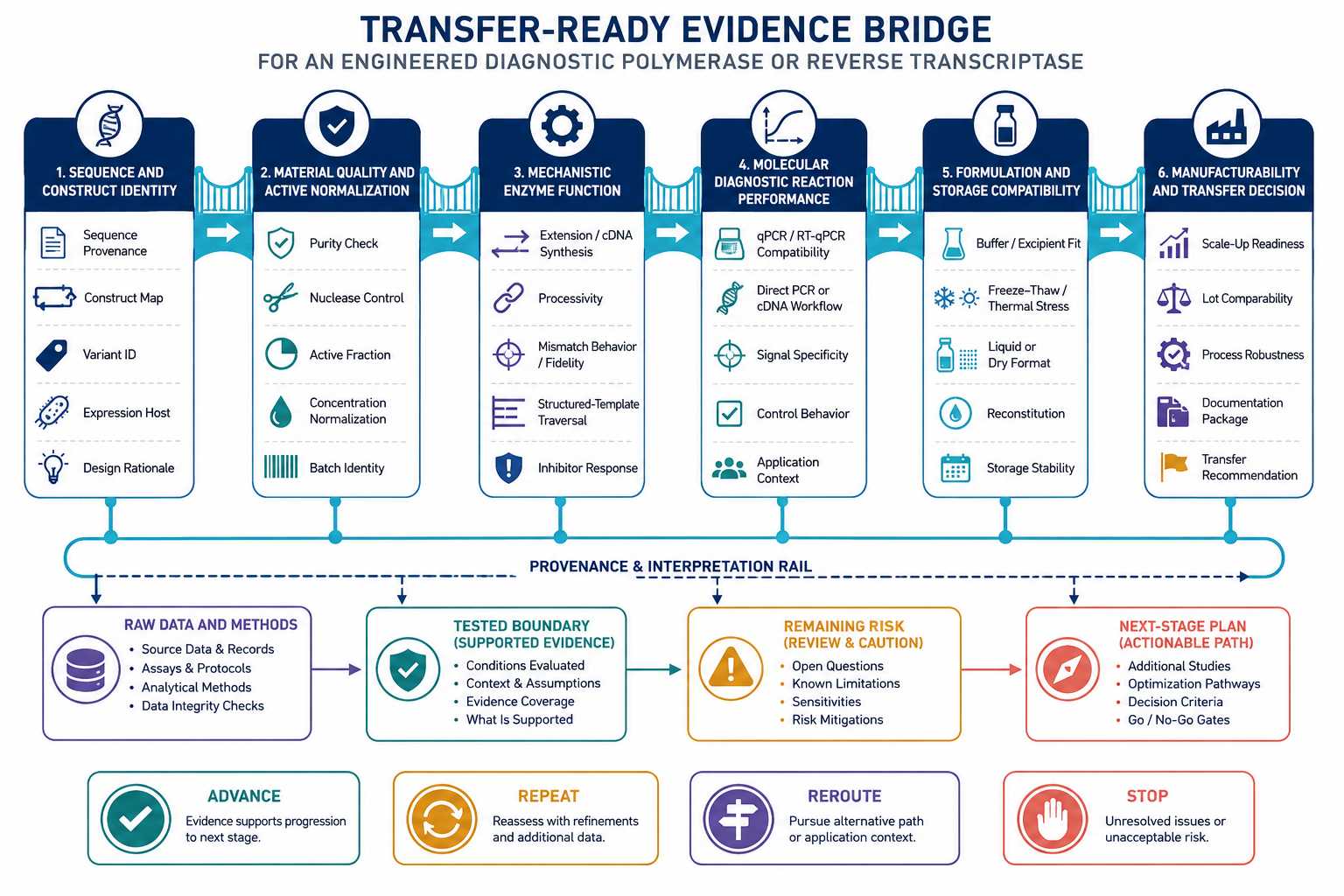 Fig 5. Lead evidence and transfer bridge. Sequence provenance, enzyme material, mechanistic function, molecular-diagnostic reaction performance, formulation compatibility, and manufacturability evidence are connected before a lead recommendation is made.
(Creative Enzymes Diagnostic)
Manufacturability assessment may include expression consistency, soluble yield, purification behavior, concentration feasibility, aggregation, storage response, nuclease or host-derived impurity concerns, and activity recovery after handling. If expression or production becomes the primary bottleneck, the program can link to the planned AI-guided expression, solubility, and manufacturability optimization service. Broader physicochemical and functional measurements can be coordinated through enzyme activity and stability analysis.
Formulation work is treated as an interaction study, not a final polishing step. Changes in salts, magnesium, detergents, stabilizers, crowding agents, preservatives, glycerol, nucleotide concentration, or enzyme concentration can reorder variant performance. A lead can therefore be confirmed in both a controlled characterization buffer and the intended formulation neighborhood. For ambient-stable or lyophilized systems, the project may require separate formulation and drying studies; intrinsic enzyme thermostability does not guarantee survival through freezing, drying, rehydration, or storage.
Typical deliverables, depending on scope, include the reaction and target-product profile; scaffold assessment; computational hypothesis report; candidate and construct records; expression and purification results; raw and processed screening data; model outputs with limitations; biochemical, challenge-panel, and application-functional results; lead sequence and material recommendation; method and control descriptions; tested and untested boundaries; formulation or manufacturability observations; and a transfer or next-round plan. Deliverables are defined in the statement of work and do not constitute regulatory approval or a finished-device validation package.
A project does not need to begin with a large multi-round campaign. If the bottleneck is uncertain, a focused reaction-deconvolution study may be the fastest route. If the parent and screen are already qualified, the engagement can begin with candidate design and a focused experimental panel. If prior variant data exist, an iterative AI-guided design-build-test-learn program may extract more value from every new measurement.
Creative Enzymes can connect the program to our broader AI-driven diagnostic enzyme engineering services, AI-guided variant design and screening, activity and kinetic performance optimization, substrate-specificity and cross-reactivity reduction, and comprehensive enzyme development and validation. Existing reagent options can also be reviewed through our diagnostic-enzyme product portfolio.
AI can propose or prioritize sequence changes using pretrained models, homologs, structures, conservation, and physical or evolutionary features. With no project-specific data, uncertainty is usually greater and the candidate set should include diverse hypotheses and controls. Experimental expression, biochemical measurement, and application-functional testing are required to determine whether a design meets the target reaction.
Yes, projects can be scoped for a DNA polymerase, an RNA-dependent DNA polymerase, or a paired-enzyme system. Feasibility depends on the starting scaffold, rights and materials, measurable objectives, screening throughput, and intended application. Work centered on strand-displacement or isothermal amplification may be routed to the dedicated isothermal-enzyme service.
Potential targets include extension activity and speed, processivity, fidelity, mismatch-extension behavior, inhibitor tolerance, template-range robustness, thermal durability, dUTP or modified-nucleotide compatibility, and application-specific nuclease behavior. Not every property should be maximized. We define the primary improvement and protected properties together and build assays that can detect the relevant tradeoffs.
Potential targets include cDNA yield, reaction rate, processivity, full-length recovery, operating temperature, structured-RNA performance, low-input or inhibitor tolerance, fidelity, sequence bias, RNase H behavior, and template switching. The desirable combination depends on whether the enzyme is intended for RT-qPCR, first-strand cDNA synthesis, amplicon sequencing, RNA library preparation, or another defined workflow.
No. Fidelity must be balanced with extension rate, yield, template range, mismatch behavior, probe chemistry, end properties, and the intended discrimination mechanism. A project can measure error rate or mismatch response where those attributes affect the use case, but a general fidelity ranking does not by itself predict qPCR, digital PCR, or multiplex performance.
Sequence changes may affect low-temperature activity, activation behavior, thermal response, or compatibility with an inhibitory partner. However, hot-start control can also use antibodies, aptamers, chemical modification, or formulation strategies. We determine which mechanism is in scope and test enzyme performance within that architecture rather than promising a sequence-only solution.
No. Reduced RNase H activity can help preserve RNA templates during long cDNA synthesis, but the optimal state depends on the complete workflow, template, reaction time, and downstream steps. We define the desired behavior and compare functional outcomes instead of treating RNase H reduction as a universal improvement.
Matched enzyme and formulation comparisons, inhibitor dose-response, extracted versus crude samples, purified product analysis, fluorescence controls, component swaps, and active-material normalization can separate these effects. In many direct-sample systems the best result may require both an engineered enzyme and a compatible buffer or sample pretreatment.
Application-relevant screening in a defined master-mix neighborhood can be included, particularly when formulation changes reorder candidate performance. Early mechanistic measurements are still useful for interpreting why a variant succeeds or fails. Client-supplied components, proprietary formulations, instruments, and materials can be handled under the agreed project and confidentiality scope.
There is no fixed number. The appropriate candidate count depends on the evidence available, sequence diversity, construct complexity, assay capacity, material needs, target difficulty, and budget. A qualified screen and a diverse, informative portfolio can be more valuable than a very large library measured with a weak proxy. Each round has a review gate and an explicit continuation decision.
Depending on scope, the package can connect sequence and construct identity, design rationale, material quality, normalization, biochemical results, challenge-panel data, application-functional results, formulation and manufacturability observations, raw and processed data, methods, controls, tested boundaries, open risks, and a transfer or next-round recommendation.
No. The service provides research and development evidence for enzyme raw materials and reagent systems under an agreed scope. The legal manufacturer or sponsor remains responsible for intended use, design control, complete analytical and clinical validation, risk management, registration, labeling, and market authorization.
Share the parent sequence or current enzyme, the molecular diagnostic reaction, the observed limitation, representative primer-template materials, existing data, and the properties that must be protected. Creative Enzymes can help determine whether the next step should be reaction deconvolution, focused variant design, an iterative AI-guided campaign, formulation co-optimization, or a connected raw-material development program.
Contact Creative Enzymes