
Creative Enzymes structures multiparameter programs around the combination a point-of-care reagent actually needs: functional speed, usable signal, controlled background, matrix tolerance, operating-temperature robustness, formulation and dry-format compatibility, expression feasibility, and performance in the intended consumable and workflow.
The useful candidate is not necessarily the variant with the highest activity in a purified-enzyme assay. It is the candidate, or small candidate portfolio, that passes non-negotiable product gates and retains the strongest defensible trade-offs when measured in the reagent, sample matrix, format, device, temperature window, and workflow that matter.
Point-of-care systems compress laboratory operations into a small number of user actions and a constrained consumable. The enzyme may have to start rapidly at one temperature, remain quiet before initiation, tolerate incomplete sample preparation, produce a readable signal before a fixed timer expires, coexist with reporters or accessory enzymes, survive drying and transport, rehydrate through a narrow fluid path, and be manufacturable at a consistent active dose. Improving one attribute can expose another limitation. A faster polymerase can increase nonspecific amplification. A mutation that raises melting temperature can reduce activity at the actual reaction temperature. A formulation-compatible variant may express poorly. A high-yield preparation can contain a lower active fraction or behave differently in the final master mix.
Useful when one clearly dominant limitation has already been localized and other attributes have sufficient margin. It becomes risky when a surrogate improvement changes background, matrix response, format recovery, or manufacturing behavior.
Required when several attributes jointly determine advancement or when improvement in one property can compromise another. The objective architecture and confirmation design matter as much as the optimization algorithm.
Required before calling a variant a POCT reagent candidate. Purified-enzyme results are connected stepwise to reagent, matrix, dry unit, cartridge or sensor, reader timing, and use-condition evidence.
A useful target product profile starts outside the protein. We document what the operator, consumable, reader, package, distribution route, and assay must accomplish, then determine which burdens are actually addressable through enzyme engineering. This prevents the enzyme from being asked to compensate for a device, formulation, sample-preparation, or fluidic failure that should be solved elsewhere.
Result window, operator steps, ambient conditions, sample handling, power and equipment limits, invalid-result tolerance, and storage or transport constraints.
Reaction volume, heat profile, mixing, material contact, rehydration path, optics or electrochemistry, timing control, and package barrier.
Signal mechanism, threshold behavior, blank response, matrix, cofactors, reporters, accessory enzymes, formulation, and dried or liquid format.
Rate, initiation, fidelity or specificity, inhibitor tolerance, temperature response, stability, solubility, expression, and process recovery.
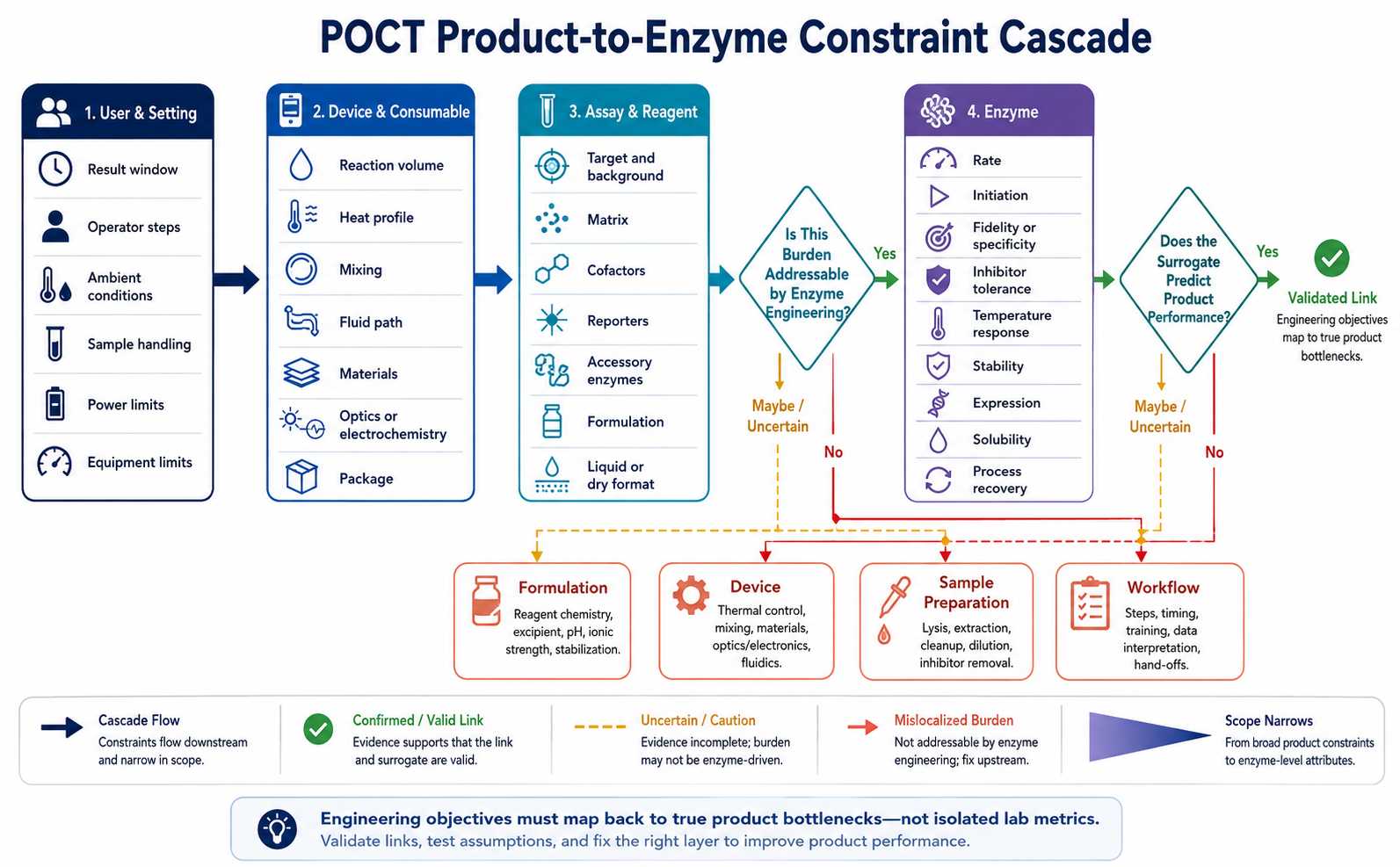 Fig. 1. POCT product-to-enzyme constraint cascade. User, device, assay, reagent, and enzyme requirements are connected so that engineering objectives address the true product bottleneck rather than an isolated laboratory metric.
(Creative Enzymes Diagnostic)
A molecular amplification reagent may emphasize initiation speed, nonspecific amplification, inhibitor tolerance, template diversity, low-copy behavior, temperature robustness, and dry-format recovery. A reporter-enzyme system may emphasize catalytic response, substrate stability, background, conjugation or immobilization tolerance, and optical or electrochemical signal behavior. A clinical chemistry reagent may require calibrated rate behavior, substrate selectivity, interference resistance, and consistency within a defined measurement interval. An enzyme-enabled biosensor may add electrode, membrane, mediator, orientation, diffusion, and on-sensor stability constraints.
We therefore do not publish a universal "POCT enzyme score." The project objective register is derived from the actual modality, sample, format, device, use environment, and advancement decision. The REASSURED diagnostic concept is a useful reminder that rapidity, ease of use, equipment burden, delivery, and connectivity are system-level properties. Enzyme engineering can contribute to those outcomes, but it cannot independently validate the finished diagnostic system.
Multiparameter programs fail when every measurement is treated as a value to maximize. Some attributes are non-negotiable gates. Some should increase or decrease. Some must remain inside a useful range. Others define robustness: the sensitivity of performance to variation in temperature, time, pH, matrix composition, reagent lot, or user handling. A fifth category contains watch variables that may not drive the current round but must not deteriorate unnoticed.
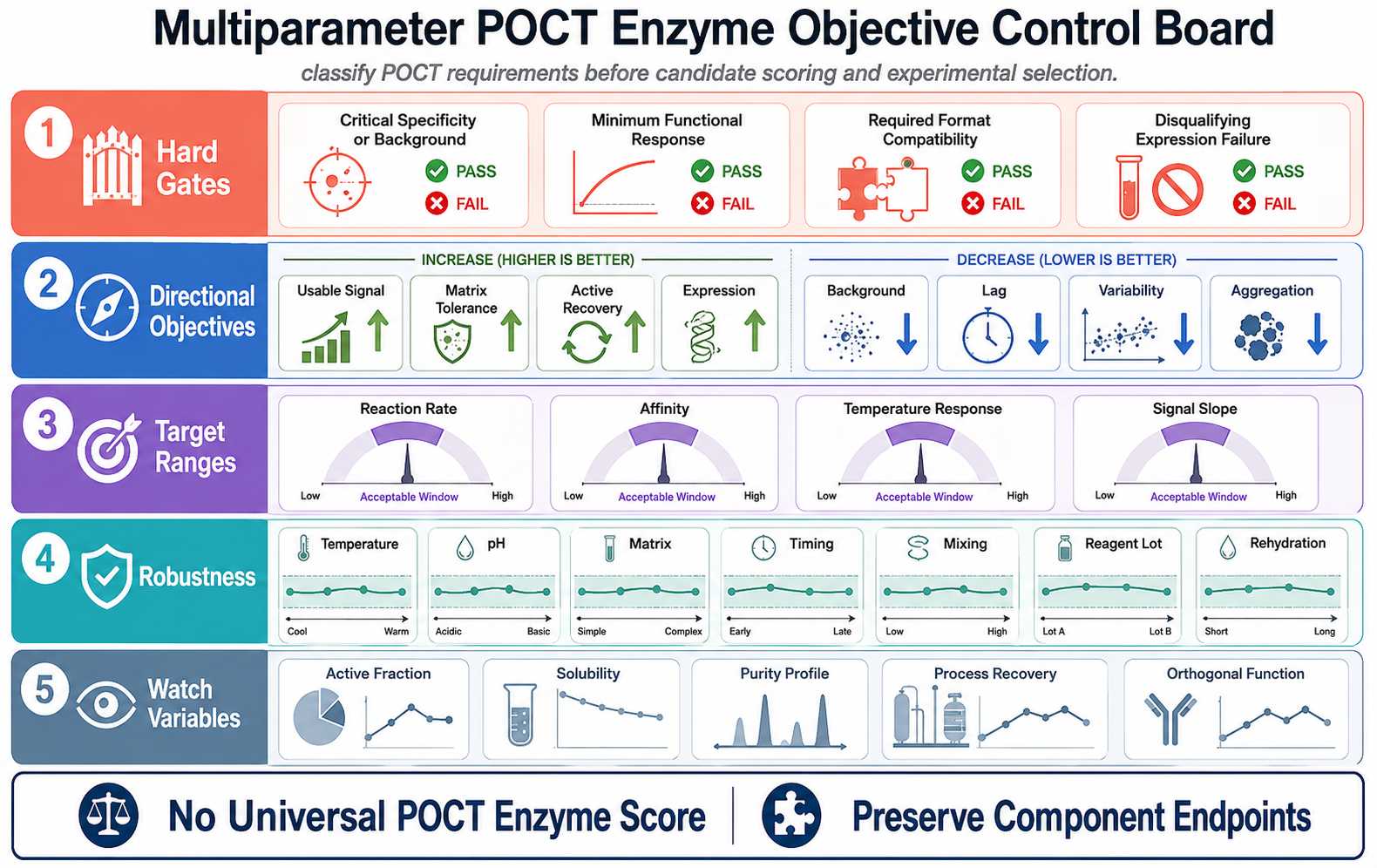 Fig. 2. Multiparameter objective control board. POCT requirements are classified as hard gates, directional objectives, target ranges, robustness measures, or watch variables before candidate scoring and experimental selection.
(Creative Enzymes Diagnostic)
"High activity" is incomplete unless it names the substrate, temperature, pH, cofactors, matrix, reaction window, enzyme input basis, calculation, and comparison. "Stable" can refer to structural integrity, retained catalytic activity, liquid storage, dry storage, in-use dwell, transport exposure, or robustness during the reaction. "Specific" can mean substrate discrimination, target sequence discrimination, absence of nonspecific amplification, low cross-reactivity, or minimal activity toward a panel of interferents. We convert broad wishes into endpoints that can be measured and repeated.
The objective register also records the decision level. Some endpoints are useful for mechanistic screening but are not product acceptance criteria. A thermal-shift measurement may help rank variants, but it does not establish retained reagent performance after drying and storage. An expression titer may estimate supply feasibility, but it does not establish active enzyme yield. A purified-enzyme kinetic parameter may explain a reaction change, but it does not replace low-signal or near-threshold performance in the application assay.
A multiparameter campaign needs a trustworthy baseline. We profile the parent or reference enzyme across the intended objective panel and identify where performance margin is strong, marginal, or unknown. This distinguishes an enzyme limitation from an assay configuration that cannot resolve meaningful differences. If the screening method is noisy, saturated, confounded with active enzyme input, or disconnected from the product decision, an AI model will learn the assay's limitations rather than the desired POCT behavior.
High-throughput screening capacity is usually much greater for a primary signal than for matrix panels, dry-format runs, cartridge tests, or long stability studies. We can use a funnel in which inexpensive assays remove clear gate failures, medium-throughput assays expose key trade-offs, and application-proximal studies confirm a smaller Pareto portfolio. The funnel is designed so that an early surrogate has a stated purpose and a planned bridge, not an assumed equivalence to the final POCT result.
| Tier | Typical question | Possible measurements | Advance only when |
|---|---|---|---|
| Gate screen | Is the variant buildable and functionally plausible? | Sequence/construct checks, expression or solubility signal, gross activity, critical off-target or background check | Required gates pass and sample identity/input are interpretable |
| Trade-off screen | Which variants improve a useful combination? | Rate or time-to-result proxy, background, temperature response, matrix/inhibitor challenge, recovery or active yield | Candidate is non-dominated or fills a deliberate portfolio role |
| Application screen | Does the trade-off persist in the reagent context? | Master mix, target matrix, low-signal material, relevant reporter/accessory system, formulation or dry-process challenge | Component and assay evidence agree within defined limits |
| Confirmation | Is the candidate reproducible and transferable? | Independent preparation/batch, final-like process, cartridge or sensor, reader timing, stress and storage modules | Predefined product gates and residual-risk review support handoff |
"AI-driven" does not mean that one model controls every project. The useful method depends on sequence information, structural confidence, prior variant data, assay reliability, number and completeness of endpoints, accessible sequence space, experimental capacity, and the distance between the current enzyme and the target product profile. We combine or stage methods when that produces more testable candidates.
Sequence conservation, structural hypotheses, known catalytic constraints, zero-shot or pretrained-model scores, literature evidence, and designed diversity can guide an initial candidate panel. Predicted scores are used for prioritization and coverage, not as measured POCT performance.
When sufficient labeled data exist, property-specific or multi-task models may estimate outcomes and uncertainty. Data splits, normalization, missing endpoints, batch effects, and deployment alignment are handled through the related AI-ready dataset design and screening analysis service.
Active-learning, Bayesian, evolutionary, or other acquisition strategies can balance exploitation, uncertainty reduction, diversity, and objective coverage. The next experiment is selected for decision value, not simply the highest predicted composite score.
Structure-based reasoning can help identify catalytic, substrate-recognition, interface, flexibility, or stability hypotheses and can connect to our structural modeling and enzyme-substrate interaction analysis. A buildable and information-rich candidate set can be developed through AI-assisted mutation library design. When the project requires multiple iterative rounds under one governance structure, the work may connect to the closed-loop DBTL enzyme evolution service.
A model may rank folding stability, sequence plausibility, expression likelihood, active-site geometry, or assay fitness. Each output has a defined domain. A stability proxy does not establish dry storage. An activity prediction does not establish low-copy detection. A solubility score does not establish active recovery from a master mix. A language-model likelihood does not establish specificity, matrix tolerance, or manufacturability. We record the role of each score, preserve alternative hypotheses, and design experiments that can falsify the proposed relationship.
When objectives conflict, no single candidate may be best in every dimension. A candidate is Pareto-dominated when another candidate is at least as good on all considered objectives and better on one or more. Non-dominated candidates form a Pareto set: each offers a different efficient trade-off. This does not prove that the candidates are experimentally optimal, but it provides a transparent way to avoid discarding a useful POCT path because of one arbitrary weight vector.
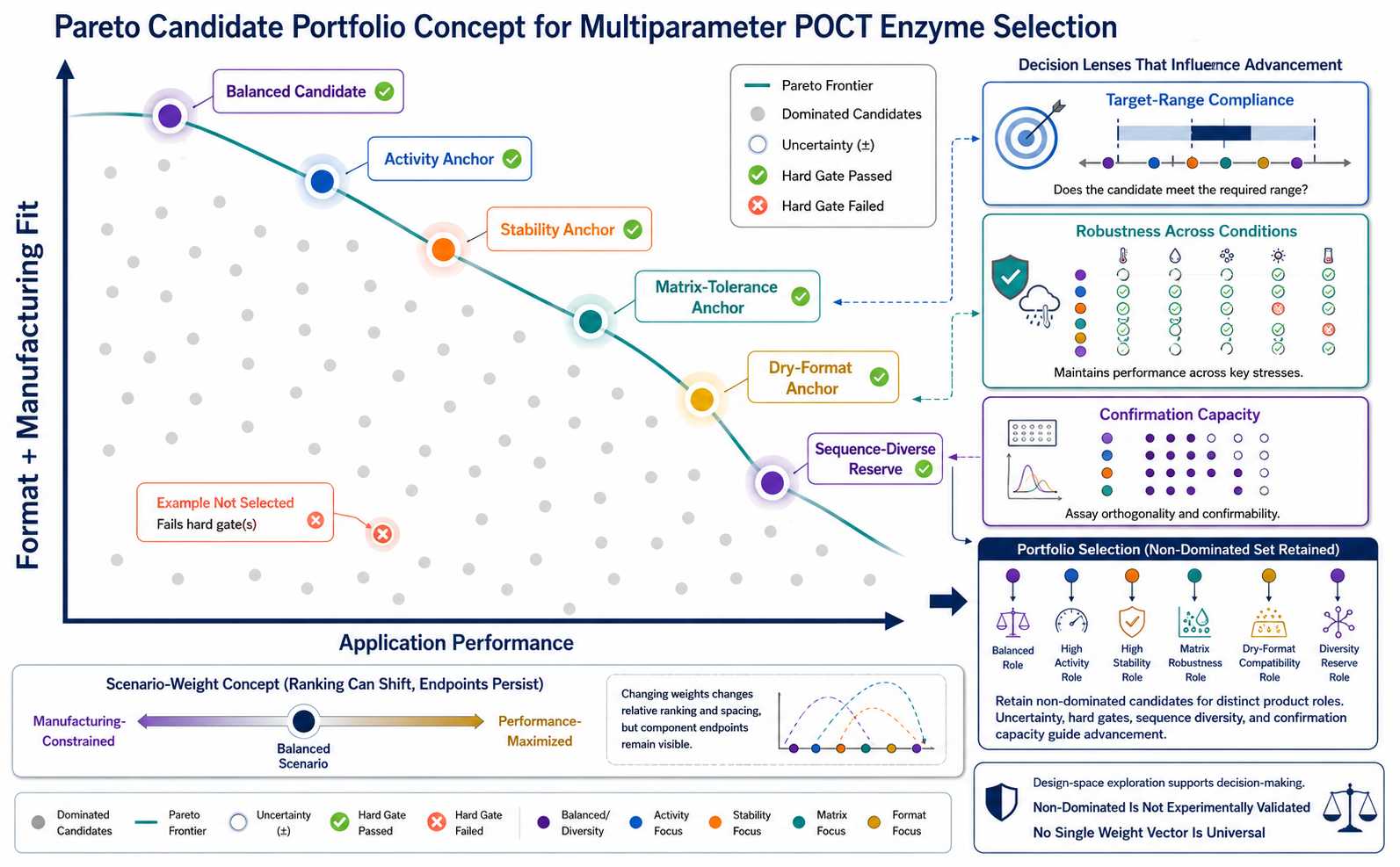 Fig. 3. Pareto candidate portfolio for POCT enzyme selection. Non-dominated variants are retained for distinct product roles, while uncertainty, hard gates, sequence diversity, and confirmation capacity determine which candidates proceed.
(Creative Enzymes Diagnostic)
A composite score is useful when the product scenario and preferences are explicit; for example, when one deployment places greater value on ambient stability and another prioritizes the shortest reaction window. We document scaling, direction, weights, hard constraints, missing-data handling, and uncertainty. The component endpoints and Pareto view remain available. This allows the candidate list to be recalculated when the device, package, target market, reagent format, or manufacturing constraint changes.
A balanced candidate is not the only useful experiment. An activity anchor can reveal how much speed is sacrificed for stability. A stability anchor can test whether the final formulation closes the performance gap. A matrix-tolerance anchor can reveal a new mechanism. A sequence-diverse candidate reduces the risk that every finalist shares the same unrecognized liability. A parent and appropriate control remain in the study. Portfolio design makes the confirmation experiment more informative than testing several nearly identical top-ranked variants.
Multiparameter optimization is only useful if improvements survive contact with the product. We use a staged evidence ladder so failures can be localized. Moving directly from a purified-enzyme screen to a final cartridge may conceal the cause of loss; stopping at a purified assay may advance a candidate that the product cannot use.
Identity, active input, baseline kinetics or functional signal, temperature/pH response, substrate or target panel, and gross stability.
Buffers, salts, cofactors, primers/probes, reporters, accessory enzymes, preservatives, surfactants, and target concentration range.
Relevant sample components, preparation residues, inhibitor panels, dilution, low-signal material, background, cross-reactivity, and matrix variability.
Liquid or dry unit, drying recovery, reconstitution, moisture exposure, package barrier, immobilization or membrane contact, and storage stress.
Cartridge/sensor geometry, reaction volume, heat and mixing, reader timing, fluid path, user variation, on-device dwell, and final-like acceptance panel.
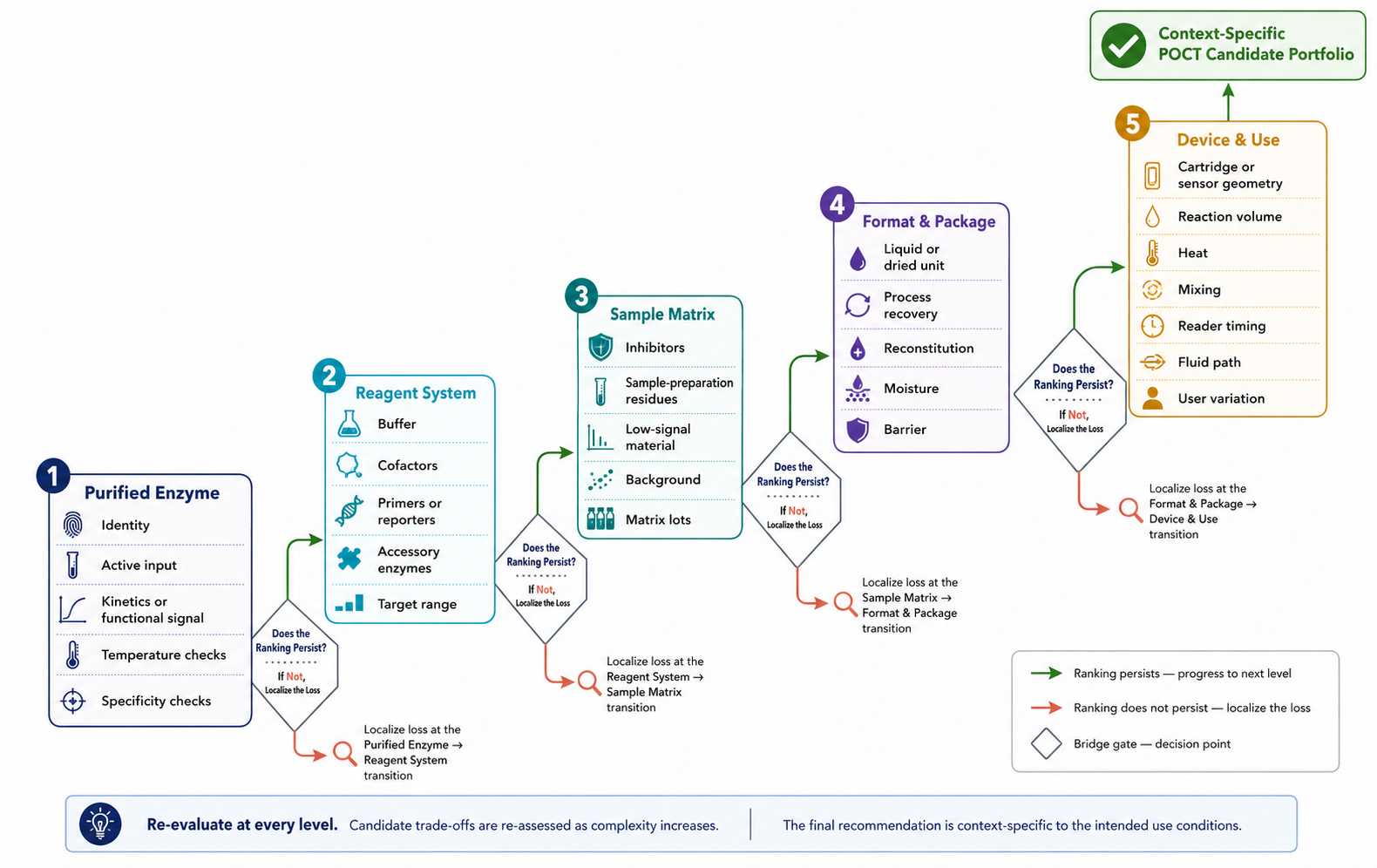 Fig. 4. POCT application evidence ladder. Candidate trade-offs are re-evaluated from purified enzyme through reagent, matrix, format/package, and device/use conditions so that loss can be localized and the final recommendation remains context-specific.
(Creative Enzymes Diagnostic)
Published POCT studies illustrate why this bridging matters. In an RPA system, mixing and reaction volume affected low-copy signal and sensitivity, while storage effects depended on reagent configuration and temperature. Dry-stored amplification studies show that formulation, porous substrate, moisture, and package can influence functional recovery. These findings are not universal operating conditions; they demonstrate that the physical workflow and reagent format can change which enzyme characteristics matter.
When drying, excipients, package, or ambient deployment is a major constraint, projects can connect to excipient, buffer, and stabilizer screening and the cold-chain reduction strategy for POCT reagents. Those services own formulation and claim-evidence depth; this page keeps them as objectives and confirmation modules within the enzyme campaign.
When sample effects or physical integration dominate, the program can include assay interference and matrix-effect evaluation and POCT cartridge compatibility for enzyme reagents. The final recommendation names the tested matrix, consumable, reader, and use condition rather than claiming universal compatibility.
Multiparameter data are valuable when they identify the next discriminating experiment. We do not interpret every unfavorable correlation as an unavoidable molecular trade-off. It can also arise from unequal active input, assay saturation, batch effects, formulation differences, or a surrogate endpoint that does not represent the product. The pattern is converted into alternative explanations and tested.
| Observed pattern | Possible explanations | Useful next experiment | Do not conclude yet |
|---|---|---|---|
| Higher purified activity, worse POCT background | Faster nonspecific initiation, reduced substrate discrimination, excessive dose, reporter interaction, or timing mismatch | Matched active input, target/off-target panel, time course, enzyme titration, and application blank/negative controls | That activity improvement is unusable in every formulation |
| Higher thermal metric, slower operating-temperature reaction | Stability-flexibility trade-off, altered initiation, cofactor response, or inappropriate stability proxy | Temperature-rate profile, kinetic decomposition, application timing window, and independent structural/functional check | That the most stable candidate is the best storage candidate |
| High expression, weak functional response | Low active fraction, misfolding, aggregation, impurity, incorrect normalization, or processing difference | Identity/purity, soluble and active yield, matched active input, concentration response, and process comparison | That expression and activity are genetically antagonistic |
| Good wet performance, poor drying recovery | Freeze/concentration stress, interface exposure, excipient mismatch, pH shift, residual moisture, reconstitution, or package ingress | Process-stage sampling, formulation matrix, moisture/package assessment, matched wet control, and reconstitution study | That the enzyme sequence alone caused dry-state failure |
| Good buffer performance, matrix-dependent loss | Direct inhibition, cofactor sequestration, adsorption, sample-preparation residue, background signal, or target accessibility | Component-spike panel, dilution/recovery, orthogonal activity, sample-lot panel, and reagent-condition interaction test | That one matrix result transfers to every specimen type |
| Good tube assay, weak cartridge performance | Heat gradient, mixing, fluid path, surface adsorption, reaction volume, delayed rehydration, optics, or timing | Tube-to-cartridge bridge with stage-matched samples, temperature logging, material control, and fluidic observation | That additional sequence optimization is the first remedy |
The service recommendation may be to engineer the enzyme, adjust the dose, change an accessory component, refine the formulation, change the drying or reconstitution process, revise the device condition, or narrow the product claim. A technically sound multiparameter program does not force every failure back into the protein sequence.
The campaign is modular because projects begin with different evidence. A client may have a well-characterized parent but no dry-format data, a large historical screen but inconsistent endpoint definitions, a small POCT cartridge with an unresolved matrix problem, or an early enzyme family requiring a first information-rich panel. We establish the smallest next phase that can change the decision.
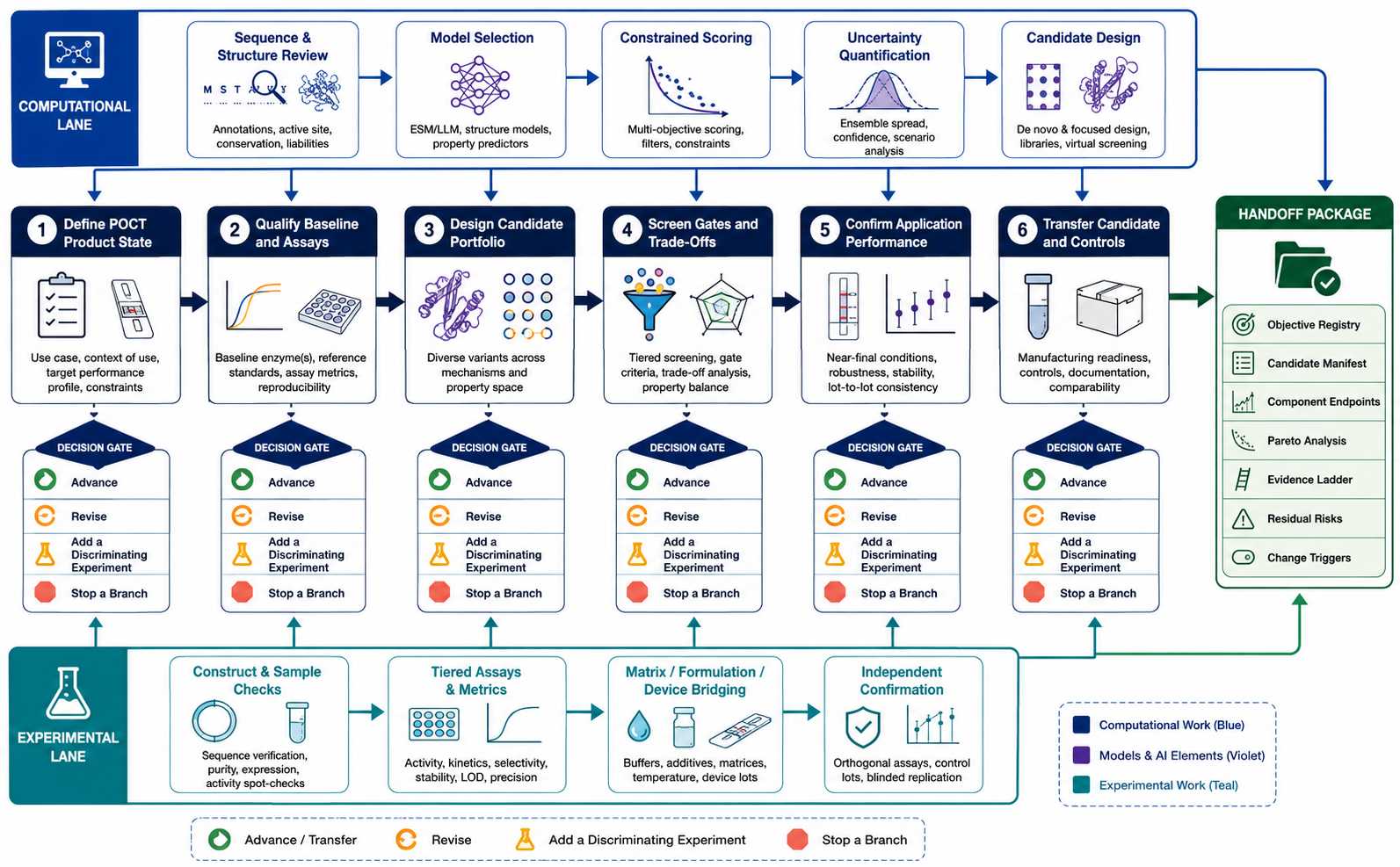 Fig. 5. Multiparameter POCT enzyme optimization decision gates. The campaign advances only when the product profile, assay evidence, candidate trade-offs, application confirmation, and transfer controls support the next investment.
(Creative Enzymes Diagnostic)
| Gate | Central question | Possible decisions | Evidence retained |
|---|---|---|---|
| Product-profile gate | Which POCT outcomes are addressable through enzyme engineering? | Proceed, separate device/formulation work, narrow scope, or collect missing use information | Constraint cascade, target product profile, objective register, and risk map |
| Assay gate | Can the endpoint panel resolve decision-relevant differences? | Launch screen, improve assay, add controls, change surrogate, or run pilot | Baseline map, control behavior, assay limitations, and tier plan |
| Portfolio gate | Which candidates pass hard constraints and cover efficient trade-offs? | Advance Pareto candidates, retain anchors, redesign library, or stop a branch | Candidate manifest, component endpoints, uncertainty, dominance and diversity analysis |
| Application gate | Do improvements persist in matrix, format, device, and use conditions? | Confirm, modify dose/formulation/device, narrow the claim, or reject the mechanism | Evidence-ladder results, comparator data, deviations, and failure localization |
| Transfer gate | Can the candidate state be reproduced and controlled? | Transfer, generate independent lots, add method/control work, bridge a change, or hold | Candidate specification proposal, process and assay context, residual risks, and change triggers |
POCT use profile, system constraint cascade, hard gates, directional and target-range objectives, robustness variables, endpoint definitions, acceptance logic, and staged evidence plan.
Sequence/structure review, model selection, candidate scoring, constrained or multi-objective ranking, diversity and uncertainty coverage, mutation/library recommendations, and hypothesis register.
Project-specific purified-enzyme, reagent, matrix, stress, formulation, dry-format, cartridge, or reader assays as agreed, with appropriate controls and comparators.
Hard-gate disposition, component endpoint review, correlations, trade-offs, Pareto set, scenario-weighted views, robustness, candidate portfolio, and next-experiment recommendation.
Independent preparation or batch, final-like formulation/process, relevant matrix and weak-signal panel, device/use conditions, orthogonal checks, and failure-mode confirmation.
Candidate identity and context, proposed critical attributes, assay and process notes, known limitations, residual risks, supply/manufacturing considerations, and triggers for bridging.
Expression and sample-generation work can be coordinated with enzyme expression and purification. Mechanistic activity and stability measurements may connect to enzyme activity and stability analysis. Exact scope, material quantities, data formats, assay maturity, and final-like components are confirmed before work begins.
If final cartridge, matrix, formulation, or reader components are unavailable, an early phase may use a declared surrogate and define the later bridge. If current data are incomplete or inconsistent, the first deliverable may be an objective and assay-gap assessment rather than an immediate AI design round. If one failure clearly dominates, a focused single-property service may be more efficient than a broad multiparameter campaign.
No model, candidate, number of rounds, performance gain, stability duration, sensitivity, specificity, or manufacturing outcome is guaranteed. The defensible result may be a balanced engineered candidate, a portfolio for further confirmation, a finding that formulation or device changes are more important than sequence changes, or evidence that the target profile must be revised.
This service integrates application-level trade-offs. More focused pages address individual bottlenecks in greater depth. The parent AI-driven diagnostic enzyme engineering services page provides the cluster overview.
Use activity and kinetic performance optimization when speed or catalytic behavior is the localized constraint; specificity and cross-reactivity reduction when off-target response dominates; and thermostability and lyophilization-stability engineering when stability is the primary sequence objective.
Focused options include polymerase and reverse-transcriptase engineering, LAMP, RPA, and isothermal enzyme optimization, CRISPR/Cas diagnostic enzyme engineering, and variant design and screening.
Programs may connect to de novo enzyme discovery and mining, expression, solubility, and manufacturability optimization, or second-source and sequence-equivalency engineering.
There is no universal maximum, but adding objectives increases measurement burden, missing-data risk, trade-off complexity, and the number of candidates needed to cover the useful space. We prioritize the smallest objective set that represents the product decision, keep hard gates explicit, and place lower-priority attributes in a watch list or later confirmation tier.
No. Some requirements are hard gates, some are directional goals, some have target ranges, and some describe robustness. Weights are used only for declared scenarios and do not replace component endpoints or the Pareto view. A candidate that fails a true gate is not advanced merely because another property is excellent.
Possibly, but the method and claim must match the evidence. Sparse-data projects may use sequence conservation, structural hypotheses, pretrained or zero-shot scores, designed diversity, and information-rich experiments. Project-specific supervised models may be inappropriate until consistent labeled data are available. Every computational recommendation remains subject to experimental testing.
A composite score embeds choices about scaling and preference. It can hide that one candidate has the best speed, another has the best dry-format recovery, and a third is more robust to matrix variation. A Pareto portfolio keeps efficient alternatives visible and allows confirmation or product-priority changes to determine the final choice.
Final-like cartridge or sensor testing is preferred for confirmation when the component, reader, materials, and required sample are available and included in scope. Earlier phases may use tubes, plates, surrogate matrices, or development containers to conserve material and isolate mechanisms. The surrogate and required bridge are documented.
Yes, if both endpoints can be measured with adequate controls. Activity can be screened first, while drying and reconstitution are tested on a smaller non-dominated portfolio. Because dry-format recovery depends on formulation, process, moisture, and package as well as sequence, the experimental design separates these contributions where possible.
Expression, soluble yield, active fraction, purification recovery, and scale-relevant behavior can be treated as gates or objectives. The project may select a slightly lower application performer with better supply margin, run a focused expression/manufacturability round, or retain separate performance and manufacturability anchors for confirmation.
No. A molecular thermal metric is not a reagent shelf-life claim. Ambient performance also depends on buffer, cofactors, other reagents, drying process, residual moisture, package barrier, transport, reconstitution, and the functional assay. Final-like real-time and other appropriate evidence are required for the proposed storage claim.
We define the relevant matrix, sample-preparation residues, interferents, concentration ranges, sample lots, and decision endpoints. A tiered panel can begin with mechanistic challenges and progress to representative matrices and final workflow samples. Results remain specific to the tested matrix and conditions.
No. Sequence space, assay noise, objective conflict, data coverage, formulation, device limitations, and manufacturing constraints may prevent a candidate from meeting the complete target profile. The program is designed to reveal achievable trade-offs, reduce uncertainty, and identify the most defensible next action.
Share the current enzyme, assay, reagent format, sample matrix, device constraints, baseline data, and candidate decision. We can define the smallest multiparameter program that can distinguish sequence, formulation, device, and workflow effects.
