AI changes which enzyme variants should be built next; it does not replace the diagnostic assay. Creative Enzymes combines sequence and structure analysis, machine-learning-guided candidate prioritization, mutation and library design, recombinant expression, functional screening, and iterative Design-Build-Test-Learn cycles. The objective is not to produce the highest model score. It is to generate experimentally supported diagnostic-enzyme candidates that meet a defined combination of activity, specificity, stability, matrix tolerance, expression, formulation, and manufacturing requirements.
Scope and use boundary: these services support research-use-only (RUO) and industrial diagnostic-reagent development. Computational predictions, screening results, engineered enzymes, and development reports are not finished consumer tests, clinical decision software, therapeutic products, food products, or authorization for direct diagnosis. The sponsor or legal manufacturer remains responsible for intended use, design controls, risk management, complete analytical and clinical validation, specifications, labeling, registration, market authorization, and final product claims.
When AI-Driven Enzyme Engineering Is the Right Development Route
AI-assisted engineering is useful when the experimental search space is much larger than the number of variants that can be built and tested, and when the desired performance can be measured with enough consistency to guide the next decision. Typical starting points include a polymerase that loses inhibitor tolerance when thermostability is improved, a reverse transcriptase that performs well on purified RNA but not in a one-step reagent, an oxidase with unwanted cross-reactivity, a CRISPR-associated enzyme with high background at the intended temperature, or a candidate that functions but cannot be expressed or purified reproducibly.
AI is a selection layer
Sequence models, structural hypotheses, generative methods, fitness predictors, and active-learning algorithms can narrow or restructure the candidate set. They help select informative variants, balance diversity and predicted performance, and determine which uncertainty should be tested next.
The assay is the evidence layer
Expression, biochemical function, application-assay behavior, specificity, robustness, stability, and manufacturability must be measured. A predicted fold, interaction pose, likelihood score, or fitness rank does not establish that an enzyme works in the intended diagnostic reagent.
The service may begin with an established parent enzyme, a family of homologs, a sequence and no experimental structure, a partially characterized mutation library, historical screening data, or a diagnostic performance specification without a selected enzyme. The appropriate route is determined by what information exists, what can be measured, and how far the proposed sequences move beyond the evidence domain. If the problem is primarily a wet formulation issue rather than an intrinsic enzyme property, our Lyophilized and Ambient-Stable Diagnostic Reagent Development platform may be a better first step. If the need is conventional engineering without an AI-led campaign, see Enzyme Engineering and Modification.
Choose the Project Route from Data Readiness
An AI enzyme program does not require the same starting data in every case. A cold-start project can use sequence families, evolutionary conservation, predicted or experimental structures, known catalytic motifs, and general pretrained representations to design a diverse first panel. A warm-start project adds project-specific activity, stability, expression, or assay data. A closed-loop project repeatedly updates design decisions using new experimental results, including failed variants. We do not apply a universal minimum data count because effective sample size depends on label quality, sequence diversity, assay noise, class balance, target distance, and the model.
Cold start
Sequence or target profile, little local data
Use homolog mining, motif and residue conservation, structure prediction, inverse-folding or language-model scores, physically informed filters, and diversity-aware library design. The first experiment is designed to learn the landscape as well as find hits.
Primary output: a defensible, diverse candidate panel and an information-rich screen.
Warm start
A small or heterogeneous sequence-function dataset
Curate labels, identify batch and assay effects, define validation splits, combine pretrained representations with project data, estimate uncertainty, and rank variants within a stated applicability domain.
Primary output: prioritized candidates plus evidence about which predictions are reliable enough to test.
Closed loop
Repeatable build and assay workflow
Use active learning or another iterative strategy to select candidates that trade off expected performance, uncertainty, diversity, and experimental cost. Capture every result with construct, plate, batch, and assay provenance for the next round.
Primary output: an evolving sequence-function model and experimentally confirmed leads.
Structural evidenceExperimental or predicted models, cofactors, substrates, nucleic acids, oligomeric state, confidence, and alternative conformations.
GovernanceSequence ownership, data-use rights, model/tool licenses, confidentiality, retention, export format, and decision responsibility.
Fig 1. AI enzyme-engineering data-readiness compass. Available sequence, structure, assay, objective, and governance information determines whether a project begins with cold-start design, supervised prioritization, or closed-loop learning. (Creative Enzymes Diagnostic)
Research on data-efficient protein engineering has shown that pretrained protein representations can support useful design from small labeled data sets in specific systems. That result is encouraging, but it does not create a universal “low-N” guarantee. A dozen noisy endpoint labels from one plate may contain less usable information than a smaller set of replicated kinetic profiles; many nearly identical variants may provide less coverage than a deliberately diverse training set. We therefore assess information content, not only row count.
Fifteen Services Organized into Five Engineering Workstreams
The portfolio is a set of connected entry points rather than a requirement to purchase every module. A project may enter through a specific property, an assay platform, a discovery question, a data problem, or a second-source requirement. It can expand only when the evidence shows that another workstream is limiting progress.
Variant, library, and structural design
Define which sequence neighborhoods and structural hypotheses should be tested.
Fig 2. Fifteen-service capability constellation. Variant design, property optimization, platform-specific engineering, discovery, and closed-loop data modules connect through shared experimental evidence. (Creative Enzymes Diagnostic)
For broader non-diagnostic use cases, Creative Enzymes also maintains an AI-Powered Enzyme Services portfolio. This page is narrower: candidates are selected and tested against diagnostic-reagent functions, such as target amplification, signal generation, background control, matrix tolerance, reagent stability, workflow timing, and raw-material manufacturability.
Match Each AI Method to the Question It Can Answer
“AI” is not one method. A structure predictor, protein language model, inverse-folding model, mutation-effect predictor, supervised fitness model, docking workflow, and active-learning policy produce different outputs. We select a method stack according to the target, available evidence, candidate distance, assay capacity, licensing constraints, and decision. Tool and model versions are recorded because an output cannot be interpreted or reproduced without its configuration and inputs.
Evolutionary and sequence-family analysis
Identifies conserved residues, covariation, family boundaries, insertions, domain architecture, homolog diversity, and unusual sequence neighborhoods.
Generates structural hypotheses where experimental models are absent or incomplete and highlights regions with different confidence or alternative states.
Proposes sequences compatible with a chosen backbone, motif, family constraint, or other conditioning information and expands beyond local single substitutions.
Useful output: diverse sequence candidates and designed libraries for further filtering.
Mutation and fitness prediction
Uses pretrained representations, project labels, physicochemical descriptors, structural features, or ensembles to rank candidate variants and estimate uncertainty.
Useful output: predicted phenotype distributions, ranks, uncertainty, and applicability-domain flags.
Interaction and substrate modeling
Examines hypotheses about enzyme-substrate, protein-nucleic-acid, cofactor, inhibitor, or interface geometry. Multiple states and controls may be needed.
Useful output: contact hypotheses, alternative poses, residue networks, and testable mutation ideas.
Active and multi-objective learning
Selects variants that balance predicted benefit, uncertainty, diversity, constraint satisfaction, and experimental information gain across rounds.
Useful output: the next experimental panel, not a claim that every selected sequence will succeed.
Fig 3. Model output-to-evidence stack. Sequence plausibility, structural confidence, interaction hypotheses, and fitness rankings support candidate selection; experimental assays establish real function. (Creative Enzymes Diagnostic)
Computational output
What it can support
What it does not establish
Experimental follow-up
High sequence likelihood or evolutionary plausibility
A sequence resembles learned family constraints or occupies a plausible region of sequence space.
Correct catalytic activity, target specificity, reagent compatibility, expression, or stability.
Construct confirmation, expression screen, biochemical assay, and application assay.
Confident predicted fold
A candidate may adopt a modeled global structure under the model's assumptions.
Required conformational dynamics, catalytic geometry, oligomerization, cofactor state, or performance in the product matrix.
Protein-quality checks, functional assay, stability challenge, and structural/biophysical work when decision-relevant.
Predicted ligand, substrate, or nucleic-acid interaction
A testable hypothesis about binding mode, contacts, pocket shape, or interface residues.
Catalytic turnover, affinity under the assay condition, selectivity across interferents, or absence of off-target activity.
Kinetic or binding experiment, substrate/interferent panel, negative controls, and application-level confirmation.
Predicted stability change
A ranked hypothesis about a thermal or folding-related property within a defined model domain.
Thermal/chemical characterization, activity after stress, formulation challenge, and storage study.
High supervised fitness score
Expected performance conditional on the training labels, features, validation design, and candidate domain.
Performance outside the sampled sequence or assay space, causal mechanism, or successful scale-up.
Blinded or held-out testing, replicate confirmation, orthogonal assays, representative matrix, and production evaluation.
Prediction boundary: structure prediction is not function prediction, docking is not kinetics, a fitness rank is not an activity certificate, and an in silico “hit” is not an IVD raw-material claim. Computational evidence changes the experiment that should be run next; it does not remove the need to run it.
AlphaFold established highly accurate protein-structure prediction for many targets, ProteinMPNN demonstrated sequence design conditioned on a protein backbone, AlphaFold 3 expanded biomolecular interaction prediction, and RFdiffusion enabled new backbone and motif-scaffolding strategies. These are important advances, yet they solve different tasks. Enzyme catalysis may depend on protonation, cofactors, water, dynamics, transient conformations, oligomeric state, substrate orientation, and reaction conditions that are incompletely represented by a single static model. The structural modeling and interaction analysis service therefore returns confidence and limitations with the engineering hypotheses.
Define a Diagnostic Target Profile Before Designing Variants
The model needs an objective, but a useful diagnostic target is rarely one number. A polymerase can become more thermostable while losing extension rate. A reporter enzyme can gain turnover but increase background with an endogenous substrate. A sample-preparation enzyme can digest an inhibitor more effectively while damaging the target analyte or impairing downstream amplification. A variant with excellent bench activity may express poorly, aggregate during purification, or fail after drying. We translate the product-use profile into measurable primary objectives, hard constraints, challenge conditions, and secondary attributes.
PCR and reverse transcription
Extension and reverse-transcription kinetics, fidelity where relevant, hot-start behavior, inhibitor tolerance, target-length and structure effects, low-target amplification, signal, background, temperature window, and one-step compatibility.
Isothermal and CRISPR-linked systems
Strand displacement, recombinase or accessory-enzyme compatibility, collateral or target cleavage, temperature tolerance, initiation time, background generation, specificity, and multiplex interactions.
Clinical chemistry enzymes
Substrate and interferent panels, cofactor dependence, coupling efficiency, blank response, linearity-supporting kinetics, matrix behavior, pH window, and reagent stability.
Reporter and coupled cascades
Signal generation, substrate depletion, endogenous interference, partner-enzyme stoichiometry, rate limiting steps, optical compatibility, background, and response timing.
POCT and manufacturing
Short workflow time, small-volume surfaces, temperature excursions, dried-format recovery, expression, solubility, purification, lot comparability, device integration, and limited user steps.
Does the variant improve the rate or useful conversion in the intended operating window?
Substrate range, initial-rate or progress-curve logic, enzyme normalization, temperature and buffer controls
Different soluble expression or active-enzyme concentration masquerading as catalytic improvement
Specificity and background
Does intended signal improve without unacceptable off-target conversion or nonspecific amplification?
Substrate/interferent panel, negative and near-neighbor controls, blank and time-dependent background
Selection on a single desired substrate without counter-screen labels
Stability and formulation
Does activity persist after heat, hold, freeze-thaw, drying, or storage conditions relevant to the format?
Paired pre/post-stress function, formulation and process controls, reconstitution and matrix challenge
Thermal unfolding metric treated as a substitute for functional storage stability
Matrix and inhibitor tolerance
Does performance remain acceptable in representative sample components or extraction carryover?
Defined interferent levels, dilution series, sample pools where appropriate, spike and process controls
Matrix-dependent target recovery or optical effect misread as enzyme inhibition
Expression and manufacturability
Can the selected enzyme be produced, recovered, purified, formulated, and measured consistently?
Host/construct comparison, soluble yield, activity per culture and per protein, purification and hold observations
A small-scale tag or host effect that does not transfer to the intended construct and process
Convert Predictions into an Uncertainty-Aware Design-Build-Test-Learn Loop
One-shot generation can provide a useful first panel, but difficult diagnostic objectives usually benefit from feedback. A closed loop begins with explicit hypotheses and a candidate-selection policy. Sequences are built and verified, expressed under tracked conditions, and tested with controls that separate expression from intrinsic function and application behavior. Results are normalized without erasing meaningful batch or plate information. The model is then evaluated on held-out or future data, updated if appropriate, and used to select the next diverse panel.
SpecifyConvert product needs into measurable objectives, constraints, challenges, reference variants, and stop/advance criteria.DesignGenerate or rank diverse candidates using sequence, structure, physics, project data, and uncertainty as appropriate.BuildCreate sequence-defined constructs, confirm identity, track design provenance, and preserve the intended diversity.TestMeasure expression, biochemical function, application performance, stability, and counter-screens with controls and replicates.LearnCurate pass and failure data, analyze batch effects, evaluate predictions, update models, and identify information gaps.DecideAdvance, combine, diversify, redesign the assay, change the parent, stop a route, or bridge the lead to production.
Fig 4. Uncertainty-aware Design-Build-Test-Learn loop. Candidate performance, diversity, uncertainty, negative results, and assay limitations feed the next experimental decision. (Creative Enzymes Diagnostic)
Negative results are not discarded. A variant that fails to express, loses activity only in matrix, changes specificity, or produces a non-monotonic signal can define the boundary of the usable sequence space. Failure codes are more informative than a blank cell: not built, no sequence confirmation, no expression, insoluble, below detection, assay interference, or true low function are different labels. The dedicated AI-Ready Experimental Dataset Design and Screening Data Analysis module helps establish those distinctions before a large campaign.
A paper integrating cell-free expression, functional assays, and machine learning illustrates how a DBTL workflow can map sequence-function relationships and use experimental feedback to design further variants. Its enzyme, assay throughput, and performance gains are system-specific. The transferable principle is that useful predictions depend on experimentally aligned labels and an iterative mechanism for testing them.
Select a Pareto-Useful Panel, Not One Artificially Perfect Score
Diagnostic enzymes are multi-objective products. Collapsing all properties into one score can hide why a candidate ranks highly and can make the result sensitive to arbitrary weights. We instead define hard constraints, desirable directions, measurement uncertainty, and acceptable trade-offs. Candidate panels may include an expected high performer, a diverse high-uncertainty design, a conservative control, and variants that isolate a mechanistic hypothesis. The aim is to find a Pareto-useful set in which no candidate can be improved on one relevant property without losing another, then choose using product priorities and evidence.
No color or score alone determines advancement. The selection report records why each candidate is included and which hypothesis it tests.
Example decision logic
A highly active but poorly soluble design may be retained as a mechanistic lead but not selected as the production lead. A slightly lower-activity variant may be preferred if it maintains function after drying and performs across representative inhibitors. A high-uncertainty variant may be valuable when it expands the model's knowledge, provided the experimental cost and risk are acceptable.
Fig 5. Diagnostic enzyme Pareto decision map. Candidates are selected across performance, uncertainty, diversity, and product constraints instead of being reduced to an unexplained single score. (Creative Enzymes Diagnostic)
Control Data Leakage, Assay Drift, and Model Overconfidence
A machine-learning result can look convincing for the wrong reason. Closely related mutations may appear in both training and validation sets. Measurements from the same plate or expression batch can leak shared noise. A model may learn expression level instead of intrinsic catalytic performance. Replicate wells can inflate the apparent sample count. Missing values may be treated as low activity even when the construct was never built. A random split can overstate performance when the intended next candidates are farther from the training sequence space.
Sequence-aware validation
Choose random, grouped, position-held-out, parent-held-out, round-forward, or time-forward evaluation according to the intended prediction. Report similarity between training and proposed candidates.
Assay and batch structure
Track plate, day, operator, reagent lot, expression batch, purification batch, instrument, control position, and normalization. Balance designs so biological effects are not inseparable from plate layout.
Label definitions
Preserve raw signal, processed phenotype, censoring, replicate rule, error flag, and exclusion reason. Do not silently convert missing, failed, saturated, or below-quantification results into one number.
Uncertainty and applicability
Use ensemble disagreement, distance, calibrated intervals, conformal or other appropriate methods as scoped. Treat uncertainty as a decision aid, not an assurance that every unknown is captured.
Prospective confirmation
Evaluate the model on variants generated after training. Confirm selected leads with independent expression, representative matrices, counter-screens, and orthogonal methods where they answer the decision.
Version and provenance control
Record input sequences, database versions, model/tool names and versions, parameters, filters, random seeds where relevant, construct identity, assay protocol, processing code, and decision date.
Model performance is reported with metrics that match the decision. Correlation may be insufficient when only the top-ranked variants will be built. Classification accuracy can be misleading with few true hits. Retrospective cross-validation does not equal prospective hit rate. We may examine rank correlation, top-k enrichment, calibration, precision/recall, error by sequence distance, and property-specific residuals, but no metric is interpreted outside the label and split design that produced it.
Data rights are agreed before work begins. Client-supplied sequences, structures, formulations, assay protocols, and screening data are handled according to the project agreement. Whether data may be used to train a project model, whether public databases or third-party tools are permitted, how outputs are retained, and which model licenses affect downstream use should be explicit. We do not assume permission to use confidential client data for unrelated model training.
Fig 6. Traceable AI engineering data package. Every recommendation can be connected to source sequence, model version, construct, experimental unit, raw signal, processed phenotype, and advancement decision. (Creative Enzymes Diagnostic)
Engagement Models, Inputs, Deliverables, and Transfer
The service can be configured around the client's existing capabilities. A computational-only engagement may rank client-designed variants or create a proposed library for the client's laboratory, but the report will clearly separate predictions from confirmed function. An integrated engagement adds construct generation, expression, screening, confirmation, and iterative design. A data-partnership engagement focuses on making an existing screening program learnable and using its prospective results to improve candidate selection.
Design and analysis package
For teams with established build and test capacity. We review the target profile and data, select methods, generate or prioritize variants, document uncertainty and diversity, and return a construct-ready design package and recommended experimental plan.
Integrated engineering campaign
For teams that want connected computational and wet-lab work. The project can include design, mutagenesis or synthesis, expression, screening, confirmation, model update, and lead handoff under stage-gated decisions.
Closed-loop data partnership
For teams with recurring screening data. We establish schemas, QC rules, validation logic, model evaluation, candidate-selection policies, and reproducible transfer files so each round improves the next decision.
Information that improves the first project design
Useful inputs include the parent enzyme sequence and provenance, domain and construct boundaries, known homologs, experimental or predicted structures, substrates and cofactors, current buffer and formulation, intended diagnostic application, assay protocol, raw and processed historical data, plate maps, control definitions, known beneficial and failed variants, expression host and construct, manufacturing constraints, intellectual-property boundaries, required and excluded sequence changes, available material and throughput, target timeline, and the decision that the first round must enable. Unknown items can become explicit work packages rather than hidden assumptions.
Typical project deliverables
Target and data-readiness briefProduct-use profile, measurable objectives, hard constraints, available evidence, risk map, data gaps, and selected engineering route.Curated input packageSequence and structure files, homolog set, assay data dictionary, preprocessing record, QC flags, batch map, inclusion/exclusion rules, and data-rights assumptions.Computational design reportModel/tool and version, input domain, scoring and filters, structural or sequence hypotheses, uncertainty, diversity, candidate rationale, and known limitations.Construct and library packageSequence-defined variants, mutation notation, construct architecture, synthesis or mutagenesis plan, plate map, controls, and sample-tracking identifiers.Experimental evidence packageExpression and functional results, raw and normalized outputs, controls, replicates, failure codes, application assays, counter-screens, stability or robustness data as scoped.Decision and transfer packageSelected leads, Pareto trade-offs, model evaluation, unresolved risks, reproducible analysis files, recommended next round, and production/validation bridge plan.
A lead is transferred with its evidence boundary. The package states which sequence and construct were tested, how the enzyme was expressed and purified, which assay and conditions generated the result, which properties remain untested, and what changes require bridging. For further development, candidates may move into Comprehensive Enzymes Development and Validation, production and engineering, formulation development, or project-specific QC method work. The broader Molecular Diagnostic Enzymes and Kits portfolio can also provide reference starting materials where appropriate.
Frequently Asked Questions
Can an AI model design a diagnostic enzyme from sequence alone?
It can generate or rank hypotheses from sequence alone, especially when pretrained representations and homolog information are available. Sequence-only output does not prove expression, folding, catalysis, specificity, stability, matrix tolerance, or application performance. A cold-start project therefore uses diversity-aware candidates and an experiment designed to learn the landscape, followed by laboratory verification.
Do we need a crystal structure before starting?
No. Experimental structures can be valuable, but predicted structures, homolog models, sequence-family evidence, known motifs, and project data may support a first design. Structural confidence varies by region and state. If catalytic function depends on a flexible loop, oligomer, cofactor, nucleic acid, or substrate pose, those limitations are included in the hypothesis and experimental plan.
How much experimental data is required for machine-learning-guided engineering?
There is no universal row count. Requirements depend on assay noise, replicate structure, sequence diversity, property complexity, hit frequency, candidate distance, missing data, and the intended model. A project can start without local labels using cold-start methods, while a supervised campaign needs enough informative, traceable data for its validation objective. We assess effective information rather than quoting a generic minimum.
Can you use our historical screening data if it was generated across several years?
Potentially. We first examine protocol changes, reagent and instrument versions, plate controls, batch structure, construct definitions, normalization, missingness, and whether raw data are available. Some data may be bridgeable with shared controls or covariates; other results may need to be analyzed as separate domains. Combining incompatible labels without documenting the difference can make a model appear accurate while reducing prospective usefulness.
Will you provide the exact AI model and scores?
Deliverables are defined in the agreement and may include tool/model identity and version, inputs, configuration, candidate scores, uncertainty, diversity measures, filters, and analysis files. Some third-party or proprietary tools can have licensing or disclosure constraints. We identify those constraints before use and ensure the decision package remains interpretable. Scores are reported with their applicability and validation boundaries.
How do you avoid selecting many nearly identical variants?
Candidate selection can explicitly balance predicted performance with sequence, structural, or embedding-space diversity and uncertainty. We may cluster candidates, limit near-neighbor redundancy, include mechanistic controls, and reserve positions for information gain. The correct diversity depends on the assay budget and objective; maximizing novelty alone is not useful if candidates leave the supported functional domain.
Can multiple properties be optimized in one campaign?
Yes, when the properties can be measured or represented with clear constraints. We avoid hiding them in an unexplained composite score. Activity, specificity, stability, expression, inhibitor tolerance, formulation recovery, and manufacturability may be modeled separately and combined through hard constraints, Pareto analysis, or an agreed utility function. Experimental confirmation determines whether the trade-off is real.
Does a high predicted score guarantee an improved enzyme?
No. A score is conditional on the training data, features, model, validation split, candidate domain, and label definition. Distribution shift, epistasis, assay noise, expression differences, missing cofactors, and unmodeled constraints can cause failure. We use scores to choose experiments and confirm performance with biochemical and application-relevant assays.
Who owns the sequences, models, and screening data?
Ownership, permitted use, confidentiality, model-training rights, third-party tool licenses, retention, and transfer format are project-agreement matters. We do not assume that confidential client data may be reused for unrelated training. The data-governance section of the project defines what is supplied, generated, retained, returned, and permitted for future rounds.
Are AI-engineered enzymes ready for clinical diagnostic use?
Not on the basis of design and development data alone. These services support RUO and industrial diagnostic-reagent development. The sponsor or legal manufacturer must establish intended use, design controls, analytical and clinical performance, production controls, stability, specifications, labeling, registration, and market authorization. An AI-assisted design method does not change those responsibilities.
Jumper J et al. Highly accurate protein structure prediction with AlphaFold. Nature (2021).
Dauparas J et al. Robust deep learning-based protein sequence design using ProteinMPNN. Science (2022), PubMed record.
Abramson J et al. Accurate structure prediction of biomolecular interactions with AlphaFold 3. Nature (2024).
Watson JL et al. De novo design of protein structure and function with RFdiffusion. Nature (2023).
Biswas S et al. Low-N protein engineering with data-efficient deep learning. Nature Methods (2021).
Landwehr GM et al. Accelerated enzyme engineering by machine-learning guided cell-free expression. Nature Communications (2025).
Yang Y et al. Machine learning-guided co-optimization of fitness and diversity facilitates combinatorial library design in enzyme engineering. Nature Communications (2024).
Madani A et al. Large language models generate functional protein sequences across diverse families. Nature Biotechnology (2023).
Computational scoring and experimental evaluation of enzymes generated by neural networks. Nature Biotechnology.
AI-redesigned starting points and outcomes enhance protein evolution. Nature (2026).
Discuss Your AI-Driven Diagnostic Enzyme Engineering Project
Share the parent enzyme or target function, current assay, available sequence/structure/screening data, performance gap, experimental throughput, product constraints, and data-governance requirements. Creative Enzymes can propose a cold-start, warm-start, or closed-loop program that connects computational hypotheses to sequence-defined constructs, application-relevant testing, and a traceable transfer package.
RUO and industrial diagnostic-reagent development only. Predictions and engineered candidates do not constitute direct diagnostic use, clinical validation, therapeutic use, food use, regulatory approval, or market authorization.


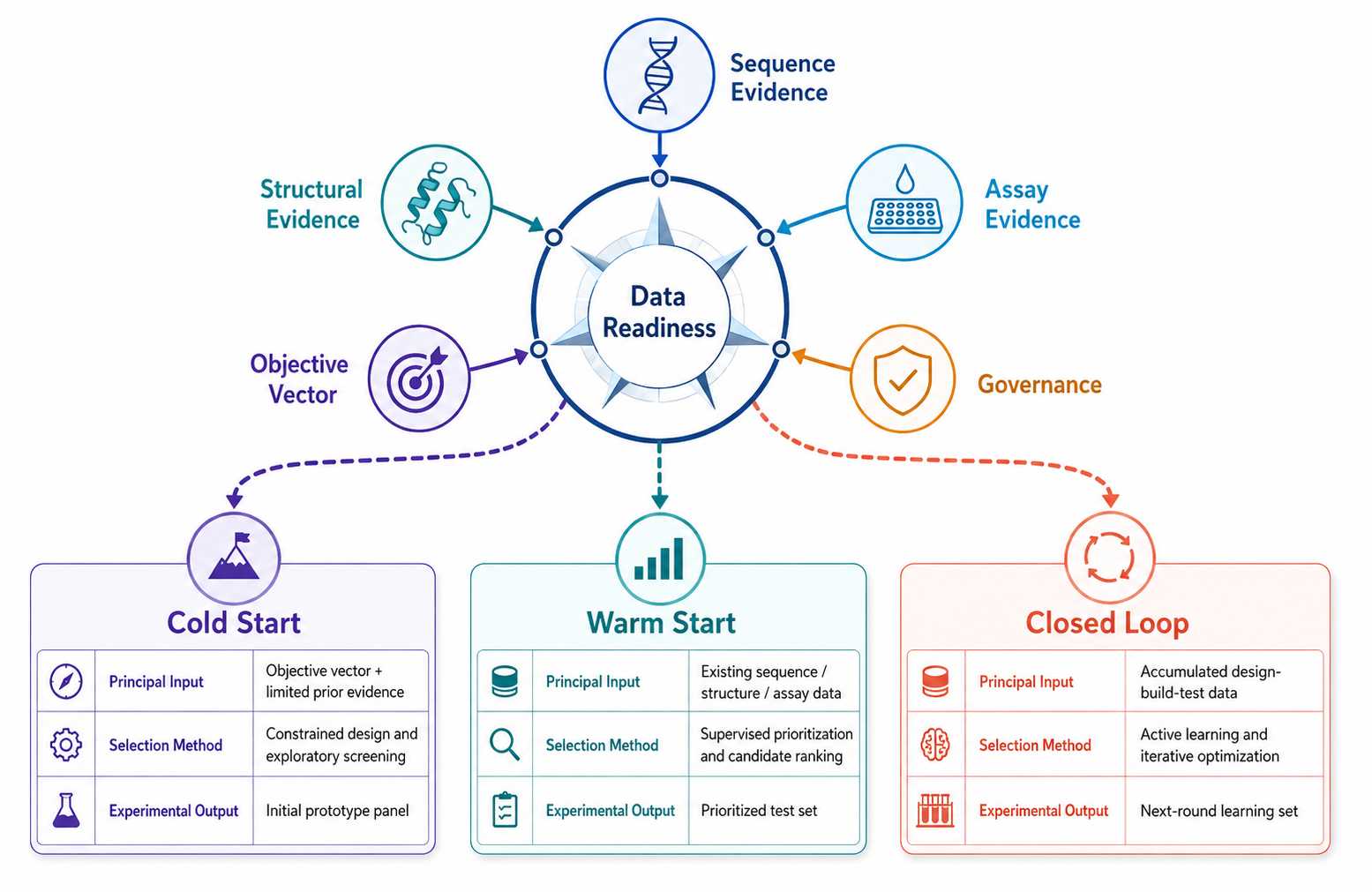 Fig 1. AI enzyme-engineering data-readiness compass. Available sequence, structure, assay, objective, and governance information determines whether a project begins with cold-start design, supervised prioritization, or closed-loop learning.
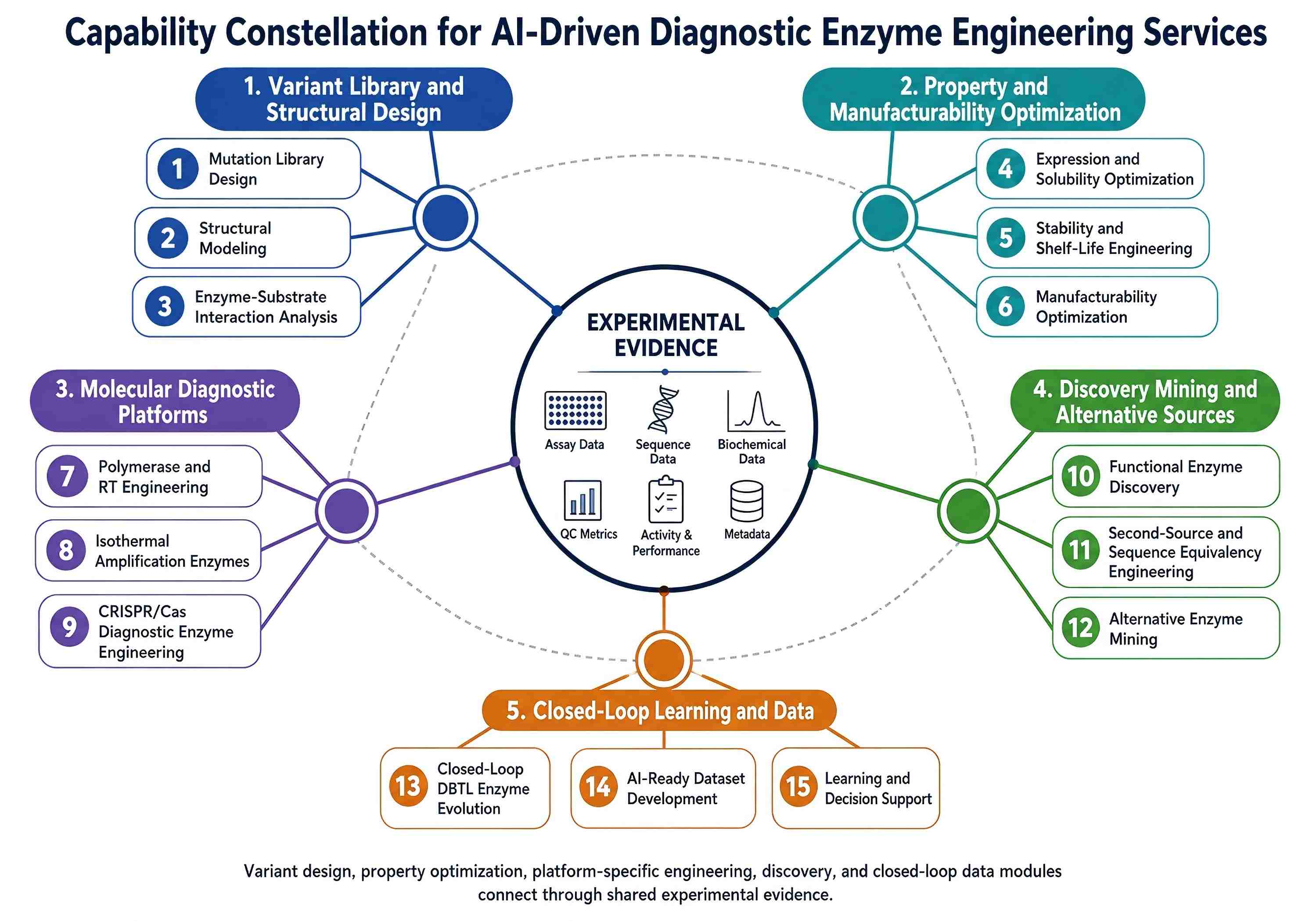 Fig 2. Fifteen-service capability constellation. Variant design, property optimization, platform-specific engineering, discovery, and closed-loop data modules connect through shared experimental evidence.
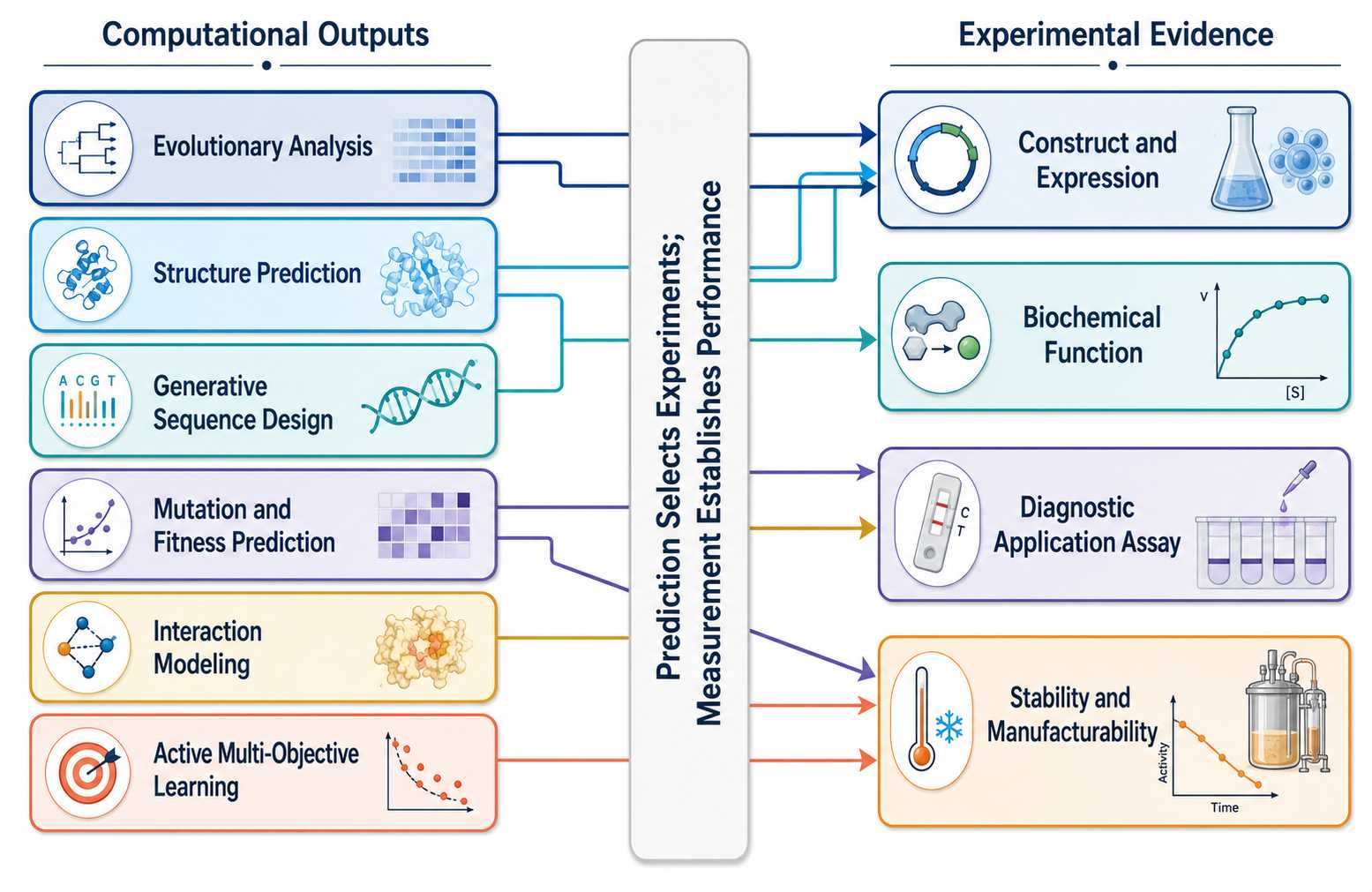 Fig 3. Model output-to-evidence stack. Sequence plausibility, structural confidence, interaction hypotheses, and fitness rankings support candidate selection; experimental assays establish real function.
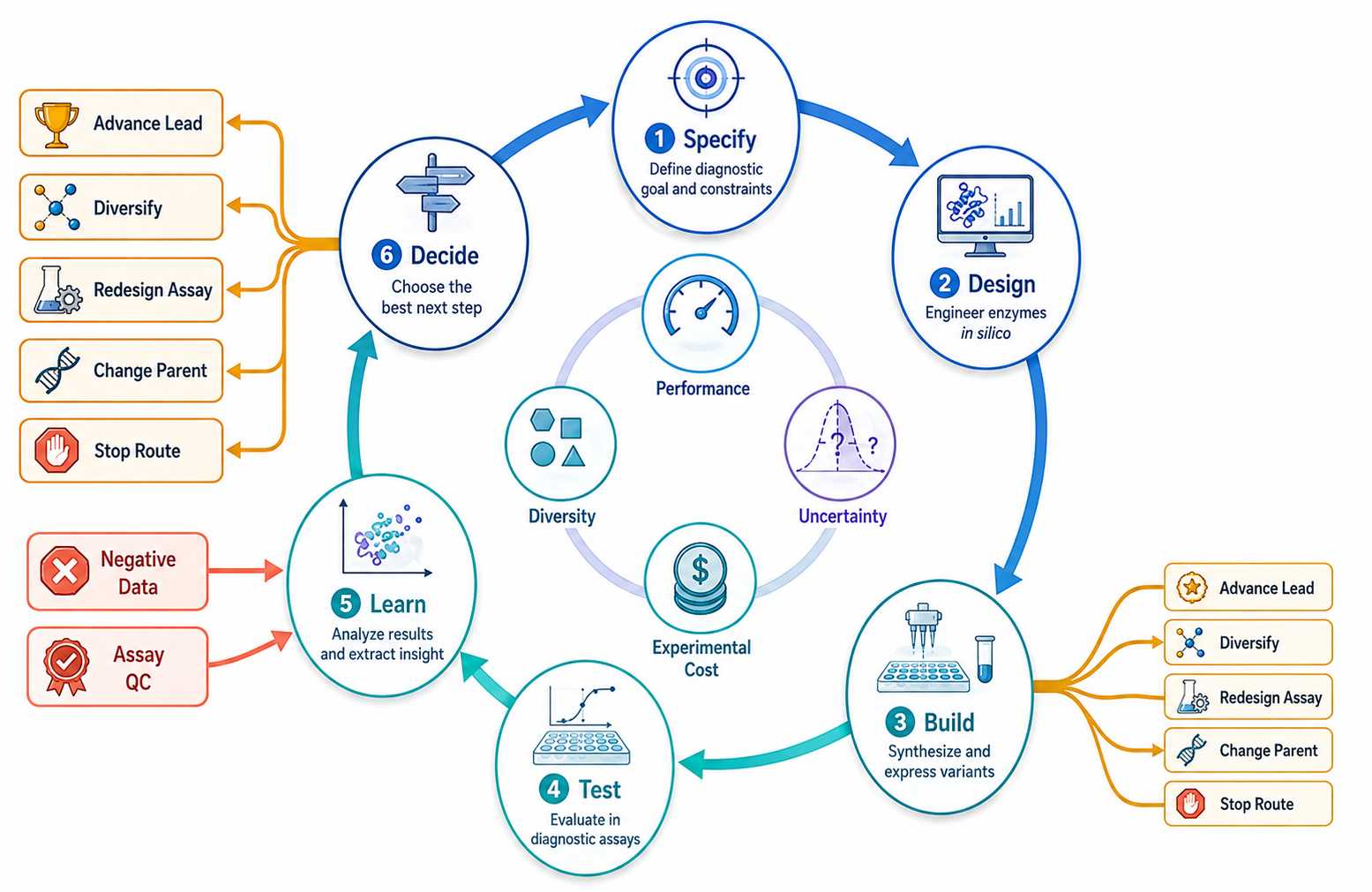 Fig 4. Uncertainty-aware Design-Build-Test-Learn loop. Candidate performance, diversity, uncertainty, negative results, and assay limitations feed the next experimental decision.
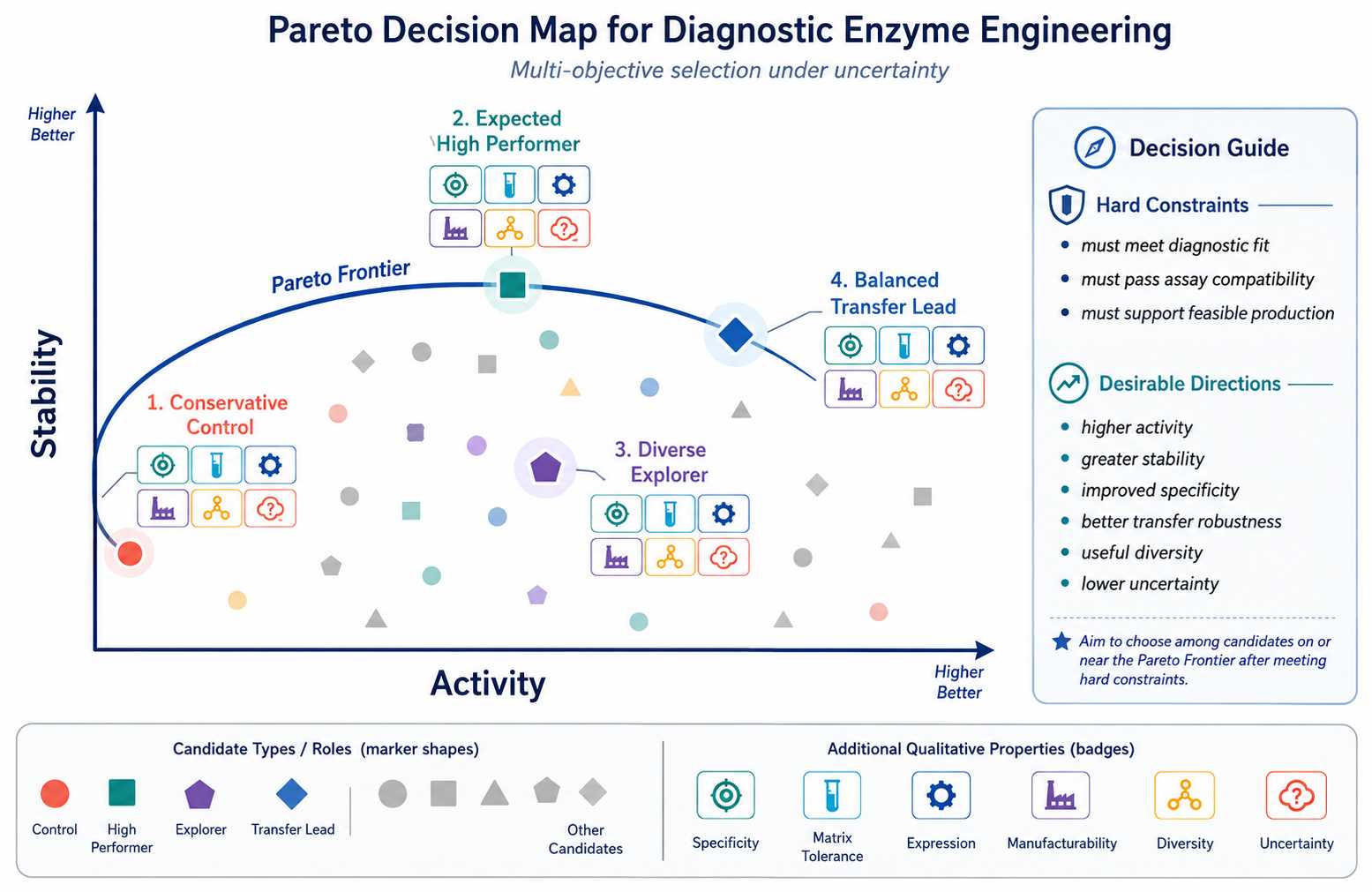 Fig 5. Diagnostic enzyme Pareto decision map. Candidates are selected across performance, uncertainty, diversity, and product constraints instead of being reduced to an unexplained single score.
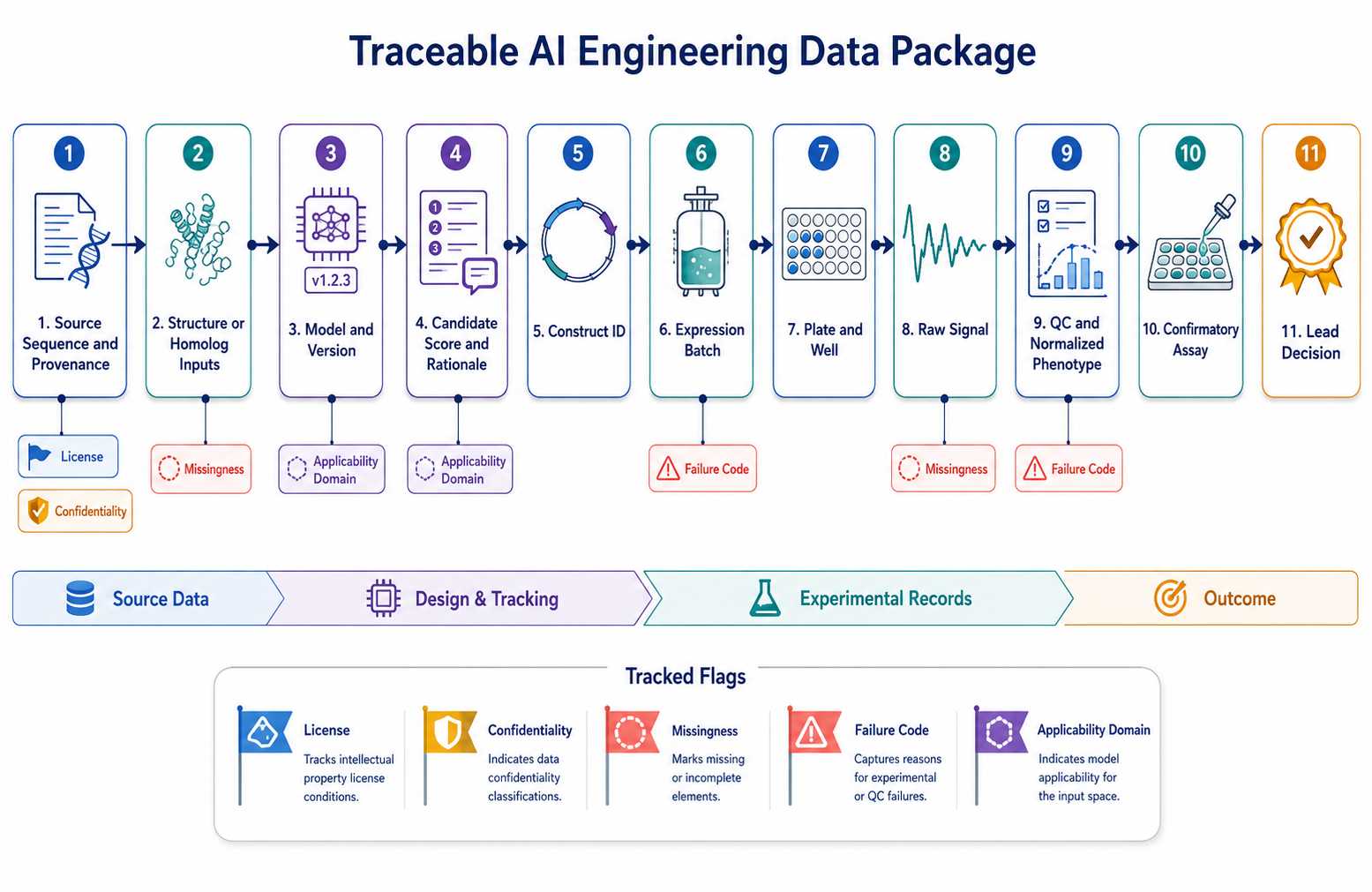 Fig 6. Traceable AI engineering data package. Every recommendation can be connected to source sequence, model version, construct, experimental unit, raw signal, processed phenotype, and advancement decision.