
Creative Enzymes converts enzyme objectives, sequence and structure evidence, prior screening results, and practical build/test limits into an executable mutation-library specification. We define which residues and substitutions to encode, how combinations should be partitioned, which DNA implementation is appropriate, and how intended diversity will be checked. The goal is not the largest theoretical library. It is a library whose members, controls, and uncertainty fit the diagnostic question and the experiments available to answer it.
The core design question is not “How many mutations can we generate?” It is “Which sequence hypotheses deserve the finite number of variants we can build, identify, express, test, and confirm?” A useful design connects the diagnostic objective to residue selection, amino-acid choices, codon or oligo implementation, library topology, physical construction limits, screening capacity, and a predeclared QC plan.
Protein sequence space grows too quickly for exhaustive testing. Even a small number of randomized positions can create more combinations than a plate-based diagnostic assay can evaluate. Degenerate codons may add synonymous DNA members, stop codons, or unwanted amino acids. Cloning and transformation can bottleneck the pool. Growth and expression can change abundance. A screen then samples only part of the physical library, and only some screened members produce interpretable enzyme data. Calling all of these stages “library size” hides the decisions that determine whether a campaign can succeed.
Our AI-assisted design service keeps those stages separate. AI may help score residue tolerance, prioritize substitutions, cluster sequences, or use prior sequence-function data, but it does not replace mechanism, assay knowledge, or construction constraints. The output is a documented design specification that can be transferred to a library-construction team, used in a client laboratory, or connected to Creative Enzymes' downstream engineering and testing work.
The amino-acid sequences the scientific design intends to test.
All DNA members created by codon, oligo, or construct choices, including redundancy.
Independent molecules or transformants that survive synthesis, assembly, and cloning.
Members detected or sampled after abundance bias, expression, and assay selection.
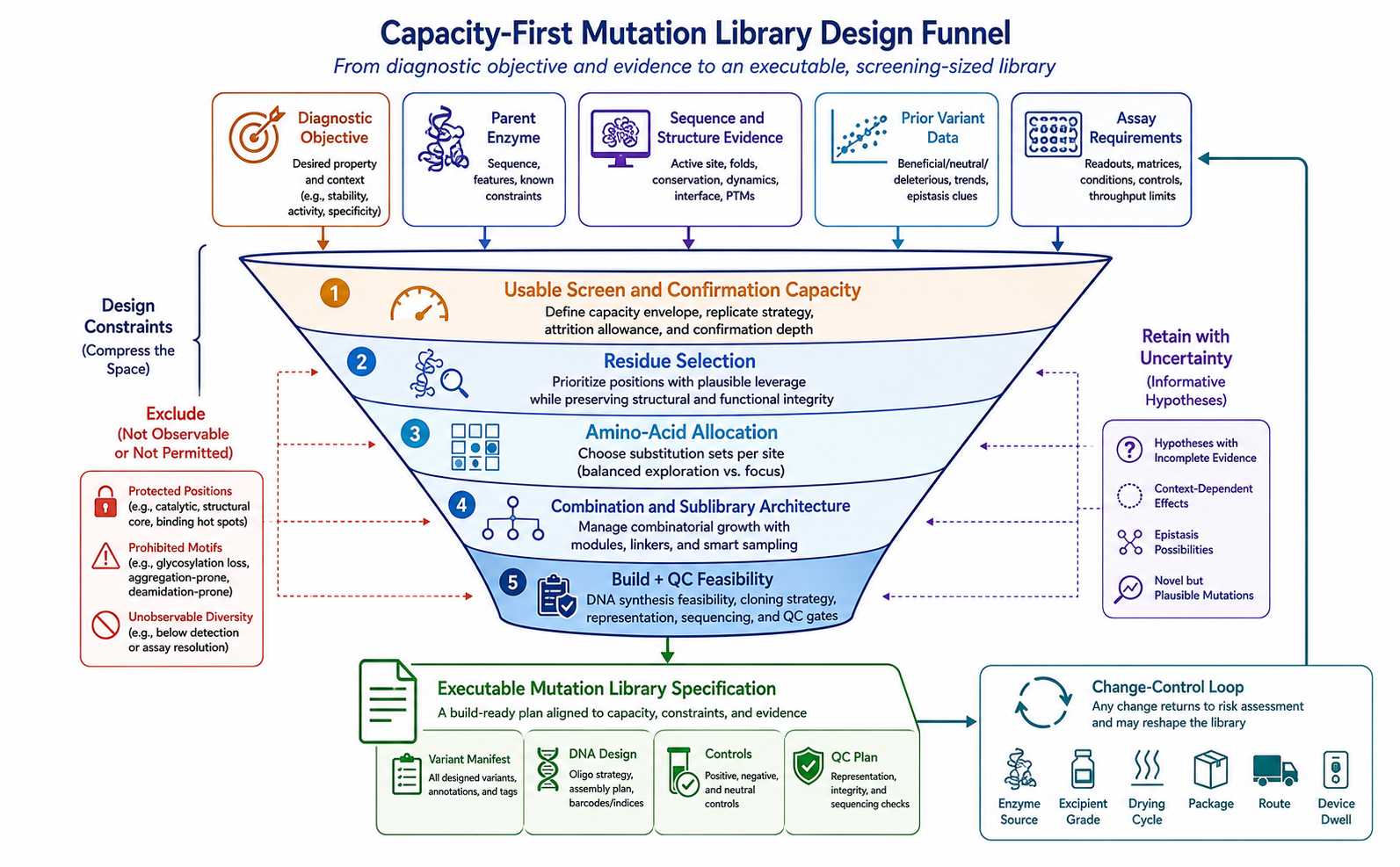 Fig. 1. Capacity-first mutation-library design. The diagnostic objective and evidence are compressed through screen capacity, residue, substitution, combination, build and QC constraints into an executable library specification.
(Creative Enzymes)
Nominal plate capacity is not variant capacity. Reference enzymes, blanks, positive and negative controls, plate-position controls, repeat wells, concentration checks, failed samples, and confirmation consume part of the available work. Application-relevant assays may also require multiple conditions, matrices, reagent lots, or instruments. We therefore define the experimental budget before expanding the sequence space.
A library designed to identify permissive positions is different from one designed to optimize a known pocket. A single-substitution scan can map position sensitivity without testing high-order epistasis. A focused combinatorial library can test interactions among supported substitutions but expands multiplicatively. A low-rate random library can discover effects outside predicted sites but provides uneven control over exact amino-acid outcomes. A recombination library can combine blocks from related parents while preserving some natural context. We select the format according to the decision the screen must support.
For diagnostic enzymes, the endpoint may be initial rate, endpoint signal, time-to-threshold, low-copy detection, mismatch discrimination, inhibitor tolerance, substrate selectivity, stability after a defined challenge, or performance in a formulation or simulated matrix. The design should not reward a proxy that is weakly connected to the intended assay. If the screen cannot distinguish the expected effect, the first design recommendation may be an assay-readiness experiment rather than a large library.
Residue selection can integrate several evidence classes. None is sufficient by itself, and apparent agreement may reflect the same underlying source. For example, conservation and a protein-language-model score can both contain evolutionary information. We retain the evidence trail so that a proposed position can be challenged, protected, or assigned to a different sublibrary.
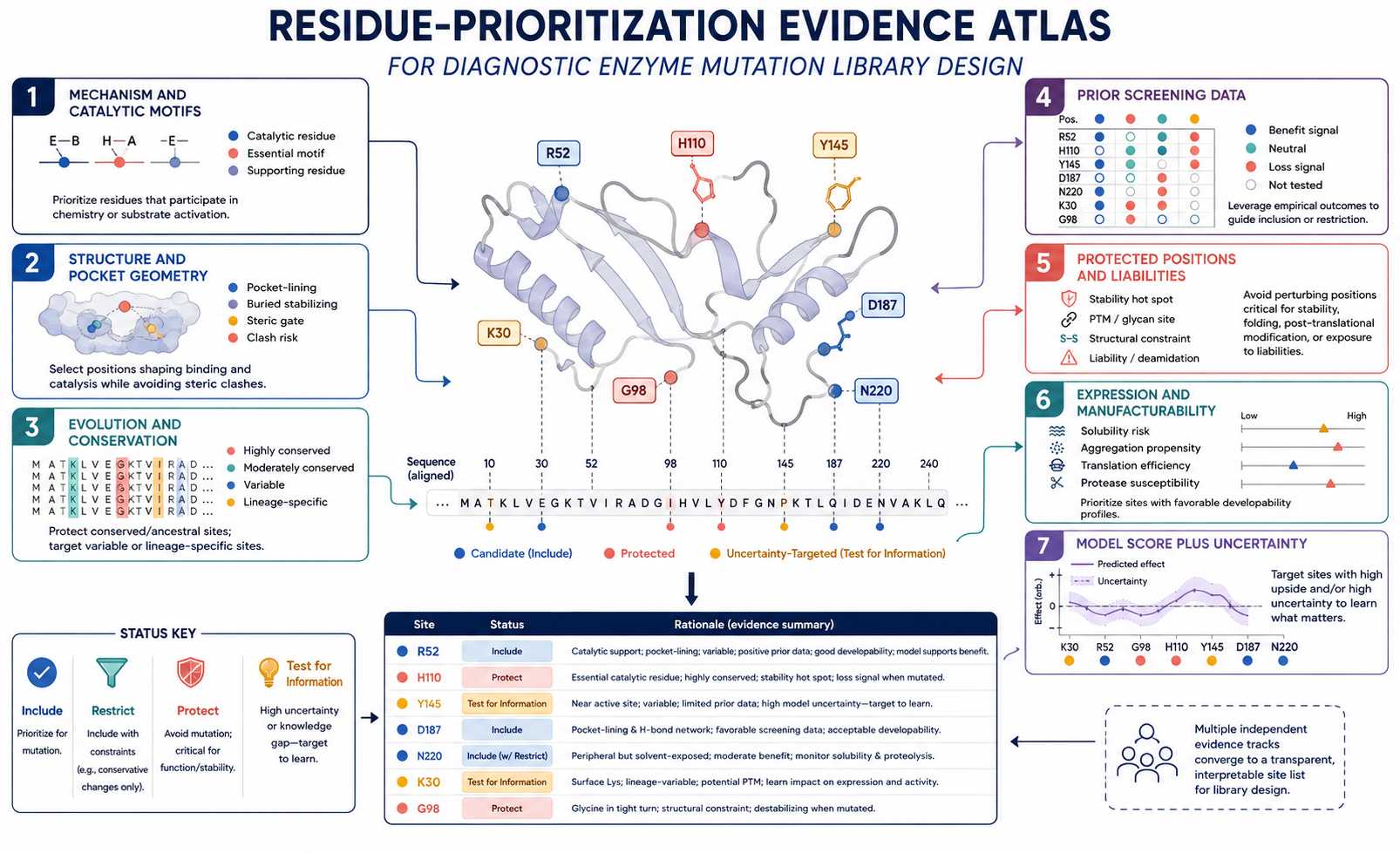 Fig. 2. Residue-prioritization evidence atlas. Candidate, protected and uncertainty-targeted positions are assigned from multiple evidence tracks rather than one opaque model score.
(Creative Enzymes)
Candidate positions have a plausible relationship to the desired property and an acceptable risk of disrupting essential function. Protected positions are excluded or restricted because of catalytic necessity, known liabilities, sequence constraints, or client requirements. Uncertainty-targeted positions are included because competing models or weak evidence make an experiment especially informative. A position can change category when the sequence background, substrate, formulation, or assay objective changes.
Depending on the available evidence, we may use multiple-sequence alignments, evolutionary statistics, structural models, docking or interaction analysis, protein language model representations, supervised models trained on prior variants, or ensemble ranking. Predictions are reviewed for sequence-background compatibility, proximity to the training domain, correlated suggestions, and conflicts with known mechanism or build constraints. A high score does not prove that a substitution improves enzyme performance; it only changes how experimental capacity may be allocated.
Structural questions can be developed through our In Silico Structural Modeling and Enzyme-Substrate Interaction Analysis Service. When the immediate need is individual candidate prioritization rather than a pooled or combinatorial library, the more suitable scope may be AI-Guided Diagnostic Enzyme Variant Design and Screening.
Sequence-defined members provide direct traceability and avoid duplicate screening, but construction cost rises per variant.
Tests amino-acid alternatives one position at a time; useful for functional mapping and first-pass hotspot discovery.
Combines supported substitutions at selected sites to test epistasis and multi-property tradeoffs.
Distributes mutations across a region or gene when important positions remain uncertain.
Combines parental segments, homolog blocks, or prior hits while managing junction and linkage constraints.
| Topology | Best suited to | Main design variables | Interpretation caution |
|---|---|---|---|
| Alanine or defined scanning | Mapping contribution of residues or comparing a prespecified substitution | Positions, background, inclusion of wild type, arrayed/pool format, replicate plan | A tolerated alanine does not establish tolerance to other chemistries; a deleterious result may reflect expression. |
| Single-site saturation | Finding substitutions at known or suspected hotspots | Full versus reduced alphabet, codon method, per-position pooling, wild-type fraction | Single-mutation effects may change when combined or transferred to another background. |
| Focused combinatorial | Testing combinations among prior hits or mechanistically selected substitutions | Sites, permitted residues, maximum mutation depth, sublibraries, parental backgrounds | Combinatorial growth and negative epistasis can make most members uninformative or inactive. |
| Error-prone or controlled random | Exploring distributed sequence effects with limited prior knowledge | Target region, mutation spectrum/rate, transition/transversion bias, indel control, background | Nucleotide-level bias produces unequal amino-acid access; mutation count varies among members. |
| Recombination | Combining diversity from homologs, parental enzymes, or evolved lineages | Parent selection, block/junction design, sequence identity, linkage, preserved motifs | New junctions and broken coevolved contacts can reduce folding or function. |
| Truncation/insertion | Boundary mapping, loop engineering, linker or domain architecture questions | Frame, junction, insert set, step size, terminal context, expression format | Expression and stability often dominate; an absent signal is not automatically a functional conclusion. |
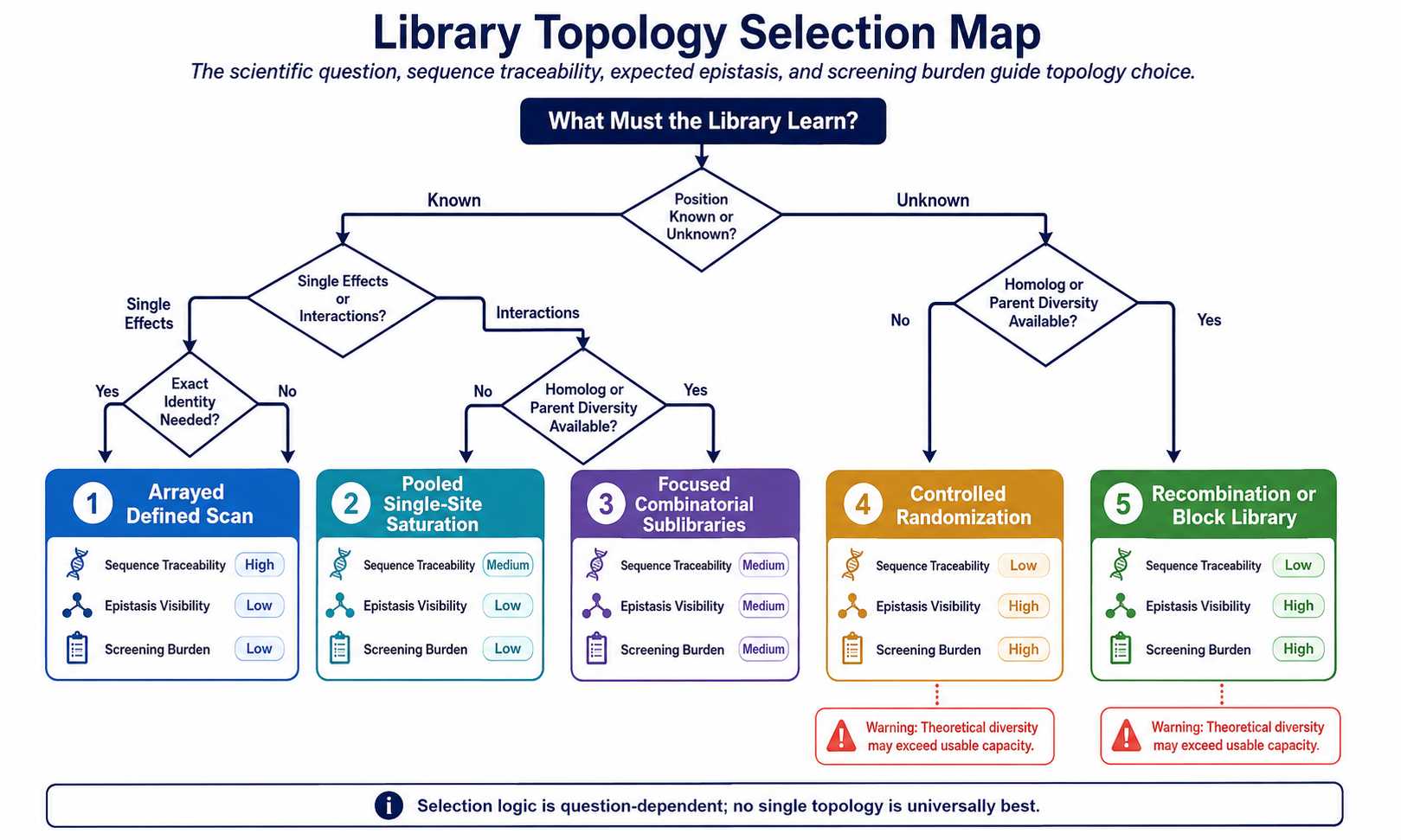 Fig. 3. Library topology selection map. The scientific question, need for sequence traceability, expected epistasis and screening burden determine whether variants should be arrayed, pooled, combined, randomized or recombined.
(Creative Enzymes)
“Saturate the site” can mean several different designs. A full natural amino-acid alphabet maximizes single-site chemistry but expands the combinatorial space rapidly. A reduced physicochemical alphabet samples side-chain classes with fewer members. A conservative set tests close alternatives; a nonconservative set probes a mechanistic hypothesis. Evolutionary or model-weighted sets prioritize substitutions supported by homologs, predicted structure, or prior assay data. Sequence-defined members provide the strongest control when a short list is already justified.
Wild-type inclusion is also a design variable. It can serve as an internal reference, preserve a viable fraction, or enable combinations that retain the parental residue at some positions. It can also consume capacity and obscure rare variants if overrepresented. We specify whether wild type is deliberately encoded, an unavoidable consequence of the codon scheme, a separate control, or an undesired member to be minimized.
The amino-acid plan and DNA plan are not interchangeable. Degenerate codons can encode multiple synonymous codons, uneven amino-acid frequencies, unwanted residues, or stop codons. Host codon usage, GC content, repeats, secondary structure, restriction sites, homopolymers, synthesis chemistry, oligo length, primer behavior, and assembly junctions can alter feasibility. We therefore enumerate or simulate the encoded DNA and protein members before release of the design.
Compact primer or oligo design, but protein distribution and redundancy follow the genetic code and selected ambiguity.
Multiple codons or primer mixes can reduce redundancy or shape amino-acid frequencies, with added preparation complexity.
Can specify amino-acid building blocks more directly and avoid selected unwanted codons, subject to provider and synthesis constraints.
Each intended DNA member is explicit; suitable for arrayed or pooled synthetic libraries and precise exclusions.
Mutation spectrum emerges from the method and template; nucleotide bias and per-clone mutation count must be modeled or measured.
NNK and NNS are familiar choices for broad amino-acid access, but familiarity does not make them optimal for every screen. Alternative degenerate codons, mixed codon sets, or sequence-defined synthesis may reduce stop codons, redundancy, or unwanted residues. These benefits must be balanced against primer count, synthesis/assembly complexity, cost, library format, and the need to weight particular substitutions. No codon scheme is universally best.
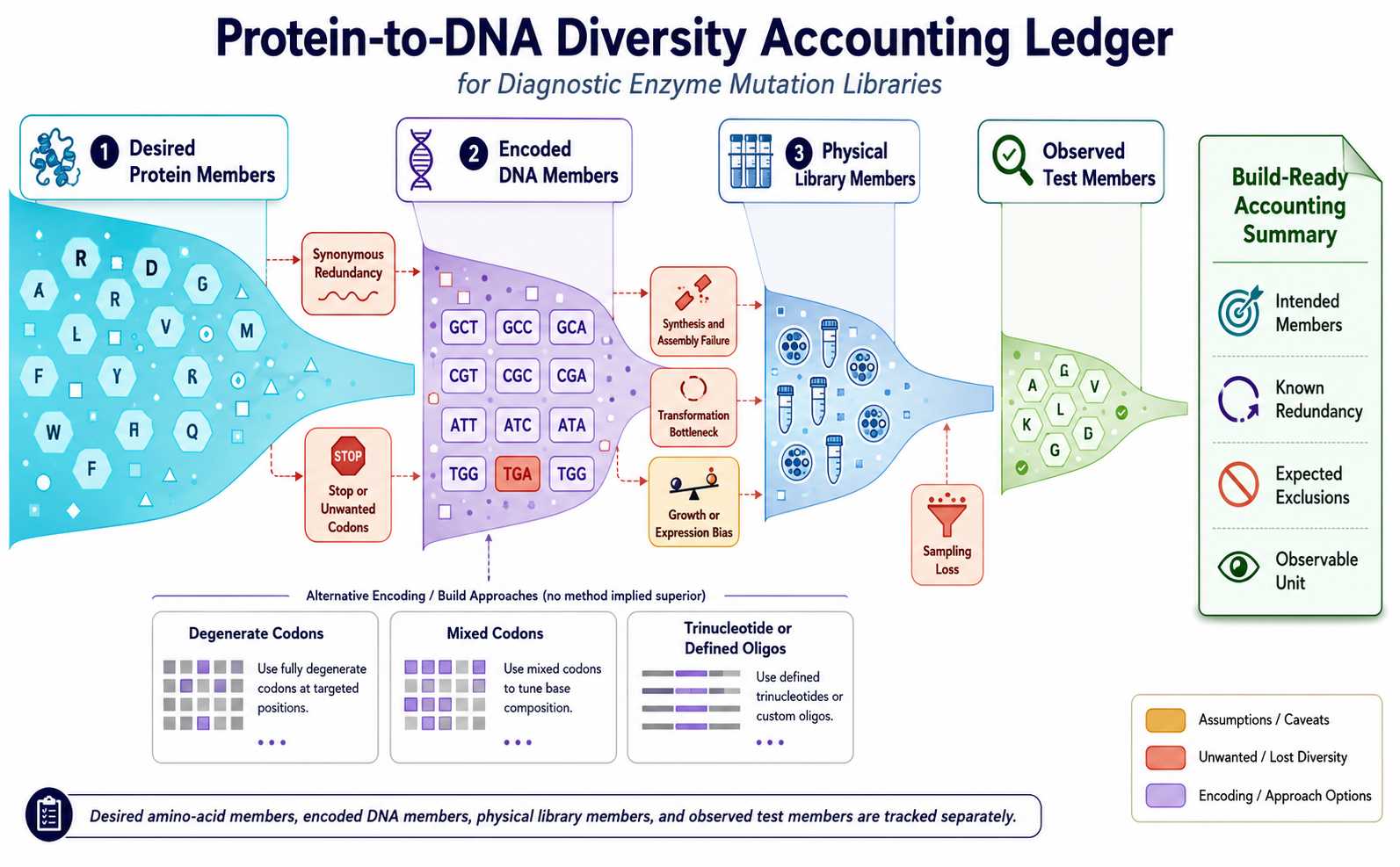 Fig. 4. Protein-to-DNA diversity accounting ledger. Desired amino-acid members, encoded DNA, physical library members and observed test members are tracked separately, including redundancy, unwanted products and sampling loss.
(Creative Enzymes)
Depending on scope, the package may include coding sequences, mutation definitions, degenerate codons or oligo sequences, primer/assembly regions, sublibrary definitions, permitted and prohibited motifs, predicted encoded amino-acid distributions, expected wild-type and stop fractions, construct architecture, host-aware codon rules, and a machine-readable variant manifest. Final oligos and manufacturing instructions are checked against the selected build method and provider requirements when those are known.
Under an idealized uniform library of size L, the chance of missing a specified member after sampling n independent members is proportional to (1 − 1/L)n. This relationship is useful for understanding why duplicate sampling grows as coverage increases. It is not proof that a real library follows the calculation. Synthesis yield, oligo abundance, amplification, assembly, transformation, growth, toxicity, expression, and sampling can make member probabilities unequal.
Enumerate protein and DNA members, redundancy, stop/unwanted products, and expected frequencies from the design specification.
Compare intended diversity with independent molecules or transformants after accounting for assembly and transformation constraints.
Use pilot sequencing, NGS, clone sampling, or screen identities to estimate abundance, missing members, and realized bias.
A colony or transformant count measures physical events, not sequence uniqueness, full-length correctness, frame integrity, or equal abundance. Duplicates, parental carryover, empty vector, out-of-frame constructs, unintended mutations, and growth-biased members can all inflate the count. We therefore describe coverage with the evidence available: predicted under a stated distribution, sampled by clone sequencing, observed within an NGS amplicon, or confirmed as full-length sequence-defined variants.
If multiple positions are varied, the product of permitted residues can exceed practical capacity even when each site alone is modest. We can limit mutation depth per member, split sites into sublibraries, create alternative parental backgrounds, preserve coevolved blocks, prioritize pairwise interactions, or stage the design from scanning to combination. Splitting a library is not merely a manufacturing convenience; it can preserve interpretability and allow the screen to allocate comparable capacity across hypotheses.
Library QC should test whether the physical material can support the intended inference. A generic sequencing certificate may not answer whether distant mutations are phased, whether rare members are observable, or whether an abundance threshold is acceptable for the planned screen. The design package therefore identifies what will be measured, how it will be summarized, and what action follows an out-of-target result.
| QC layer | Questions | Possible evidence | Decision use |
|---|---|---|---|
| In silico design QC | What protein and DNA members are encoded? Are stops, unwanted residues, motifs, frames, or synthesis liabilities present? | Enumeration, translation, motif/restriction scan, distribution simulation, oligo/primer feasibility review | Release, revise codons, change sequence, split the library, or alter the build method |
| Construct pilot QC | Does the build produce full-length, in-frame, correctly assembled members? | Representative clone sequencing, insert checks, assembly diagnostics, parental/empty-vector assessment | Proceed, adjust assembly, change input ratios, rebuild, or reduce complexity |
| Distribution QC | Are intended substitutions or sublibraries represented, and how uneven is abundance? | Amplicon NGS, long-read sequencing where needed, codon/amino-acid frequency, missing-member and abundance analysis | Accept, re-balance, deepen sampling, split, remake, or qualify limitations |
| Screen-entry QC | Can identified variants be linked to expression and assay results? | Barcode/sequence map, plate or well identity, sample lineage, control and reference allocation | Authorize the screen or correct identity and layout risks first |
Wild-type sequence may be intentional, encoded, or an assembly artifact; those cases require different action.
A mean frequency can hide rare or absent members that the screen is unlikely to observe.
Distant mutations may not be phased into full-length variants by a short amplicon.
Synthesis, amplification, or assembly errors can add members outside the designed distribution.
Out-of-frame or prematurely terminated members consume physical and screening capacity.
Physical diversity may be much smaller than encoded diversity.
Some constructs can become depleted or enriched before enzyme screening.
A useful phenotype cannot guide engineering if its sequence or sample lineage is uncertain.
Evidence supports the intended use of the library under stated limitations.
Adjust inputs or sublibrary ratios when composition is recoverable.
Separate hypotheses or diversity blocks to restore coverage and interpretability.
Correct construction, frame, identity, or representation failures.
Change sites, substitutions, codons, topology, or capacity assumptions.
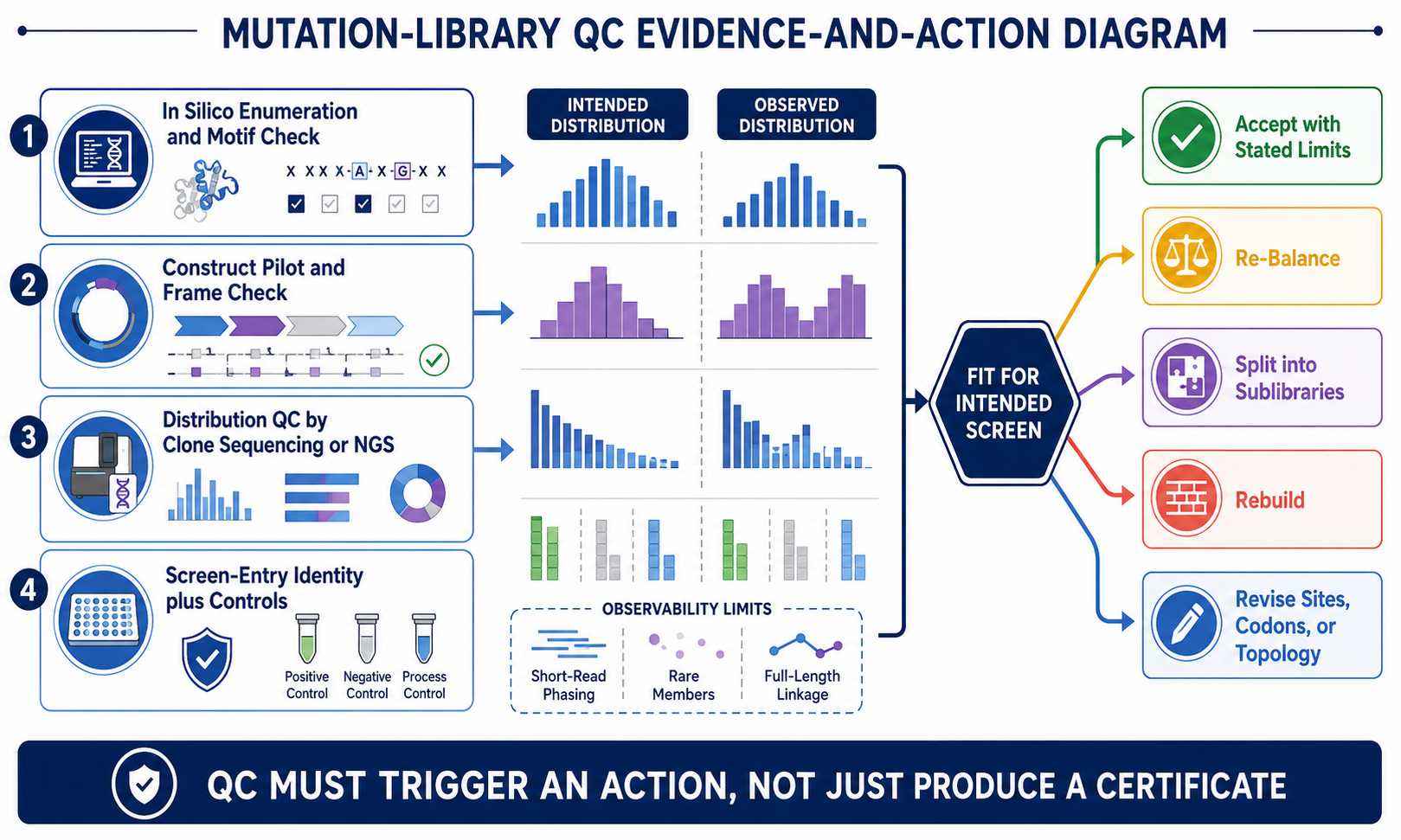 Fig. 5. Library QC acceptance and redesign gate. In silico, pilot, distribution and screen-entry evidence determine whether the library is accepted, re-balanced, split, rebuilt or redesigned.
(Creative Enzymes)
NGS is configured to the question. Read length and amplicon design determine whether substitutions can be phased; sequencing depth and analysis thresholds determine which abundance claims are supportable. A pooled codon-frequency profile cannot always reconstruct full-length combinatorial variants. We state the observable unit and avoid calling partial evidence “complete library coverage.”
Diagnostic enzymes must function in defined analytical systems, so the diversity plan can include properties beyond catalytic turnover. Depending on the enzyme and assay, design evidence may address fidelity, mismatch discrimination, strand displacement, inhibitor tolerance, temperature profile, substrate specificity, cross-reactivity, cofactor dependence, conjugation or labeling context, formulation compatibility, lyophilization tolerance, soluble expression, purity, and lot-scalable production.
Polymerases, reverse transcriptases, nucleases, recombinases, and CRISPR/Cas enzymes may require libraries around template/substrate contacts, fidelity determinants, processivity, temperature response, inhibitor tolerance, or accessory-protein interfaces.
Oxidoreductases, hydrolases, phosphatases, and coupled-assay enzymes may require libraries around substrate discrimination, cofactor use, turnover, product inhibition, conjugation behavior, or performance in reagent formulations.
Library design may reserve capacity for activity under constrained temperatures, short reaction times, matrix exposure, low enzyme loading, drying/reconstitution, or limited cold-chain conditions.
These examples define engineering contexts, not universal methods or acceptance criteria. Application-specific scopes can connect to Polymerase and Reverse Transcriptase Engineering, LAMP, RPA and Isothermal Enzyme Optimization, CRISPR/Cas Diagnostic Enzyme Engineering Support, or Multiparameter Enzyme Optimization for POCT Reagents.
Objective, parent, constraints, assay, capacity, and downstream decision
Sequence, structure, mechanism, homologs, prior variants, and data quality
Positions, substitutions, weights, mutation depth, backgrounds, and topology
Codons, oligos, constructs, sublibraries, motifs, and build compatibility
Encoded members, redundancy, bottlenecks, sampling, and screen allocation
Manifest, rationale, QC plan, acceptance/redesign rules, and handoff
Projects may be design-only, design plus construction handoff, design plus pilot QC review, or next-round redesign after screening. Exact outputs depend on sequence complexity, library type, construction platform, data maturity, and agreed responsibility. We do not promise a universal library size, mutation rate, oversampling factor, coverage percentage, timeline, or probability of obtaining an improved enzyme.
Useful inputs include the parent protein and coding sequence; construct, vector, host, and tag information; intended diagnostic reaction and assay conditions; the primary objective and properties that must not regress; known catalytic, binding, conserved, protected, or liability positions; prior variant identities and raw data; practical screen and confirmation capacity; preferred pooled or arrayed format; prohibited motifs or fixed regions; and the intended construction and QC workflow.
This service is one component of the AI-Driven Diagnostic Enzyme Engineering Services cluster. Once a library specification is released, the next work may include construction, expression, screening, analysis, or another design round. The Closed-Loop Design-Build-Test-Learn Enzyme Evolution Service is appropriate when those stages need to be managed across repeated rounds with explicit continuation and transfer decisions.
Mutation-library design assumes that a suitable parent or defined sequence background exists. If the first decision is instead which natural or computationally proposed scaffold should enter engineering, begin with the AI-Driven De Novo Enzyme Discovery and Enzyme Mining Service for Diagnostic Applications. Scaffold selection and mutation-space design are related, but they answer different experimental questions.
Residue and substitution choices can be informed by Activity and Kinetic Performance Optimization, Thermostability and Lyophilization Stability Engineering, or Substrate Specificity and Cross-Reactivity Reduction.
Construct design can connect to Expression, Solubility and Manufacturability Optimization, Enzyme Expression and Purification, and broader Enzymes Production and Engineering.
Screening records and QC outputs can be structured through AI-Ready Experimental Dataset Design and Screening Data Analysis before another focused library is designed.
When the target is a second-source sequence or a new background, mutation effects and library assumptions must be reconsidered. The AI-Assisted Second-Source and Sequence Equivalency Engineering Service addresses that broader program; sequence similarity alone does not establish that a library optimized for one background transfers to another.
Variant design usually prioritizes a finite list of individual sequences. Mutation-library design specifies a distribution or structured set of variants, including positions, permitted substitutions, combinations, codons or oligos, sublibraries, capacity assumptions, and QC. If you need a few sequence-defined candidates, a variant-design scope may be more efficient than a pooled library.
No. AI-assisted means that statistical, language-model, sequence, or structure predictions may contribute evidence. Recommendations are reviewed against mechanism, conservation, prior experiments, sequence background, assay objective, protected positions, construction feasibility, and uncertainty. Model scores are hypotheses, not proof of improved function.
Not necessarily. A full alphabet reduces assumptions but increases the screening burden, especially in combinations. Reduced, weighted, conservative, nonconservative, or sequence-defined sets may be more useful. The tradeoff is explicit: compression can improve coverage of the chosen set but may exclude an unchosen beneficial substitution.
No. They are convenient and familiar, but they encode redundancy and may include unwanted members depending on the design. Alternative degenerate codons, mixtures, trinucleotide synthesis, or sequence-defined oligos may better match a particular amino-acid set or host. Primer complexity, synthesis method, cost, library format, codon usage, stop codons, and distribution all matter.
There is no universal size. The design depends on the question, number of sites and substitutions, mutation depth, distribution, build bottleneck, assay throughput, controls, confirmation reserve, and acceptable uncertainty. We work backward from usable experimental capacity and may recommend sublibraries or staged designs.
No. It does not establish sequence uniqueness, equal abundance, correct insert, reading frame, full-length linkage, or representation of rare members. Coverage should be qualified by its evidence: theoretical under stated assumptions, sampled by clone sequencing, observed in an NGS amplicon, or confirmed for sequence-defined members.
It can characterize what the read length, amplicon design, depth, and analysis support. Short reads may quantify individual sites without phasing distant mutations into full-length variants. Long-read or alternative linkage strategies may be needed when full-length combination identity is the question. We specify the observable unit and limitations before recommending a QC method.
Yes, subject to data availability. We can review the intended design, oligos or codons, construction process, transformant information, clone sequencing, NGS, screening identities, and assay capacity. Options may include reduced alphabets, new weights, sublibrary partitioning, lower mutation depth, sequence-defined members, re-balancing, or a different topology.
Construction, expression, and screening can be scoped separately or connected through related Creative Enzymes services. This page specifically covers library design and verification planning. The proposal identifies which physical build, QC, expression, and assay activities are included and which are client- or third-party responsibilities.
The service supports research and diagnostic-reagent development. Library design, construction, or application-relevant testing does not itself establish clinical performance, regulatory clearance, or suitability for direct personal treatment or consumption.
References provide scientific context. They do not establish a universal mutation alphabet, codon set, coverage target, library size, or project outcome.
To begin, send the parent protein and coding sequence, construct and host context, intended diagnostic assay, engineering objective, protected positions or motifs, prior variant data if available, and the number of variants you can realistically screen and confirm. Creative Enzymes will use those inputs to define an appropriate design review, focused library, sublibrary strategy, DNA specification, or redesign plan.
Research use and diagnostic-reagent development support only. Services and resulting materials are not intended for direct personal treatment or consumption.
