Background
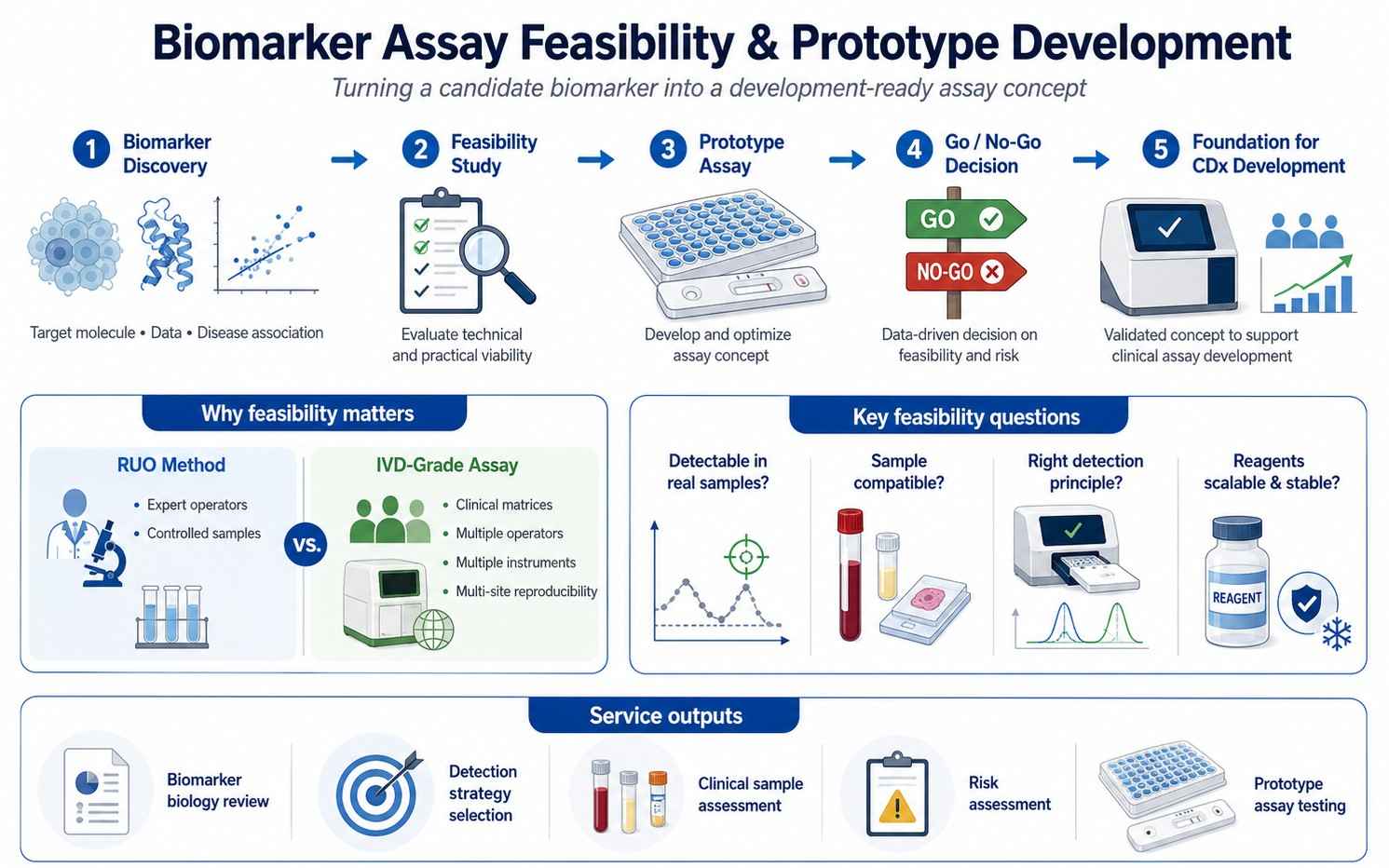
Discovering a biomarker that correlates with a disease state or drug response is only the first step toward a companion diagnostic (CDx). A statistically significant association demonstrated in a research setting does not automatically translate into a robust, deployable clinical assay. Research-use-only (RUO) methods are typically run by expert operators on well-characterized samples, whereas an IVD-grade assay must deliver reproducible results across diverse clinical matrices, operators, instruments, and sites—and must withstand regulatory scrutiny for analytical and clinical validity.
Many promising biomarkers fail during CDx development not because the underlying biology is wrong, but because feasibility gaps were never systematically addressed: the target may be expressed below the limit of detection in real clinical specimens, the intended sample type may contain inhibitors or degraded analyte, the detection principle may not support the required sensitivity or multiplexing level, or reagent supply and stability may not be sustainable at commercial scale. Committing to full CDx development—pivotal trial integration, validation, and regulatory submission—without answering these questions first exposes the program to costly late-stage failure and timeline delays.
A structured feasibility study closes this gap. By evaluating biomarker biology, detection principles, clinical sample compatibility, and program risks upfront—and by building and testing a prototype assay—developers can make evidence-based go/no-go decisions before major resources are committed. Creative Enzymes Diagnostic offers a dedicated Biomarker Assay Feasibility and Prototype Development service that transforms a candidate biomarker into a technically validated, development-ready assay concept, laying a solid foundation for subsequent CDx development.
Feasibility Assessment Strategy
Our feasibility assessment follows a systematic, four-dimensional framework. Each dimension addresses a distinct category of development risk, and together they produce a complete picture of whether—and how—a biomarker can progress toward a CDx assay.
Biomarker Biology Evaluation
- Review of biological plausibility and mechanistic linkage between the biomarker and the disease or drug mechanism of action
- Assessment of prevalence and expression levels in the intended-use population, including variant allele frequency, protein abundance, and intra-/inter-patient heterogeneity
- Evaluation of temporal stability of the biomarker and its dynamic range relative to the clinical decision threshold
- Evidence consolidation from literature, public databases, and available clinical datasets to support analytical and clinical validity assumptions
Detection Principle Selection
- Matching biomarker type (protein, DNA, RNA, fusion transcript, methylation signature, or multi-marker panel) to the appropriate detection modality
- Defining target performance requirements: limit of detection, quantification range, qualitative vs. quantitative readout, and multiplexing level
- Comparing candidate principles (immunoassay, amplification-based, sequencing-based, or hybrid approaches) against performance, cost, and instrumentation constraints
- Identifying the most suitable platform pathway aligned with the intended clinical setting, from central laboratory to point-of-care
Clinical Sample Compatibility
- Evaluation of intended specimen types (FFPE tissue, plasma, serum, whole blood, cfDNA, or other matrices) and their impact on analyte integrity
- Assessment of pre-analytical variables: collection, handling, storage, shipping stability, and sample volume limitations
- Characterization of matrix effects and common interferents (e.g., hemolysis, lipemia, heparin, hemoglobin) relevant to the detection method
- Confirmation that the required sensitivity is achievable with the analyte quantity and quality realistically obtainable from clinical specimens
Risk Identification
- Systematic identification of technical, operational, and programmatic risks across biology, assay, sample, and supply-chain dimensions
- Assessment of reagent and raw material availability, scalability, and long-term supply stability for diagnostic-grade manufacturing
- Preliminary review of regulatory pathway considerations (IVD vs. LDT) and their implications for design and validation strategy
- Delivery of a structured risk register with mitigation plans to support an informed go/no-go decision
Prototype Assay Development
Once the feasibility framework supports continued development, we build a working prototype assay and generate preliminary analytical performance data. This stage converts strategic recommendations into a tangible, testable assay system.
Assay Format Selection
We select and configure the assay format based on the detection principle defined during feasibility assessment, covering the major platforms used in diagnostic development:
- ELISA: Plate-based immunoassay for protein biomarkers in serum, plasma, or lysates; well suited for quantitative single-analyte measurement with established workflows and straightforward validation.
- PCR: Conventional end-point PCR for qualitative detection of defined genetic targets, including allele-specific and multiplex configurations for mutation or fusion screening.
- qPCR: Real-time quantitative PCR offering high sensitivity and a broad dynamic range for mutation detection, gene expression analysis, and copy number assessment; a mainstay format in approved CDx products.
- NGS: Next-generation sequencing for comprehensive genomic profiling and multi-marker panels, enabling simultaneous detection of SNVs, indels, fusions, and copy number alterations, including unknown variants.
- POCT: Point-of-care formats such as lateral flow and microfluidic or isothermal amplification (LAMP/RPA) devices, designed for rapid results in decentralized and near-patient settings.
- CLIA: Chemiluminescent immunoassay providing high sensitivity, wide dynamic range, and automated high-throughput operation for protein biomarkers on clinical analyzer platforms.
Reagent Screening
Enzyme Selection
The performance of a molecular diagnostic assay is fundamentally determined by its core enzymes. Leveraging our diagnostic-grade enzyme portfolio and engineering expertise, we screen and select the optimal enzyme components for the chosen format—such as high-fidelity or hot-start DNA polymerases, thermostable reverse transcriptases, isothermal amplification enzymes, and nucleic acid processing enzymes. Selection criteria include sensitivity, inhibitor tolerance, fidelity, lyophilization compatibility, and batch-to-batch consistency under diagnostic-grade quality standards.
Signal Optimization
We systematically optimize the reaction system to maximize signal-to-noise performance: primer and probe design, antibody pairing, buffer composition, substrate and enhancer selection, and cycling or incubation conditions. The objective is to achieve the required analytical sensitivity and specificity while minimizing background, cross-reactivity, and hook effects—establishing a robust reagent foundation for downstream development.
Preliminary Performance Evaluation
The prototype assay undergoes a preliminary analytical evaluation aligned with recognized methodology frameworks (e.g., CLSI EP guidelines), providing early evidence that the assay can meet its target performance profile:
- Sensitivity: preliminary limit of detection (LoD) and limit of quantitation (LoQ) estimation using contrived and, where available, clinical specimens
- Specificity: cross-reactivity and exclusivity testing against closely related non-target analytes and common sample background components
- Precision: repeatability and intermediate precision across replicates, operators, and runs
- Accuracy and linearity: recovery assessment and linear range verification for quantitative assays
- Interference: evaluation of endogenous and exogenous interferents relevant to the intended specimen type
- Stability: preliminary reagent and sample stability assessment to inform formulation and storage strategy
Deliverables
Upon completion of the feasibility and prototype development program, you receive a comprehensive documentation package that supports internal decision-making and provides a direct starting point for full CDx development:
| Item |
Description |
| Feasibility Assessment Report |
Integrated evaluation of biomarker biology, detection principle rationale, clinical sample compatibility, and overall technical feasibility. |
| Detection Principle & Format Recommendation |
Evidence-based selection of detection modality and assay format, with performance targets and platform pathway justification. |
| Prototype Assay Protocol |
Complete standard operating procedure for the working prototype, including workflow, reaction conditions, and quality control checkpoints. |
| Reagent Formulation & Sourcing Summary |
Optimized reagent composition, selected enzyme and raw material specifications, and diagnostic-grade supply recommendations. |
| Preliminary Performance Data Package |
Experimental data and analysis for LoD/LoQ, specificity, precision, linearity, interference, and stability. |
| Risk Register & Mitigation Plan |
Structured documentation of identified risks with severity assessment and proposed mitigation strategies. |
| CDx Development Roadmap |
Recommended next-phase plan covering analytical validation, clinical bridging, and regulatory strategy considerations. |
FAQs
Q1. When should a feasibility study be performed in the CDx development timeline?
A1. Ideally before committing to prototype lock-in and clinical trial integration. Conducting feasibility assessment early—typically alongside biomarker discovery or early clinical translation—ensures that technical and sample-related risks are resolved before pivotal development investments are made.
Q2. What is the difference between a feasibility study and full CDx development?
A2. A feasibility study determines whether a biomarker can be reliably measured with an appropriate assay format and generates a working prototype with preliminary performance data. Full CDx development builds on this foundation and encompasses design lock, analytical and clinical validation, manufacturing scale-up, and regulatory submission. Feasibility is the de-risking stage that makes full development predictable.
Q3. What starting materials do we need to provide?
A3. We typically require background information on the biomarker (biology, target population, intended clinical use), any existing RUO methods or data, and—where available—representative clinical or contrived samples. If samples are limited, we can begin with contrived specimens and transition to clinical matrices as they become available.
Q4. How long does the feasibility and prototype program take?
A4. Timelines depend on biomarker type, assay complexity, and sample availability. A standard program generally spans several weeks to a few months. A project-specific schedule is defined at initiation and documented in the development roadmap.
Q5. What happens if the feasibility result is negative?
A5. A negative outcome is a valuable result: it prevents substantial downstream investment in an assay that cannot meet clinical requirements. Our report will document the limiting factors, evaluate alternative detection principles or sample strategies, and, where scientifically justified, recommend a revised path forward.
Q6. Can you support the subsequent CDx development phase after prototype delivery?
A6. Yes. The deliverables package is designed for seamless handover into full development. Creative Enzymes Diagnostic can continue to support analytical validation, bridging studies, diagnostic-grade raw material supply, and regulatory documentation through our integrated CDx development services.
Creative Enzymes Diagnostic combines deep biomarker science, diagnostic-grade enzyme expertise, and multi-platform assay development capabilities to de-risk your path from biomarker discovery to companion diagnostic. Whether you are evaluating a single candidate marker or a multi-analyte panel, our team delivers the evidence you need to move forward with confidence.
Contact our business development team today to discuss your specific project needs!
Related Services

