Background
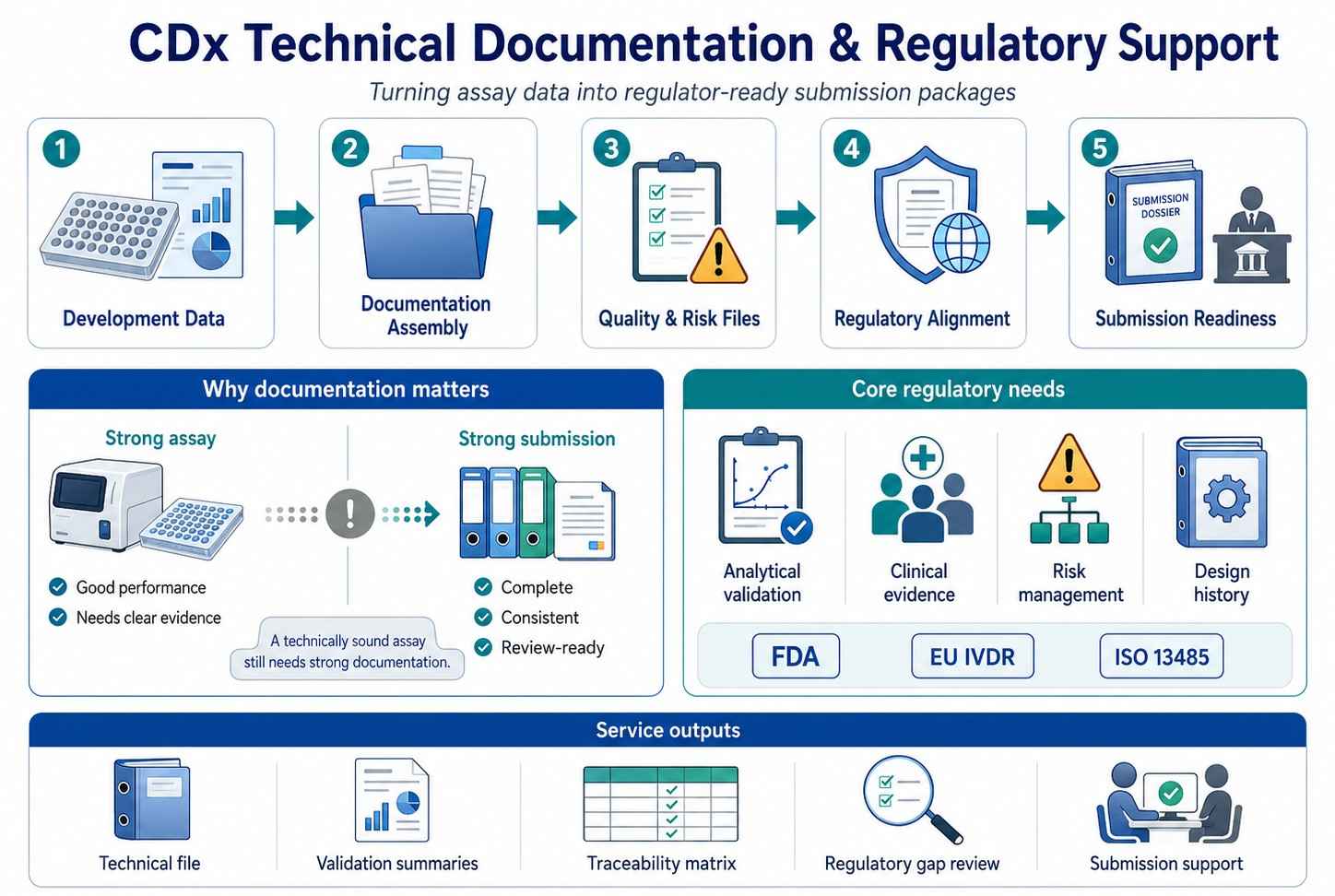
Regulatory documentation is the backbone of every successful companion diagnostic (CDx) submission. Regulators do not evaluate the assay itself—they evaluate the evidence presented in the submission package. A technically sound assay can be rejected if its documentation is incomplete, inconsistent, or fails to demonstrate that the product was developed and validated under a controlled quality system. Conversely, a well-documented program can accelerate review timelines, reduce agency queries, and increase the probability of first-cycle approval.
The documentation burden for CDx products is substantial and continues to grow. FDA companion diagnostic submissions require extensive analytical and clinical validation data, risk management files, and design history documentation. The EU In Vitro Diagnostic Regulation (IVDR) imposes additional requirements for technical documentation, performance evaluation, and post-market surveillance. ISO 13485 quality system documentation must be maintained throughout the product lifecycle. For developers without dedicated regulatory affairs infrastructure, assembling a compliant submission package can become a critical path bottleneck that delays market entry by months or years.
Creative Enzymes Diagnostic offers a comprehensive CDx Technical Documentation and Regulatory Support service that transforms your development data into regulator-ready submission packages. Our team combines deep IVD regulatory expertise with hands-on assay development experience, ensuring that every document is scientifically accurate, internally consistent, and aligned with the expectations of FDA, EU notified bodies, and other global regulators.
Documentation Support
We provide end-to-end documentation development services that cover every document category required for CDx regulatory submission and quality system compliance. Our documentation is prepared by scientists with direct assay development experience, ensuring technical accuracy and regulatory rigor.
Design History File
- Compilation of the complete design history file (DHF) documenting all design inputs, outputs, reviews, verifications, validations, and design changes throughout the product development lifecycle
- Preparation of design input specifications derived from user needs, intended use, and regulatory requirements, with traceability to design outputs and verification methods
- Documentation of design reviews at key milestones, including risk analysis integration, design verification planning, and design validation strategy
- Management of design change records with impact assessment, approval workflows, and verification of implemented changes to maintain DHF integrity
Risk Management File
- Development of risk management plans aligned with ISO 14971, including risk analysis methodology, acceptance criteria, and evaluation of residual risks
- Execution of hazard identification and risk assessment for all phases of the product lifecycle: design, manufacturing, clinical use, and post-market surveillance
- Integration of risk controls into design and process specifications, with verification that implemented controls effectively reduce risk to acceptable levels
- Maintenance of the risk management file as a living document, with updates triggered by design changes, complaint trends, or post-market surveillance findings
Analytical Validation Report
- Preparation of comprehensive analytical validation reports documenting limit of detection, limit of quantitation, analytical specificity, precision, accuracy, linearity, and interference studies
- Alignment of study designs and acceptance criteria with CLSI guidelines (EP17, EP07, EP05, EP06, EP09) and regulatory guidance documents
- Statistical analysis of validation data with appropriate methods, confidence intervals, and graphical presentation to support regulatory review
- Integration of validation results with design outputs and risk management documentation to demonstrate that the assay meets its predetermined specifications
Traceability Documentation
- Construction of complete traceability matrices linking user needs to design inputs, design inputs to design outputs, design outputs to verification and validation activities, and V&V results to acceptance criteria
- Maintenance of requirements traceability throughout the development lifecycle, ensuring that no requirement is left unverified and no test is performed without a corresponding requirement
- Integration of traceability data with risk management documentation to confirm that all identified hazards are addressed by design controls and verified by testing
- Preparation of traceability summaries for regulatory submission, formatted to facilitate agency review and reduce the likelihood of information requests
Regulatory Strategy
Beyond document preparation, we provide strategic regulatory guidance that aligns your development program with the specific requirements of your target markets and regulatory pathways. Our regulatory strategists work alongside your scientific team to anticipate agency expectations and position your submission for success.
FDA Companion Diagnostic
- Development of FDA pre-submission packages (Q-Sub) for companion diagnostic devices, including device description, intended use, predicate comparison, and proposed study designs
- Preparation of 510(k) or PMA submission documentation, including analytical validation summaries, clinical bridging study reports, and labeling proposals
- Strategic guidance on co-development pathway coordination with therapeutic sponsors, including protocol alignment, biomarker stratification strategies, and regulatory meeting preparation
- Support for FDA interactions, including pre-submission meetings, response to information requests, and post-approval compliance activities
IVDR
- Preparation of EU IVDR technical documentation in accordance with Annex II and Annex III requirements, including device description, specifications, manufacturing information, and general safety and performance requirements
- Development of performance evaluation plans and reports, including scientific validity, analytical performance, and clinical performance evidence
- Support for notified body conformity assessment, including technical documentation review preparation, gap analysis, and response to non-conformities
- Guidance on post-market surveillance planning, periodic safety update reporting, and vigilance reporting obligations under IVDR
ISO 13485 Documentation
- Development and maintenance of quality system documentation required for ISO 13485 certification, including quality manual, procedures, work instructions, and records
- Preparation of management review documentation, internal audit reports, and corrective and preventive action (CAPA) records to demonstrate ongoing quality system effectiveness
- Support for supplier quality management documentation, including supplier evaluation, qualification, and monitoring records
- Documentation of training records, equipment calibration, and environmental monitoring to support audit readiness and regulatory inspection
Change Control Support
- Implementation of change control procedures that ensure all design, process, and labeling changes are evaluated for impact on safety, performance, and regulatory status
- Assessment of change classification (minor vs. significant) and determination of required regulatory notifications, submissions, or approvals
- Preparation of change documentation packages, including change description, rationale, risk assessment, verification data, and regulatory filing strategy
- Maintenance of change history records and integration with design history files, risk management files, and technical documentation to ensure traceability and audit readiness
Documentation Package
Upon completion of the technical documentation and regulatory support engagement, you receive a comprehensive documentation package that supports immediate regulatory submission and ongoing quality system compliance:
| Item |
Description |
| Design History File |
Complete DHF documenting all design phases, inputs, outputs, reviews, verifications, validations, and changes, formatted for regulatory inspection and submission. |
| Risk Management File |
ISO 14971-compliant risk management plan, hazard analysis, risk assessment, risk control verification, and residual risk evaluation with ongoing maintenance protocol. |
| Analytical Validation Report |
Comprehensive report covering all analytical performance characteristics with statistical analysis, graphical data presentation, and alignment with CLSI guidelines and regulatory expectations. |
| Traceability Matrix |
Complete bidirectional traceability documentation linking user needs through design controls to verification and validation results, with gap analysis and coverage assessment. |
| FDA Submission Package |
510(k) or PMA submission documentation including device description, intended use, predicate comparison, analytical and clinical data summaries, and proposed labeling. |
| IVDR Technical Documentation |
Annex II and Annex III compliant technical documentation including device description, specifications, GSPR checklist, performance evaluation, and post-market surveillance plan. |
| ISO 13485 Quality System Documentation |
Quality manual, procedures, work instructions, and records supporting ISO 13485 certification and ongoing compliance, including management review and internal audit documentation. |
| Change Control Records |
Documented change control procedures, change request evaluations, impact assessments, verification data, and regulatory filing determinations with complete change history. |
| Regulatory Strategy Document |
Market-specific regulatory pathway analysis, submission timeline, agency interaction strategy, and risk-based prioritization of documentation development activities. |
| Submission Response Support |
Prepared response templates and supporting data packages for anticipated agency information requests, deficiency letters, and post-approval compliance inquiries. |
FAQs
Q1. When should we engage regulatory documentation support in the CDx development timeline?
A1. Regulatory documentation support should be engaged as early as possible—ideally at the initiation of development or during the feasibility phase. Early engagement ensures that design controls, risk management, and traceability are established from the outset, preventing the costly and time-consuming effort of reconstructing documentation retrospectively. For programs already in development, we can perform gap assessments and backfill missing documentation while maintaining scientific accuracy and regulatory compliance.
Q2. Can you support submissions to multiple regulatory jurisdictions simultaneously?
A2. Yes. We have experience preparing submission packages for FDA (United States), EMA/notified bodies (European Union), PMDA (Japan), NMPA (China), and Health Canada, among others. Where possible, we leverage common technical documentation to avoid redundant work while ensuring that each submission addresses jurisdiction-specific requirements. Our regulatory strategists can also advise on optimal submission sequencing to maximize efficiency and minimize time to market across regions.
Q3. What is the difference between a Design History File and a Technical Documentation file?
A3. The Design History File (DHF) is a FDA-specific requirement under 21 CFR Part 820 that documents the design control process—how the device was designed and verified. Technical Documentation (TD) is the EU IVDR requirement under Annexes II and III that describes what the device is, how it is manufactured, and how it meets safety and performance requirements. While there is substantial overlap in content, the organizational structure, emphasis, and regulatory intent differ. We prepare both in parallel, ensuring consistency while meeting the specific expectations of each jurisdiction.
Q4. How do you ensure that documentation remains accurate when the assay design is still evolving?
A4. We implement a living document management system where documentation is updated in real time as design changes occur. All changes are processed through formal change control with impact assessment, ensuring that related documents (DHF, risk management, traceability, validation reports) are updated simultaneously. Version control, change history, and document interdependencies are managed through a structured quality system to prevent inconsistencies and ensure that the documentation always reflects the current device design.
Q5. Can you support us during FDA pre-submission meetings and Q-Sub interactions?
A5. Absolutely. We prepare pre-submission meeting packages, draft meeting requests, and develop presentation materials and talking points for FDA interactions. Our regulatory team can participate in meetings as technical advisors, help formulate responses to FDA feedback, and translate agency guidance into actionable development and documentation plans. This support extends through the entire submission lifecycle, including response to information requests and post-approval compliance activities.
Q6. Do you provide ongoing documentation maintenance after initial regulatory approval?
A6. Yes. Regulatory documentation is a living requirement that must be maintained throughout the product lifecycle. We provide ongoing support for post-market surveillance documentation, periodic safety update reports, design change documentation, CAPA records, and annual quality system reviews. Our team can also manage document updates triggered by regulatory changes, new guidance documents, or modifications to the approved device, ensuring continued compliance and audit readiness.
Creative Enzymes Diagnostic combines scientific rigor, regulatory expertise, and quality system discipline to deliver documentation packages that meet the highest standards of global regulatory agencies. From design history files to submission-ready packages, we ensure that your CDx program is supported by evidence that regulators can trust.
Contact our business development team today to discuss your specific project needs!
Related Services

