
Creative Enzymes helps diagnostic-reagent teams use experimental structures, predicted models, homology models, complex modeling, docking, molecular dynamics, and structure-guided analysis without confusing a computational picture with experimental proof. We define the decision first, qualify the model and chemical system, examine plausible enzyme-substrate interactions, and translate each conclusion into an experiment that can support, revise, or reject it.
Direct answer: this service converts a sequence, structure, reaction, and assay question into a qualified structural model, a traceable enzyme-substrate interaction hypothesis, and an experimental plan. A project may include experimental-structure review, AlphaFold or homology-model assessment, construct mapping, pocket and interface analysis, substrate/cofactor/metal or nucleic-acid complex modeling, docking, conformational ensemble analysis, molecular dynamics, approximate energetic calculations, residue prioritization, and report-ready visualization. Every output states its provenance, assumptions, confidence, and decision boundary.
Structural modeling can answer questions such as whether an annotated residue is positioned to contact a substrate, whether a loop may control pocket access, whether two variants plausibly change an interaction network, which conformations deserve experimental attention, or which substitutions should be tested first. It can also reveal that the available evidence is too weak for a residue-level conclusion. That negative result is useful: it prevents a low-confidence model from becoming an expensive engineering assumption.
A predicted pose is not a measured binding event. A docking score is not a dissociation constant, inhibition constant, Michaelis constant, turnover number, or catalytic efficiency. A stable interaction pattern in one simulation does not prove the biological ensemble. A high-confidence protein fold does not automatically establish ligand geometry, protonation, catalytic waters, a transition state, or the relevant oligomer. When the question concerns actual activity or kinetics, structural findings should be connected to AI-Guided Activity and Kinetic Performance Optimization or laboratory characterization.
Model selection, structural annotation, residue hypotheses, plausible poses, interaction maps, comparative analysis, and experiment prioritization.
Predicted confidence, docking rank, conformational stability, energetic estimates, and inferred catalytic geometry.
Binding, activity, Km, kcat, specificity, inhibition, stability, matrix tolerance, and application performance.
Clinical claims, regulatory clearance, finished-product release, patent conclusions, and proof of a reaction mechanism.
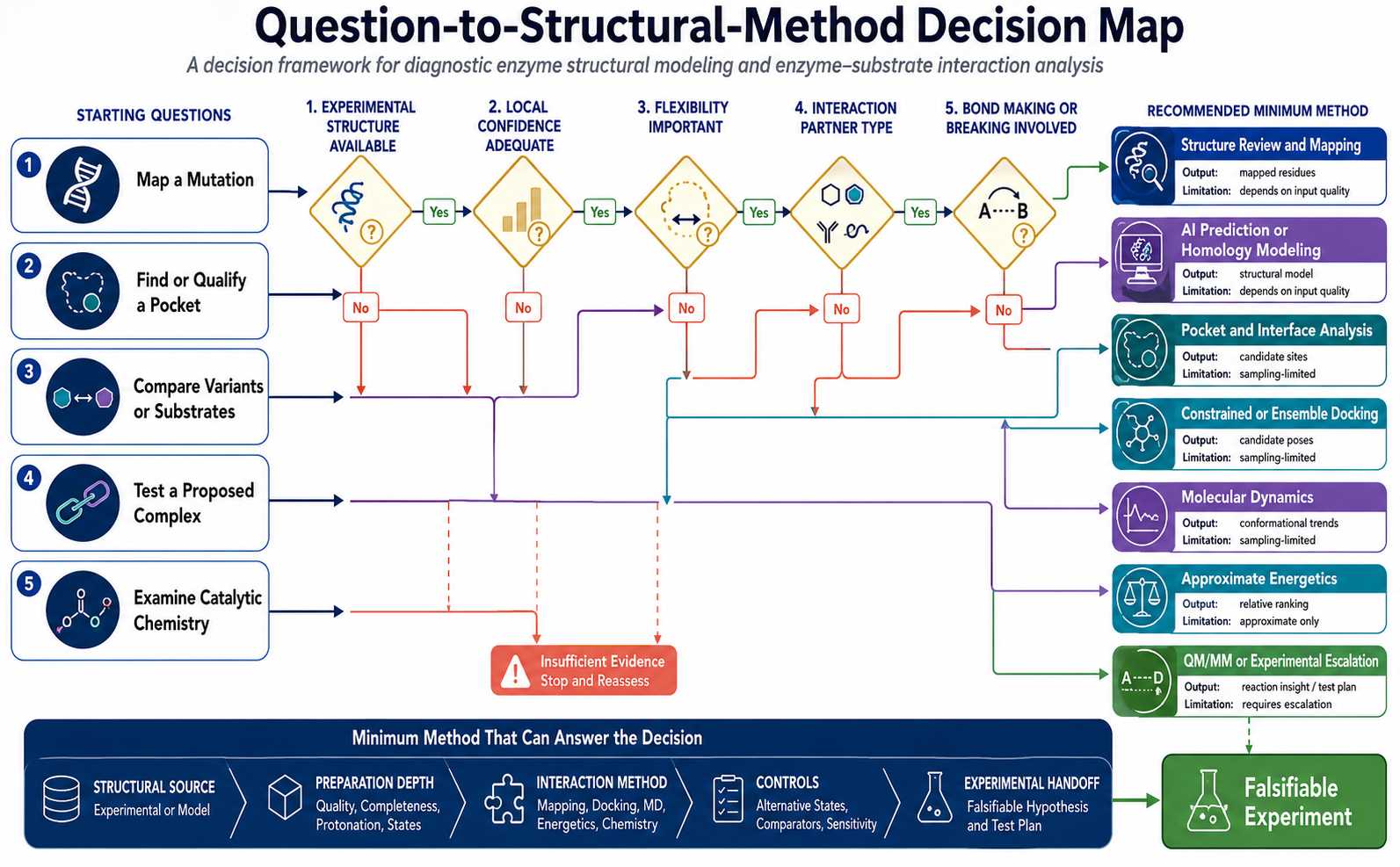 Fig. 1. Question-to-structural-method decision map. The scientific decision determines the structural source, preparation depth, interaction method, controls, and experimental handoff.
(Creative Enzymes)
Computational depth should follow the question rather than a fixed package. If a client needs to map a mutation onto a reliable experimental structure, a well-documented structure review may be more useful than a long molecular-dynamics trajectory. If the concern is a flexible loop that changes substrate access, one static model is inadequate. If the question concerns bond making and breaking, classical docking is not a chemical reaction model. We define the decision, expected evidence, and stopping rule before selecting methods.
Examples include: “Prioritize five residues for testing whether a hydrolase can accept a larger chromogenic substrate without losing activity on the current substrate,” or “Assess whether an engineered polymerase changes the geometry of a primer-template contact that could affect mismatch discrimination.” A sentence like “run docking and MD” specifies tools but not what conclusion the client needs. We reformulate tool requests into a scientific decision and identify the lowest-cost experiment that could challenge the computational interpretation.
X-ray, cryo-EM, NMR, or integrative models may provide direct structural evidence, but method, resolution, local support, construct, missing regions, alternate states, assembly, and ligand quality still require review.
Local confidence and relative-position confidence are examined separately. A confident fold can be valuable while an interface, loop, domain orientation, ligand pose, or catalytic state remains uncertain.
Template identity, alignment, coverage, active-site conservation, insertions/deletions, oligomeric state, and transferred ligands influence whether a local conclusion is defensible.
Multiple experimental and predicted sources may be aligned, reconciled, or retained as alternatives when no single structure represents the decision-relevant state.
“Experimental” does not mean flawless, and “predicted” does not mean unusable. The relevant question is whether the coordinates in the region that drives the conclusion are supported at the required resolution. For an active-site hypothesis, local side-chain placement, ligand chemistry, cofactors, metals, waters, alternate conformations, and missing loops may matter more than a global quality score. For domain motion, relative-domain confidence and multiple states matter more than a single high average confidence value.
The coordinate file should remain linked to the sequence, construct, chemical state, version, preparation protocol, confidence record, and intended decision.
Protein sequence, residue numbering, termini, tags, linkers, mutations, processing, missing residues, and chain mapping.
PDB/EMDB or prediction source, model/version, template IDs, dates, parameters, and file lineage.
Experimental validation measures, template coverage, pLDDT, PAE, local model quality, geometry, clashes, and uncertain regions.
Assembly, conformation, substrate/product/analog, cofactor, metal, water, protonation, tautomer, and modifications.
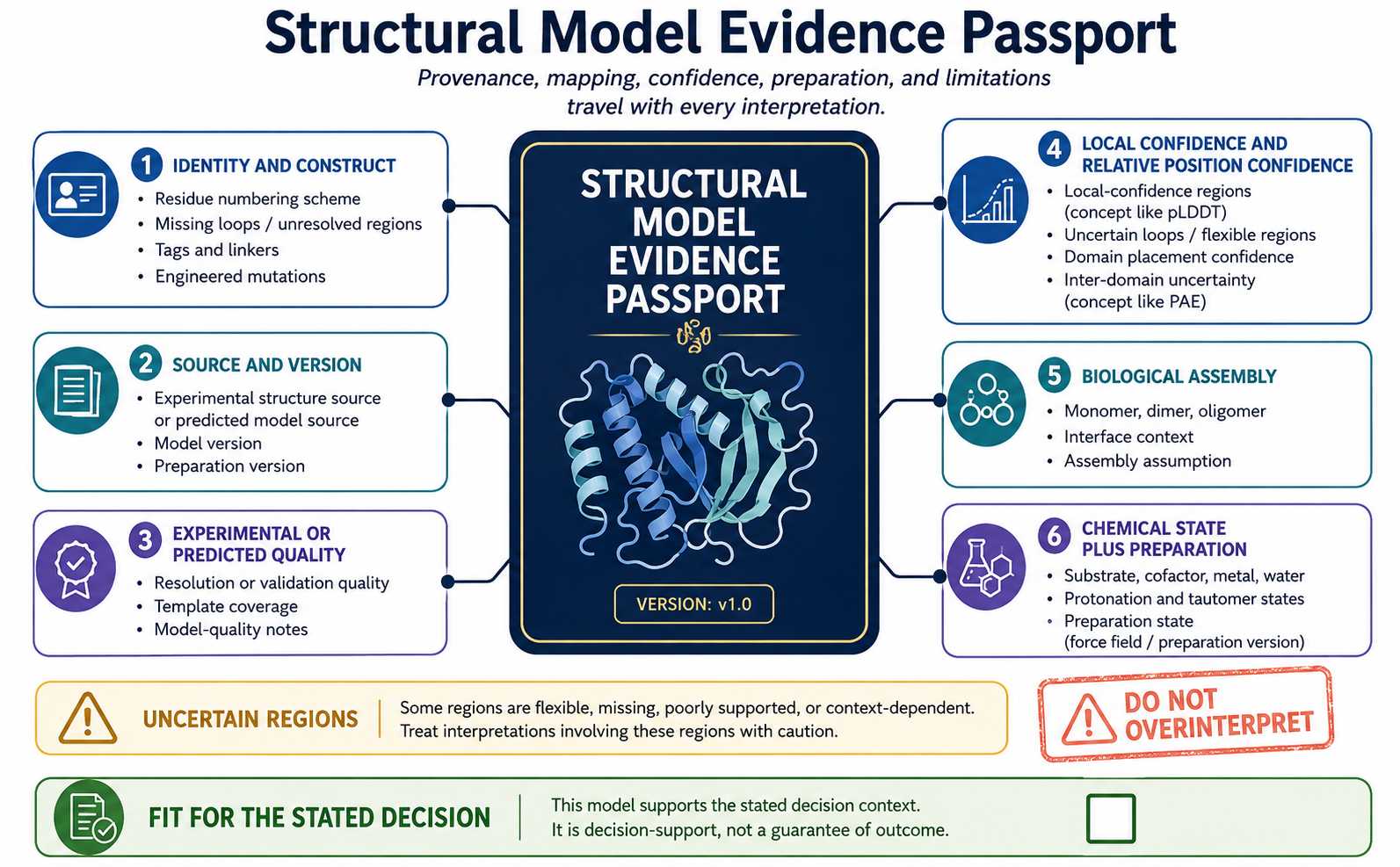 Fig. 2. Structural model evidence passport. Provenance, sequence/construct mapping, confidence, chemical state, assembly, preparation, and limitations travel with every interpretation.
(Creative Enzymes)
For AlphaFold-derived models, pLDDT describes local confidence, while predicted aligned error helps evaluate confidence in the relative placement of residues, domains, chains, or other modeled entities. They answer different questions. A domain can have strong local geometry but uncertain placement relative to another domain. An interface or ligand may require entity-specific confidence review. Neither measure reports an experimental binding constant, conformational population, kinetic rate, or catalytic barrier.
We keep low-confidence regions visible in the evidence record. Removing them may create a cleaner picture but can hide the uncertainty controlling pocket access, interdomain orientation, or partner recognition. Depending on the decision, the appropriate action may be to retain multiple models, add experimental constraints, avoid interpreting the region, redesign the construct, or collect new structural/functional data.
Most interaction errors begin before docking. A protein may be modeled as the wrong chain, construct, oligomer, or conformation. The substrate may have the wrong stereochemistry, tautomer, protonation, leaving group, or chemical state. A cofactor or catalytic metal may be deleted as if it were crystallization debris. A primer-template may be truncated outside the contacts that control processivity. A bound inhibitor may be treated as a substrate even though it stabilizes a different state.
Preparation can include construct reconciliation, biological-assembly review, missing atom/residue treatment, side-chain and loop alternatives, bond-order assignment, disulfides, termini, protonation hypotheses, metal coordination, cofactor retention, clash review, and minimization. Changes are recorded rather than hidden behind a “prepared” label.
When several templates or predicted states are plausible, we may create a comparative ensemble. The ensemble is not used to inflate the number of results; it represents genuine uncertainty or known conformational diversity that could change the decision.
We map the substrate to the actual enzyme-catalyzed reaction: bonds that change, cofactors consumed or regenerated, proton/electron donors and acceptors, stereochemistry, products, inhibitors, and known analogs. For coupled diagnostic reactions, the modeled enzyme step is separated from downstream signal generation so that structural claims remain tied to the correct chemistry.
When a substrate is polymeric, conjugated, membrane-associated, or part of a primer-template complex, a small isolated fragment may be inadequate. The model scope should preserve the contacts that could control recognition and catalysis.
A good enzyme-substrate model does more than place a ligand inside a cavity. It asks whether the pose is consistent with the reaction, known catalytic residues, cofactor/metal geometry, conserved water networks, substrate stereochemistry, conformational access, and experimental observations. A pose that scores well but points the reacting group away from the catalytic machinery may describe nonspecific binding rather than a productive complex.
Pocket complementarity, electrostatics, hydrogen bonds, hydrophobic contacts, steric access, substrate orientation, and competing ligands.
Reacting atoms, catalytic residues, cofactor or metal, relevant waters, proposed proton/electron route, and reaction-relevant distances or angles where justified.
Loop closure, domain motion, induced fit, conformational selection, substrate entry, product release, and alternative states.
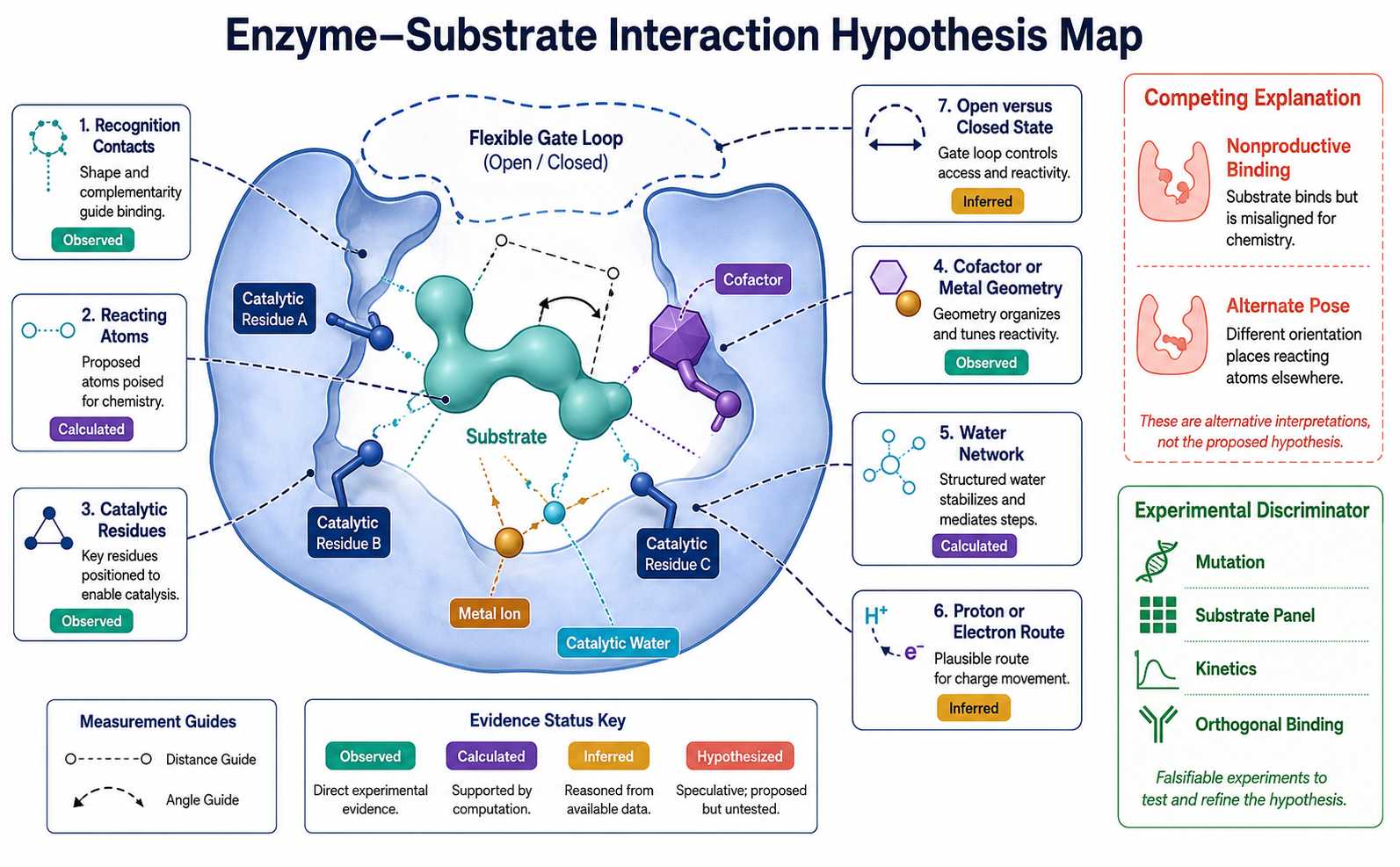 Fig. 3. Enzyme-substrate interaction hypothesis map. Recognition contacts, reaction geometry, cofactors, metals, waters, dynamics, and evidence status are interpreted as a connected and testable hypothesis.
(Creative Enzymes)
| Evidence state | Example | What it can support | What it cannot establish alone |
|---|---|---|---|
| Observed | Residue and ligand coordinates supported by experimental density; measured mutation or activity data | Direct evidence under the experimental construct and conditions | All solution states, all substrates, or the complete catalytic pathway |
| Calculated | Predicted structure, docking pose, contact occupancy, approximate energy, or trajectory metric | A method-specific result under documented inputs and assumptions | Experimental affinity, kinetics, catalytic rate, or universal ranking |
| Inferred | Residue assigned as a specificity determinant from conservation, proximity, and comparative data | A reasoned interpretation combining evidence sources | Causality without a suitable perturbation and assay |
| Hypothesized | Mutation expected to alter substrate orientation or loop closure | A falsifiable prediction and test plan | Improvement, mechanism, or acceptable tradeoffs before testing |
Stereochemistry, ionization, reaction state, cofactors, metals, conserved waters, and near-attack geometry may dominate. Docking a ground-state substrate is a recognition hypothesis, not a simulation of chemistry.
Sequence, duplex form, ends, mismatches, modifications, ions, processive contacts, and protein/nucleic-acid conformational states can affect polymerases, reverse transcriptases, nucleases, ligases, recombinases, and CRISPR/Cas enzymes.
Interfaces may involve transient complexes, avidity, flexible linkers, multiple orientations, or conjugation constraints. Interface confidence and experimental restraints are usually more informative than a single rigid-body pose.
Docking proposes ways a ligand may fit a receptor under a scoring function and sampling protocol. It is useful for generating poses, comparing hypotheses, prioritizing candidates, and identifying potential contacts. It uses approximations. Receptor flexibility, ligand strain, protonation, water, metal coordination, cofactors, induced fit, and the scoring function can change the result. The top-ranked pose is not automatically the most biologically plausible pose.
A docking score is not an experimental affinity. It may help rank poses or compounds within a specific prepared system and protocol. Values from different programs, receptor states, grids, protonation choices, or substrates are not directly interchangeable. We label the method, scoring function, preparation, search region, constraints, and intended comparison rather than reporting an isolated negative number as a physical truth.
Redock a co-crystallized ligand or use a relevant complex to test whether the protocol can recover a known interaction pattern.
Use experimental, predicted, homology, apo/holo, or ensemble states when flexibility could change the pocket.
Review stereochemistry, protonation, tautomers, charges, cofactors, metals, covalent state, and conserved waters.
Apply justified residue, distance, or orientation constraints from reaction knowledge or experiments; do not force an unsupported answer.
Include known substrates, non-substrates, products, inhibitors, analogs, or related variants when they answer the decision.
Retain plausible alternatives and inspect reaction geometry, strain, contacts, clashes, and agreement with evidence—not score alone.
A docking result should not be escalated simply because more compute is available. We may stop when the structural source is too uncertain in the pocket, the substrate chemistry is inadequately defined, controls fail, several poses remain indistinguishable, or the question requires an experiment rather than another calculation. The deliverable then identifies the evidence gap and a practical next step—for example, testing a substrate analog panel, measuring activity across a concentration series, mutating one discriminatory residue, or obtaining a bound structure.
Molecular dynamics can examine how a prepared molecular system evolves under a force field, boundary conditions, and simulation protocol. It can help evaluate whether proposed contacts persist, whether a loop samples open and closed states, whether a substrate remains oriented near catalytic groups, whether a mutation changes local flexibility, or whether alternative starting poses converge or diverge. Its value depends on the question and sampling—not on the visual appeal of a trajectory.
Experimental, predicted, template, apo/holo, and locally remodeled states; uncertain states remain explicit.
Docking and template-based alternatives filtered by chemistry, controls, strain, clashes, and reaction plausibility.
Replicas, restraints, equilibration, contact/geometry metrics, conformational analysis, and uncertainty review.
Hypotheses that justify a mutation, substrate, binding, kinetic, specificity, or application experiment.
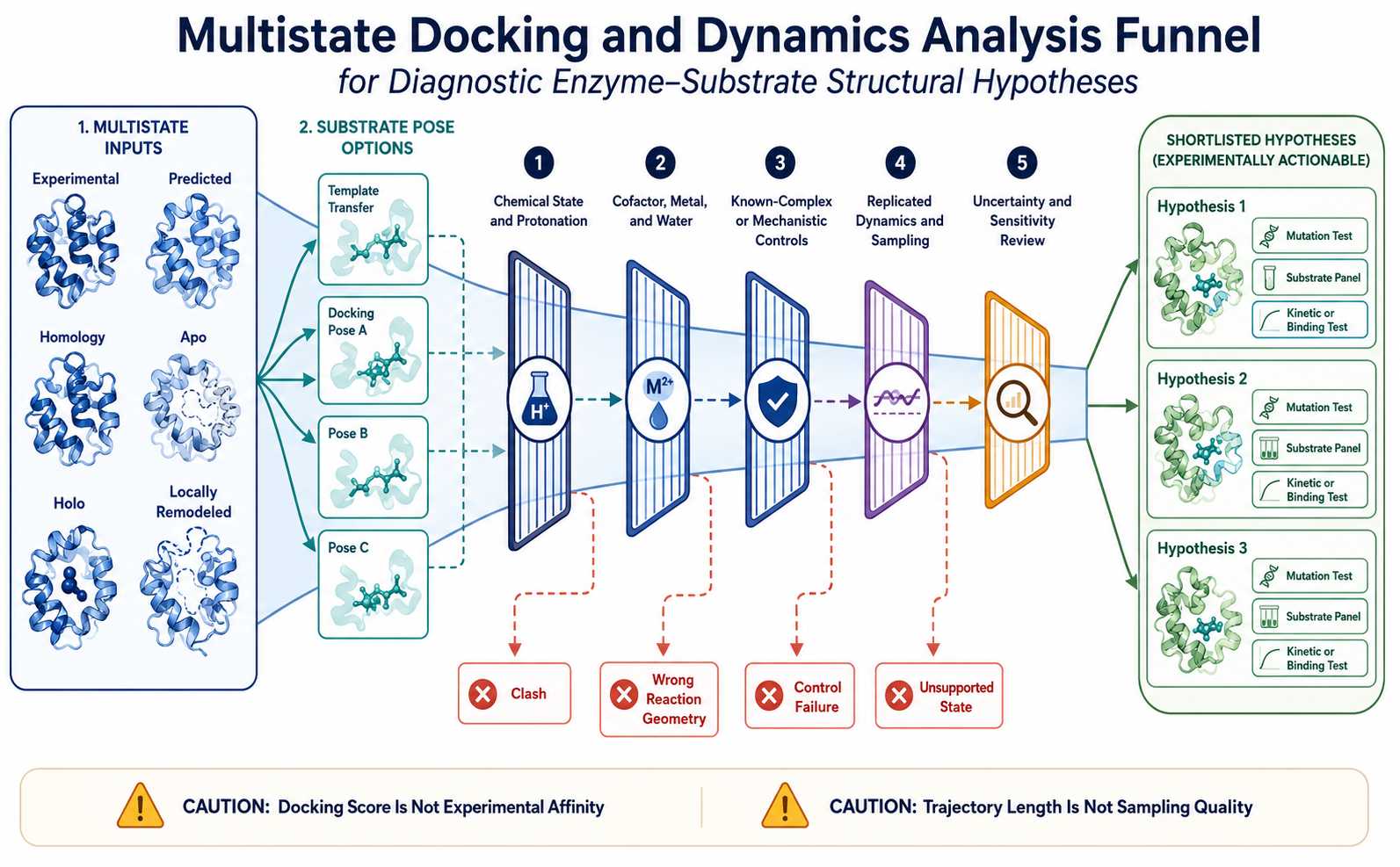 Fig. 4. Multistate docking and dynamics analysis funnel. Structural and pose alternatives are tested through chemistry, controls, sampling, and uncertainty before an experimentally actionable shortlist is released.
(Creative Enzymes)
We document force field and parameter sources, system composition, solvent and ion choices, protonation assumptions, metal/cofactor treatment, restraints, minimization, equilibration, production settings, replicas where used, analysis definitions, and software versions. If a nonstandard substrate, cofactor, modified nucleotide, metal center, or covalent intermediate is not covered reliably, that limitation is addressed before simulation rather than buried after it.
A long trajectory may remain trapped near its starting state. Repeated simulations can disagree. Rare transitions may occur outside the simulated timescale. Force-field errors can be systematic even when a metric appears converged. We therefore examine replicate behavior, autocorrelation or effective sampling where appropriate, stability of conclusions across analysis choices, and whether the simulation actually visited the states needed for the decision. Results are stated as observations within the simulated model and timescale.
MM/GBSA or MM/PBSA can provide approximate, method-dependent comparisons; free-energy perturbation can be valuable for suitable relative changes with carefully connected states; quantum mechanics or QM/MM may be needed for electronic rearrangement and reaction paths. No method is selected from its label alone. The chemical transformation, available parameters, structural confidence, desired precision, number of candidates, and experimental anchors determine whether the calculation is justified.
Interpretation rule: predicted energetic differences are reported with the method, direction of comparison, uncertainty or sensitivity information available, and applicable chemical series. They are not silently relabeled as measured binding affinity or catalytic free energy.
Diagnostic enzymes operate in reagent systems with defined substrates, partners, temperatures, timing, salts, inhibitors, matrices, preservatives, surfactants, drying histories, and signal-generation requirements. A structural hypothesis should therefore connect to the assay endpoint, not only to molecular contacts in pure water. The relevant tradeoff may be activity versus mismatch discrimination, substrate range versus cross-reactivity, processivity versus nonspecific amplification, or active-site flexibility versus storage robustness.
| Diagnostic enzyme context | Structural questions | Experimental bridge | Related service |
|---|---|---|---|
| Polymerases and reverse transcriptases | Primer-template contacts, nucleotide positioning, fidelity residues, metal coordination, processivity interfaces, open/closed states | Extension rate, fidelity or mismatch panel, inhibitor tolerance, temperature range, processivity, assay output | Polymerase and RT Engineering |
| LAMP, RPA, and isothermal systems | Strand displacement, nucleic-acid access, partner interfaces, temperature-dependent conformations, inhibitory contacts | Time-to-signal, low-copy detection, nonspecific amplification, reagent compatibility, temperature robustness | Isothermal Enzyme Optimization |
| CRISPR/Cas diagnostics | Guide/target recognition, mismatch-sensitive contacts, cleavage geometry, accessory nucleic acids, conformational activation | Target/non-target panels, guide dependence, collateral activity, rate, temperature, matrix and reagent conditions | CRISPR/Cas Engineering Support |
| Signal-generating enzymes | Substrate channel, cofactor/metal network, product release, chromogenic or fluorogenic group accommodation, coupled-reaction interfaces | Initial rate, substrate panel, interference, cofactor dependence, linear range, signal/background, coupled-assay performance | Specificity and Cross-Reactivity Reduction |
| POCT and dried reagents | Flexible regions, interfaces, solvent exposure, formulation-sensitive contacts, competing multiparameter effects | Drying/reconstitution, accelerated and real-time stability, temperature excursion, matrix, cartridge, and instrument output | Multiparameter POCT Optimization |
Structure modeling can also help compare candidate second sources, but structural similarity is only one evidence layer. Defined-use equivalency requires analytical, functional, stability, lot, and application-level evidence through the AI-Assisted Second-Source and Sequence Equivalency Engineering Service. Likewise, a model may suggest a stability-sensitive loop or interface, while actual thermal, drying, shipping, and shelf-life performance must be measured through Thermostability and Lyophilization Stability Engineering and appropriate testing.
The project is staged so that uncertainty can stop or redirect work before an expensive calculation. A client with a validated enzyme-substrate complex and a focused mutation question may enter at comparative modeling. A client with only a sequence and a suspected substrate may begin with source qualification and reaction-context review. A client with contradictory docking and assay results may require failure localization rather than a new end-to-end pipeline.
Decision, reaction, assay endpoint, constraints, and claim boundary
Sequences, constructs, structures, substrates, cofactors, data, and literature
Source, confidence, coverage, assembly, local quality, and evidence gaps
Protein/complex, chemical states, protonation, metals, waters, and controls
Pockets, contacts, poses, ensembles, dynamics, energetics, or reaction geometry
Alternative states, protocol controls, sensitivity, uncertainty, and conflicts
Ranked hypotheses, experiments, decision rules, files, and reproducibility record
The model is adequate for the stated local or global conclusion, and the next method can add decision value.
The analysis is useful only for specified regions, states, comparisons, or qualitative hypotheses.
An experiment, alternative structure, substrate definition, or assay result is needed before deeper computation.
The inputs or method cannot support the intended claim; a different question or experimental route is recommended.
Disagreement is not automatically a model failure or an assay failure. It can arise from a sequence/construct mismatch, wrong oligomer, missing partner, inactive chemical state, protonation error, missing metal or cofactor, inappropriate force-field parameters, inadequate sampling, nonproductive binding, altered expression/solubility, impurity effects, incorrect enzyme normalization, or an application interaction outside the model. We preserve intermediate evidence so the next action targets the most plausible cause.
| Work package | Possible deliverables | What the deliverable is for | What it does not claim |
|---|---|---|---|
| Structural source and model qualification | Sequence/construct map, source comparison, template and coverage record, quality/confidence assessment, assembly review, model evidence passport, gap memo | Defines whether and where the structure is suitable for interpretation | Does not prove function or make uncertain regions accurate |
| Structure preparation and annotation | Prepared coordinate files, residue numbering map, pocket/interface annotation, cofactors/metals/waters record, chemical-state assumptions, versioned workflow | Creates a traceable system for downstream analysis | Does not establish that one prepared microstate dominates experimentally |
| Interaction and docking package | Protocol and controls, pose ensemble, interaction maps, reaction-geometry review, score table with definitions, rejected-pose rationale, uncertainty statement | Generates and prioritizes plausible interaction hypotheses | Does not report docking scores as measured affinity or catalytic rate |
| Dynamics and energetic package | Simulation inputs, parameter sources, replicas and settings, trajectory analyses, contact/geometry metrics, sensitivity or uncertainty review, approximate energy results where scoped | Tests behavior within the specified model, force field, and timescale | Does not prove the biological ensemble, rare events, or reaction mechanism |
| Structure-guided engineering package | Candidate residues, protected residues, substitution rationale, variant/condition shortlist, expected tradeoffs, experiments and decision rules | Allocates experimental capacity to explicit hypotheses | Does not guarantee improved activity, specificity, stability, or expression |
| Reproducibility and transfer package | Input manifest, software/method versions, parameters, scripts or command record where applicable, coordinate/trajectory files as scoped, figure assets, report, limitations | Allows internal review, reuse, and update when inputs change | Does not transfer third-party software licenses or undisclosed proprietary code |
Projects may be computational only or integrated with enzyme expression, purification, characterization, and iteration. Production can connect to Enzymes Production and Engineering and Enzyme Expression and Purification. Experimental activity and stability work can connect to Enzymes Activity and Stability Analysis. Matrix-dependent predictions should be checked through Assay Interference and Matrix Effect Evaluation when the application requires it.
The strongest deliverable is not a final-looking molecular image. It is a hypothesis register in which each proposed interaction or residue role is linked to its evidence, competing explanation, test, control, measurable outcome, and next action. This prevents a plausible interpretation from becoming an unquestioned design rule.
For example, a loop residue may orient the substrate; a mutation may open the pocket; a metal-coordinating residue may be intolerant; an interface may control processivity.
Sequence-defined mutation, matched protein preparation, substrate or mismatch panel, concentration series, cofactor/metal perturbation, orthogonal binding, or application assay.
Support, narrow, revise, or reject the hypothesis; update the model passport and choose the next engineering or experimental action.
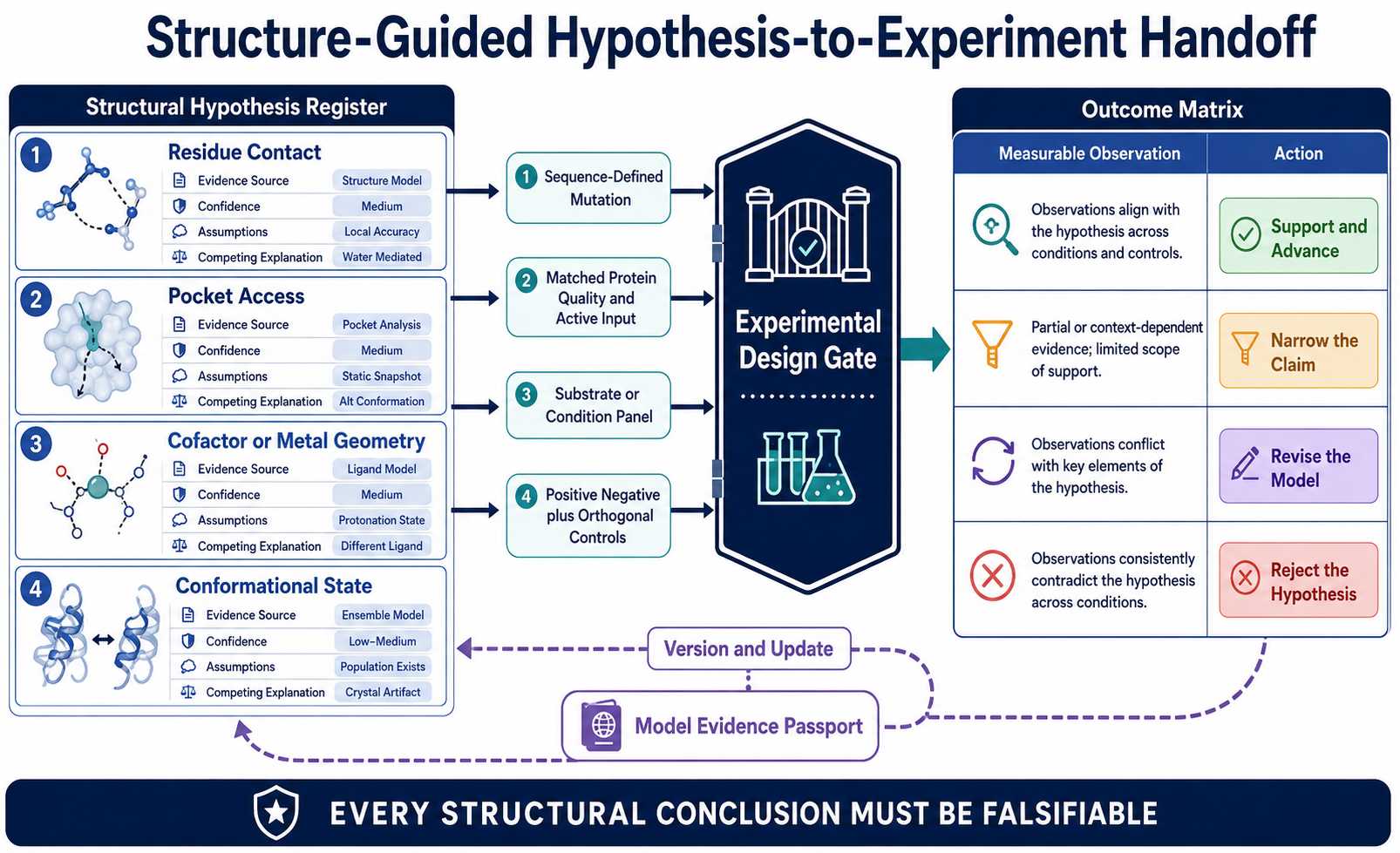 Fig. 5. Structure-guided hypothesis-to-experiment handoff. Every model-based claim is paired with a discriminating experiment, controls, measurable outcomes, and support/revise/reject actions.
(Creative Enzymes)
Compare a targeted residue substitution with a conservative control, equalize active enzyme input, and test a small substrate panel. A uniform activity loss may indicate folding or catalytic disruption rather than selective recognition.
Choose mutations or conditions predicted to favor alternative states, then measure rate, temperature response, processivity, or binding under conditions that distinguish state effects from expression and concentration differences.
Test the purified-system prediction in the matched reagent, matrix, or device. A model can explain molecular interactions, but formulation partners, inhibitors, surfaces, and instrument timing may determine the observed diagnostic output.
When multiple rounds are justified, experiments and updated models can be governed through the Closed-Loop Design-Build-Test-Learn Enzyme Evolution Service. A finite candidate list can move to AI-Guided Diagnostic Enzyme Variant Design and Screening. A larger, capacity-aware sequence space can be specified through AI-Assisted Diagnostic Enzyme Mutation Library Design. The modeling page supplies the structural evidence; those pages own candidate or library execution.
This service is part of AI-Driven Diagnostic Enzyme Engineering Services. It owns structure-source qualification, model confidence, interaction hypothesis generation, and structure-to-experiment handoff. It does not absorb every engineering objective merely because a structure is used.
Use De Novo Enzyme Discovery and Enzyme Mining when the parent scaffold is unknown. Use Variant Design and Screening for a finite tested candidate set and Mutation Library Design for a structured diversity specification.
Use Activity and Kinetic Performance Optimization, Specificity and Cross-Reactivity Reduction, Thermostability and Lyophilization Stability Engineering, or Expression, Solubility and Manufacturability Optimization when the objective owns the project.
Use Polymerase/RT Engineering, LAMP/RPA/Isothermal Optimization, or CRISPR/Cas Engineering for modality-specific programs. Use AI-Ready Dataset Design and Screening Data Analysis to organize evidence for future modeling.
For a supply-alternative program, the AI-Assisted Second-Source and Sequence Equivalency Engineering Service defines the reference, differences, evidence tiers, and qualified-use decision. For tightly coupled POCT objectives, AI-Driven Multiparameter Enzyme Optimization for POCT Reagents balances activity, specificity, stability, manufacturability, drying, matrix, and device constraints.
Often, yes. Feasibility depends on sequence coverage, homologs/templates, model confidence, oligomeric and ligand context, and the level of detail required. A predicted or homology model may support domain mapping, pocket hypotheses, or candidate-residue prioritization while remaining insufficient for precise energetic or catalytic conclusions. We state where the model is reliable enough for the decision and where experiments or alternative evidence are needed.
pLDDT estimates local structural confidence, reported per residue in AlphaFold 2 and per atom in AlphaFold 3 outputs. PAE estimates confidence in the relative placement of two modeled items, such as residues, domains, chains, nucleic acids, or ligands depending on the model. A region can have high local confidence while its orientation relative to another domain remains uncertain. Neither metric is an experimental measure of binding or activity.
Not necessarily. The ranking depends on the receptor state, search space, ligand chemistry, sampling, scoring function, cofactors, metals, waters, and constraints. Several poses may be plausible, and a top score can be chemically or catalytically unconvincing. We use controls and inspect interaction/reaction geometry, strain, clashes, and consistency with experiments rather than accepting the first score automatically.
No direct conversion is justified. Km can reflect multiple kinetic steps and is not always a binding constant; kcat depends on the catalytic cycle; kcat/Km combines kinetic behavior. Docking mainly proposes poses and method-specific scores. Measured kinetics require an appropriate assay with a substrate concentration series and a justified model. Structural analysis can help explain or prioritize experiments but does not replace them.
MD may be useful when the decision depends on receptor flexibility, interaction persistence, loop or domain motion, alternative poses, hydration, or mutation-induced changes within an accessible timescale. It is not automatically required for every docked pose. If structure preparation is uncertain, controls fail, or the needed transition is outside feasible sampling, an experiment or a different model may add more value.
Potentially, subject to chemical definition and method suitability. These components can be essential and should not be deleted by default. Nonstandard metals, covalent states, modified nucleotides, unusual cofactors, or reactive intermediates may need specialized parameters or quantum-mechanical treatment. The proposal states what can be modeled, how, and with what limitations.
Yes. We can map mutations, locally remodel structures, compare pockets and interaction networks, examine multiple states, and prioritize experiments. A predicted structural difference does not prove that the mutant expresses, folds, retains active protein concentration, or changes function. Matched production and functional testing are required for those conclusions.
Yes, depending on the system and available evidence. Polymerases, reverse transcriptases, nucleases, ligases, recombinases, and CRISPR/Cas enzymes may require protein-DNA/RNA complexes, primers, templates, guides, targets, mismatches, ions, and relevant conformational states. The modeled construct and nucleic-acid sequence/length must reflect the decision; a short generic fragment may omit important contacts.
We first localize the disagreement. Possible causes include incorrect sequence/construct, protein quality or active concentration, wrong chemical or oligomeric state, missing cofactors/partners, inadequate sampling, nonproductive binding, assay interference, formulation effects, or an application interaction outside the model. The model is revised only when the evidence supports revision; the assay should also be checked with appropriate controls.
Deliverables are configured in the proposal and can include input/output coordinate files, alignments, prepared systems, poses, analysis tables, model-confidence records, parameter and software versions, trajectory or selected-frame files, figures, and a report. Large files, proprietary software formats, licensed components, and executable workflows are scoped explicitly.
No. It can develop a mechanistic hypothesis and recommend experiments or higher-level chemical calculations. Proof of mechanism requires appropriate experimental and computational evidence. The service supports research and diagnostic-reagent development; it does not establish clinical performance, regulatory clearance, finished-product release, patentability, freedom to operate, or legal conclusions.
References support general scientific principles. The method appropriate to a particular enzyme, substrate, reaction, and decision is defined in the project proposal.
Send the available enzyme sequence and construct, structure or model files, substrate/cofactor/metal information, reaction scheme, known functional data, assay conditions, intended decision, and the result that currently does not make sense. Creative Enzymes will define a model-qualification, interaction-analysis, dynamics, comparison, or structure-to-experiment scope appropriate to the evidence.
Research use and diagnostic-reagent development support only. Services and resulting materials are not intended for direct personal treatment or consumption. Computational results do not replace experimental validation, clinical validation, regulatory review, finished-product release, or qualified legal advice.
