
Creative Enzymes designs stability programs for diagnostic enzyme raw materials and intermediates whose useful life depends on more than a fresh activity result. We define the material state, handling clock, storage history, analytical sentinel panel, allowable drift, and decision boundary before generating a shelf-life, retest, thawed-use, open-vial, process-hold, or shipping-recovery recommendation.
A stability result becomes useful only when the material and intended decision are explicit. “The enzyme is stable for 12 months” is incomplete without the enzyme lot, concentration, buffer, physical state, container closure, fill volume, storage range, handling history, analytical methods, and specification. The same enzyme can be stable as a concentrated frozen stock but lose usable margin after dilution into a working buffer. A lyophilized enzyme can be stable while sealed yet become moisture sensitive after opening. A shipment can pass immediate activity testing but still alter aggregation or performance later in storage.
We therefore begin by separating the clocks instead of forcing every question into a single shelf-life study. This also prevents a short bench-top exposure from being confused with long-term storage evidence and prevents a finished diagnostic reagent claim from being inferred from a component-level result.
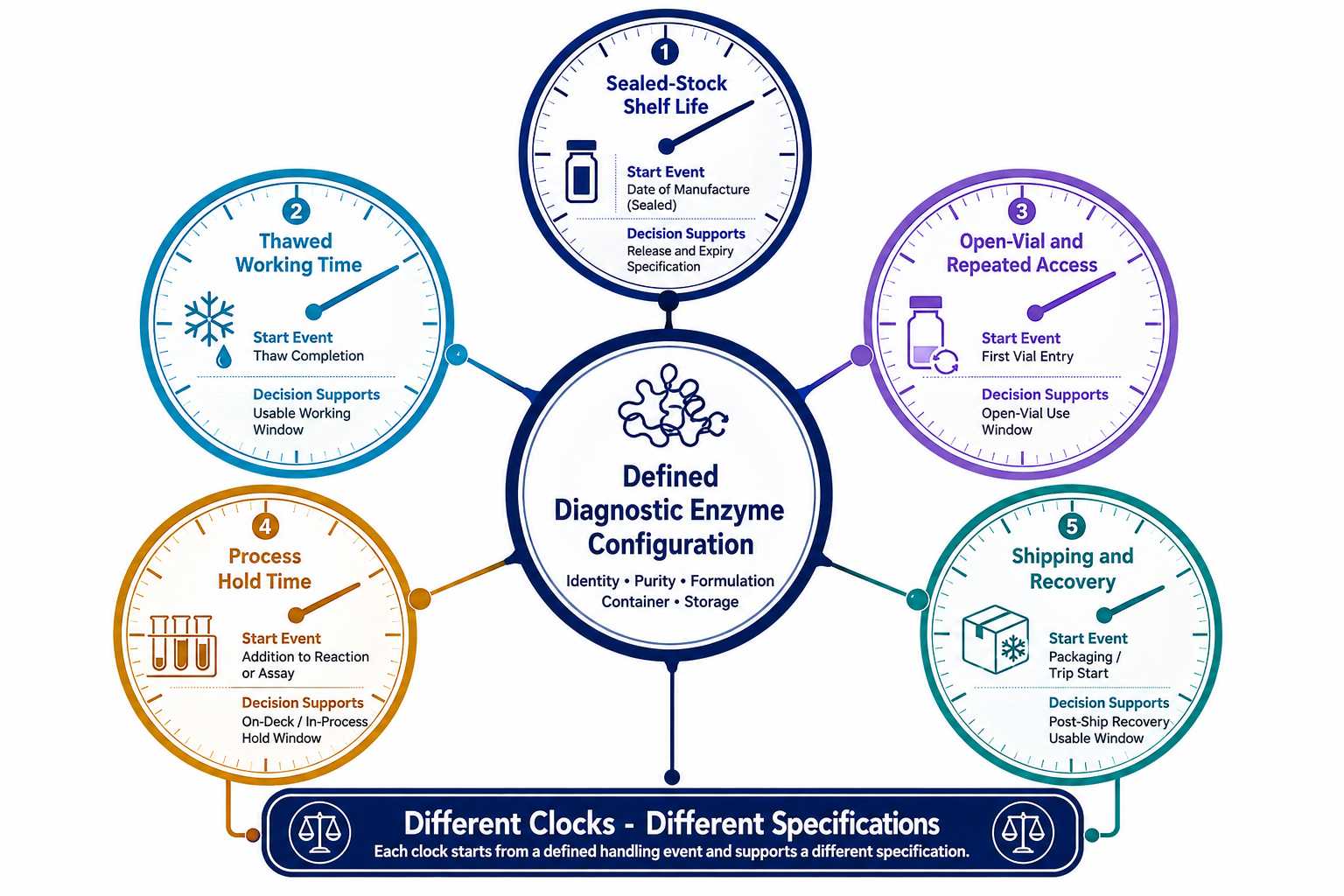 Fig 1. Multiple stability clocks for a diagnostic enzyme raw material. Each clock starts from a defined handling event and supports a different specification.
(Creative Enzymes Diagnostic)
An expiration or shelf-life statement normally defines the period through which the material is expected to comply when stored as specified. A retest period can be used in some quality systems to identify when a material should be tested again before continued use, but it is not permission to extend use indefinitely. The appropriate terminology depends on the material role, sponsor procedures, applicable requirements, and the evidence. Our reports identify the decision being supported; the sponsor remains responsible for final labeling and quality-system implementation.
Protein stability responds to concentration, buffer composition, pH, ionic strength, cofactors, reducing or chelating agents, surfactants, preservatives, residual process components, container surface, headspace, fill volume, and physical state. A stability program cannot be transferred silently from one of these configurations to another. We document the configuration and identify which future changes require a risk assessment or bridging study.
The test article may change by phase. An early screen can use a development container to compare formulations; a later confirmation should use final-like material if the conclusion is meant to cover the production configuration. When a surrogate is necessary, we document the difference and the required bridge. The study clock should not begin until the intended configuration is sufficiently controlled to make the result interpretable.
Loss of activity is a symptom, not a complete mechanism. It can result from chemical modification at or near the active site, unfolding, aggregation, precipitation, adsorption, cofactor loss, oxidation, proteolysis, fragmentation, microbial contamination, or an analytical artifact. Conversely, an enzyme can retain apparent activity in a permissive assay while developing particles, altered kinetics, or reduced performance in the customer's reaction system. We design a degradation-signature network that connects plausible mechanisms to observable signals and follow-up measurements.
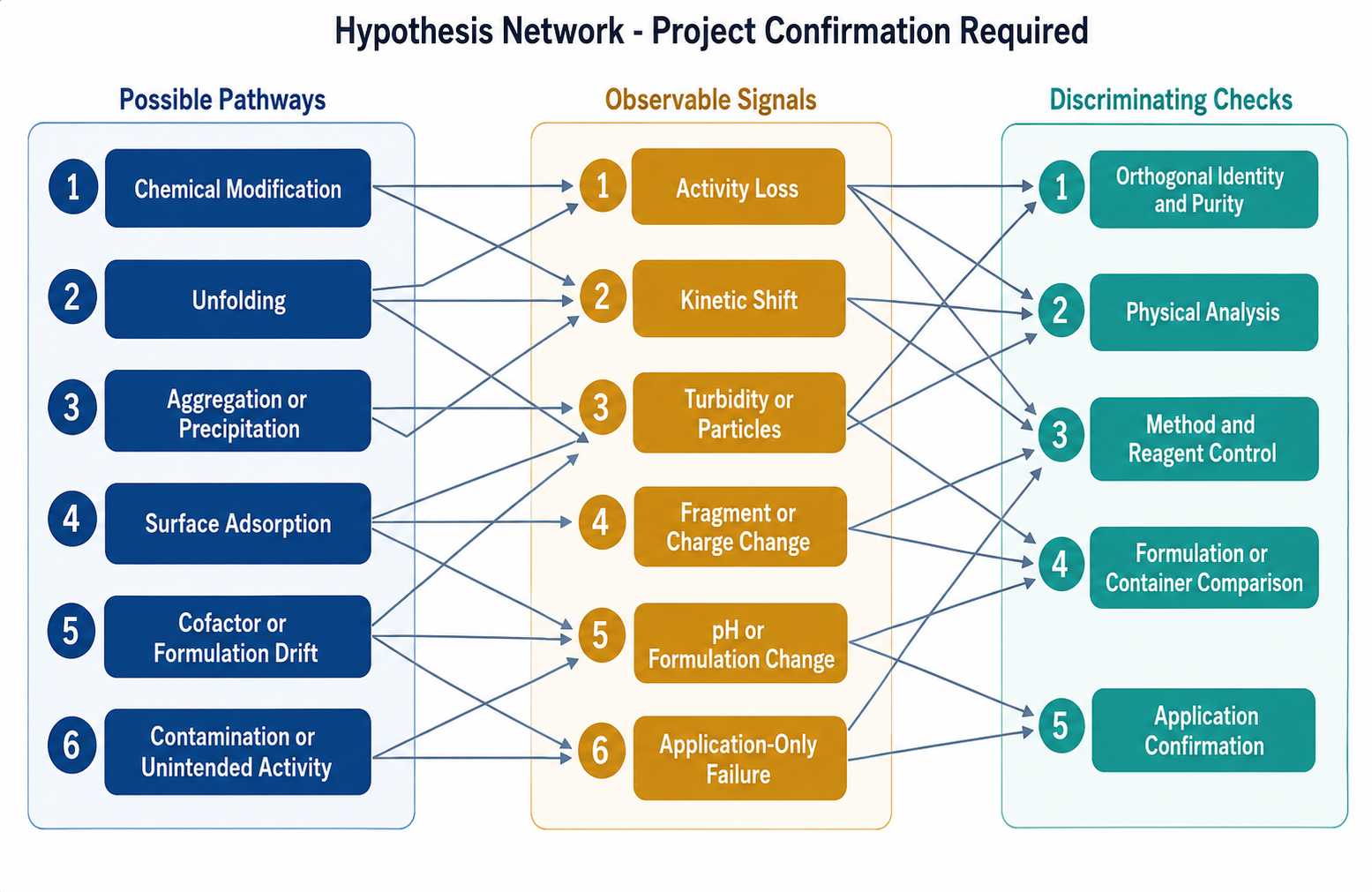 Fig 2. Diagnostic enzyme degradation-signature network. Observable signals are used to select follow-up tests rather than assign a mechanism by assumption.
(Creative Enzymes Diagnostic)
For a diagnostic enzyme, biological or catalytic function is usually central because the customer uses the enzyme to perform a reaction. The function method must have adequate precision, range, controls, and sensitivity to the drift that matters. It should define the substrate, concentration regime, cofactors, reaction time, temperature, calculation, reference, and unit assignment. A method designed only to confirm strong fresh activity may be unsuitable for detecting gradual aging.
Orthogonal tests are added when they explain a risk, protect against a blind spot, or support a specification. We do not default every program to a maximal analytical package. The sentinel panel is selected from the enzyme's degradation hypothesis, product state, use burden, available sample, and maturity.
Residual activity, reaction rate, kinetic response, product formation, substrate conversion, or application-specific functional output compared with a defined reference and acceptance rule.
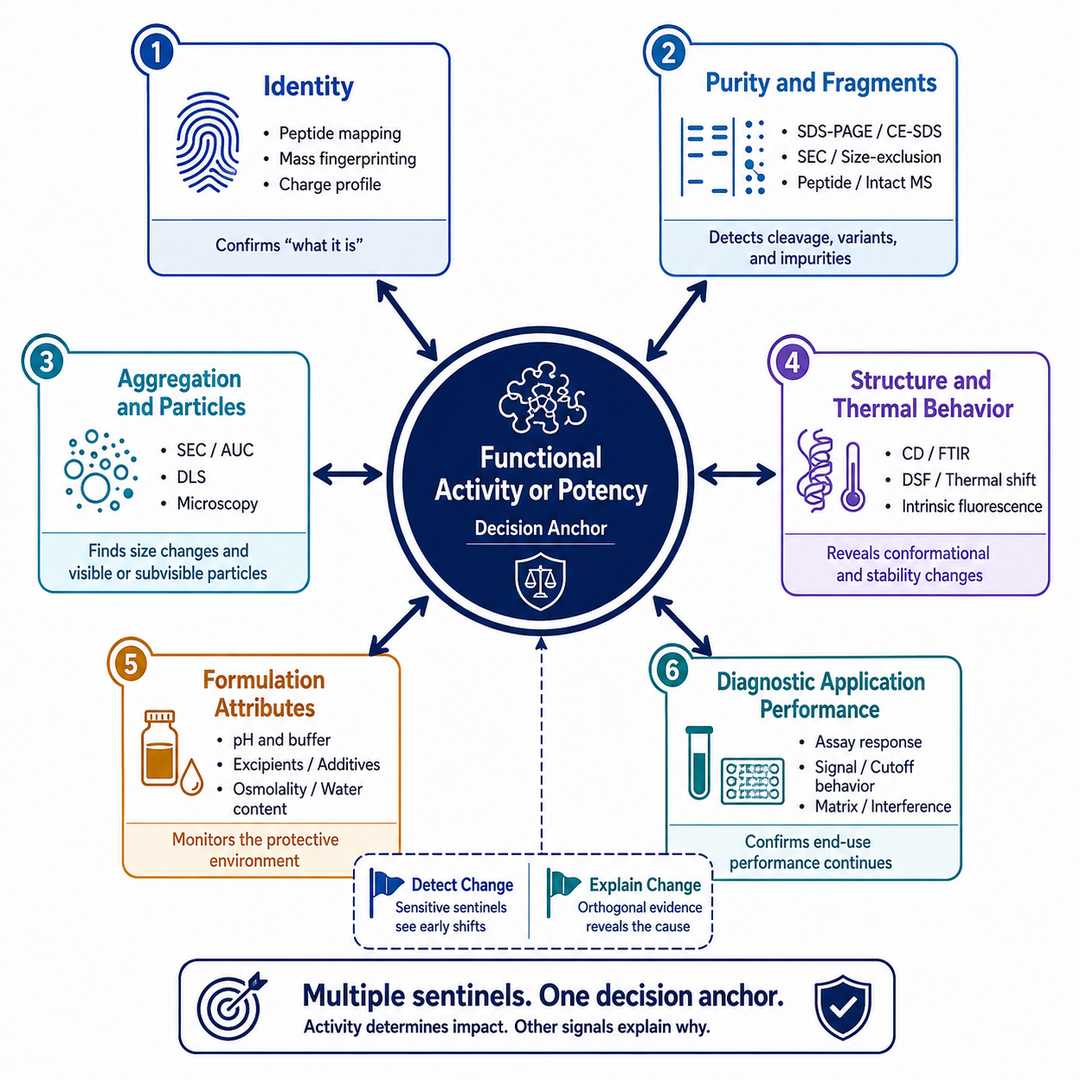 Fig 3. Stability-indicating analytical sentinel panel. Activity is the decision anchor, while orthogonal methods identify changes that activity alone can miss or misattribute.
(Creative Enzymes Diagnostic)
We review whether expected stability drift is distinguishable from analytical variation. The evaluation can include sample preparation, dilution effects, reference behavior, reagent stability, specificity, precision, range, robustness, and analyst or run effects as appropriate. If the method itself is unstable, a time trend may be an artifact. When a customer-specific procedure needs development or qualification, the program can link to our Custom Analytical Method Development and Qualification service.
Baseline characterization is tied to Enzyme Activity and Kinetic Characterization rather than repeated as a separate promise here. Purity and impurity endpoints can be coordinated with Diagnostic Enzyme Purity Analysis and Residual Host Cell Protein, DNA and Endotoxin Testing Support where those attributes are relevant to the stability question.
A useful protocol works backward from the proposed decision. The study matrix identifies the test article, lots, reference, storage and handling arms, pull points, replicate allocation, analytical batch controls, allowable drift, statistical approach, deviations, sample reserve, and decision gates. Study size is not copied from a generic schedule; it is proportional to the claim, variability, method, product maturity, and applicable quality framework.
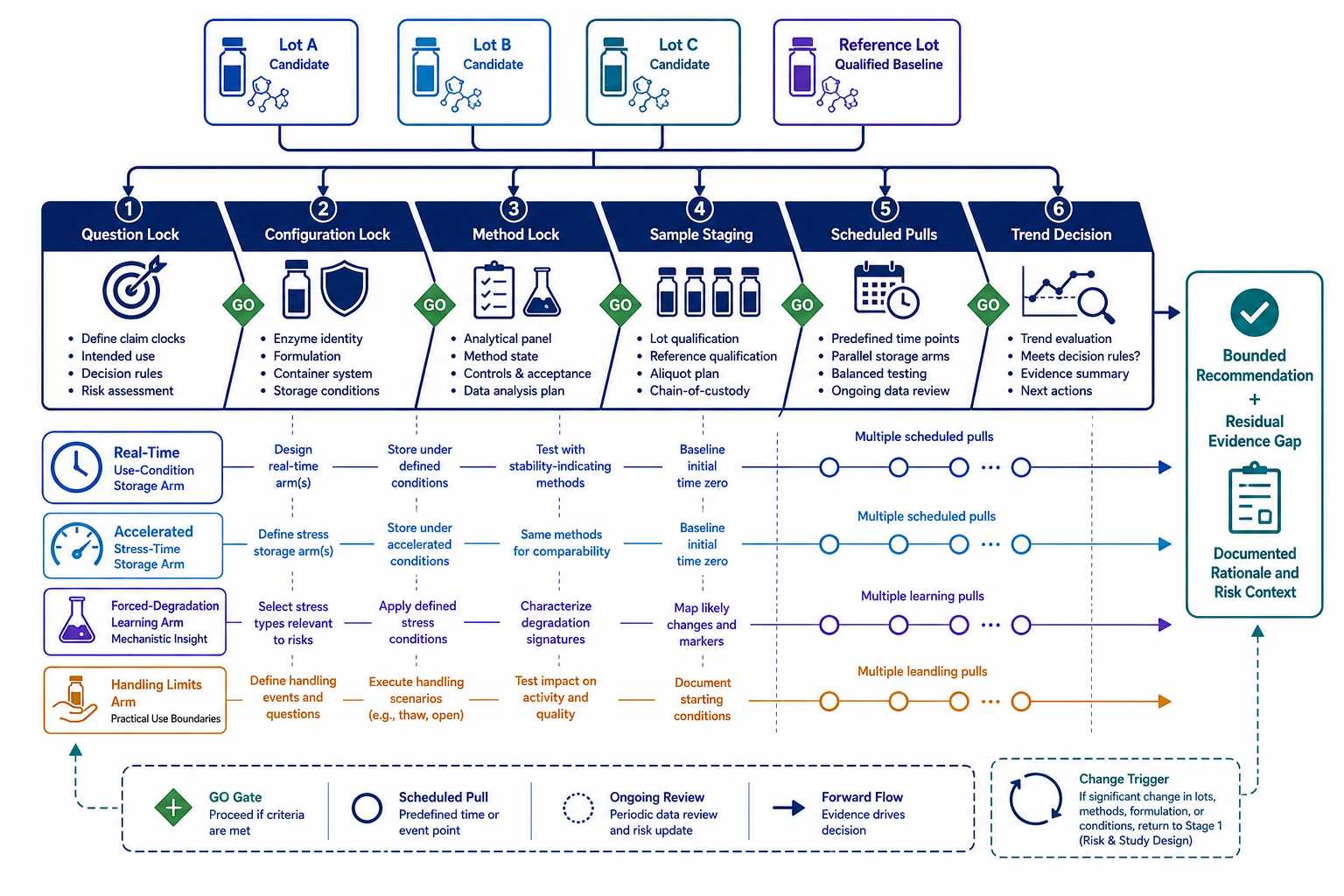 Fig 4. Claim-bounded stability study runway. Lots, references, storage arms, pulls and decision rules are allocated before the study clock begins.
(Creative Enzymes Diagnostic)
| Study factor | Question answered | Design concern | Interpretation boundary |
|---|---|---|---|
| Lots and production history | Does observed drift represent one lot or a reproducible material behavior? | Lot selection should reflect the intended conclusion and development phase. | A single lot may support feasibility but cannot automatically characterize future-lot variability. |
| Reference and baseline | What state defines initial performance and how is long-term analytical continuity maintained? | Reference material and reagents can age; baseline timing and bridging must be controlled. | Changing the reference can create an apparent trend unrelated to the test article. |
| Storage condition | What temperature, light, humidity, orientation, and package state are being supported? | The condition must match the material state and intended claim, including plausible variability. | A constant chamber condition does not automatically cover shipping or repeated access. |
| Timepoints and reserve | Can the design detect the shape of drift and evaluate the intended decision time? | Timepoints should support the model and include enough material for investigation or repeat testing. | A sparse design can miss nonlinearity or make an endpoint estimate unstable. |
| Replicates and analytical runs | How much of the observed variability is analytical versus material-related? | Replicates, days, analysts, plates, and runs answer different variance questions. | Technical replication does not replace independent lots or stability units. |
| Container and fill | Does the conclusion apply to the final or representative primary container? | Surface area, headspace, evaporation, orientation, and closure can change behavior. | A bulk container result cannot silently transfer to a low-fill working vial. |
| Handling history | Does thawing, access, mixing, dilution, vibration, or bench exposure create a separate limit? | Sequence and cumulative history should be defined, not described only as “cycles.” | Passing a long-term sealed condition does not establish in-use handling stability. |
CLSI EP25 is directly focused on IVD reagent stability and notes that its principles can be adapted to components, although raw materials are not explicitly covered. ISO 23640 addresses IVD reagent stability, and ISO is currently developing a second edition. ICH Q5C and ICH Q2(R2) provide useful concepts for biological-product stability profiles and analytical-method fitness, but their pharmaceutical scope is not presented as a blanket requirement for diagnostic enzyme raw materials. The applicable framework is selected with the sponsor based on intended use, jurisdiction, development phase, and quality system.
A timepoint can remain within specification while showing a drift pattern that reduces confidence in the proposed interval. Conversely, one atypical result can arise from sample handling or analytical variation rather than material failure. We preserve individual results, control behavior, deviations, repeats, and investigations so that the decision can be reconstructed.
The allowable drift limit should connect to intended enzyme performance, method capability, variability, and downstream risk. A nonsignificant regression slope is not proof that the enzyme is stable; an underpowered study may simply be unable to detect change. Where regression or kinetic models are used, we evaluate fit, residuals, attribute behavior, lot effects, poolability where relevant, and whether the proposed endpoint stays within the predefined boundary. Extrapolation beyond real-time data is identified explicitly and is not assumed to be valid when degradation pathways change.
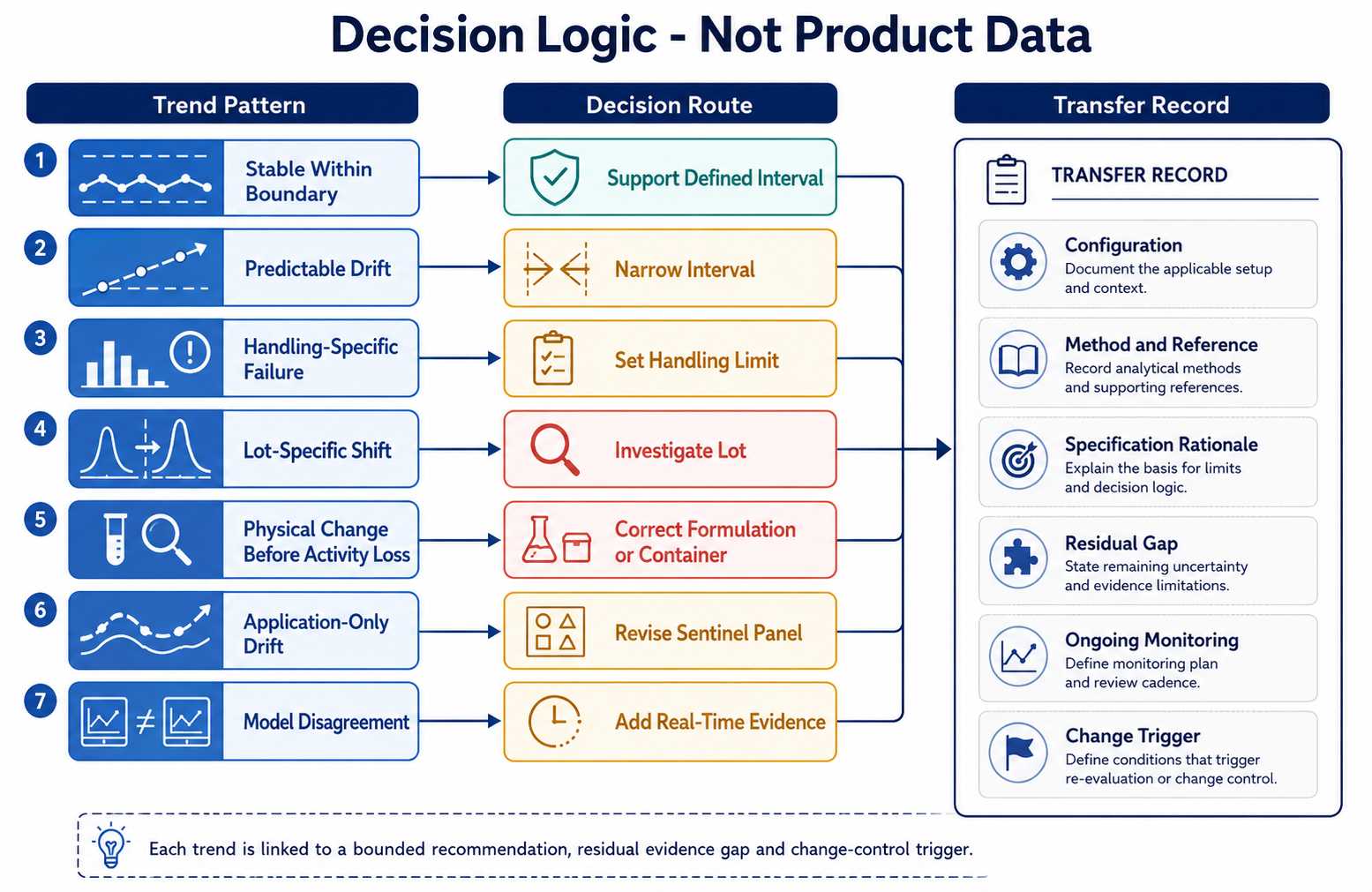 Fig 5. Stability decision and transfer record. Each trend is linked to a bounded recommendation, residual evidence gap and change-control trigger.
(Creative Enzymes Diagnostic)
A stability recommendation can be affected by changes in enzyme sequence or source, expression host, purification, impurity profile, concentration, formulation raw-material grade, preservative, container resin, closure, fill volume, drying cycle, package, storage equipment, shipping lane, test method, or reference lot. The transfer record identifies which changes are unlikely to affect the conclusion, which require documented risk assessment, and which may need analytical or stability bridging. The sponsor determines the final change-control path within its quality system.
The service can begin with a failing material, an early development candidate, a nearly final raw material, or an existing commercial-supply question. We use phase-appropriate gates so that a long confirmation program does not start before the material, method, and decision are sufficiently defined.
Stability testing can identify that the current formulation, container, or handling scheme lacks margin. Corrective work can be routed to Excipient, Buffer and Stabilizer Screening, Lyophilized Enzyme Formulation Development, or Freeze-Thaw and Shipping Stress Testing. When the objective is a finished diagnostic reagent rather than the enzyme component, the appropriate page is Ambient-Temperature Stability and Shelf-Life Study or Accelerated and Real-Time Stability Testing for Diagnostic Reagents. Route and infrastructure decisions can connect to Cold-Chain Reduction Strategy for POCT Reagents.
Missing information can be converted into a preliminary characterization or method-development phase rather than filled with assumptions.
The final release package can be coordinated with COA Specification and Release Testing Package Development. Application discrepancies can be investigated through Assay Interference and Matrix Effect Evaluation. Study outputs are development and analytical records; the customer approves the final specification and its use within the applicable quality system.
Activity and kinetic characterization establish how an enzyme performs under defined analytical conditions at a given state. Stability testing asks how that performance and other relevant attributes change with time, storage, handling, and configuration. A fit-for-purpose activity method is usually an input to the stability program, not the entire program.
The enzyme study applies to the defined component configuration. A finished reagent adds other enzymes, primers, substrates, antibodies, dyes, salts, packaging, device materials, sample matrices, and workflow effects. Component stability is useful development and supplier-control evidence, but the finished reagent needs its own configuration-specific study.
Not automatically. Accelerated conditions can rank candidates, reveal vulnerable attributes, and support a model when the mechanism and model assumptions are defensible. Proteins and enzymes can show nonlinear or non-Arrhenius behavior, and elevated temperatures can trigger pathways that do not dominate in real-time storage. The use of extrapolation is explicitly justified and bounded.
It may be the central acceptance attribute, but it can miss aggregation, particles, chemical change, altered kinetics, formulation drift, or application failure. The sentinel panel is risk based: orthogonal methods are included when they detect a meaningful blind spot or explain a change.
There is no universal number on this page. The design depends on the proposed conclusion, development phase, applicable framework, expected variability and drift, method precision, storage interval, time-course model, material availability, and whether the study is feasibility or confirmatory. We document the rationale before execution.
Yes, when that is the defined decision. The protocol specifies what starts the clock, container and concentration, access frequency, mixing, cumulative and continuous exposure, storage between uses, contamination controls, and the functional/orthogonal endpoints. The result should not be generalized to a different vial, dilution, or access pattern without assessment.
The first phase can assess method fitness and develop or qualify a revised procedure. The study should not proceed to an expensive long-term phase if analytical variability or reagent instability prevents meaningful trend detection. Orthogonal methods or an application assay may be added to clarify the decision.
The result is reviewed with controls, sample history, analytical run, deviations, other attributes, prior trends, and retained/reserve samples. A repeat or investigation must be scientifically justified and documented; it should not be used simply to replace an inconvenient result. The final report preserves the original observation and its disposition.
Potentially, within the sponsor's quality system and applicable requirements, if the configuration remains representative and the new data support the extension. The decision should consider lots, methods, change history, trends, deviations, and whether the original model or assumptions remain valid. Creative Enzymes can provide the analytical evidence and recommendation; the sponsor approves the extension.
Yes, subject to feasibility, composition disclosure sufficient for safe and interpretable work, and agreed controls. We can compare the enzyme stock, customer buffer, working dilution, or final-like reaction to separate intrinsic enzyme change from formulation or application interference.
No. We generate a traceable study and bounded technical conclusion within the agreed scope. Shelf-life duration depends on the data, and regulatory or quality acceptance depends on the product, intended use, jurisdiction, sponsor documentation, and final-device evidence.
This service sits within Diagnostic Enzyme QC, QA and Analytical Characterization. Direct sibling and supporting pages include:
Send the current enzyme configuration, storage instruction, intended diagnostic use, available analytical methods, existing stability data, and the decision you need to make. Creative Enzymes can convert that material history into a phased, claim-bounded protocol and a transfer-ready evidence package.
Discuss Your Diagnostic Enzyme Stability Program