Background
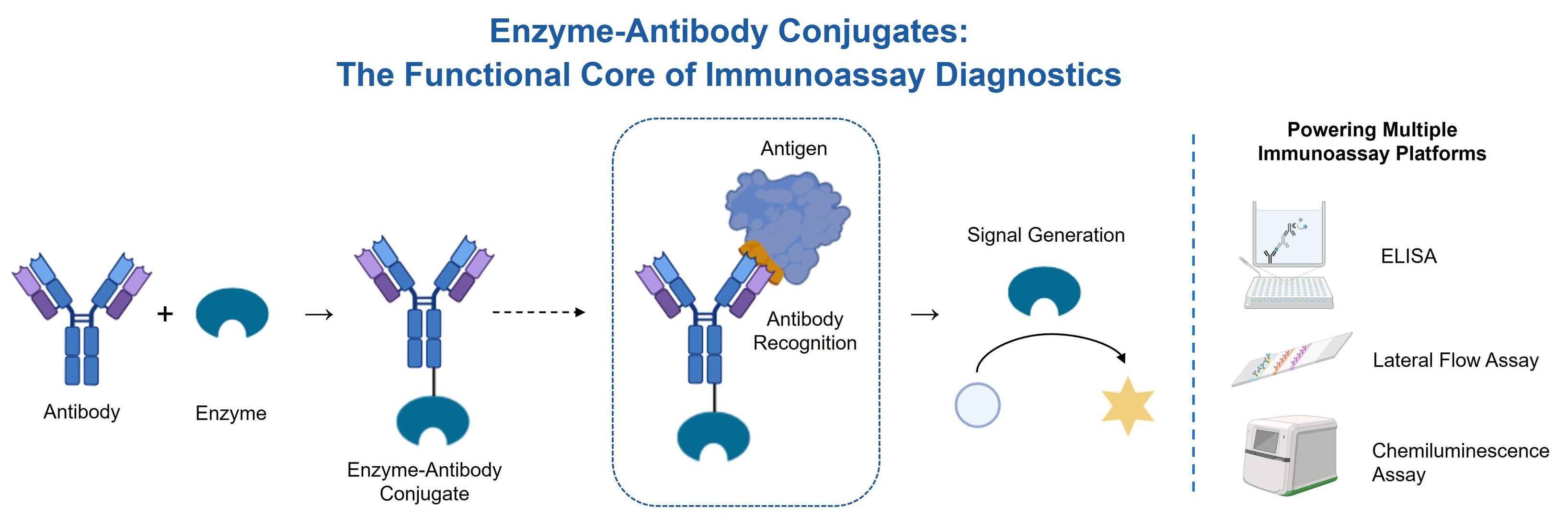
Enzyme-antibody conjugates are the functional core of modern immunoassay diagnostics, serving as the molecular bridge that translates antigen recognition into quantifiable signal. The performance of an ELISA, lateral flow assay, or chemiluminescence platform depends not merely on the coupling reaction itself, but on a systematic development process spanning strategic enzyme and antibody selection, rational linker design, controlled conjugation chemistry, rigorous optimization of labeling stoichiometry, and comprehensive analytical characterization. A suboptimal conjugate—whether through excessive labeling, aggregation, or compromised binding affinity—can degrade assay sensitivity, inflate background, and introduce lot-to-lot variability that undermines diagnostic reliability. Creative Enzymes Diagnostic provides end-to-end Enzyme-Antibody Conjugate Development and Optimization, guiding each project from initial design through validated, manufacturing-ready reagents.
Conjugate Design
Successful conjugate development begins upstream of the chemical reaction. We evaluate the intended assay format, detection platform, analyte properties, and regulatory requirements to architect a conjugate with the optimal enzyme, antibody format, linker chemistry, and labeling strategy.
Enzyme Selection
- HRP selected for rapid, high-turnover applications requiring chromogenic or chemiluminescent readouts; ideal for ELISA, Western blot, and IHC where small conjugate size (~44 kDa enzyme) minimizes steric interference and broad substrate compatibility supports multiplex instrument platforms → HRP Conjugation Service for Immunoassays
- AP chosen for assays demanding extended signal accumulation, broad dynamic range, or low endogenous background; preferred for quantitative ELISA, CLIA, and applications in sample matrices rich in peroxidase activity (hemolysed blood, plant extracts) → Alkaline Phosphatase (AP) Conjugation Service
- Specialty reporters (β-galactosidase, urease, oxidases) deployed for ultra-sensitive fluorescence detection, electrochemical biosensors, or coupled amplification cascades where standard enzymes fail to meet sensitivity or instrumentation constraints → β-Galactosidase, Urease and Oxidase Labeling Services
- Enzyme source (plant, microbial, recombinant) and glycosylation profile evaluated for immunogenicity risk in therapeutic diagnostic applications and for compatibility with the intended conjugation chemistry
Antibody Selection
- Whole IgG (150 kDa) as the default format for sandwich and indirect ELISA, offering bivalent binding, Fc-mediated effector functions, and robust conjugation handles via surface lysines and hinge thiols; species (mouse, rabbit, goat, human) matched to assay specificity and secondary reagent availability
- Fab and F(ab')2 fragments selected when Fc-mediated interference (rheumatoid factor, heterophilic antibodies, Fc receptors) compromises assay accuracy; smaller size reduces steric hindrance in densely packed antigen arrays and improves tissue penetration in IHC
- Recombinant formats (scFv, nanobodies, diabodies) engineered with C-terminal cysteines, sortase tags, or unnatural amino acids to enable precise, site-specific enzyme attachment with defined 1:1 stoichiometry and preserved paratope integrity
- Antibody affinity (KD), epitope accessibility, and susceptibility to chemical modification assessed by SPR or BLI prior to conjugation to flag clones that may lose binding activity upon surface residue modification
Linker Selection
- Zero-length cross-linkers (EDC/NHS, glutaraldehyde) for direct enzyme-antibody contact, minimizing hydrodynamic radius and maximizing signal proximity to the binding event; suitable when the antigen epitope is surface-exposed and the antibody CDRs are distal from the conjugation site
- Flexible linkers (PEG4-PEG12, Sulfo-SMCC, GMBS with alkyl spacer arms) that decouple the enzyme from the antibody binding domain, reducing steric clash and allowing independent orientation of both moieties; spacer length optimized (typically 1.5–5 nm) to balance flexibility against increased conjugate size
- Rigid linkers (α-helical peptide spacers, proline-rich sequences, aromatic stacking domains) that maintain a fixed enzyme-antibody geometry, preventing intramolecular folding that can bury the active site or paratope; preferred for crystallography, biosensor surface immobilization, and assays requiring precise inter-molecular distance control
- Cleavable linkers (disulfide, hydrazone, enzyme-cleavable peptide) evaluated for applications requiring triggered release of the reporter enzyme after target binding, such as in vivo imaging probes or controlled-release diagnostic sensors
Labeling Chemistry
- Random labeling via primary amines (lysine ε-NH2, N-terminus) or carboxyls (aspartate/glutamate) using NHS-esters, EDC chemistry, or glutaraldehyde; cost-effective and broadly applicable, but yields heterogeneous product distributions requiring rigorous purification and characterization
- Thiol-directed coupling through hinge-region cysteines (reduced disulfides) or introduced sulfhydryl groups (SATA, Traut's reagent), enabling controlled stoichiometry and directional attachment; particularly effective for Fab' fragments and engineered cysteine antibodies
- Glycan-directed conjugation exploiting Fc N-linked glycosylation sites modified by mild periodate oxidation to generate aldehydes for reductive amination; directs labeling away from CDRs, preserving antigen-binding affinity while leveraging a conserved, predictable modification site across IgG subclasses
- Site-specific bioorthogonal ligation (click chemistry, sortase-mediated ligation, transglutaminase labeling, enzymatic biotinylation-streptavidin bridging) for production of homogeneous conjugates with exact 1:1 enzyme-to-antibody ratios, essential for quantitative assays, reference standards, and regulatory-grade diagnostic reagents
Conjugate Optimization
Following initial conjugation, every batch undergoes iterative optimization to maximize functional performance. We do not treat conjugation as a single reaction but as an engineering problem requiring tuning of labeling density, activity preservation, steric geometry, and colloidal stability.
Degree of Labeling (DOL)
- Systematic screening of enzyme-to-antibody molar ratios (typically 1:1 to 8:1 for random coupling) to identify the DOL that maximizes signal output per conjugate molecule without inducing aggregation or antibody cross-linking
- Analytical fractionation by SEC to isolate populations with discrete DOL values (1:1, 2:1, 3:1); each fraction tested in the target assay to empirically determine the optimal stoichiometry rather than relying on theoretical predictions
- Site-specific conjugates manufactured at exact 1:1 DOL with mass spec confirmation, eliminating the need for DOL optimization while delivering batch-to-batch consistency with CV
Activity Retention
- Post-conjugation enzyme activity quantified against unconjugated enzyme reference standards using substrate-specific kinetic assays (TMB/ABTS for HRP, pNPP for AP, MUG for β-Gal); target >85% retention of specific activity
- Antigen-binding affinity validated by SPR, BLI, or direct ELISA titration to detect KD shifts or EC50 drift caused by CDR-proximal modification; conjugates with >20% binding loss are rejected or reformulated with alternative chemistry
- Functional assay performance (signal-to-background, LOD, dynamic range) measured in the client's intended assay architecture to confirm that individual component activities translate into integrated assay superiority
Steric Hindrance Reduction
- Computational modeling (molecular dynamics, rigid-body docking) of enzyme-antibody conjugate geometry to identify orientations where the enzyme occludes the antigen-binding cleft or interferes with epitope accessibility
- Experimental validation by comparing binding kinetics (kon, koff) of conjugated versus unconjugated antibody; significant decreases in kon indicate steric blockage requiring linker lengthening or relocation of the conjugation site to the Fc distal from CDRs
- Alternative antibody formats (Fab', scFv, nanobody) or site-specific Fc labeling evaluated when random conjugation consistently compromises binding, particularly for antibodies targeting recessed or conformational epitopes
Aggregation Control
- Dynamic light scattering (DLS) and analytical ultracentrifugation (AUC) to quantify monodispersity; acceptance criteria typically require PDI 90% monomeric species by SEC-HPLC
- Optimization of cross-linker concentration, reaction time, and protein concentration to minimize intermolecular cross-linking; dilute conjugation conditions (0.5–2 mg/mL) often preferred over high-concentration reactions that promote aggregation
- Formulation screening with stabilizers (BSA, trehalose, glycerol, polysorbate-20) and pH adjustment to maintain colloidal stability during purification, storage, and freeze-thaw cycles
Characterization
Comprehensive analytical characterization is mandatory for conjugate release and regulatory qualification. We apply a multi-modal analytical package that verifies molecular integrity, purity, functional activity, and stability.
SDS-PAGE
- Reducing and non-reducing SDS-PAGE with Coomassie staining to visualize conjugate bands, free enzyme, free antibody, and high-molecular-weight aggregates; band pattern compared against theoretical molecular weights to confirm successful cross-linking
- Dual-stain protocols (Coomassie plus enzyme-specific substrate staining, e.g., TMB for HRP or pNPP for AP) to identify which bands contain active enzyme, distinguishing functional conjugates from denatured aggregates
- Densitometric quantification of band intensities to estimate relative proportions of conjugated species, unconjugated starting materials, and degradation products
SEC (Size-Exclusion Chromatography)
- Analytical SEC-HPLC with UV detection at 280 nm (protein) and enzyme-specific wavelengths (403 nm for HRP Soret band, 405 nm for AP) to resolve monomeric conjugate, free enzyme, free antibody, and aggregate populations
- Quantification of purity as percentage of integrated peak area corresponding to the target conjugate species; release criterion typically ≥95% monomeric conjugate for diagnostic-grade reagents
- Multi-angle light scattering (MALS) inline with SEC for absolute molecular weight determination, confirming that the observed elution volume corresponds to the expected conjugate mass rather than anomalous column interactions
Activity Assay
- Enzyme activity measured by initial-rate kinetics with appropriate substrate (TMB, ABTS, pNPP, MUG, chemiluminescent substrates) to determine specific activity (U/mg) and compare against unconjugated enzyme reference
- Binding activity determined by direct ELISA against immobilized antigen, measuring EC50 and maximum signal (Amax) to confirm that conjugation has not compromised antibody affinity or antigen recognition
- Integrated functional assay in the client's target format (sandwich ELISA, competitive ELISA, lateral flow, CLIA) to validate that the conjugate performs as required in the complete assay system, not just in isolated component tests
Stability Study
- Accelerated degradation at elevated temperatures (37°C, 45°C, 55°C) with periodic sampling for activity, binding, and aggregation; Arrhenius modeling applied to predict real-time shelf-life at intended storage temperatures (4°C, −20°C, or ambient for lyophilized products)
- Freeze-thaw stress testing (10 cycles, −80°C to 25°C) to identify formulations susceptible to ice-crystal damage, with evaluation of cryoprotectant addition (glycerol, trehalose) to mitigate activity loss
- Real-time stability monitoring under recommended storage conditions with predefined pull points (1, 3, 6, 12, 24 months) for comprehensive Certificate of Analysis (CoA) documentation and regulatory submission support
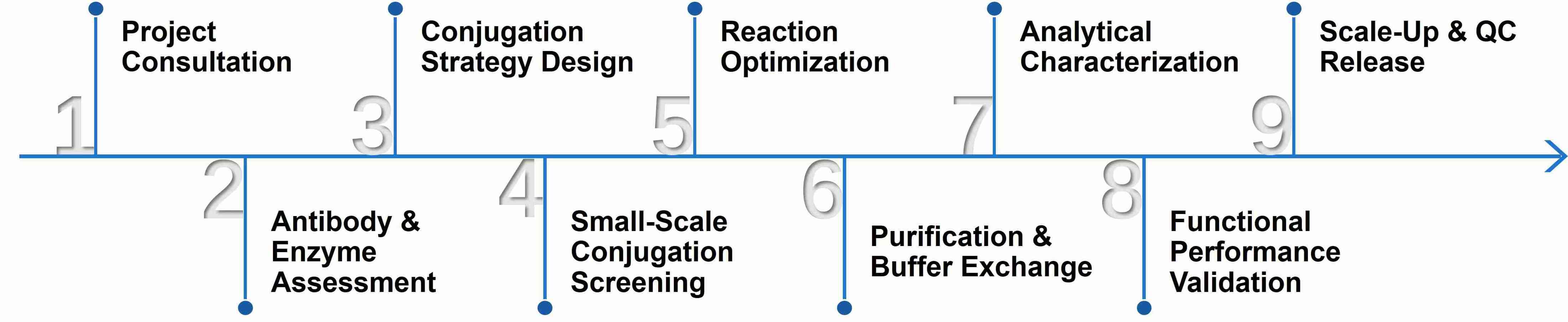
Integrated workflow
Applications
Our optimized enzyme-antibody conjugates are deployed across the full spectrum of diagnostic and research immunoassay platforms, with each conjugate tailored to the performance demands of its intended application.
- Diagnostic Kits: Manufacturing of conjugates as critical raw materials for commercial IVD kits, including infectious disease serology panels (HIV, hepatitis, COVID-19), cardiac marker assays (troponin, BNP), and thyroid function tests. Conjugates delivered with full CoA, stability data, and traceability documentation compliant with ISO 13485 and FDA 510(k) requirements.
- ELISA: Custom conjugates for sandwich, competitive, indirect, and capture ELISA formats in 96-well and 384-well microplates. Optimized for high signal-to-background ratios, broad dynamic ranges, and compatibility with automated liquid handlers and plate readers. Special formulations available for high-dose hook effect mitigation and heterophilic antibody interference reduction.
- Rapid Tests: Conjugates engineered for lateral flow immunoassay (LFIA) and vertical flow platforms, with optimized colloidal gold, latex bead, or fluorescent nanoparticle coupling. Formulated for dry-down on conjugate pads with rapid reconstitution in running buffer, extended shelf-life in desiccated pouches, and strong line intensity at low analyte concentrations for point-of-care and home testing applications.
FAQs
Q1. How do you determine the optimal enzyme-to-antibody ratio for my assay?
A1. We perform a systematic DOL titration, conjugating at molar ratios ranging from 1:1 to 8:1 (enzyme:antibody) and fractionating the products by SEC. Each fraction is tested for enzyme activity, antigen-binding affinity, and performance in your target assay format. The DOL that delivers the highest signal-to-background ratio with minimal aggregation is selected as the optimum. For site-specific conjugates, the ratio is fixed at 1:1 by design.
Q2. Will conjugation reduce my antibody's binding affinity?
A2. Some affinity loss can occur if the conjugation chemistry modifies residues within or near the complementarity-determining regions (CDRs). We mitigate this risk through glycan-directed Fc labeling, site-specific engineering, and computational modeling to avoid CDR-proximal modifications. In practice, our optimized conjugates retain >90% of native binding affinity. If a particular antibody clone is sensitive to modification, we will recommend alternative formats (Fab', scFv) or linker strategies.
Q3. What is the difference between random and site-specific conjugation, and which should I choose?
A3. Random conjugation labels surface lysines or thiols statistically across the antibody, producing a heterogeneous mixture of species with varying DOL and orientation. It is cost-effective and suitable for most research and screening applications. Site-specific conjugation attaches the enzyme at a single, predefined location (e.g., Fc glycan, engineered cysteine, C-terminal tag), yielding a homogeneous 1:1 product with consistent batch-to-batch performance. Choose site-specific conjugation for quantitative diagnostics, reference standards, and regulated IVD manufacturing where reproducibility is critical.
Q4. How do you control aggregation during conjugation?
A4. Aggregation is controlled through three levers: (1) reaction conditions—low protein concentration (0.5–2 mg/mL), controlled pH, and optimized cross-linker-to-protein ratios minimize intermolecular cross-linking; (2) purification—SEC removes aggregates and free components immediately post-reaction; (3) formulation—stabilizers (BSA, trehalose, polysorbate-20) and optimal pH/ionic strength maintain monodispersity during storage. Batches exceeding PDI > 0.15 or aggregate content > 5% are rejected.
Q5. Can you develop conjugates for lateral flow rapid tests?
A5. Yes. We specialize in conjugates for lateral flow immunoassays, including enzyme-labeled antibodies for colorimetric or chemiluminescent readouts, as well as enzyme-nanoparticle hybrids. We optimize conjugates for dry-down stability on conjugate pads, rapid rehydration in assay buffer, and strong visual signal intensity within the 5–15 minute test window. Lyophilization and stabilizer formulations are validated for ambient-temperature shelf-life claims.
Q6. What analytical data do you provide with each conjugate batch?
A6. Every batch is released with a comprehensive Certificate of Analysis (CoA) that includes: (1) SDS-PAGE images (reducing and non-reducing); (2) SEC-HPLC chromatogram with purity percentage; (3) enzyme specific activity (U/mg); (4) antigen-binding EC50 or KD; (5) degree of labeling (DOL); (6) endotoxin level; (7) stability data (accelerated and/or real-time as applicable). Additional custom assays (SPR kinetics, mass spectrometry, functional ELISA validation) are available upon request.
Creative Enzymes Diagnostic treats enzyme-antibody conjugate development as a disciplined engineering discipline, not merely a chemical reaction. From strategic design and rational linker selection to rigorous optimization and multi-modal characterization, our integrated service delivers conjugates that perform reliably at the bench and at scale. Whether you are developing a research tool, a commercial diagnostic kit, or a regulated IVD reagent, our team provides the technical depth and quality infrastructure to transform your antibody into a high-performance detection reagent.
Contact our business development team today to discuss your conjugate development requirements!
Related Services

