
Creative Enzymes helps diagnostic-reagent teams define, engineer, and evaluate alternative enzyme sources when supply continuity, manufacturing flexibility, cost structure, host selection, or product lifecycle needs make a second route necessary. We connect sequence and construct analysis with expression, purification, functional characterization, stability, impurity assessment, and application-level bridging. The objective is not to declare two materials universally identical. It is to determine whether a candidate is supported for one clearly defined use, under stated methods, criteria, and limitations.
A second-source program should begin by defining what must match for the intended diagnostic-reagent use, what may differ without affecting that use, what must not differ, and which unknowns require testing. The comparison then follows the risk created by the actual change. A synonymous coding sequence, a new tag, a different expression host, a revised purification route, a related homolog, and an engineered functional substitute are not the same change and should not receive the same evidence package.
Procurement may ask whether two enzymes are “the same,” while the development team actually needs a more precise answer. Does the candidate produce the same analyte conversion or amplification behavior under the intended reagent conditions? Does it maintain the required substrate or template discrimination? Is activity concentration normalized in a way that makes the comparison meaningful? Are new impurities introduced by the host or purification route? Does the candidate remain functional in the formulation, after the expected storage or shipping stress, and across representative lots? The useful question is not metaphysical identity; it is whether the evidence supports replacement in a defined system.
The name of an enzyme, an EC classification, a sequence-alignment percentage, a supplier unit, or one activity result in a permissive buffer can each be informative, but none is sufficient by itself. Unit definitions may use different substrates, pH values, temperatures, reaction times, or calculation rules. Sequence identity does not disclose construct boundaries, tags, post-translational processing, folding, aggregation, host-derived impurities, formulation, or storage history. Application behavior may also depend on interactions with salts, cofactors, primers, probes, antibodies, substrates, blockers, surfactants, matrices, instruments, and other enzymes.
A candidate can be supported for a specified use when predeclared evidence and decision rules are met.
A candidate may be usable with controls, formulation changes, loading adjustments, monitoring, or a limited operating range.
The work does not establish universal identity, biosimilarity, interchangeability, or equivalence in untested assays.
Patent, licensing, freedom-to-operate, ownership, and non-infringement questions require qualified legal review.
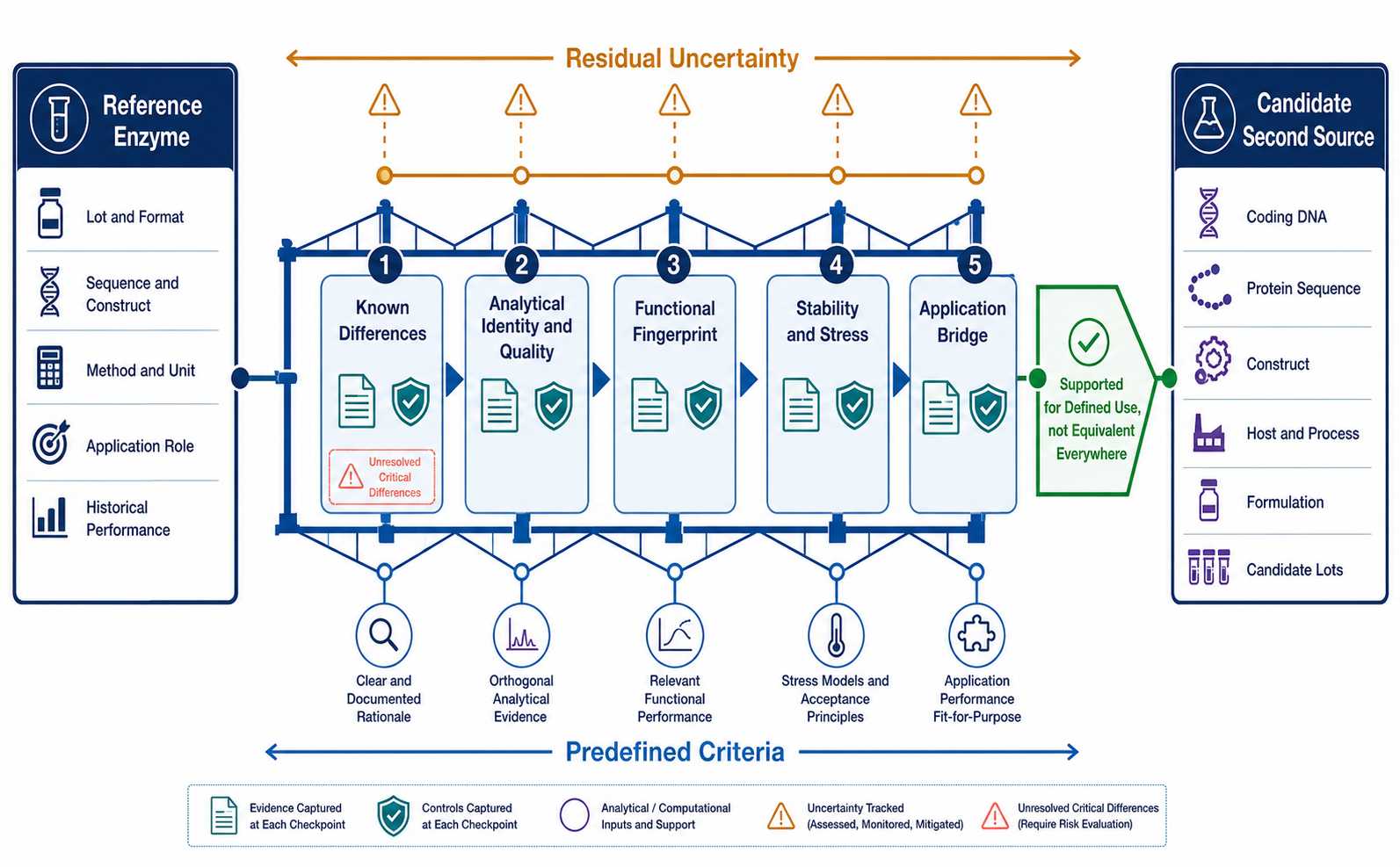 Fig. 1. Second-source engineering bridge. A defined reference and intended use are connected to the candidate through known-difference, analytical, functional, stability, application, and decision checkpoints.
(Creative Enzymes)
Creative Enzymes can configure the work as a design and evidence-planning package, a sequence-to-protein development program, a side-by-side comparability study, or an integrated engineering and application-bridging project. Feasibility depends on access to the reference material, rights to use supplied sequences or materials, the observability of relevant attributes, the intended assay, and the amount of uncertainty the project must resolve.
Two candidate materials can appear close at one level and be far apart at another. We use a difference hierarchy to prevent a narrow sequence comparison from masking construct, process, or application risks. The hierarchy is not a claim that every layer must always be matched. It is a way to identify which layers can plausibly change the properties that matter in the customer's system.
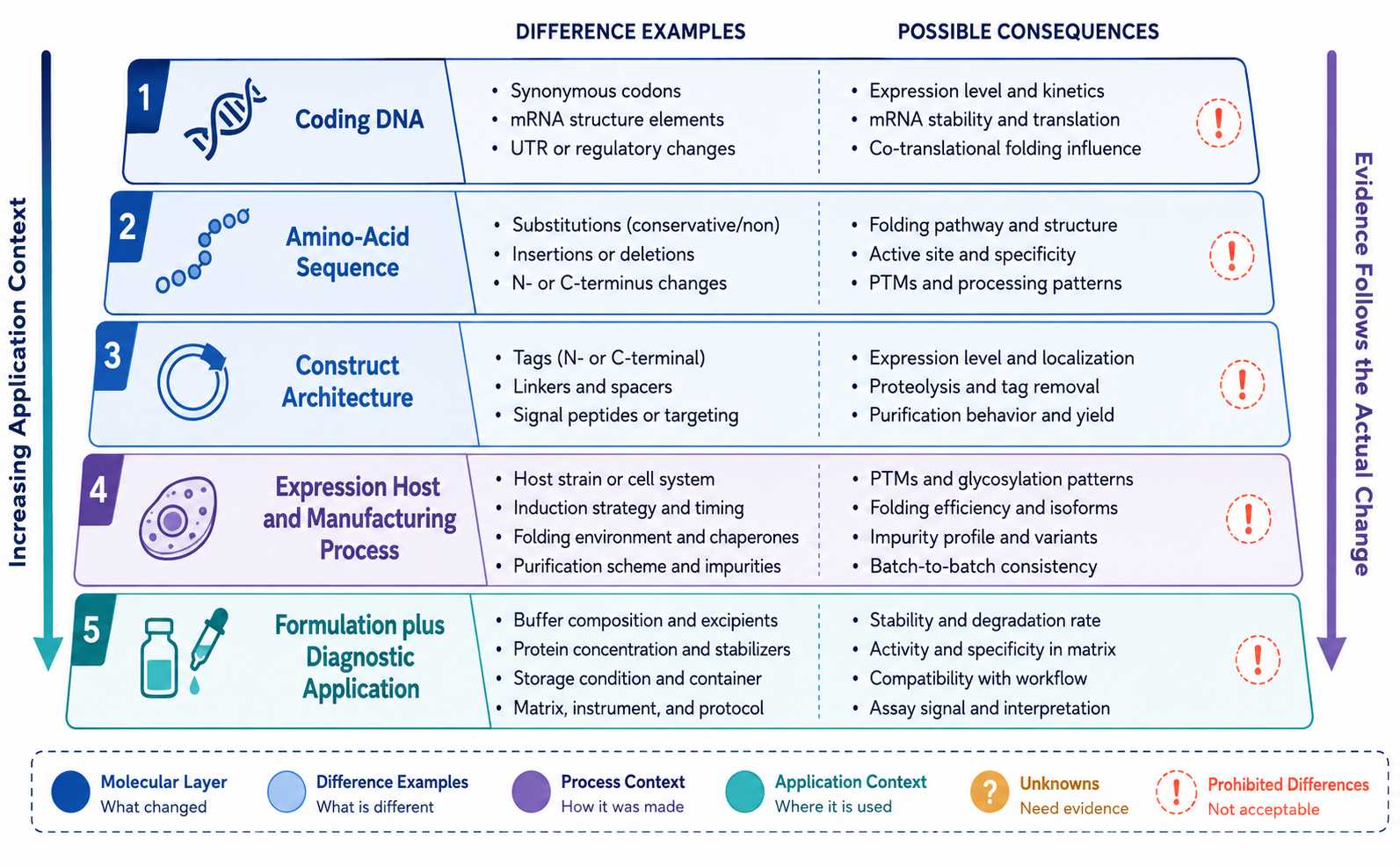 Fig. 2. Sequence-to-application difference hierarchy. Each layer can create a different comparability question, so the evidence plan follows the actual change rather than the enzyme name alone.
(Creative Enzymes)
Codon optimization or reverse translation can create many DNA sequences encoding the same amino-acid chain. These constructs are equivalent at the translated sequence level but not necessarily at the production level. Synonymous codons can affect mRNA structure, translation rate, ribosome pausing, expression, and soluble recovery. Published effects are system-specific; they do not mean that every synonymous change alters function. They do mean that a second-source plan should verify the expressed material rather than assume the coding choice is biologically silent.
Amino-acid identity does not guarantee the same conformational population, processing, modification, aggregation state, or impurity profile. Host choice is particularly important when disulfides, cofactors, cleavage, glycosylation, phosphorylation, or other modifications affect activity or stability. For many bacterial diagnostic enzymes, a bacterial host may be appropriate, but strain, expression rate, solubility, refolding, and purification can still change the test article. The comparison must focus on attributes relevant to that enzyme and use, not on an exhaustive list copied from a therapeutic protein.
A related natural homolog or engineered variant may meet the functional need even though it is not sequence-identical to the reference. In that case, “sequence equivalency” should not be used to imply identity. The project becomes functional-alternative engineering: preserve the required catalytic or binding role and application performance while accepting documented sequence differences. This route can be appropriate when the reference sequence is unavailable, difficult to express, constrained by the required production host, or incompatible with the intended formulation. The acceptance decision still belongs to the defined use and evidence package.
A comparability study becomes ambiguous when the team does not agree on which differences are acceptable. We therefore establish a controlled-difference ledger early. It converts stakeholder expectations into four classes and connects each item to evidence, method, criterion, owner, and downstream action. The ledger can be updated as new information is generated, but changes are versioned rather than made silently after seeing the results.
Attributes that must be consistent with the reference or a defined target, such as catalytic role, critical specificity, assay response direction, or an essential construct boundary.
Attributes allowed to change when evidence shows no unacceptable impact, such as synonymous DNA, tag removal, host, formulation, concentration, or purification format.
Prohibited residues, incompatible activities, unwanted cross-reactivity, contaminating functions, restricted materials, or other project-defined exclusions.
Missing sequence, uncertain processing, method mismatch, undocumented reference history, or untested application stress that must be investigated or qualified.
The ledger distinguishes a scientific requirement from a habit. A legacy purification tag may not need to be copied if it is removed before use and does not define the reference's function. Conversely, a terminal residue that appears minor may influence polymerase processivity, nuclease activity, oligomerization, or conjugation behavior. A supplier's activity unit may be accepted for ordering but unsuitable for candidate normalization if the methods differ. Each item is challenged in the context of the assay, process, and cost of an incorrect substitution.
| Ledger field | Example question | Evidence source | Decision use |
|---|---|---|---|
| Reference definition | Which lot, format, sequence, formulation, concentration, and storage history represent the baseline? | CoA, label, method sheet, sequence/construct record, retained sample, historical assay data | Prevents comparison against an undefined or drifting reference. |
| Intended use | Where, at what loading, and with which reagents, sample type, instrument, and workflow will the enzyme be used? | Assay protocol, master-mix composition, device constraints, product requirements | Determines which differences are meaningful and which tests are application-relevant. |
| Change description | Is the candidate a codon variant, construct variant, host/process change, homolog, or engineered alternative? | Sequence alignment, construct map, host/process summary, material genealogy | Sets the risk hypotheses and depth of comparison. |
| Attribute rule | Must match, may differ, must not differ, or unknown to resolve? | Mechanism, prior failures, application knowledge, stakeholder requirements | Defines candidate filters and test priorities. |
| Method and criterion | How will a difference be observed and how will its acceptability be judged? | Qualified methods, reference distribution, assay capability, predefined tolerance | Prevents retrospective movement of the goalposts. |
| Residual uncertainty | What remains unmeasured or outside the test domain? | Method limitations, sample coverage, lot count, stress range, data gaps | Qualifies the conclusion and defines monitoring or follow-up work. |
A useful reference is more than a vial. It is a material connected to identity, preparation, condition, methods, and performance data. If only one aging vial or one supplier specification is available, the observed value may not represent typical lot behavior. We therefore build a reference performance fingerprint from the evidence available and mark which attributes are measured, supplier-reported, historical, inferred, or unknown.
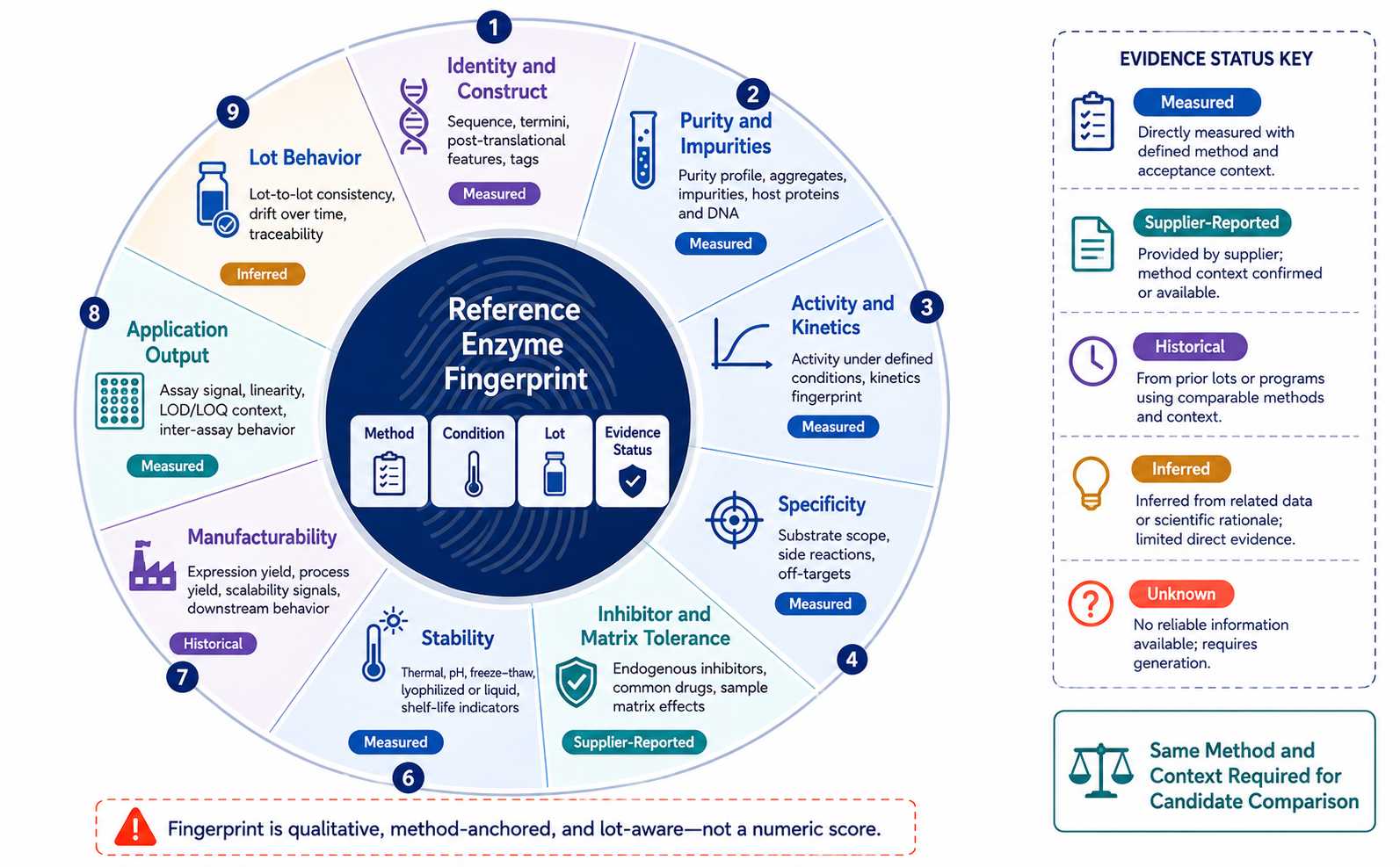 Fig. 3. Reference performance fingerprint. Attributes are linked to the method, condition, lot, and evidence status so that candidate matching is based on an observable baseline rather than an enzyme name.
(Creative Enzymes)
If multiple representative reference lots are available, they can reveal normal variation and help distinguish a candidate difference from reference-lot noise. Historical release or application data may also help, provided that methods, units, reagent lots, instruments, and processing rules are comparable. Data generated under incompatible methods should not be merged as if they were one distribution. When only a single lot is available, the conclusion should acknowledge that the observed fingerprint may be lot-specific.
Comparing equal volume can confound concentration and specific activity. Comparing equal total protein can be distorted by purity or inactive material. Comparing equal supplier units can be misleading if unit definitions differ. Comparing equal functional units can hide a concentration or formulation burden that matters to the final reagent. We choose normalization according to the decision and may use more than one basis: equal mass for specific activity, equal functional input for application behavior, and equal delivered volume for formulation or device constraints. The normalization rule is reported with the result.
A specification should protect performance, not merely reproduce a small set of observed numbers. If the reference's variability, method capability, or link to application performance is unknown, narrow acceptance limits may be unjustified. The first work package may therefore characterize the reference and qualify the assay before candidates are judged. This can connect to Enzymes Activity and Stability Analysis, Batch-to-Batch Consistency Validation, or COA Specification and Release Testing Package Development.
A second source is not always a molecular copy. The appropriate route depends on what is known, what rights and materials are available, why the existing source is vulnerable, and which attributes are non-negotiable. We can compare routes before laboratory work so that the project does not spend months reproducing a construct that fails the actual supply or application objective.
Use a known protein and construct design with a new qualified production route. Main burden: host/process and product-quality bridging.
Design new coding DNA, vector, tags, cleavage, or expression conditions while retaining the intended amino-acid sequence. Main burden: production and construct effects.
Mine natural homologs or available candidates that plausibly perform the same reaction. Main burden: functional, specificity, and application confirmation.
Introduce deliberate sequence changes to meet the fingerprint and manufacturing constraints. Main burden: broad evidence and explicit non-identity.
The primary objective may be an independent manufacturing source, alternate geography, additional scale, different raw-material chain, or reduced dependency on one process. The technical plan must test whether the new route introduces meaningful product differences. Supply resilience is not proven by sequence alone, and no service can guarantee uninterrupted future supply.
The incumbent material may be difficult to express, insufficiently stable, incompatible with drying, vulnerable to inhibitors, or too variable in the intended assay. A candidate can be intentionally different to solve the problem, but it should be described as an engineered functional alternative and assessed against the revised target profile rather than called an identical second source.
When the problem is candidate generation, the project may draw on AI-Guided Diagnostic Enzyme Variant Design and Screening, AI-Driven De Novo Enzyme Discovery and Enzyme Mining, or AI-Assisted Diagnostic Enzyme Mutation Library Design. This page remains focused on the reference-to-candidate bridge: how a proposed alternative is defined, tested, and qualified for the intended use.
AI-assisted analysis can reduce an unstructured search space, especially when many homologs, sequence variants, constructs, or process options are available. Depending on the data, we may combine sequence alignments, conservation, protein-language-model representations, structural models, residue environment, predicted solubility or stability indicators, motif and liability scans, docking or interaction hypotheses, prior assay results, and multiobjective ranking. The computational method is selected after reviewing the decision and data; the label “AI” does not determine the experimental plan.
Reference sequence and construct, homologs, known motifs, structures or models, prior variants, expression history, assay data, and hard constraints
Cluster candidates, identify sequence differences, rank structural or functional risk, propose conservative changes, and preserve diversity and uncertainty
Candidate rationale, protected residues, predicted risks, construct choices, comparison tier, controls, and experimental falsification conditions
Predicted structural similarity cannot establish identical dynamics, kinetics, specificity, folding, or formulation behavior. A generated sequence that looks plausible may not express or function. A high sequence identity may still contain a change at a catalytic, binding, allosteric, interface, or stability-critical position. Conversely, a more distant homolog may retain the required reaction but differ in temperature profile, substrate preference, cofactor use, inhibitor tolerance, or contaminating side activities. We therefore attach the reason and uncertainty to each candidate and test the attributes that determine the intended use.
When structure and interaction questions dominate, a focused In Silico Structural Modeling and Enzyme-Substrate Interaction Analysis Service can support the hypothesis package. When data from many candidates or prior campaigns must be repaired and made model-ready, the AI-Ready Experimental Dataset Design and Screening Data Analysis Service may be added. Neither computational work package replaces side-by-side experimental evidence.
The deepest possible characterization is not automatically the best study. The evidence burden should reflect the change, the risk of failure, the amount of reference knowledge, the observability of relevant attributes, and the consequence of using the candidate. A defined same-sequence host transfer may begin differently from a remote homolog proposed for a complex multiplex assay. We use a tiered ladder with decision gates so that weak candidates can be rejected early and promising candidates advance to more application-relevant tests.
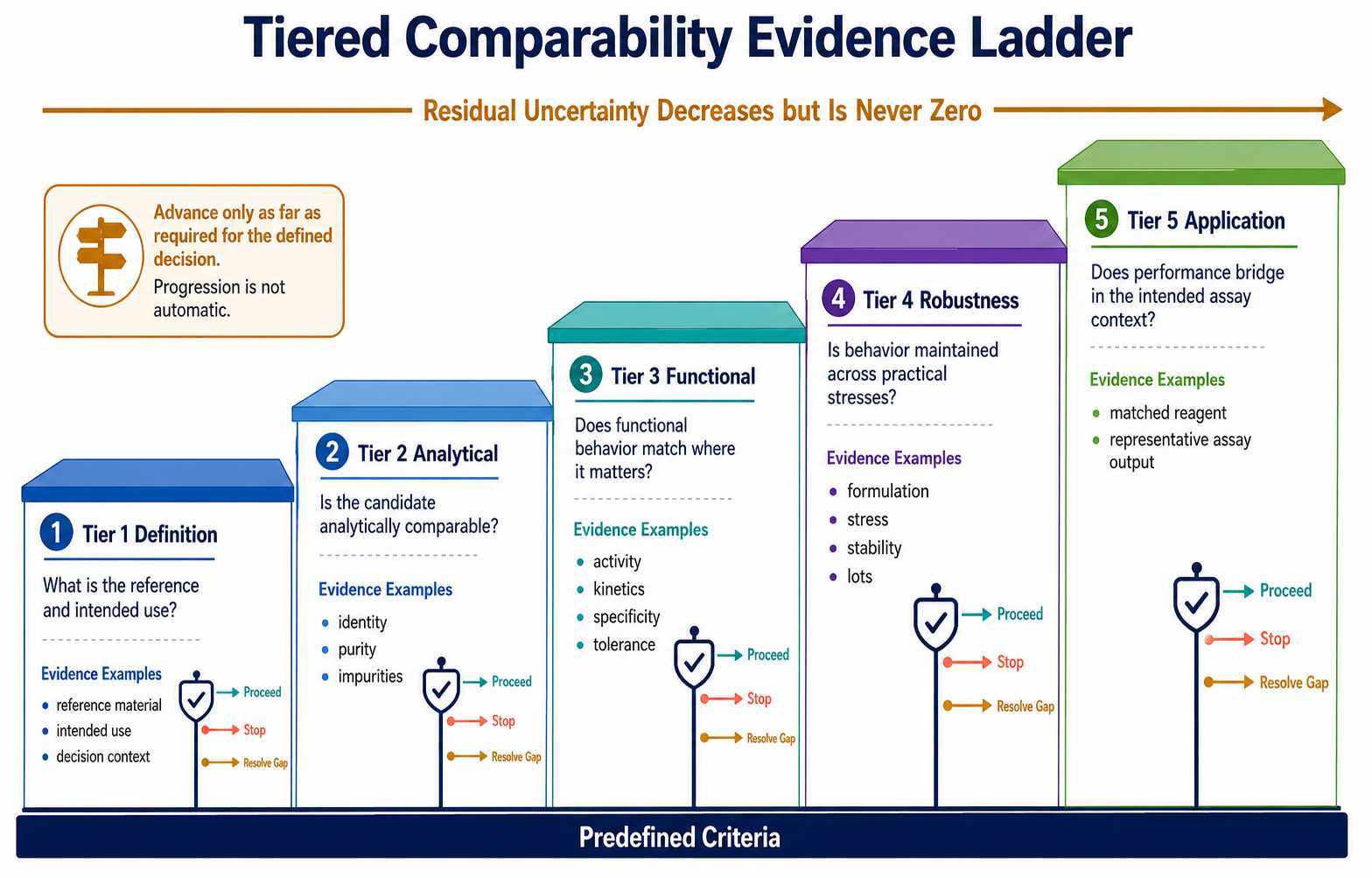 Fig. 4. Tiered comparability evidence ladder. The candidate advances from definition and analytical identity to functional, robustness, and application evidence only as required by the change and the decision.
(Creative Enzymes)
ICH Q5E describes risk- and evidence-based comparability principles for biotechnology and biological products after manufacturing changes. Those principles can help organize thinking about relevant quality attributes, analytical capability, and residual uncertainty, but the guideline addresses a different regulated product context and is not automatically applicable to a diagnostic enzyme raw-material project. Similarly, CLSI EP26 provides a structured approach to evaluating reagent-lot changes using representative samples and a predefined critical difference; it is useful conceptual input but not a complete second-source enzyme protocol. ISO 23640 is relevant when a modification may affect IVD reagent stability, yet this service does not itself confer ISO conformity.
Orthogonal methods should answer different plausible failure questions, not merely create a longer report. For identity, intact mass and peptide mapping may provide different information. For purity, electrophoretic and chromatographic methods may resolve different species. For function, a kinetic assay and an application readout may separate catalytic behavior from reagent-system interactions. For stability, a biophysical signal may be paired with retained activity. The method set is chosen for the molecule and use; not every project requires every technique.
A new host or process can change residual host cell proteins, DNA, endotoxin, nucleases, proteases, cofactors, metals, detergents, or process additives. The relevant risk depends on the assay. Trace nuclease can be critical for nucleic-acid reagents; protease may affect antibody or enzyme components; endotoxin may be a product-quality concern in some workflows but should not be described through patient-safety claims for an RUO raw material without an applicable requirement. Our Residual Host Cell Protein, DNA and Endotoxin Testing Support can be configured to the process and intended decision.
A comparison can produce a source difference when the real cause is plate position, day, operator, reagent lot, dilution, storage, concentration assignment, or instrument. The plan should place reference and candidate materials into a common experimental frame whenever practical. This does not mean that every measurement must occur on the same plate, but it does mean that avoidable confounding is controlled and unavoidable differences are documented.
Run a qualified reference alongside candidates rather than relying only on a historical mean.
Align thawing, dilution, buffer exchange, concentration assignment, storage, and handling where appropriate.
Distribute source, concentration, sample, and replicate across plate, day, instrument, or batch effects.
Include blanks, positive/negative controls, system suitability, dynamic range, and invalid-run rules.
Use independent candidate preparations and reference lots when the decision requires production consistency.
Define endpoint, normalization, exclusions, allowable difference, uncertainty, and decision rule before unblinding results.
A study composed only of easy, mid-range samples may miss changes near decision limits, low analyte or template levels, high concentrations, known interferents, difficult matrices, or stressed reagents. The panel should represent the use and the mechanism of concern. For a polymerase or reverse transcriptase, this may include template composition, GC content, input range, inhibitors, low-copy behavior, nonspecific amplification, or time-to-threshold. For a clinical-chemistry or biosensor enzyme, the panel may emphasize substrate range, related compounds, coupled-reaction balance, endogenous interference, linearity regions, or signal timing. These are development examples, not universal test requirements.
Matrix and interference studies may be needed when the alternative changes nonspecific binding, inhibitor tolerance, background reaction, or interactions with sample components. Such work can connect to Assay Interference and Matrix Effect Evaluation. A simulated matrix can be useful for development but should not be presented as equivalent to every clinical specimen type.
A statistical difference can be too small to matter, while a non-significant result can be inconclusive when the study is underpowered or variable. The comparison should define a practically meaningful difference, expected variability, replicate and sample structure, and decision logic appropriate to the endpoint. Where formal equivalence or noninferiority statistics are used, the margin must be scientifically justified rather than selected after seeing the data. In other projects, a specification-band, ratio interval, bias profile, or multivariate rule may be more appropriate. We report the method, assumptions, confidence interval or uncertainty, exclusions, and limitations.
| Comparison question | Useful design feature | Common failure | Corrective action |
|---|---|---|---|
| Is apparent activity lower? | Compare equal mass, equal volume, and/or reconciled functional units with concentration and purity checks. | Different unit definitions or inactive protein confound the result. | Reassign concentration/activity, inspect purity and folding, or adjust production/purification. |
| Are kinetics different? | Use substrate/cofactor ranges and a model appropriate to the reaction and assay regime. | Single endpoint or saturated substrate hides altered affinity or inhibition. | Expand the design, check mechanism, or select/engineer another scaffold. |
| Does the full assay diverge? | Run matched reagent mixes, sample panels, controls, and application endpoints. | A candidate passes isolated activity but interacts differently with mix components. | Adjust loading or formulation, localize interference, or reject the candidate. |
| Does stress expose a difference? | Use matched container, concentration, formulation, time, and stress history with retained activity. | Biophysical similarity is interpreted without functional confirmation. | Reformulate, change format, revise shipping/storage controls, or redesign the enzyme. |
| Can the process reproduce the candidate? | Compare independent preparations/lots and track critical process and quality attributes. | One favorable development batch is treated as a stable supply route. | Improve process control, update release methods, or repeat bridging at representative scale. |
A failed application comparison does not immediately reveal whether the sequence, expression, purification, formulation, concentration assignment, impurity profile, or assay execution is responsible. The study should preserve intermediate evidence so that the next action addresses the most likely cause. This is particularly important when a candidate is valuable for supply or manufacturability but misses one application attribute that may be recoverable.
Unexpected sequence, processing, truncation, modification, or construct boundary. Confirm the test article before interpreting function.
Expression burden, translation, folding, inclusion bodies, or degradation. Revisit coding DNA, host, induction, chaperones, or construct.
Co-purifying proteins, nucleic acid, endotoxin, protease, nuclease, aggregate, or process additive. Modify purification and controls.
Concentration, unit method, active fraction, buffer, or substrate definition differs. Reconcile methods and normalization.
A homolog or mutation changes desired versus undesired reactivity. Test related targets and consider focused engineering.
Salt, stabilizer, surfactant, cofactor, preservative, or concentration changes the candidate differently. Screen compatibility.
Freeze-thaw, shipping, drying, storage, or reconstitution reveals loss. Adjust molecule, formulation, process, or handling.
Purified tests pass but matrix, reagent partners, instrument, or workflow exposes a difference. Use bridge assays to isolate the interaction.
Corrective work can include codon and construct redesign, host or strain selection, expression-condition optimization, purification changes, buffer exchange, concentration or loading adjustment, stabilizer screening, mutation of a defined liability, alternative homolog selection, or an application-method change. Property-specific engineering can connect to AI-Guided Activity and Kinetic Performance Optimization, AI-Assisted Substrate Specificity and Cross-Reactivity Reduction, AI-Assisted Thermostability and Lyophilization Stability Engineering, or AI-Guided Expression, Solubility and Manufacturability Optimization.
For molecular-diagnostic enzymes, additional route-specific work may use AI-Guided Polymerase and Reverse Transcriptase Engineering, AI-Guided LAMP, RPA and Isothermal Enzyme Optimization, or AI-Assisted CRISPR/Cas Diagnostic Enzyme Engineering Support. POCT constraints can be incorporated through AI-Driven Multiparameter Enzyme Optimization for POCT Reagents.
Projects are staged around decisions rather than a fixed package. A client with a known sequence and retained reference lots may enter at candidate production and bridging. A client with only a product name and application history may need a reference-definition and route-feasibility stage. An existing alternative that fails only after drying may need failure localization and formulation work rather than new sequence discovery.
Reference, intended use, sourcing driver, hard constraints, rights boundary, and decision
DNA, protein, construct, host, process, formulation, method, and evidence gaps
Reference attributes, lots, methods, uncertainty, application endpoints, and acceptance logic
Source, design, express, purify, identify, and triage alternative materials
Analytical, functional, robustness, lot, and application-level side-by-side comparison
Qualified-use conclusion, remaining controls, specifications, monitoring, or redesign plan
| Work package | Possible deliverables | What the deliverable does not claim |
|---|---|---|
| Reference and route assessment | Intended-use statement, source-risk problem, reference record, difference hierarchy, controlled-difference ledger, route options, feasibility and evidence-gap memo | Does not determine legal rights, patent position, or regulatory equivalence. |
| Sequence and construct package | Sequence alignment, residue/structure risk review, coding-sequence options, construct maps, protected positions, candidate rationale, and design manifest | Does not prove expression, folding, function, or non-infringement. |
| Production and analytical package | Expression/purification development summary, sample genealogy, identity, concentration, purity, impurity, aggregation or modification data as scoped | Does not establish application performance from analytical results alone. |
| Functional and robustness package | Activity, kinetics, specificity, inhibition/tolerance, formulation, stress, stability, and lot-comparison data with methods and QC status | Does not generalize beyond the tested conditions, lots, time points, and endpoints. |
| Application bridge and decision | Study plan, sample/control map, raw and processed data, analysis, deviations, candidate/reference comparison, residual uncertainty, and defined-use decision memo | Does not constitute clinical validation, finished-product release, registration, or universal interchangeability. |
| Transfer and lifecycle package | Proposed specifications/methods, reference standard plan, change-control triggers, monitoring, retained-sample plan, and rebridging recommendations | Final specification approval, validation, registration, labeling, and market authorization remain with the sponsor/legal manufacturer. |
Laboratory activities are specified in the proposal. Sequence analysis alone, design plus DNA, expressed research samples, purified enzyme, analytical testing, application testing, or an integrated program can each be scoped. We do not promise a universal number of candidates, lots, methods, weeks, or a guaranteed successful second source.
Production work can connect to Enzymes Production and Engineering and Enzyme Expression and Purification. Iterative candidate improvement can be managed through the Closed-Loop Design-Build-Test-Learn Enzyme Evolution Service when more than one engineering round is justified.
The final review integrates the difference ledger, method validity, reference behavior, analytical and functional results, stress and application data, lot evidence, deviations, and unresolved questions. Passing every individual test is not always sufficient if the tests do not cover the intended failure mechanism. Conversely, a measured difference may be acceptable if it is understood, controlled, and shown not to impair the defined use. The rationale is documented rather than reduced to a single opaque score.
The evidence meets the predeclared criteria for the stated reagent, method, conditions, and responsibilities. Remaining limitations and monitoring are listed.
Use is supported only with specified loading, formulation, controls, range, lot monitoring, supplier/process restriction, or additional confirmation.
The candidate has recoverable value, but a localized sequence, expression, purification, formulation, concentration, or application issue must be corrected and rechecked.
The candidate fails a critical requirement, evidence remains inadequate for the decision, or the residual risk cannot be controlled within the agreed scope.
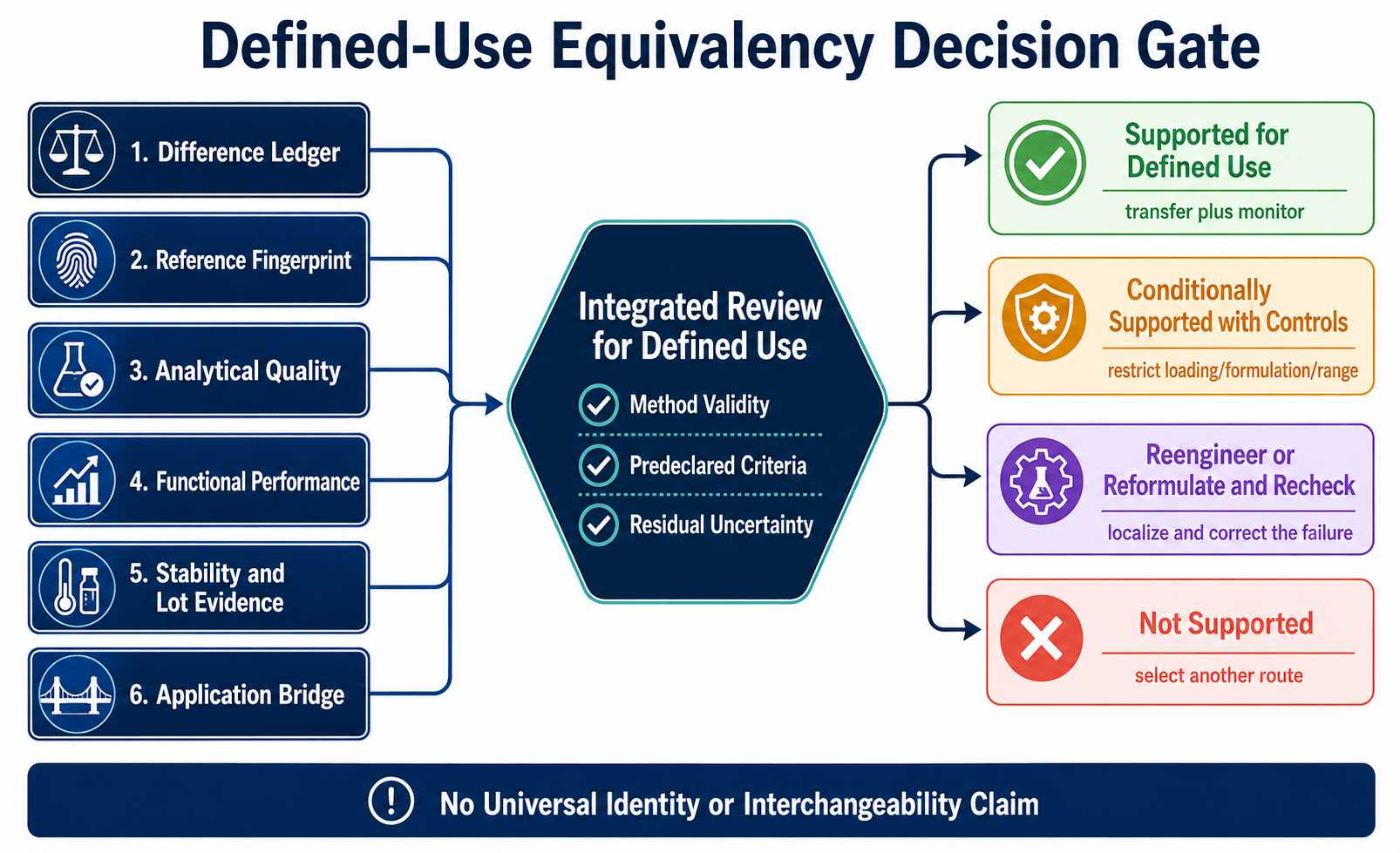 Fig. 5. Defined-use equivalency decision gate. Integrated evidence leads to support, conditional support, reengineering or reformulation, or a not-supported conclusion for the stated application.
(Creative Enzymes)
A second-source decision is made on versions of the sequence, construct, host, process, formulation, methods, and application. Later changes can invalidate part of the evidence. The transfer package can define change-notification expectations, critical material and process attributes, reference standards, retained samples, lot monitoring, trend review, and triggers for partial or full rebridging. Candidate lots should be evaluated through release methods that remain connected to application performance, not merely through easily measured attributes.
A COA Specification and Release Testing Package can translate development evidence into a practical testing and documentation framework. Batch-to-Batch Consistency Validation can examine whether the new route remains controlled across representative lots. These services support raw-material and reagent development; they do not replace the legal manufacturer's validation and release responsibilities.
This service is part of AI-Driven Diagnostic Enzyme Engineering Services. It owns the reference-to-alternative comparison and defined-use decision. Other pages address narrower generation, optimization, modality, data, or structural questions:
Use AI-Guided Diagnostic Enzyme Variant Design and Screening, AI-Assisted Mutation Library Design, or De Novo Enzyme Discovery and Enzyme Mining when the immediate need is candidate creation rather than equivalency bridging.
For a multi-round alternative-development campaign, Closed-Loop Design-Build-Test-Learn Enzyme Evolution can govern how each round changes the next. The current page remains the comparability frame that defines what the alternative must demonstrate and how its differences will be handled.
It means a project-specific evaluation of sequence and related product differences against a defined engineering and assay objective. It does not mean that different sequences are molecularly identical or that identical amino-acid sequences are automatically interchangeable. The conclusion states the sequence/construct relationship, tested attributes, intended use, conditions, and residual uncertainty.
No. It is strong identity information at the primary-sequence level, but coding DNA, construct boundaries, tags, host, expression conditions, purification, folding, modifications, aggregation, impurities, formulation, and storage may affect the material. The amount of additional evidence depends on the change and intended use.
They may perform an agreed function similarly under defined conditions, but that must be demonstrated. A related homolog or engineered variant should be described as a functional alternative rather than sequence-identical. Testing may include kinetics, specificity, tolerance, stability, and application output, with limits based on the use.
Not always. A complete reference process can improve risk assessment, but the project may proceed with reference material, sequence/construct information, specifications, methods, and application data. Missing knowledge is recorded as uncertainty, and the candidate is compared through observable attributes. The conclusion should not imply sameness in unobserved process or product features.
Potentially. Feasibility depends on the reference material, rights and permissions, enzyme class, available public or client information, and the required decision. Options may include analytical characterization, sequence determination within agreed rights, natural homolog mining, reaction-based candidate selection, or functional-alternative engineering. The project would not claim reproduction of an unknown sequence.
AI-assisted methods can cluster homologs, compare sequences, prioritize substitutions, identify structural-risk regions, combine multiple evidence types, and rank candidates across performance and manufacturability objectives. Predictions remain hypotheses. Candidate identity, expression, function, stability, and assay performance must be confirmed experimentally at the level required by the decision.
There is no universal number. It depends on the maturity of the process, expected variability, availability of retained material, strength of historical data, risk of the change, method variability, and whether the decision concerns development feasibility or a repeatable supply route. A single batch can support early screening but usually cannot characterize future lot consistency by itself.
Supplier units are useful only when their definitions and methods match the comparison need. Differences in substrate, temperature, pH, reaction time, calculation, purity, or formulation can make equal units non-comparable. We reconcile unit definitions and may compare equal mass, equal functional input, and equal delivered volume for different decisions.
We localize the failure by examining concentration assignment, formulation, cofactors, reagent partners, inhibitors, matrix components, stress history, nonspecific activity, and application conditions. The next step may be loading adjustment, buffer/stabilizer work, impurity control, process modification, focused enzyme engineering, another candidate, or a not-supported decision.
No. Creative Enzymes can implement client-provided technical restrictions and document sequence or construct differences. Patentability, freedom to operate, non-infringement, licensing, ownership, and legal design-around conclusions require qualified legal counsel. The client is responsible for rights to supplied sequences, materials, and data.
No. The work supports research, diagnostic-reagent development, and applicable industrial raw-material decisions. It does not establish biosimilarity, interchangeability, clinical performance, regulatory clearance, or finished-product release. The sponsor or legal manufacturer remains responsible for validation, specifications, registration, labeling, and authorization.
Yes, subject to feasibility and the proposal. The scope can include coding and construct design, host/condition screening, expression, purification, analytical testing, functional characterization, formulation/stability work, application bridging, and transfer planning. Each included activity and responsibility is stated explicitly.
The therapeutic-biologic comparability sources above are used only for general scientific principles. They do not define regulatory requirements for every diagnostic enzyme raw-material project.
Send the available reference material and lot information, protein or coding sequence, construct and host context, activity method, intended reagent or assay conditions, historical performance data, sourcing objective, and the differences you can or cannot accept. Creative Enzymes will use those inputs to define a reference-characterization package, alternative route assessment, candidate engineering plan, side-by-side bridge study, or failure-localization program.
Research use and diagnostic-reagent development support only. Services and resulting materials are not intended for direct personal treatment or consumption. Legal rights, clinical validation, regulatory clearance, and finished-product release remain outside this service.
