
Should a Cas nuclease recognize a broader target grammar, activate faster after a correct target, cleave a reporter more efficiently, reject a one-base mismatch more sharply, remain quiet without target, or survive the temperature and formulation required by the reagent?
Creative Enzymes provides AI-assisted engineering support for Cas12, Cas13, and feasibility-qualified related effectors intended for molecular diagnostic research and reagent raw-material development. We connect sequence and structural hypotheses to state-resolved biochemical testing, so a client can see which change belongs to the protein and which belongs to the guide, activator, reporter, buffer, amplification module, or formulation. Most outputs are intended for research use. Selected programs may support industrial diagnostic raw-material development under an agreed scope; the resulting enzyme is not a finished diagnostic test and does not establish clinical or regulatory performance.
“Improve Cas activity” is not a sufficient engineering brief. A fluorescence trace produced by a CRISPR diagnostic reaction can contain several biochemical events: formation of the effector-guide ribonucleoprotein, recognition of the correct target, conformational activation, cis cleavage of the bound target, release or retention of cleavage products, repeated trans cleavage of a reporter, and optical detection of the released label. Upstream amplification, transcription, guide structure, reporter length, salt, magnesium, additives, temperature, and enzyme purity can change the same trace. If those contributions are not separated, a variant may be selected for the wrong reason.
We begin with a molecular-event specification. It records the effector family and ortholog, target type, guide format, PAM or protospacer-flanking requirement where relevant, reporter chemistry, acceptable operating window, expected upstream product, sample-related inhibitors, storage format, and the client decision that the data must support. A project may seek a drop-in second source, a focused performance change in an existing scaffold, a broader sequence-access window, a lower-background enzyme, a different operating temperature, improved soluble production, or a starting point for a complete assay. Each route requires a different control structure.
That boundary also determines where this service stops. We can confirm a lead in a representative amplification-coupled or transcription-coupled context when it is necessary to protect variant ranking. Development of the entire reaction chain—including primer and guide co-design, preamplification, one-pot timing, reporter format, sample preparation, analytical sensitivity and specificity studies, and device implementation—is covered by our CRISPR diagnostic enzyme assay development support. The two services can be linked, but their data packages and acceptance criteria are not interchangeable.
Cas12 and Cas13 effectors are programmable nucleases, but they do not move directly from “enzyme present” to “diagnostic signal.” Target recognition reorganizes the ribonucleoprotein and exposes or assembles catalytic functions. Cas12a structural and biochemical work has shown that target hybridization activates the RuvC site, that target cleavage and trans cleavage are mechanistically related but distinguishable, and that a target-bound complex can remain catalytically competent for reporter cleavage. Cas13a uses guide-directed RNA recognition and composite HEPN nuclease domains; guide-bound structures show how target engagement relieves an inhibited surveillance state. These mechanisms make activation-state measurements a practical engineering tool rather than a purely structural description.
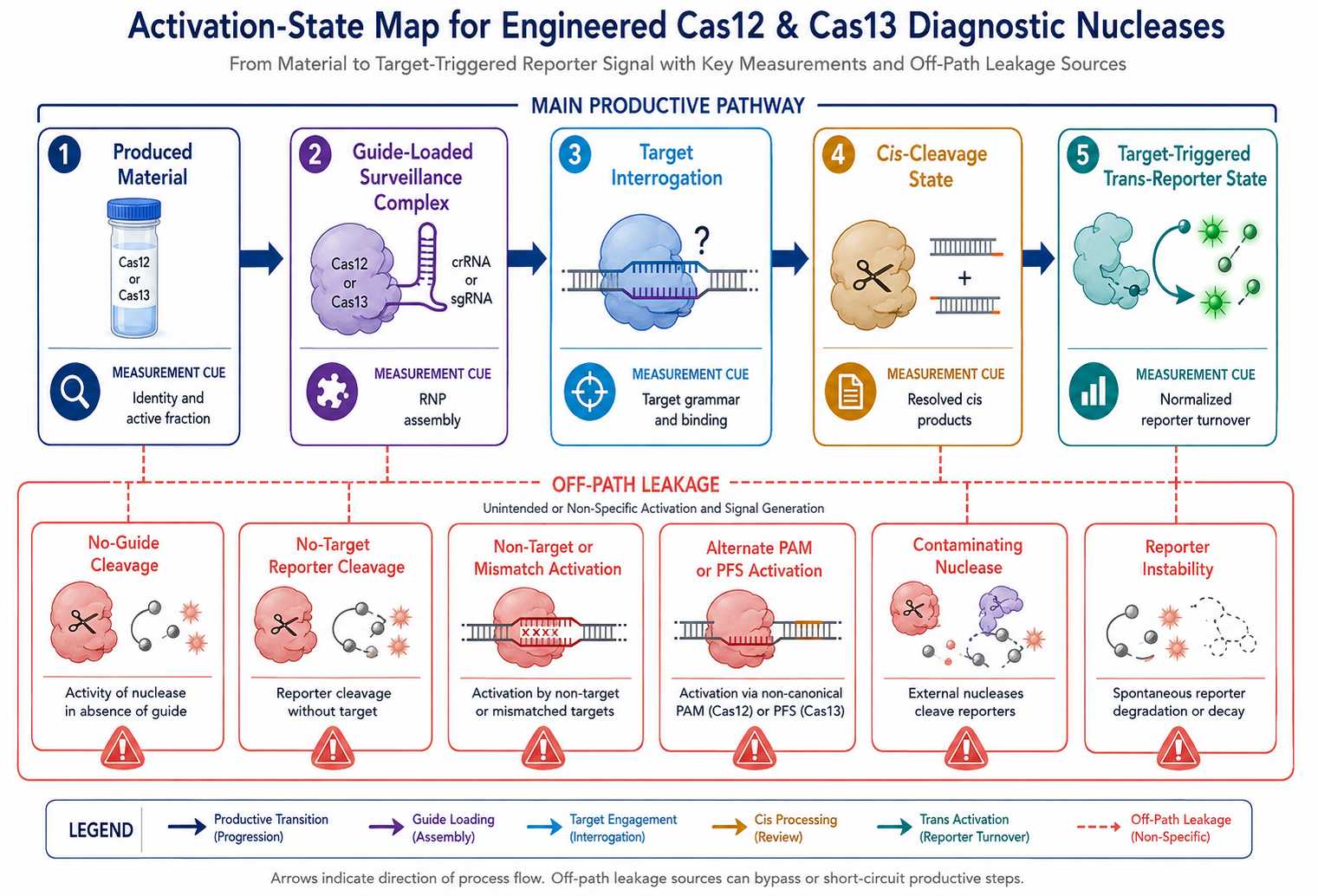 Fig 1. Cas diagnostic nuclease activation-state map. Produced protein, guide-loaded surveillance complex, target interrogation, cis cleavage, target-triggered trans cleavage, and off-path leakage are measured as separate states so variant effects remain attributable.
(Creative Enzymes Diagnostic)
The specification assigns at least one direct or orthogonal measurement to every state relevant to the project. For example, guide loading can be evaluated through a binding or mobility method rather than inferred from endpoint reporter fluorescence. Target recognition can be separated from cleavage with catalytic controls or noncleavable substrates. Cis products can be resolved directly. Trans cleavage can be measured with defined reporter concentration and an independently quantified activator. No-target, no-guide, catalytically inactive, non-target, mismatch, and reporter-only conditions localize leakage. Not every project needs every method, but every claimed change needs a measurement that can reasonably support it.
| Engineering question | Primary measurement | Orthogonal or control measurement | Interpretation protected |
|---|---|---|---|
| Did the variant improve RNP formation? | Guide-binding or RNP-assembly response under defined stoichiometry | Guide integrity, protein active fraction, no-guide and scaffold-control conditions | Separates assembly from catalytic gain or higher protein loading |
| Did target engagement change? | Target-binding, activation-threshold, or target-cleavage response | PAM/PFS panel, seed and distal mismatches, binding-only or catalytic control | Separates recognition grammar from reporter turnover |
| Did cis cleavage change? | Resolved target cleavage products or time course | Uncleavable target, product-retention or strand-handling experiment | Shows whether the target-processing step limits later trans cleavage |
| Did trans cleavage improve? | Initial reporter-cleavage rate or defined unit under fixed activator and reporter conditions | No-target, no-guide, reporter-only, alternate reporter, and active-enzyme normalization | Prevents brighter endpoints, contaminants, or reporter instability from masquerading as enzyme improvement |
| Did discrimination improve? | Matched-to-mismatched activation separation across a defined challenge panel | Equivalent activator input, multiple guide contexts, no-target background, direct binding or cis readout | Shows whether specificity arises at recognition, activation, or reporter cleavage |
The family name does not define a complete diagnostic raw material. Orthologs can differ in size, guide architecture, PAM or PFS behavior, preferred temperature, buffer response, target form, catalytic rate, product handling, and expression characteristics. Even within one ortholog, a changed guide scaffold or reporter can reorder apparent performance. We therefore route a project using the complete recognition-and-reporting grammar rather than a broad label such as “high-activity Cas.”
Cas12a and Cas12b are common starting families when a DNA target or DNA amplification product is available and target-triggered cleavage of a single-stranded DNA reporter is desired. The program records whether the activating target is single- or double-stranded, which PAM is required for double-stranded recognition, how the guide is supplied, whether cis cleavage is necessary for the intended signal state, and how temperature and buffer conditions interact with the upstream reaction.
Engineering levers can include target-interrogation contacts, PAM recognition, guide-scaffold interaction, R-loop propagation, target-strand or non-target-strand handling, RuvC access, allosteric coupling, product release, reporter-substrate preference, thermostability, and soluble production. Cas12a and Cas12b should not be treated as plug-compatible; their temperature and mechanistic constraints can route them to different assay architectures.
Cas13 effectors are considered when the desired activated complex recognizes RNA and cleaves an RNA reporter. If the upstream input is DNA, the assay may require transcription before Cas13 activation; that extra enzyme and timing step belongs in the application context. Guide processing, guide loading, target-RNA structure, target flanking preferences where applicable, HEPN activation, reporter sequence, RNA integrity, and RNase contamination require explicit controls.
Engineering levers can include guide repeat recognition, spacer presentation, target-duplex accommodation, allosteric communication between recognition and HEPN regions, composite active-site geometry, target versus collateral cleavage balance, low-temperature behavior, RNA-compatible purification, and storage protection. Protein and RNA effects are separated because altered guide scaffolds can change activation without any change to the protein.
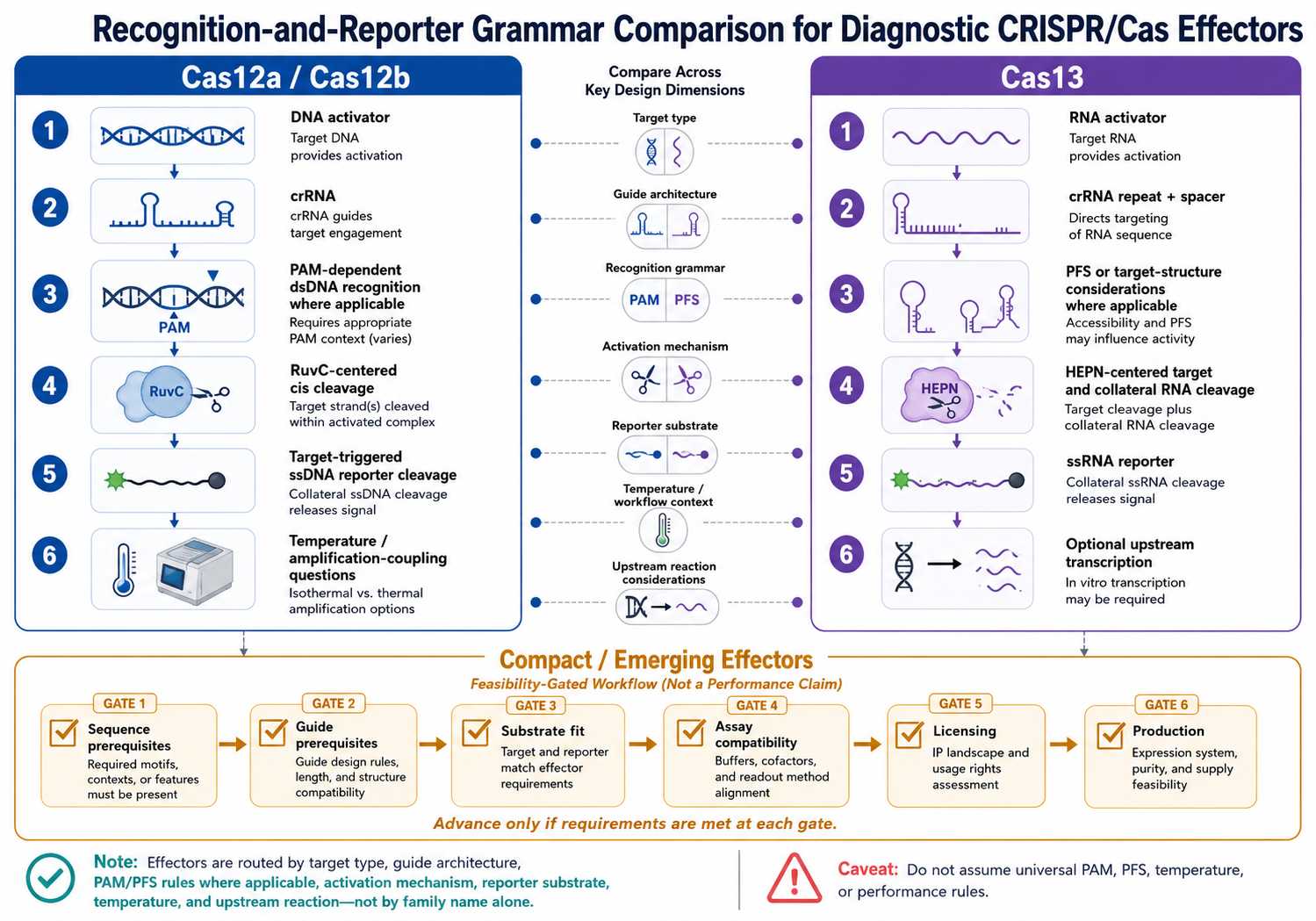 Fig 2. Effector-family recognition and reporter grammar. Cas12a/Cas12b and Cas13 programs are routed by target type, guide architecture, PAM/PFS rules, activation mechanism, reporter substrate, temperature, and upstream reaction rather than by family name alone.
(Creative Enzymes Diagnostic)
| Routing field | Cas12-centered question | Cas13-centered question | Why it changes the engineering plan |
|---|---|---|---|
| Activating nucleic acid | ssDNA, PAM-bearing dsDNA, amplicon, or another defined activator? | Direct RNA, transcript, or T7-generated RNA intermediate? | Changes recognition controls, upstream enzymes, target structure, and one-pot compatibility |
| Recognition grammar | Which PAM, guide length, seed positions, and R-loop constraints apply? | Which guide repeat, spacer positions, target structure, and PFS constraints apply? | Defines the challenge panel and whether broader access or sharper discrimination is required |
| Catalytic output | cis DNA cleavage, trans ssDNA cleavage, or both? | target RNA cleavage, collateral ssRNA cleavage, guide processing, or a subset? | Determines which active site and conformational event can be engineered without creating a misleading assay |
| Operating context | Separate detection, LAMP/RPA coupling, one-pot timing, fluorescence, lateral flow, or dry format? | Direct RNA, RT-amplification plus transcription, one-pot cascade, fluorescence, or lateral flow? | Can reorder variants through temperature, salt, crowding, reporter, and partner-enzyme effects |
| Manufacturing route | Construct boundaries, host, tag, nuclease control, active fraction, concentration, and storage? | RNA-compatible purification, RNase control, guide stability, host, tag, active fraction, and storage? | Ensures that a biochemical lead can become a consistent reagent raw material |
A useful target profile has several axes. Their relative priority depends on the intended diagnostic architecture. For a separate, post-amplification Cas reaction, rapid trans cleavage at a convenient temperature may dominate. A one-pot reaction may value compatibility with amplification salts, crowding agents, polymerases, reverse transcriptases, or T7 RNA polymerase more than maximum activity in a proprietary Cas buffer. A low-copy research assay may prioritize target-triggered turnover, whereas variant discrimination may require a narrower activation window. A dry reagent may accept a modest kinetic tradeoff for improved recovery after drying and storage.
The objectives become acceptance ranges, not vague aspirations. The project team agrees how each metric will be normalized, which baseline materials will be compared, which guide and target contexts must be represented, and what evidence would stop a design route. A “high-activity” variant that gains fluorescence because it carries a co-purified nuclease fails immediately. A broad-PAM variant that activates strongly on the intended target but also narrows the match-to-mismatch separation may be unsuitable for discrimination. A stable protein that loses most active fraction after concentration may not be manufacturable. Negative outcomes are retained because they improve the next design round and define the tested boundary.
AI is most useful when it reduces an experimentally meaningful search space. We can combine sequence conservation, ortholog comparisons, protein language-model representations, coevolution, available structures, predicted structures, guide and target complexes, surface and electrostatic features, prior mutational data, and client-owned results. Depending on data availability, ranking can use supervised models, zero-shot or few-shot protein-model scores, structure-aware filters, multi-objective acquisition, active learning, or a simpler expert-weighted scheme. The output is a candidate portfolio with stated hypotheses and uncertainty—not a claim that a model has already discovered a working diagnostic enzyme.
The portfolio is intentionally diverse. It can contain direct mechanism variants, conservative rescue variants, distal allosteric variants, stability or solubility variants, and combinations that test whether two effects cooperate or conflict. Positions essential to fold, guide loading, or catalysis can be protected unless the project deliberately tests them. Sequence liabilities, aggregation risk, host-expression constraints, purification tags, intellectual-property restrictions supplied by the client, and assay throughput are applied before synthesis.
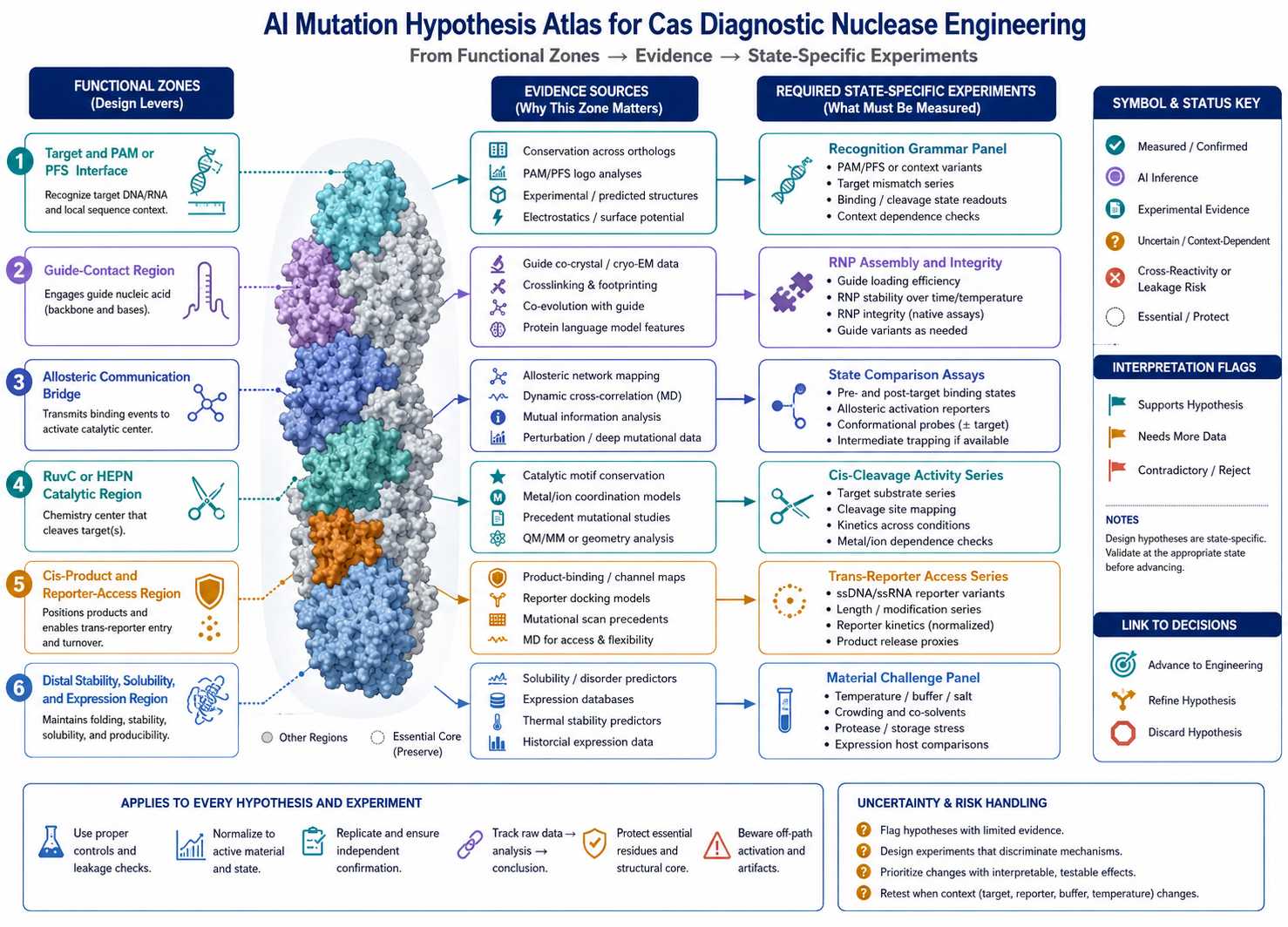 Fig 3. AI mutation hypothesis atlas for Cas engineering. Recognition, guide-contact, allosteric, catalytic, product-handling, stability, and production regions are connected to explicit evidence and state-specific experiments rather than treated as an undifferentiated mutation list.
(Creative Enzymes Diagnostic)
A first round may use a compact, hypothesis-rich set when the scaffold and failure mode are well defined. A broader designed library is useful when multiple interfaces may control the phenotype and a robust screen is available. Ortholog mining is preferable when the desired temperature, target grammar, reporter behavior, or manufacturability lies outside the credible range of the starting scaffold. Those routes connect respectively to our AI-assisted diagnostic enzyme mutation library design, de novo enzyme discovery and enzyme mining, and expression, solubility, and manufacturability optimization services.
A reliable screen is not one plate of endpoint fluorescence. It is a linked set of assays that can eliminate material artifacts early and preserve mechanistic information for the next design round. The exact methods depend on the effector and project, but the logic remains consistent: verify the material, confirm RNP formation, measure target recognition and cis behavior, quantify target-triggered trans cleavage, challenge the quiet state and discrimination boundary, and only then confirm the ranking in the required application context.
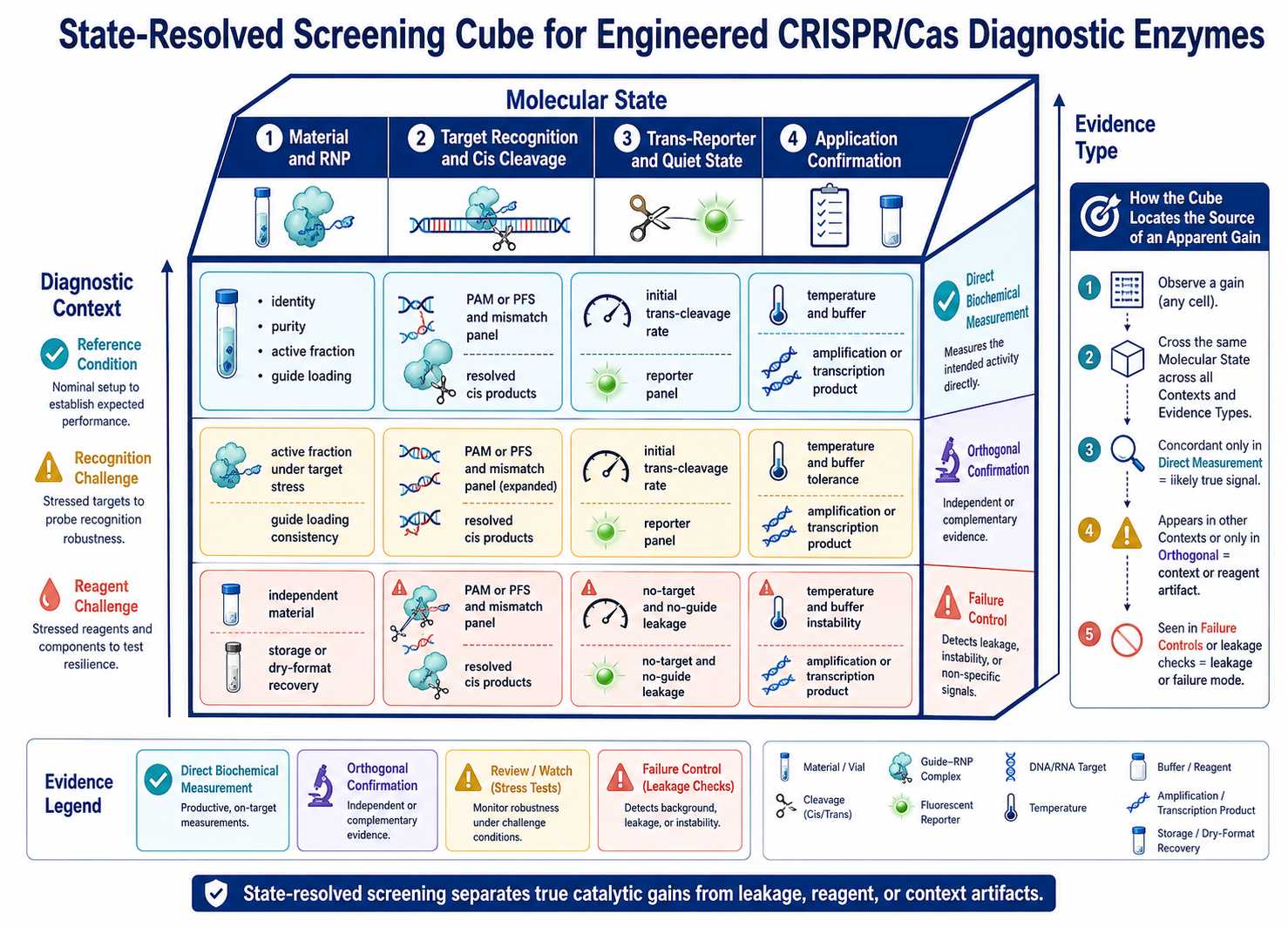 Fig 4. State-resolved screening cube. Material quality, guide-loaded state, target recognition, cis cleavage, trans-reporter turnover, quiet-state controls, and application challenges are crossed so the source of each apparent gain can be located.
(Creative Enzymes Diagnostic)
Nominal protein concentration is not always the same as active RNP concentration. Variants can differ in soluble recovery, aggregation, guide loading, damaged active sites, retained host nucleases, or concentration accuracy. Comparing equal mass without checking these variables can favor a sample with a different active fraction or an impurity. The screen can include protein identity and purity, monomer or aggregation assessment, guide-binding capacity, activity titration, catalytic controls, and no-target reporter stability. The agreed normalization basis is carried through the dataset and report.
For Cas12, cis and trans cleavage are assessed separately when the mechanism or project question requires it. A change that accelerates target cleavage may not improve reporter turnover; a change in target-strand product handling may alter access of the reporter to the catalytic site. A 2025 study provides an instructive example: mutations in a target-strand-loading region were designed to reduce interference by cis-cleavage products and increased trans cleavage in that experimental system. We use the mechanistic lesson—product handling can be an engineering lever—without treating the reported variant or magnitude as a universal solution.
For Cas13, RNase control is especially important. Guide and target RNAs, reporter integrity, water and buffer quality, production-derived RNases, and handling surfaces can all change fluorescence. Guide processing and target-triggered collateral cleavage are distinct Cas13 functions, and different subtypes can use different activation architectures. Screening therefore includes sufficient RNA controls to show that the observed rate belongs to the intended Cas13 state.
When the final reagent receives a LAMP, RPA, PCR, or transcription product, isolated Cas-buffer ranking may not hold. Residual primers, amplicon topology, pyrophosphate, salts, magnesium, crowding agents, dNTPs, polymerase, recombinase proteins, reverse transcriptase, T7 RNA polymerase, and temperature history can alter recognition or reporter cleavage. A confirmation module can compare the purified activator with the representative upstream product, use locked amplification material across variants, and separate amplification yield from Cas signal. If the upstream system itself requires optimization, the project can connect to our AI-guided LAMP, RPA, and isothermal enzyme optimization or isothermal amplification reagent development services.
Cas engineering objectives frequently conflict. Lowering the activation barrier may accelerate the correct target but also admit mismatches or increase target-independent reporter cleavage. Broadening PAM use can expand target access while changing discrimination at noncanonical sites. A more permissive guide interface may improve difficult guides but raise scaffold-dependent background. Stronger catalytic output may consume reporter rapidly at high target while providing little improvement near the required decision boundary. A thermostable protein may recover well after heat challenge but express poorly or require a buffer incompatible with the upstream enzyme.
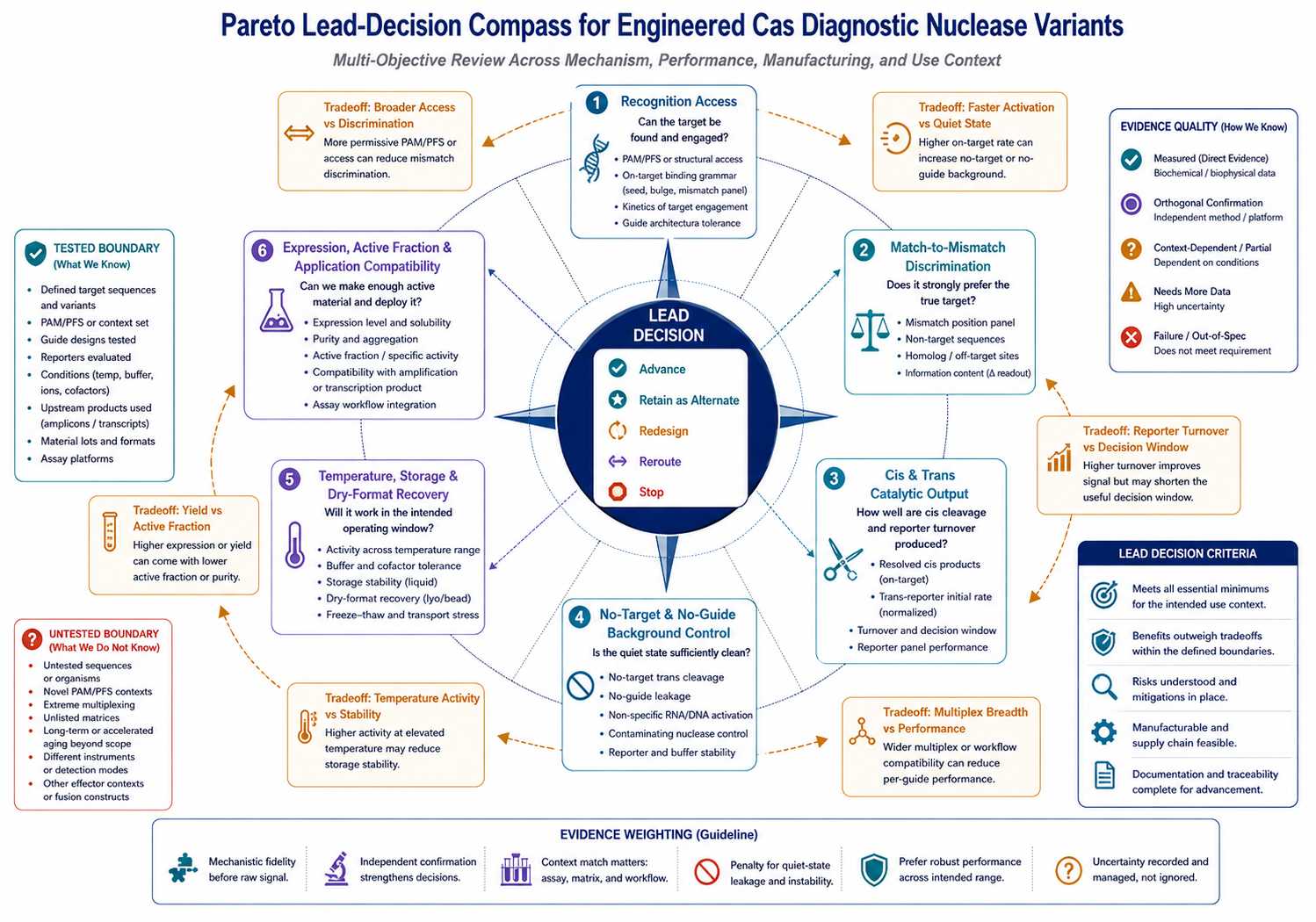 Fig 5. Pareto lead-decision compass. Target access, discrimination, cis/trans output, quiet-state control, temperature, stability, expression, active fraction, and application compatibility are reviewed together before an engineered Cas nuclease advances.
(Creative Enzymes Diagnostic)
A project can retain more than one lead. One candidate may be the best separate-reaction enzyme, another may tolerate the amplification buffer, and a third may offer superior storage recovery. Alternates reduce transfer risk and provide a rational next step if a guide panel or formulation later exposes a weakness. We report the tested boundary, failed criteria, unresolved risks, and conditions that can reverse the ranking. This is more useful to a reagent-development team than a candidate list stripped of assay context.
The deliverable is configured at project start. It can range from a design package to purified research material, a characterized lead, an independent-batch confirmation, or a process-oriented package for further scale-up. Sequence ownership, background intellectual property, permitted use, construct handoff, raw-data format, and material disposition are handled through the agreed project terms. We do not imply freedom to operate or diagnostic authorization unless a separate qualified review is explicitly in scope.
When thermostability, drying, or ambient storage is a primary objective, the Cas program can be integrated with our AI-assisted thermostability and lyophilization stability engineering and lyophilized enzyme formulation development services. When the principal gap is catalytic characterization, it can connect to AI-guided activity and kinetic performance optimization and enzyme activity and stability analysis. These links avoid forcing protein sequence engineering to solve a formulation or method problem.
Project size is determined by uncertainty and decision risk rather than a fixed number of variants. A narrow change at a known interface may need a small focused set and deep mechanistic assays. A poorly characterized ortholog may need construct and material triage before sequence design. A multi-objective program may need designed diversity, automated data capture, and more than one design-build-test-learn cycle. We define stage gates so the program can advance, reroute, or stop without spending the entire scope on candidates that fail basic material or quiet-state controls.
This service focuses on the Cas effector protein: scaffold and construct selection, variant design, expression and purification, active-material normalization, guide loading, target recognition, cis/trans cleavage, background, specificity, stability, and transfer evidence. Full assay development additionally coordinates primers, amplification or transcription, guide design, reporter and readout, sample preparation, matrix studies, one-pot timing, analytical performance, and device workflow. Those activities are available through our CRISPR diagnostic enzyme assay development support.
Yes, subject to scaffold, sequence, guide, substrate, assay, and licensing feasibility. Cas12-centered programs usually investigate DNA recognition and target-triggered ssDNA reporter cleavage. Cas13-centered programs investigate RNA recognition and HEPN-mediated RNA reporter cleavage, including the extra controls required for RNA integrity and RNase contamination. The precise ortholog and subtype are selected from the intended target and reaction grammar.
AI can rank hypotheses and reduce the experimental search space using sequence, structure, dynamics, conservation, ortholog, and prior assay information. It cannot establish collateral activity by prediction alone. Variants must be produced and tested with defined guide, activator, reporter, buffer, temperature, active-enzyme normalization, and no-target controls. The most useful model output is a diverse, interpretable candidate portfolio with uncertainty.
They answer different questions. Cis measurements show target cleavage and product handling; trans measurements show target-triggered turnover of a reporter substrate. A mutation can change target recognition, target-strand retention, active-site access, or reporter turnover differently. Measuring both can locate the step that produced a signal change and prevent selection from a single composite endpoint.
No. The benefit depends on how much activator the upstream reaction produces, target and no-target separation, reporter abundance and stability, background cleavage, instrument resolution, read time, and matrix. A faster enzyme can be unhelpful if target-independent background rises, if activation rather than reporter turnover is limiting, or if the reporter is already saturated. We evaluate the decision window, not rate in isolation.
It can be an engineering objective when the scaffold, structural evidence, target panel, and screening capacity support it. Broader sequence access must be measured together with target activation, alternate-motif behavior, positional mismatches, non-targets, and guide diversity. A broader rule is not automatically better if it reduces discrimination or changes background in the intended assay.
That is a legitimate multi-objective goal. Designs can target surveillance-state stabilization, guide loading, allosteric coupling, catalytic access, construct quality, or contaminating nuclease control depending on the source of background. The screen must include no-target, no-guide, reporter-only, inactive-control, non-target, and matched-target reactions so reduced background is not simply inactive protein.
Yes, if the design space and intellectual-property terms are defined. We generally use a factorial or staged plan so protein effects, guide-scaffold effects, and spacer-specific effects remain distinguishable. Engineered crRNAs have been shown to alter Cas12a trans cleavage without a protein mutation, which is exactly why attribution and locked controls matter.
Reporter sequence, length, chemistry, concentration, label, and readout can be included. The panel depends on Cas family, intended fluorescence or lateral-flow format, background risk, availability, and assay throughput. Reporter effects are separated from target activation and normalized to the agreed reaction conditions; we do not claim one universal reporter substrate for every effector.
Yes, representative application confirmation can be included when it is needed to protect lead ranking. We can compare purified activator with a locked upstream product and study relevant carryover conditions. If the project also requires redesign or optimization of the upstream amplification, transcription, guide, reporter, or one-pot architecture, that work is scoped as an integrated reagent- or assay-development program.
Operating temperature, thermal challenge, dry-formulation recovery, and storage stability can be included, but they are separate properties. A protein can be active at a temperature yet unstable during storage, or stable after heating yet incompatible with the reaction buffer. Sequence engineering, formulation optimization, and accelerated or real-time stability studies are selected according to the failure mechanism.
There is no technically defensible fixed number. The answer depends on scaffold maturity, objective complexity, structural and sequence evidence, screen throughput, data quality, expression success, number of guide-target contexts, and whether objectives conflict. We propose a staged portfolio and stop criteria after reviewing the available evidence rather than promising a generic library size or timeline.
The agreed package can include sequences and construct maps, purified research material, expression and purification records, identity and purity data, active-fraction basis, methods, raw and processed results, guide-target-reporter definitions, state-resolved performance, challenge panels, stability data, lead rationale, alternate candidates, tested boundaries, residual risks, and recommended next experiments.
No. Enzyme data support raw-material and reagent development under the tested conditions. Finished-test validation requires the complete assay, sample type, controls, manufacturing process, instrument or device, analytical and clinical studies, quality system, and regulatory pathway. Most Creative Enzymes outputs are intended for research use; selected industrial raw-material projects are defined by contract.
Send us the Cas scaffold or sequence, guide and target format, current assay data, desired molecular change, operating and storage constraints, and the decision your development team must make. Creative Enzymes can propose a state-resolved plan that connects AI-assisted variant design to protein production, orthogonal biochemical evidence, diagnostic-context challenges, and a reconstructable raw-material lead dossier.
Contact Creative Enzymes