
Release compliance
Does this lot meet the approved or development-stage specification for identity, activity, purity, physical attributes, residuals, and other selected quality characteristics?
Output: individual lot disposition evidence
A defensible enzyme-lot replacement decision needs more than two passing Certificates of Analysis. Creative Enzymes can build a side-by-side comparison that asks whether each lot meets its own requirements, whether the candidate agrees with a qualified reference within predefined technical boundaries, and whether both lots behave comparably in the diagnostic application that matters.
Confirm that every tested lot is evaluated in the same defined material state using suitable analytical procedures.
Measure the candidate and reference side by side so the intended lot contrast is not obscured by avoidable run or handling differences.
Challenge the lot change in an assay, formulation, matrix, device, or coupled reaction selected for its downstream risk.
Batch consistency is not a synonym for release testing. A release result asks whether one batch falls inside an established specification. A comparability study asks whether a candidate batch can replace or bridge to a defined reference without a decision-relevant change. Ongoing monitoring asks whether the process is drifting across many batches. These questions use overlapping measurements, but they require different comparators, statistical logic, and conclusions.
For a diagnostic enzyme, two lots may both satisfy a broad activity range yet differ in specific activity, kinetic response, purity profile, trace interfering activities, formulation carryover, physical state, or performance in a finished reaction. Conversely, a small numerical difference may be analytically detectable but irrelevant to the intended assay. The validation program must connect the observed difference to a technical boundary that was chosen before the result was seen.
Does this lot meet the approved or development-stage specification for identity, activity, purity, physical attributes, residuals, and other selected quality characteristics?
Output: individual lot disposition evidenceIs the candidate lot sufficiently similar to the reference for the proposed replacement, scale, source, formulation, process, or application bridge?
Output: bounded replacement decisionDoes the sequence of lots remain within an understood operating pattern, or is a shift, trend, cycle, or increase in variability emerging?
Output: monitoring and change trigger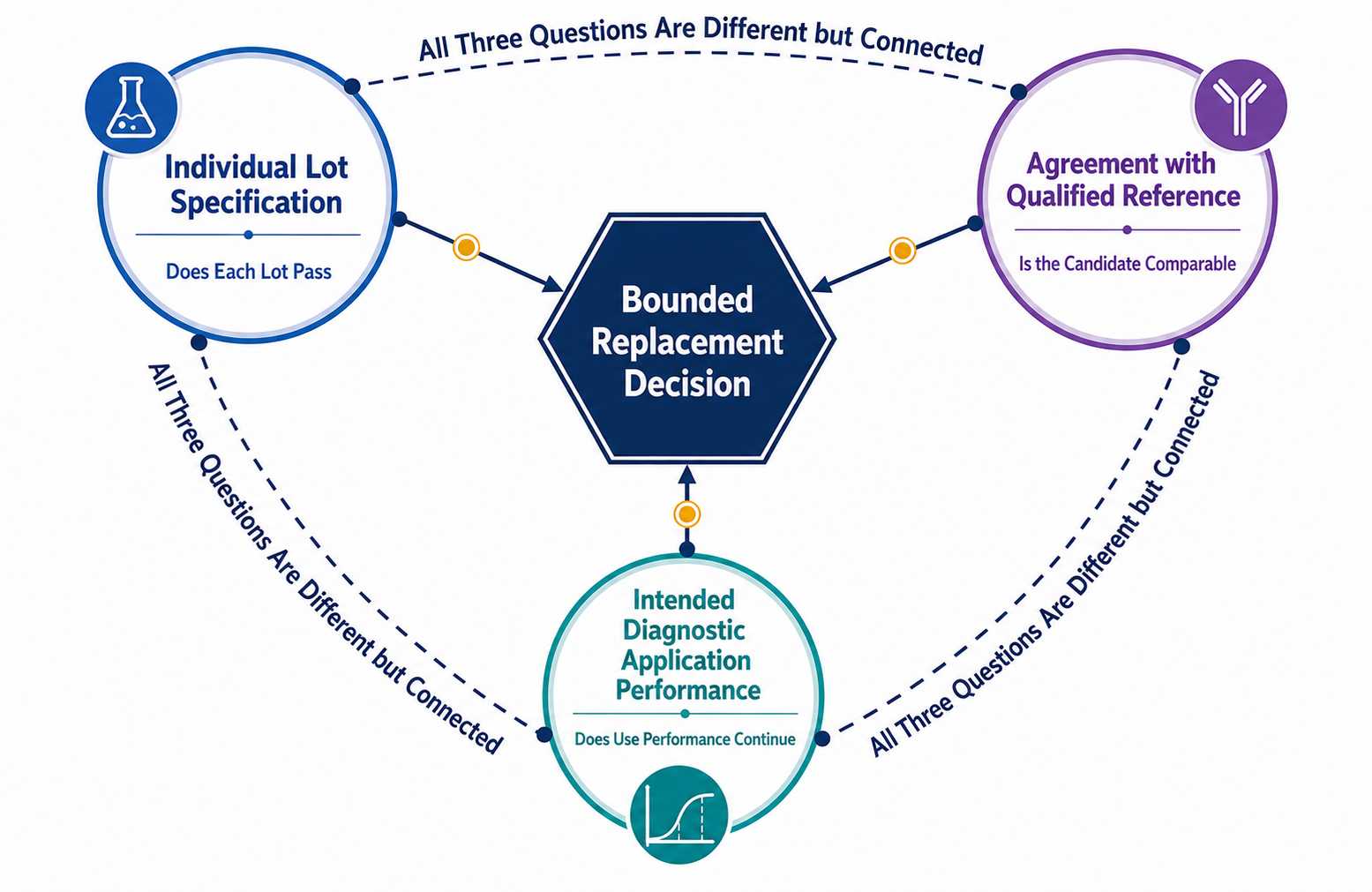 Fig 1. Three-way comparability for diagnostic enzyme lots. A defensible replacement decision connects specification compliance, reference-lot agreement, and intended-application performance.
(Creative Enzymes Diagnostic)
A lot-comparison result is only as credible as its reference. “Compare with the previous lot” may be operationally convenient, but it can create a chain in which small accepted shifts accumulate from one lot to the next. A deeply characterized reference lot, a controlled retain, a reference pool, a current production lot, or a defined application benchmark may be more suitable. The choice depends on the decision, material availability, reference stability, and how the sponsor controls traceability.
The comparison anchor should represent the enzyme configuration that the sponsor intends to preserve: sequence or source, expression system, purification state, formulation, concentration or activity presentation, container, storage history, and application role. Its fitness should be confirmed close enough to the comparison that reference deterioration is not mistaken for improvement in the candidate.
If the reference has aged, been repeatedly thawed, changed container, or lost traceability, the project may need a reference-bridging step or a new hierarchy rather than a direct accept/reject comparison. Related time-dependent evidence can be developed through diagnostic enzyme stability and shelf-life testing.
Identity lock: confirm the exact lots, aliases, manufacturing stage, material form, fill, and chain of custody.
Configuration lock: record buffer, additives, concentration basis, activity-unit definition, container, and preparation procedure.
History lock: document storage, transport, thawing, sampling, pooling, dilution, and any prior stress or use.
Role lock: state whether the reference supports a development benchmark, incoming qualification, scale bridge, supplier change, process change, or routine release program.
Fitness check: verify that the reference remains analytically and functionally suitable for the intended comparison.
A robust hierarchy can include a primary internal reference, qualified working references bridged to it, retained lots from relevant process eras, and an application control. Not every program needs every level. The design should conserve scarce reference material while ensuring that future comparisons remain tied to a stable decision basis. When calibration values or assigned values are involved, metrological traceability may require additional controls; a retained enzyme lot should not be described as a certified reference material unless it truly has that status.
Nominal protein concentration and one activity result rarely describe the complete quality state of a diagnostic enzyme. The panel should be selected from the ways a batch change could affect the intended assay. For one polymerase, the dominant risk may be inhibitor tolerance, fidelity-related behavior, nonspecific amplification, or response at low template input. For an oxidoreductase in a coupled colorimetric reaction, cofactor state, side activity, lag behavior, linearity, and companion-enzyme balance may matter. For a conjugated enzyme, labeling distribution, free enzyme, aggregation, and signal-to-background can be decisive.
Creative Enzymes can organize a project-specific fingerprint across five evidence domains. The goal is not to run the longest test menu; it is to create an orthogonal panel in which each result has a defined role in the replacement decision.
Labels below show decision states, not customer data or universal acceptance criteria.
Where the comparison method is not sufficiently sensitive, selective, precise, or transferable, the lot decision may first require custom analytical method development and qualification. Detailed identity and purity questions can be addressed through diagnostic enzyme purity analysis, while functional method questions can be linked to enzyme activity and kinetic characterization.
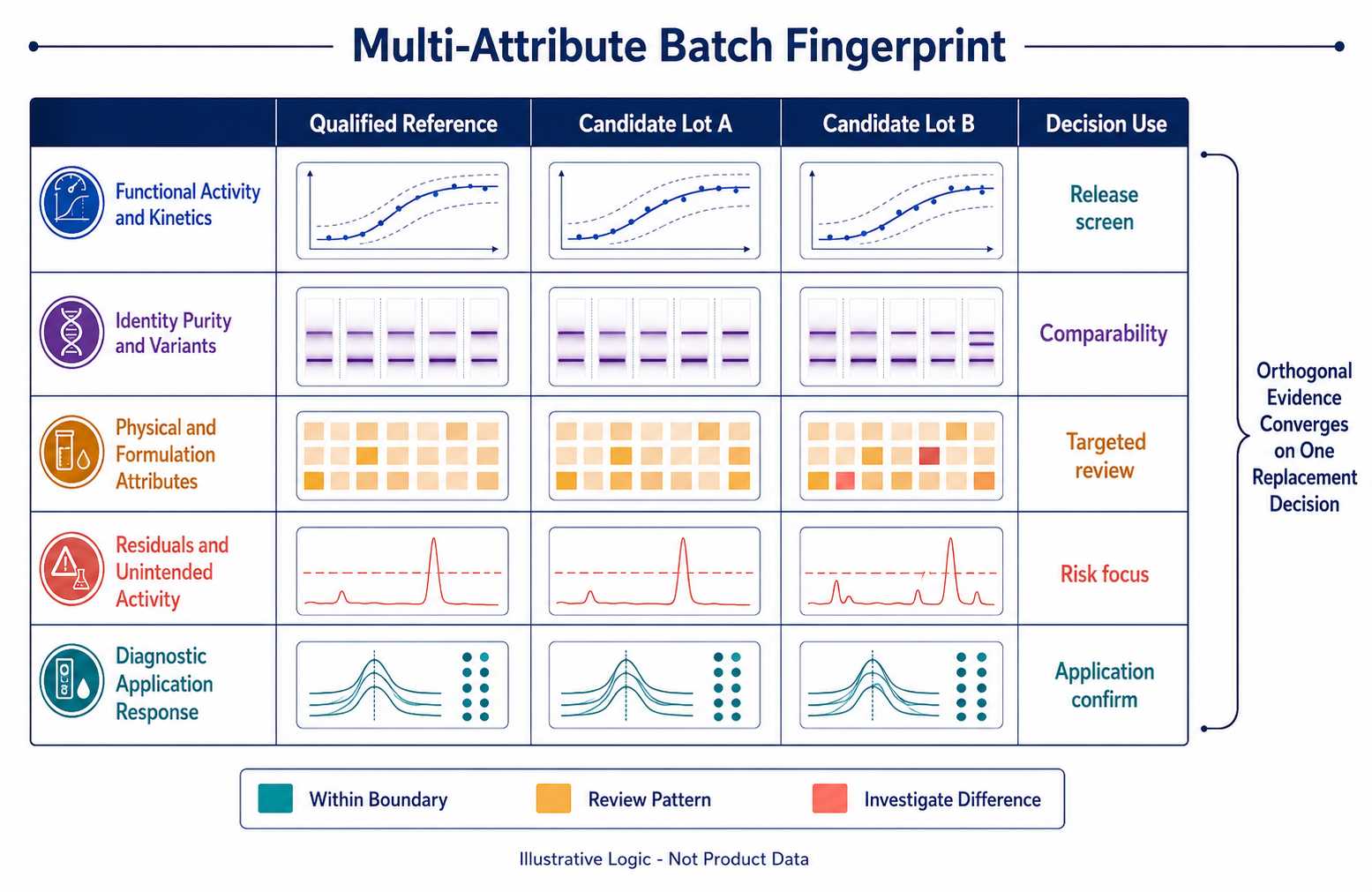 Fig 2. Multi-attribute diagnostic enzyme batch fingerprint. The comparison panel is selected from the replacement risk, not copied from a generic test menu.
(Creative Enzymes Diagnostic)
A difference observed between two vials is not automatically a manufacturing-lot difference. The measured response contains contributions from the biological production process, purification and formulation, sampling and storage, the analytical procedure, and the downstream assay system. If those contributors are not controlled or represented in the design, the comparison can reject a suitable lot or accept a problematic one for the wrong reason.
Cell bank or seed, culture medium, induction, harvest timing, expression state, and biological variability.
Clarification, chromatography, concentration, hold time, pool definition, and carryover.
Buffer preparation, excipient grade, mixing, filtration, concentration adjustment, container and fill.
Storage age, shipping, thawing, repeated access, dilution, adsorption, and sample preparation.
Method precision, run, day, analyst, instrument, calibration, companion reagents, and sample matrix.
Process knowledge makes the study more discriminating. A scale-up comparison may emphasize mixing, hold time, purification capacity, and pool boundaries. A new expression host may require deeper identity, variant, residual, and application-interference work. A formulation or excipient-source change may require physical-state, stability, and assay-compatibility testing. If a difference appears only after transport or thawing, the next step may be freeze-thaw and shipping stress testing rather than a broad claim that the production batch is inconsistent.
If the reference has lost activity or accumulated physical change during storage, a fresh candidate may look different because it is better preserved, not because production has drifted. The study should compare known histories, include a suitable time-zero or working control where possible, and interpret any reference deterioration as a separate evidence problem.
Total protein normalization assumes that the same fraction of protein is active and equally accessible in every lot. Changes in inactive species, fragments, aggregation, cofactor occupancy, or formulation can break that assumption. Pairing concentration, specific activity, molecular-quality evidence, and application response helps reveal the mechanism.
A coupled enzyme, primer/probe set, substrate, calibrator, antibody, membrane, or master-mix component can interact differently with candidate enzyme lots. Holding companion lots constant isolates the enzyme contrast; deliberately varying them in a later robustness phase tests whether the candidate remains suitable across the expected operating environment.
The most informative comparison places reference and candidate materials into the same analytical context. This can mean testing them in the same run, with the same calibrated equipment, freshly prepared shared reagents, randomized well or sequence positions, common samples, and matched preparation histories. Pairing removes avoidable between-run variation from the lot contrast. Blocking allows important sources such as day, analyst, instrument, assay plate, or sample level to be represented without confounding them with batch.
Before sample allocation, the protocol defines what difference would affect the intended use, what analytical imprecision is expected, where in the response range the risk is highest, and which lots or factors must support the conclusion.
| Design element | What it controls or reveals | Common failure if omitted |
|---|---|---|
| Paired reference and candidate measurements | Direct lot contrast under a shared analytical context | Run-to-run change is misread as a lot difference |
| Response levels or application states | Constant, proportional, threshold-specific, or low-signal differences | Agreement at one convenient point hides a decision-relevant shift elsewhere |
| Replicates | Short-term imprecision and uncertainty of the lot contrast | A single noisy result controls the decision |
| Day, analyst, instrument, or plate blocks | Robustness and variance components across realistic execution factors | Lot and operational effects become inseparable |
| Randomized or balanced position | Plate, sequence, time, temperature, or carryover gradients | Position bias aligns with one batch |
| Shared companion reagents | Isolates the enzyme lot as the primary contrast | Another reagent lot creates an apparent enzyme effect |
| Application-relevant samples or controls | Commutability and actual use performance | Neat-buffer agreement is overextended to the finished assay |
| Predefined data handling and exclusion rules | Consistent treatment of invalid runs, outliers, and technical failures | Post hoc decisions bias the comparison toward a preferred outcome |
The number of lots, response levels, samples, and replicates cannot be prescribed from the page title alone. It depends on the technical margin, method precision, expected variance, response distribution, desired confidence, available reference material, and the consequences of accepting or rejecting the candidate. A small feasibility study may be used to estimate variance before the confirmatory design is locked.
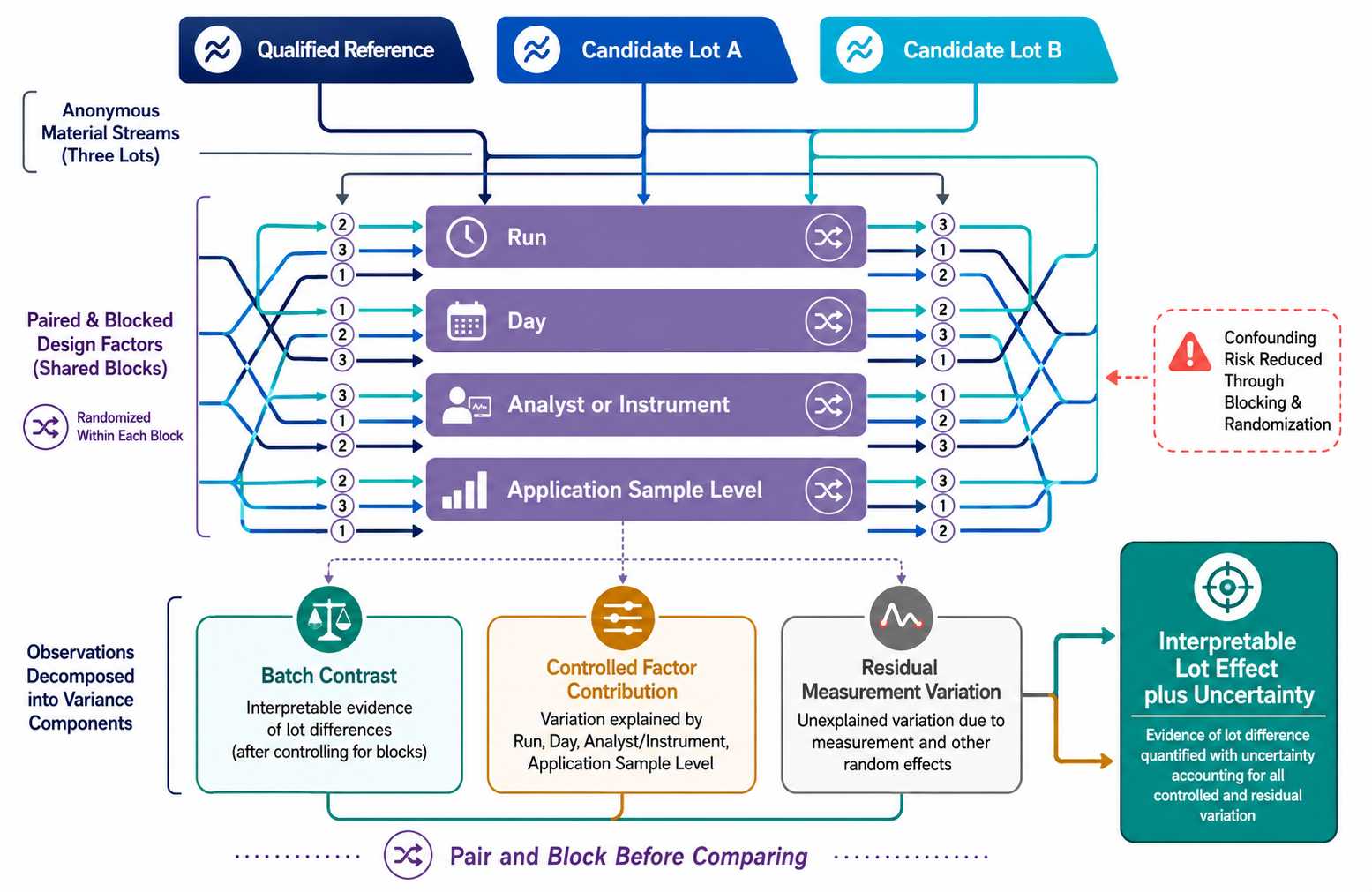 Fig 3. Variation-partition design for enzyme-lot comparison. Pairing and blocking make the batch contrast interpretable by controlling avoidable measurement and handling differences.
(Creative Enzymes Diagnostic)
A conventional difference test begins with the assumption of no difference and asks whether the data provide evidence against it. Failing to reject that assumption may reflect genuine similarity, but it may also reflect a noisy method, too few observations, a narrow sample range, or an insensitive analysis. It is therefore not sufficient to say that lots are consistent because the difference was “not statistically significant.”
A consistency protocol should define the technical boundary before unblinded interpretation. The boundary can be based on assay-performance needs, development history, established specification rationale, measurement capability, risk assessment, or an application-specific allowable shift. The analysis then asks whether the estimated lot difference and its uncertainty remain within that boundary under the tested conditions.
No single tool is universally best. Published comparisons of reagent-lot methods show that imprecision, response range, sample allocation, model choice, and false-rejection tolerance affect the ability to detect bias. Creative Enzymes can predefine the analysis with the study design so the statistics answer the technical question rather than decorate a completed dataset.
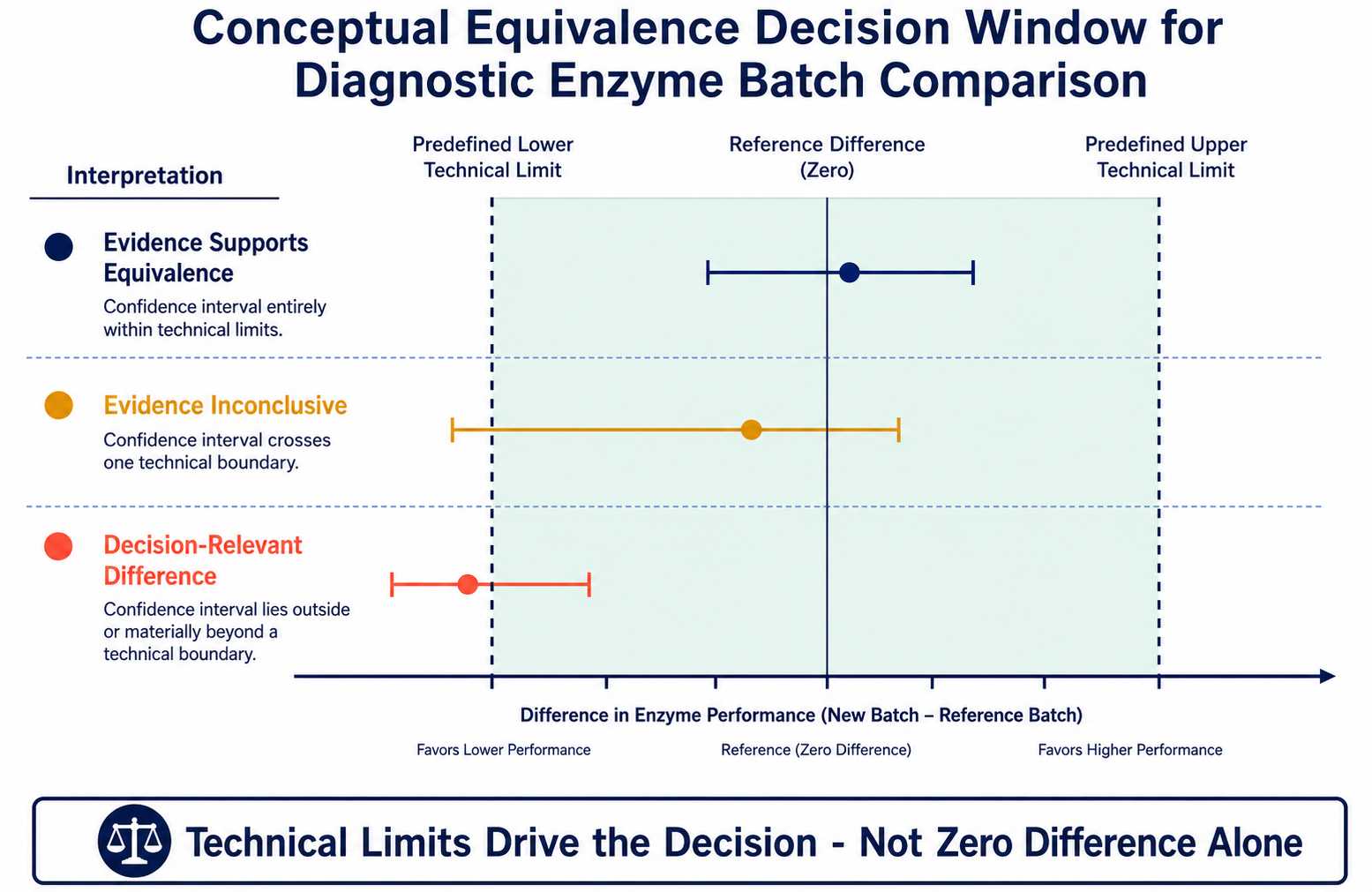 Fig 4. Conceptual equivalence decision window. The estimate and its uncertainty are interpreted against predefined technical boundaries, not against zero difference alone.
(Creative Enzymes Diagnostic)
A useful service does not reduce every mixed result to “pass” or “fail.” The pattern across orthogonal methods often indicates the next discriminating experiment. The purpose is to determine whether the candidate is unsuitable, the reference is no longer fit, the method cannot resolve the decision, or the application needs a more specific control.
Support comparability within the tested boundaries, document residual gaps, and define the future change triggers that would require re-bridging.
Determine whether the changed attribute is a harmless process signature, a leading indicator, or a risk that the selected application challenge was not designed to expose.
Evaluate matrix, inhibitor tolerance, companion-reagent interaction, active fraction, low-input behavior, formulation carryover, or device-format sensitivity through assay interference and matrix-effect evaluation.
Check reference age, storage, thaw history, container, preparation, and method controls. Establish a new bridge rather than automatically rejecting the candidate.
Connect the changed quality attribute to raw material, expression, purification, formulation, fill, or scale records and define confirmation testing around the suspected cause.
Pause the equivalence conclusion, improve method readiness, increase informative replication or range, and resolve influential technical factors before consuming scarce reference material.
Examples include: comparable for a defined biochemical activity assay but not yet bridged in the finished master mix; comparable after normalization to active units but requiring a tighter concentration-control step; acceptable for one instrument or matrix with additional robustness work pending; or analytically comparable while real-time monitoring remains necessary after a major process change. Every conclusion should name the configuration, test panel, decision boundary, evidence limitation, and next change that would invalidate the bridge.
The work is organized as an auditable comparison docket. Each stage closes a specific ambiguity before the next stage consumes material. The exact program is scaled to the development phase, intended use, material availability, and risk of the lot transition.
Define the lot change, intended use, reference hierarchy, proposed conclusion, technical acceptance boundary, and decisions that the data must support. Separate exploratory learning from confirmatory evidence.
Review available methods, expected imprecision, system suitability, controls, reference fitness, sample history, and material requirements. Run targeted feasibility work if the measurement system cannot yet support the intended boundary.
Select orthogonal attributes from enzyme function, molecular quality, physical/formulation state, process residuals, and downstream assay response. Define how each result changes the decision.
Stage aliquots, balance or randomize execution, apply common controls, document invalid-run rules, maintain traceability, and preserve the planned lot contrast across runs and factors.
Analyze attribute differences and uncertainty, review cross-method concordance, identify reference or method limitations, and route discordant signatures to the smallest discriminating follow-up.
Document the bounded conclusion, residual evidence gaps, specification implications, future monitoring, retained-sample plan, and triggers for requalification, method revision, or process investigation.
The final output is evidence for the sponsor's decision process, not an automatic product-release authorization or regulatory approval. If the objective is to convert development evidence into routine specification fields, CoA content, method status, sampling rules, and release documentation, the next activity may be CoA specification and release-testing package development.
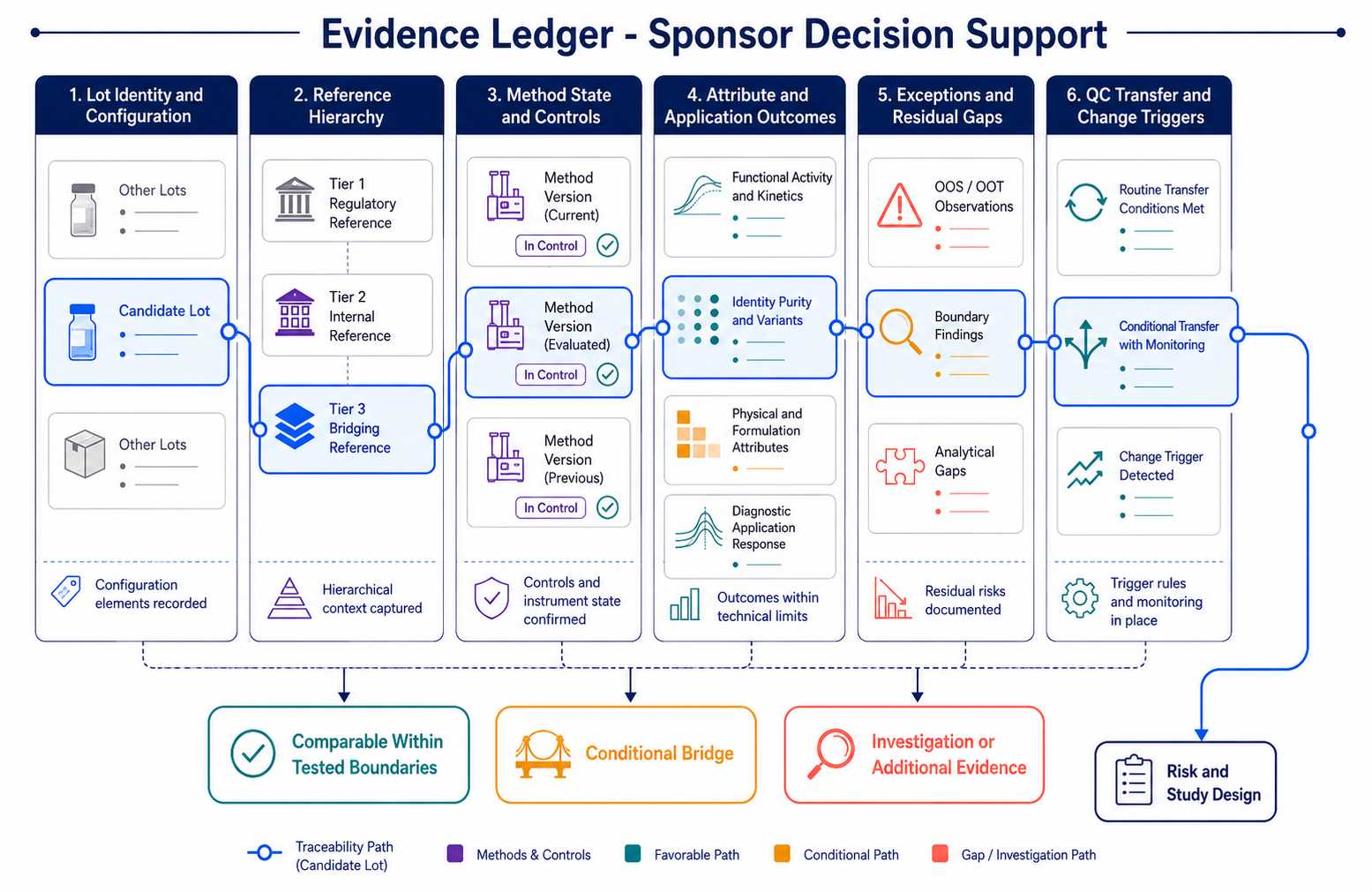 Fig 5. Batch-consistency evidence ledger. Each conclusion remains linked to the tested configuration, method state, reference, exception, release control, and future change trigger.
(Creative Enzymes Diagnostic)
Activity units alone may not expose inhibitor tolerance, low-copy behavior, nonspecific products, reaction speed, response across templates or GC content, multiplex balance, hot-start behavior, or interaction with primers, probes and master-mix components. Candidate lots may need to be compared at several enzyme inputs and across assay conditions selected from the intended use.
Substrate architecture, end compatibility, side activity, carryover contamination, reaction completion, library yield or distribution, and workflow-specific bias may be more informative than a single vendor-style unit assay. A staged design can first confirm biochemical comparability and then test the critical workflow output.
Specific activity, cofactor dependence, substrate selectivity, lag phase, linear range, interfering activity, companion-enzyme balance, chromogenic or electrochemical response, and matrix tolerance may determine whether a lot transition is acceptable.
Free versus conjugated enzyme, labeling distribution, aggregation, signal gain, background, binding retention, substrate response and stability can change independently. Molecular and application evidence should converge before the new lot replaces the reference.
The comparison may need to distinguish bulk-enzyme consistency from drying, dispensing, unit-uniformity, residual-moisture, reconstitution and package effects. A candidate bulk lot can be comparable before drying yet interact differently with the formulation or process.
The extent of the analytical bridge should follow the change mechanism and risk. A minor documented change may need a focused comparison; a new host, purification train, formulation, site or scale may require a broader fingerprint, additional lots and continued monitoring. Related manufacturing support is available through enzyme production and engineering.
For molecular-diagnostic applications, the enzyme evidence can be linked to relevant molecular diagnostic enzymes and kits. Where formulation differences are suspected, excipient, buffer and stabilizer screening can help isolate composition-driven behavior.
No. Routine release testing determines whether one batch meets established specifications. Consistency validation compares a candidate with a qualified reference and asks whether any difference is acceptable for a defined replacement or bridging decision. The validation may later inform the routine release package, but the two activities are not interchangeable.
Not automatically. Broad individual specifications may allow two lots to occupy different parts of the acceptable range, and a difference in an unlisted attribute may affect the downstream assay. Comparability normally needs direct side-by-side evidence and a technical boundary tied to the intended use.
Sometimes a well-designed functional assay can be the principal decision anchor, but activity alone may miss changes in active fraction, purity, aggregation, variants, residuals, formulation, unwanted activity or application-specific behavior. The panel should be selected from the known lot-change risk and the assay mechanism.
Choose a lot or reference hierarchy that represents the configuration and performance you intend to preserve. The reference should be traceable, sufficiently characterized, available in suitable quantity, and demonstrably fit at the time of comparison. A repeatedly thawed or poorly documented previous lot may require requalification or bridging before it can serve as the anchor.
There is no universal count. The design depends on the proposed conclusion, technical margin, method precision, expected between-lot and within-lot variance, response range, factor structure, confidence requirement and material availability. Feasibility data can be used to plan an efficient confirmatory study.
No. A nonsignificant result can occur because the study is insensitive or underpowered. Equivalence should be evaluated against predefined technical margins with an estimate of uncertainty and with a design capable of detecting the smallest difference that would matter.
The study can be configured around client-supplied formulation, companion reagents, controls, matrices or an application protocol when the materials and method information are suitable. Method transfer, feasibility, confidentiality, sample requirements and the boundary between developer-side evidence and clinical validation should be agreed before execution.
That pattern points to an application-sensitive difference rather than proof that either result is wrong. Follow-up may evaluate matrix effects, inhibitor tolerance, companion-reagent interactions, low-input behavior, formulation carryover, active fraction, side activities or device/dried-format effects.
Yes, a study can be designed as a development or change-control bridge. The scope should follow the mechanism and risk of the change. The resulting report can support the sponsor's internal assessment, but the sponsor or legal manufacturer remains responsible for regulatory strategy, specifications, product release and required submissions.
The report should identify the decision-driving attributes, analytical confidence, plausible causes and the smallest useful next study. Outcomes may include method investigation, targeted impurity or interference testing, process review, formulation correction, a narrower use condition, rejection of the candidate, or manufacture and evaluation of additional lots.
Yes. A qualified baseline can support future working references, retained-sample strategy, control charts, trend rules, periodic application checks, specification refinement and re-bridging triggers. The monitoring program must remain linked to the same material configuration, method state and intended-use risk.
Share the enzyme configuration, lot histories, current methods, application context, known variability and proposed acceptance boundary. Creative Enzymes can convert that information into a risk-based comparison plan that separates batch effects from measurement noise and produces a bounded, transfer-ready consistency conclusion.
Discuss Your Batch Consistency Validation Project