Background
Diagnostic enzymes must perform reliably under conditions that are often far more demanding than their natural physiological environments. Assay formulations may contain organic solvents, chaotropic agents, or high salt concentrations; storage conditions may require lyophilization or extended liquid stability at ambient temperature; and detection platforms may demand enhanced catalytic turnover, altered substrate specificity, or improved signal-to-noise ratios. Wild-type enzymes, evolved over millions of years for biological function, rarely possess the optimal combination of properties required for these engineered diagnostic applications.
Directed evolution offers a powerful solution to this challenge. By generating large libraries of enzyme variants and applying selective pressure through high-throughput screening, directed evolution can identify mutants with dramatically improved performance characteristics—often achieving improvements that rational design alone cannot predict. Enhanced thermostability, expanded pH range, increased substrate specificity, reduced inhibition by assay components, and improved performance in lyophilized formats are all accessible through iterative rounds of mutagenesis and screening.
However, the success of directed evolution depends critically on the quality of the mutant library and the throughput and selectivity of the screening platform. A library with insufficient diversity or biased representation will miss beneficial mutations; a screening assay with low throughput or poor correlation to the target property will fail to identify true hits amid the background. The integration of sophisticated library construction methods with robust, physiologically relevant screening platforms is therefore essential for efficient directed evolution.
Creative Enzymes Diagnostic offers a comprehensive Directed Evolution and Mutant Library Screening service that combines advanced library construction technologies with automated high-throughput screening platforms to accelerate the development of optimized diagnostic enzymes. Our integrated workflow spans library design, construction, screening, hit validation, and sequence analysis, delivering enzyme variants with quantifiably improved performance for your specific diagnostic application.
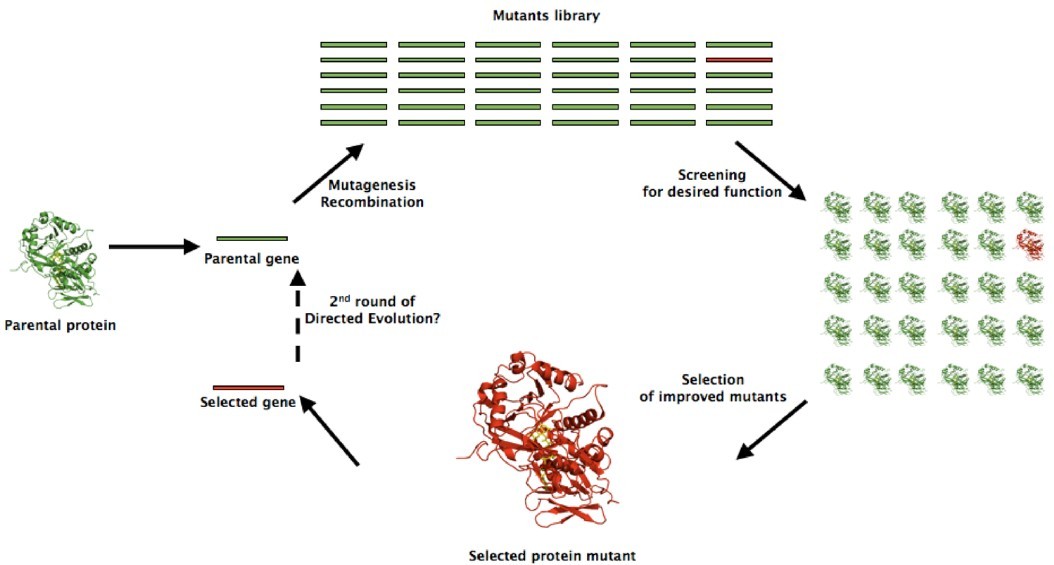 Figure 1. Directed evolution campaign. (Rigoldi et al., 2018)
Library Construction
We employ a diverse toolkit of library construction methods, each selected based on the target property, the structural and functional knowledge available for the enzyme, and the desired diversity landscape. Our molecular biology team ensures that each library is balanced in composition, free from sequence bias, and representative of the designed diversity space.
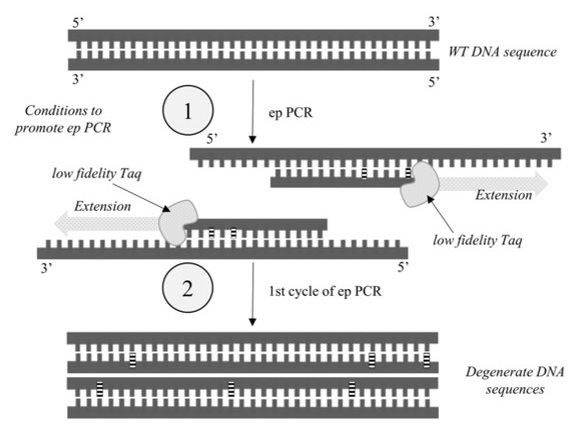
Error-prone PCR
- Controlled random mutagenesis across the entire coding sequence using error-prone DNA polymerases with tunable error rates, enabling the introduction of 1–7 mutations per kilobase depending on the desired diversity level
- Optimization of Mn2+ and Mg2+ concentrations, dNTP ratios, and polymerase conditions to achieve a balanced mutation spectrum (transitions, transversions, insertions, deletions) that maximizes functional diversity
- Library size validation by colony counting and next-generation sequencing to confirm that the constructed library covers the theoretical diversity space with adequate depth
- Application to enzymes where the target property is likely distributed across multiple regions of the protein and where no specific structural hypothesis guides targeted mutagenesis
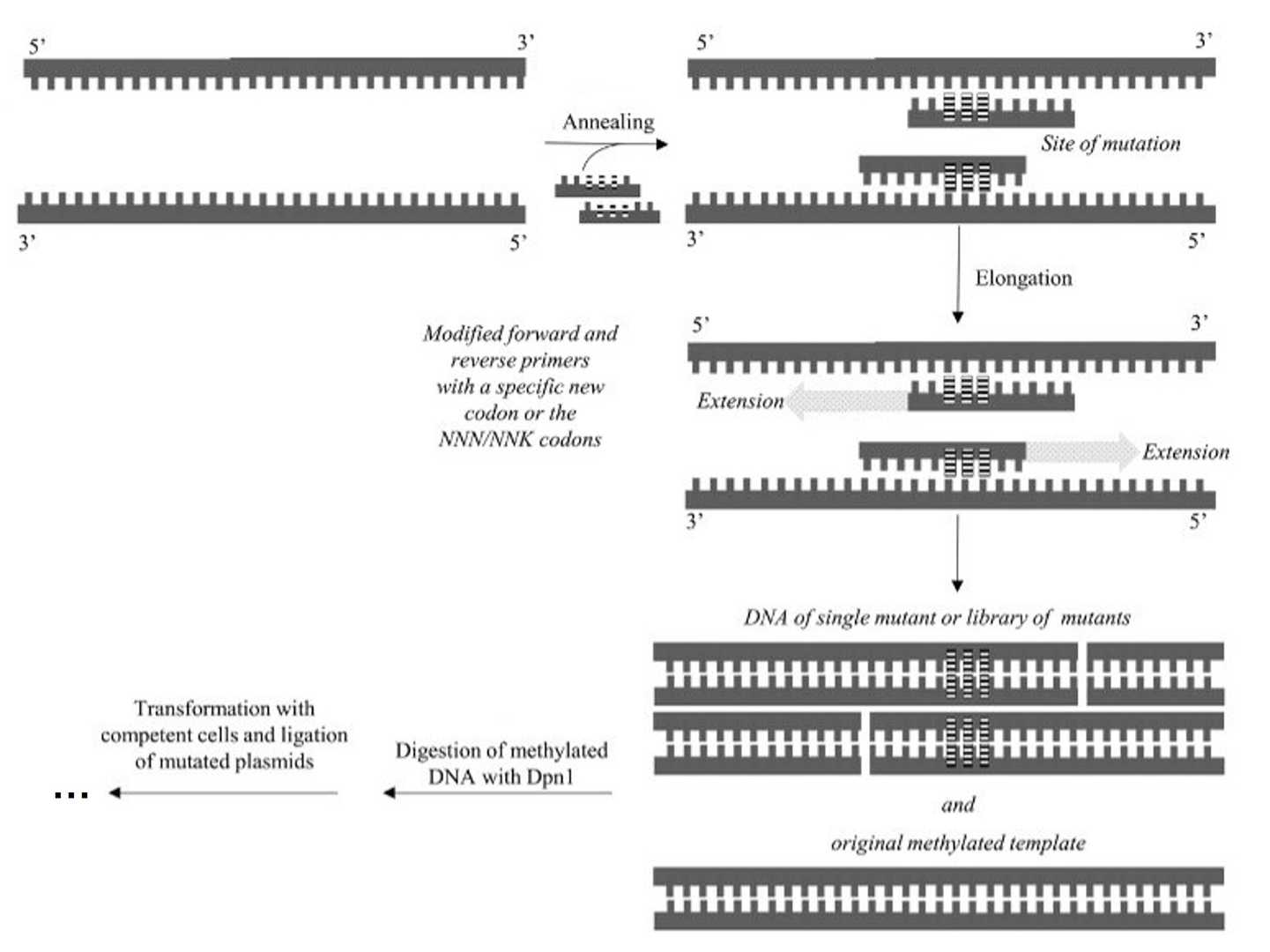
Saturation Mutagenesis
- Complete substitution of every amino acid position within a defined target region (single site, multiple sites, or full sequence) with all 20 proteinogenic amino acids using NNK or NNS degenerate codons
- Focused saturation at positions identified by structural analysis, computational modeling, or prior mutagenesis data as likely to influence the target property (active site, substrate binding pocket, surface residues, dimer interface)
- Combinatorial saturation mutagenesis (ISM) at multiple sites to explore synergistic mutation effects and identify optimal amino acid combinations that cannot be predicted from single-site data
- Quality control by sequencing of random clones to verify codon distribution uniformity and confirm absence of frameshifts, premature stop codons, or synthesis artifacts
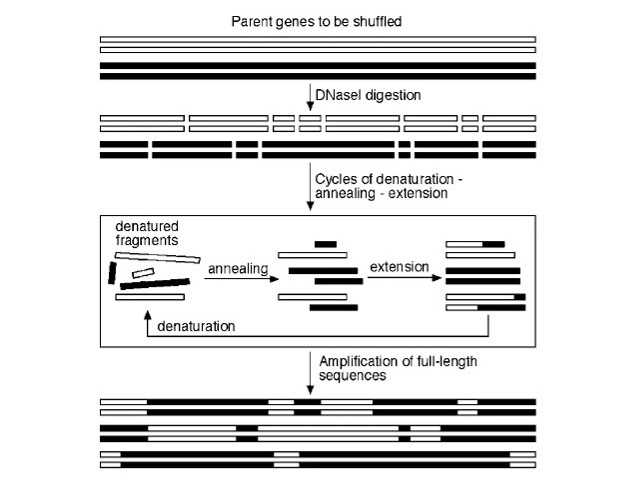
DNA Shuffling
- Generation of combinatorial libraries by fragmentation and reassembly of related gene sequences (family shuffling) or mutant gene pools (staggered extension process, SEPR), creating chimeric enzymes that combine beneficial mutations from different parental variants
- Family shuffling of homologous enzymes from different species to access natural sequence diversity and identify hybrids with improved properties not present in any single parent
- Back-crossing of shuffled libraries with the wild-type sequence to remove neutral or deleterious mutations while retaining beneficial combinations, accelerating convergence toward optimal variants
- Application to enzymes where multiple beneficial mutations have been identified in separate variants and where combinatorial exploration is needed to find the best combination
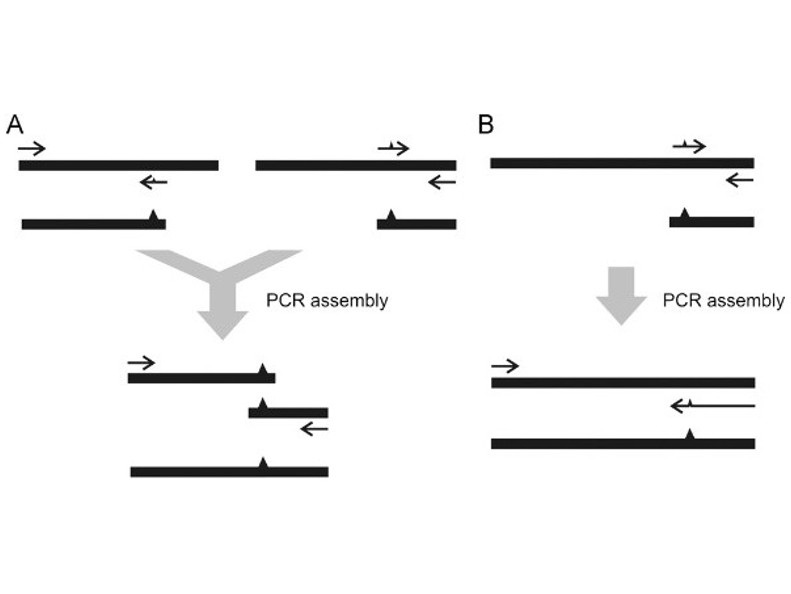
Site-directed Libraries
- Rational design of focused libraries based on structural information, sequence alignments, or computational predictions, targeting specific residues or regions with high probability of influencing the desired property
- Design of smart libraries using reduced amino acid alphabets (e.g., hydrophobic, polar, charged subsets) to increase the probability of functional variants while reducing library size and screening burden
- Integration of machine learning predictions and Rosetta or AlphaFold-based energy calculations to prioritize mutation sites and amino acid substitutions with the highest predicted impact
- Application when structural data or mechanistic understanding provides a strong hypothesis for which residues to mutate, enabling efficient exploration of high-probability variants
High-throughput Screening
Our screening platforms are designed to evaluate large mutant libraries under conditions that closely mimic the intended diagnostic application. We develop customized screening assays that correlate strongly with the target performance property, ensuring that identified hits will translate effectively to the final assay format.
Activity Screening
- Quantitative kinetic screening using chromogenic, fluorogenic, or chemiluminescent substrates in 96-, 384-, or 1536-well microplate formats, enabling the evaluation of >104 variants per round
- Determination of catalytic parameters (kcat, KM, kcat/KM) for hit variants under standard and challenging conditions to identify mutations that improve turnover rate or substrate affinity
- Screening under assay-relevant conditions: elevated temperature, non-physiological pH, presence of organic solvents, or in the presence of potential inhibitors to select for robust performance
- Signal-to-noise optimization screening to identify variants with improved detection sensitivity and reduced background signal in the target diagnostic platform
Stability Screening
- Thermal stability screening by differential scanning fluorimetry (DSF) or thermal shift assays to identify variants with increased melting temperature (Tm) and improved resistance to thermal denaturation
- Accelerated degradation screening at elevated temperature, oxidative stress, or freeze-thaw cycles to identify variants with extended shelf-life under storage and shipping conditions
- Lyophilization compatibility screening to evaluate activity retention and structural integrity after freeze-drying and reconstitution, critical for kit-based diagnostic products
- Long-term stability monitoring of primary hits under real-time storage conditions to confirm that enhanced stability translates to practical shelf-life extension
Specificity Screening
- Substrate specificity profiling using panels of structurally related substrates to identify variants with altered or broadened substrate scope for multi-analyte detection platforms
- Cross-reactivity screening against structurally similar non-target analytes, endogenous interferents, and common assay matrix components to select for improved analytical specificity
- Inhibitor resistance screening in the presence of known or suspected inhibitors (e.g., heparin, hemoglobin, lipemic components) to identify variants that maintain activity in complex clinical matrices
- Enantioselectivity or regioselectivity screening for enzymes used in chiral or positional discrimination assays, with quantification of selectivity factors (E values) for hit variants
Automation Platform
- Integrated robotic liquid handling systems (Hamilton, Tecan, Agilent) for accurate and reproducible pipetting across microplate formats, eliminating well-to-well variation and operator-dependent errors
- Automated colony picking and culture inoculation from agar plates to liquid media, enabling seamless transition from library construction to expression and screening
- High-content imaging and multimode plate readers for simultaneous detection of multiple readouts (absorbance, fluorescence, luminescence, polarization) in a single screening run
- Data pipeline integration with laboratory information management systems (LIMS) for real-time tracking, automated hit calling based on statistical thresholds, and direct export to sequence analysis workflows
Hit Identification
Following primary screening, identified hits undergo rigorous secondary and tertiary validation to confirm that observed improvements are genuine, reproducible, and attributable to the intended mutation(s). This multi-tier validation process eliminates false positives and ensures that only the most promising variants progress to downstream characterization.
- Hit confirmation and re-expression: Independent re-cloning, re-expression, and re-purification of primary hits to confirm that the observed phenotype is sequence-dependent and not an artifact of library construction or screening conditions
- Biochemical characterization: Comprehensive kinetic analysis (kcat, KM, kcat/KM), thermal stability profiling (Tm, ΔG), and structural integrity assessment (CD spectroscopy, DSF) of confirmed hits under standardized conditions
- Diagnostic context validation: Evaluation of hit performance in the target assay format and matrix, including detection limit, dynamic range, precision, and interference resistance, to confirm translational relevance
- Sequence analysis: Full-length sequencing of validated hits to identify the specific mutation(s) responsible for the improved phenotype, with correlation to structural and functional predictions where available
- Epistasis and combination analysis: Systematic combination of individual beneficial mutations to identify additive or synergistic effects, and back-mutation analysis to confirm the contribution of each mutation to the observed phenotype
- Iterative evolution: Design and construction of second-generation libraries focused around validated hit sequences, enabling further rounds of optimization and convergence toward the global optimum
Workflow
Our directed evolution workflow is structured as an iterative cycle of library construction, screening, hit identification, and validation, with each round informed by the data and insights from the previous cycle. This systematic approach maximizes the probability of success while minimizing the time and resources required to achieve the target performance improvement.

| Phase |
Activities |
Timeline |
| Phase 1: Project Definition |
Target property definition, parental enzyme characterization, structural analysis, and library strategy selection based on available data and project goals. |
1–2 weeks |
| Phase 2: Library Construction |
Gene synthesis or PCR-based mutagenesis, library cloning, transformation, and quality control by sequencing and colony counting. |
2–4 weeks |
| Phase 3: Primary Screening |
High-throughput screening of the mutant library under selective conditions, automated hit calling, and primary hit identification. |
2–3 weeks |
| Phase 4: Hit Validation |
Re-expression, biochemical characterization, diagnostic context validation, and sequence analysis of primary hits to confirm genuine improvements. |
3–4 weeks |
| Phase 5: Iterative Optimization |
Design of second-generation libraries based on validated hits, followed by additional rounds of screening and validation to achieve further improvement. |
4–6 weeks per round |
| Phase 6: Final Variant Delivery |
Sequence confirmation, expression optimization, scale-up production, and comprehensive documentation of the evolved enzyme variant. |
2–3 weeks |
FAQs
Q1. What properties of diagnostic enzymes can be improved through directed evolution?
A1. Directed evolution can improve virtually any measurable enzyme property relevant to diagnostic applications. Common targets include thermostability, pH tolerance, organic solvent resistance, substrate specificity, catalytic turnover rate, inhibitor resistance, lyophilization compatibility, and signal-to-noise ratio. The key requirement is that the target property can be translated into a selectable or screenable phenotype under high-throughput conditions.
Q2. How many rounds of evolution are typically needed to achieve meaningful improvement?
A2. The number of rounds depends on the starting enzyme, the magnitude of improvement required, and the complexity of the property being optimized. Many projects achieve significant improvement (2- to 10-fold in the target parameter) after one to two rounds of evolution. More challenging targets, such as dramatic shifts in substrate specificity or large gains in thermostability, may require three or more iterative rounds. We monitor progress after each round and adjust the library strategy accordingly.
Q3. What is the typical library size, and how does it relate to screening throughput?
A3. Library sizes range from 104 to 107 variants depending on the mutagenesis method and the diversity space being explored. Error-prone PCR libraries are typically 105–106 clones; saturation mutagenesis at a single site requires 20–32 clones but scales combinatorially for multiple sites; DNA shuffling libraries can exceed 107 variants. Our screening platform handles up to 105 variants per round in microplate format, with higher throughput achievable using droplet microfluidics or cell surface display for specialized applications.
Q4. Can directed evolution improve an enzyme that already has acceptable baseline performance?
A4. Yes. Even enzymes with good baseline performance often have substantial room for improvement when pushed beyond their natural operating envelope. Directed evolution can extend the performance margin, enabling the enzyme to function reliably under more stressful conditions (higher temperature, longer storage, harsher matrices) or with improved analytical parameters (lower detection limit, wider dynamic range, better precision). This performance headroom is valuable for regulatory submissions and competitive product positioning.
Q5. How do you ensure that screening conditions correlate with the actual diagnostic application?
A5. Screening assay design is one of the most critical steps in directed evolution. We work closely with clients to understand the intended diagnostic format, sample matrix, storage conditions, and performance specifications. The screening assay is then designed to replicate these conditions as closely as possible—using the same substrates, buffers, detection chemistry, and stress parameters that the final product will encounter. Diagnostic context validation of confirmed hits provides the final confirmation that screening improvements translate to real-world performance.
Q6. What deliverables do we receive at the end of a directed evolution project?
A6. Deliverables include the nucleotide and amino acid sequences of all validated hit variants, comprehensive biochemical characterization data (kinetics, stability, specificity), diagnostic context validation results, a complete project report documenting the library design, screening strategy, and evolutionary trajectory, and—if requested—research-grade or pre-IVD quantities of the optimized enzyme. For iterative projects, interim reports after each round enable go/no-go decision-making before committing to subsequent rounds.
Creative Enzymes Diagnostic combines molecular diversity generation expertise, automated high-throughput screening capabilities, and rigorous hit validation to deliver evolved enzyme variants with quantifiably superior performance for diagnostic applications. Whether you need enhanced stability for lyophilized kits, improved specificity for complex matrices, or elevated activity for sensitive detection platforms, our directed evolution platform provides a systematic path from wild-type to optimized enzyme.
Contact our business development team today to discuss your specific project needs!
References
- Rigoldi F, Donini S, Redaelli A, Parisini E, Gautieri A. Review: Engineering of thermostable enzymes for industrial applications. APL Bioengineering. 2018;2(1):011501. doi:10.1063/1.4997367
- Siloto RMP, Weselake RJ. Site saturation mutagenesis: Methods and applications in protein engineering. Biocatalysis and Agricultural Biotechnology. 2012;1(3):181-189. doi:10.1016/j.bcab.2012.03.010
- Joern JM. Dna shuffling. In: Directed Evolution Library Creation. Vol 231. Humana Press; 2003:85-90. doi:10.1385/1-59259-395-X:85
- Jimenez-Rosales A, Flores-Merino MV. Tailoring proteins to re-evolve nature: a short review. Mol Biotechnol. 2018;60(12):946-974. doi:10.1007/s12033-018-0122-3
Related Services