
Creative Enzymes helps diagnostic developers determine where refrigerated or frozen handling can be reduced without confusing technical feasibility with a finished-product stability claim. We connect enzyme behavior, formulation, reagent format, packaging, distribution exposure, device conditions, and functional assay performance in one decision program.
POCT products are often expected to work where centralized laboratories have the least control: small clinics, pharmacies, mobile units, field programs, decentralized manufacturing networks, and homes or workplaces used for research sampling. The user may have limited refrigeration, limited training, intermittent power, a small inventory turnover, or no way to document an unplanned excursion. These are strong reasons to reduce cold-chain dependence, but they also make the technical claim more demanding. “Ambient” is not a single temperature, and a distribution lane is not represented by one constant incubator condition.
Our strategy service begins with the business and use problem, then translates it into a technical target. We ask which material is temperature controlled, at what stage, for how long, and why. The constraint may originate in a glycerol-containing enzyme stock at the manufacturing site, an unstable liquid master mix, a humidity-sensitive dried pellet, a package with insufficient barrier, a refrigerated finished kit, or a site procedure that leaves an opened pouch beside a warm instrument. Each problem calls for a different intervention.
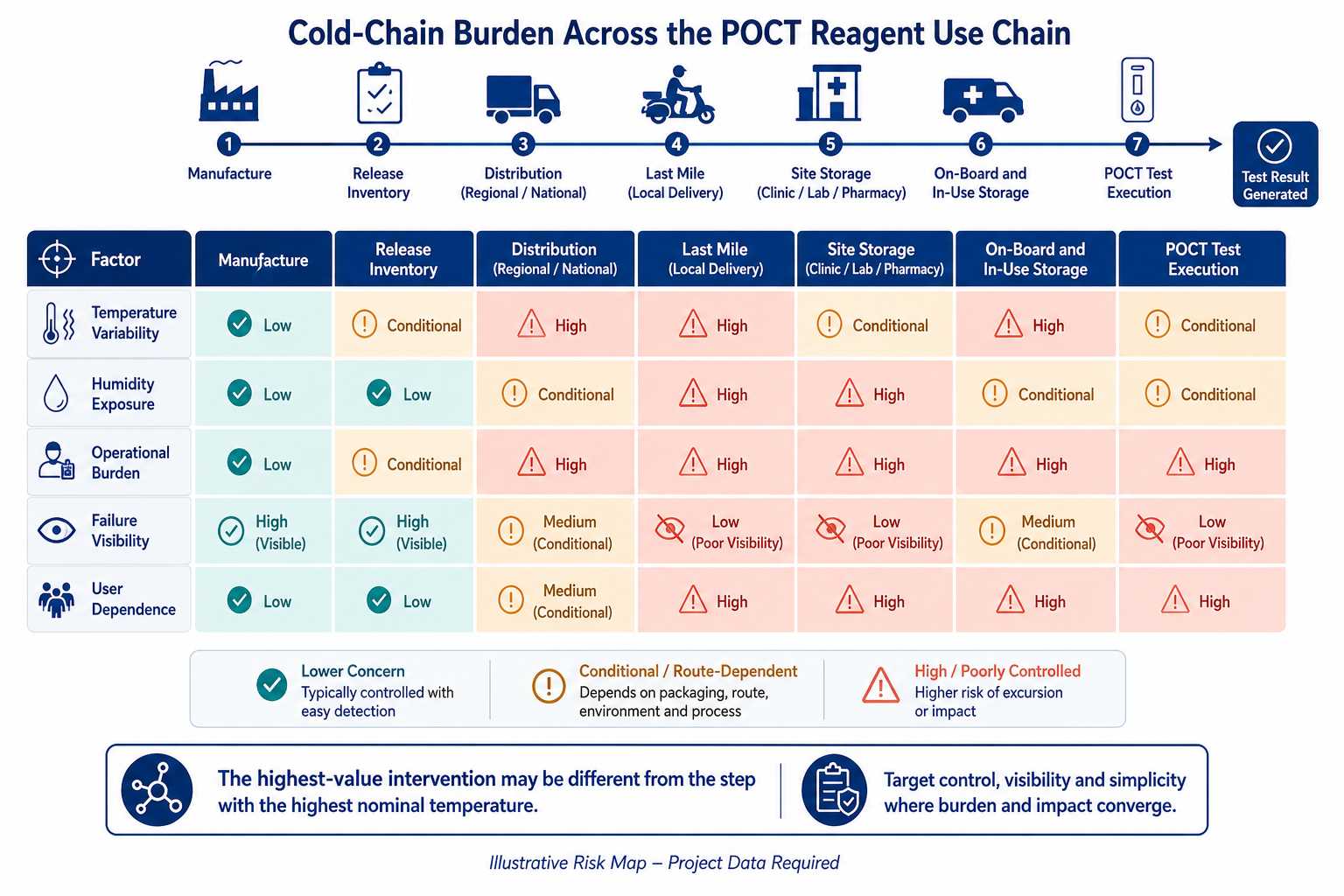
Cold-chain reduction programs fail when teams optimize what is easiest to test rather than what is most costly or fragile in the use chain. We construct a burden ledger that follows material from manufacturing through the reported POCT result. The ledger identifies temperature-control steps, duration, frequency, failure consequences, monitoring practices, packaging burden, waste, and the stakeholder who owns each step. This reveals whether the priority is a reagent-development problem, a packaging problem, a route-qualification problem, or an inventory-policy problem.
The heatmap above is illustrative; it is not a default risk score. In a real project, cells are populated from the customer's current route, seasonal data, instrument environment, reagent presentation, and quality history. We distinguish the nominal storage label from the temperatures the product is likely to experience. Where field information is limited, we identify data gaps rather than replacing them with arbitrary stress conditions.
| Input | Questions resolved | Why it changes the strategy | Typical evidence or material |
|---|---|---|---|
| Current reagent and format | Which enzyme, cofactors, substrates, primers, antibodies, dyes, salts, and preservatives are present? Liquid, dried, bead, pellet, membrane, or cartridge-deposited? | Different components fail through different pathways and may be incompatible with the same drying or stabilization route. | Composition ranges, certificate data, current storage instruction, fill volume, process flow |
| Assay performance profile | Which result attributes are most sensitive to degradation? | Residual activity can look acceptable while LoD, time-to-result, background, precision, or qualitative agreement changes. | Baseline curves, control material, weak-positive or near-cutoff panel, current acceptance limits |
| Distribution and inventory route | What are the nodes, dwell times, seasons, transport modes, customs risks, and monitoring gaps? | A controlled ambient window must match actual sequences and durations, not a generic constant-temperature exposure. | Lane maps, logger histories, packaging configuration, complaint or excursion records |
| POCT environment | What temperature, humidity, altitude, power, dust, light, and user-handling conditions are plausible? | Deployment conditions can create failure modes absent in a development laboratory. | Target product profile, user workflow, reader specifications, site interviews or field observations |
| Operational objective | Which step must change, and what is the acceptable residual control? | Removing cold packs from shipment is a different program from supporting two-year ambient storage. | Cost map, service-level requirement, waste target, receiving constraints, launch markets |
Cold-chain dependence is rarely removed by one additive or one process setting. We use a layered control strategy in which each layer is assigned a job and a verification method. The objective is not to maximize the number of interventions. It is to assemble the smallest practical stack that protects the critical performance attributes under the target route and use profile.
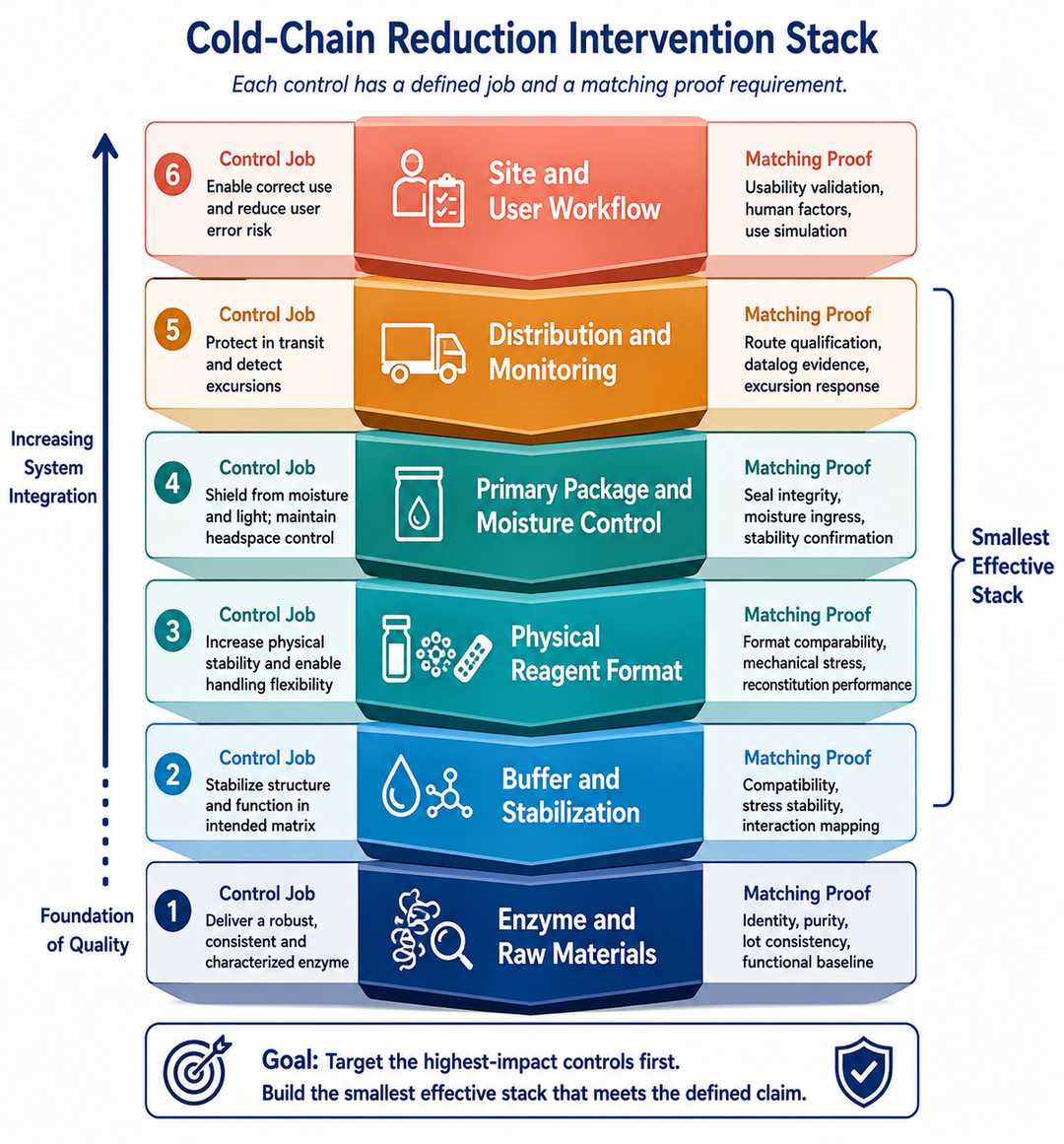
We begin with the least disruptive change capable of meeting the operational target. If a liquid reagent already has adequate margin for a short ambient shipment window, a route-specific qualification and packaging adjustment may be more efficient than converting the assay to a dried format. If repeated freeze-thaw at the manufacturing site is the dominant risk, aliquoting or bulk-hold controls may solve the problem without changing the customer-facing kit. If the final site cannot support refrigeration at all, a dried unit dose and high-barrier package may be necessary.
When drying is appropriate, the choice among air drying, lyophilization, beads, pellets, and in-cartridge deposition is driven by composition, thermal exposure during processing, fill precision, residual moisture, reconstitution, device geometry, and scale. Our Air-Dryable Master Mix Optimization Service, Lyophilized Enzyme Formulation Development Service, and Lyophilized Bead and Pellet Reagent Development can be used as technical work packages within the broader strategy.
Formulation is treated as an interaction problem. A sugar that protects an enzyme during drying may slow dissolution; a polymer that improves glass formation may change viscosity or microfluidic flow; a surfactant may reduce surface adsorption but affect a membrane or fluorescence readout; a preservative may protect a multi-use liquid yet inhibit amplification. The Excipient, Buffer and Stabilizer Screening for Diagnostic Enzymes service is linked when a structured design space is needed.
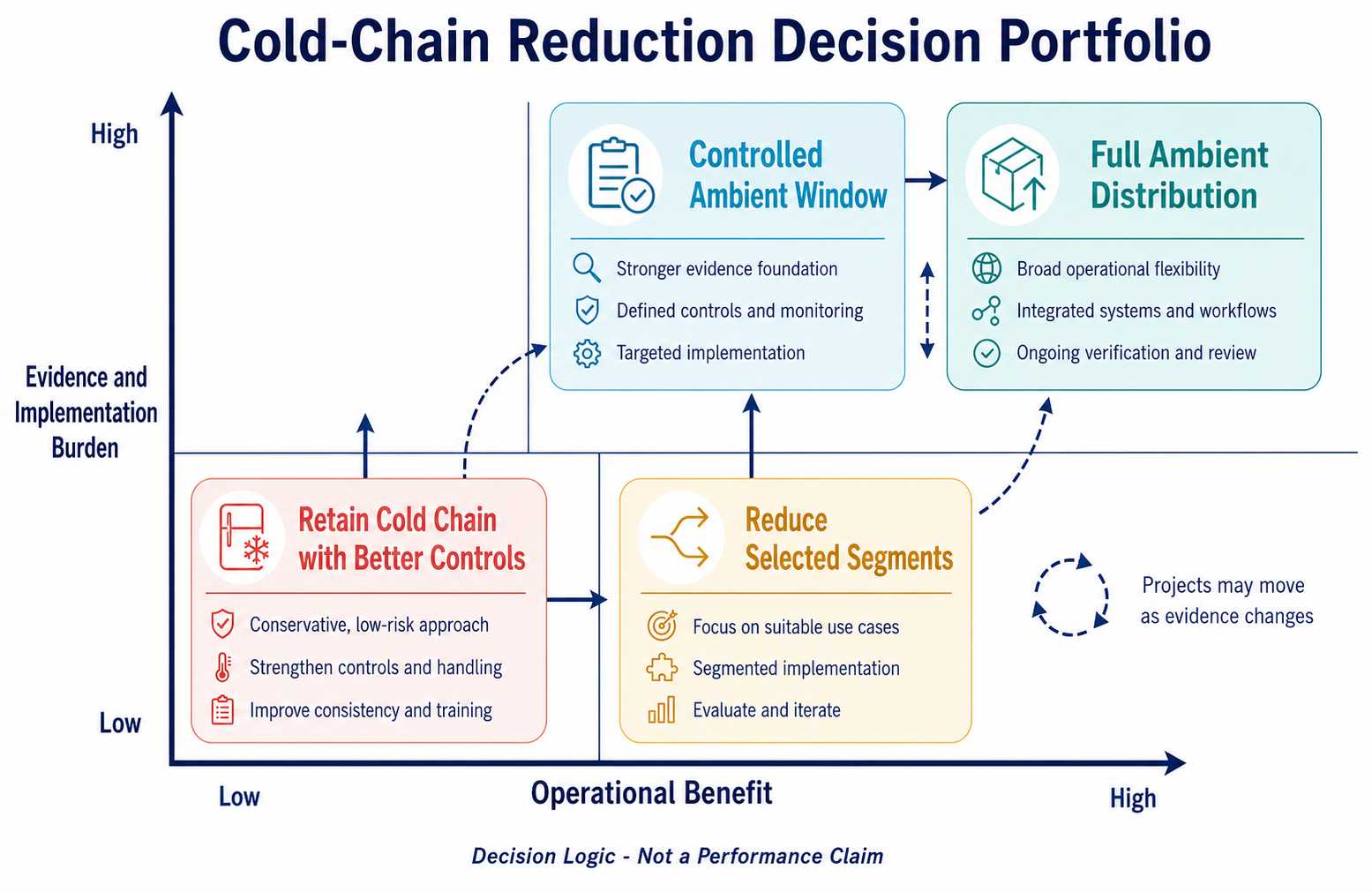
Best suited when the final system has adequate stability margin, package protection, and functional performance across the proposed range and duration. Evidence must cover the packaged product, relevant lots, route exposure, real-time storage, and use conditions. This outcome may require a dried unit-dose format but should not be assumed at project start.
Useful when long-term cold storage remains appropriate but cooling during a defined shipment, receiving delay, or field-use interval is the main burden. The window must specify range, duration, sequence, package, and what happens after exposure; “room temperature for several days” is not precise enough.
Cold chain is removed from selected lanes, seasons, or distribution nodes while retained elsewhere. This can create operational benefit with less formulation disruption, but it requires clear route assignment, inventory controls, labeling logic, and change governance to prevent a qualified lane from being generalized.
When removal would reduce sensitivity, complicate manufacturing, increase package cost, or demand evidence disproportionate to the benefit, we document the decision and focus on freeze-thaw control, improved pack-out, excursion handling, or monitoring. A disciplined no-go decision is a valid development output.
A cold-chain claim needs an evidence trail that remains connected as the product moves from a development vial to its final POCT configuration. We call this the evidence passport. Each gate answers a different question, and passing one gate does not automatically satisfy the next. This prevents a promising elevated-temperature screen from being used as if it were real-time shelf-life or final-device evidence.
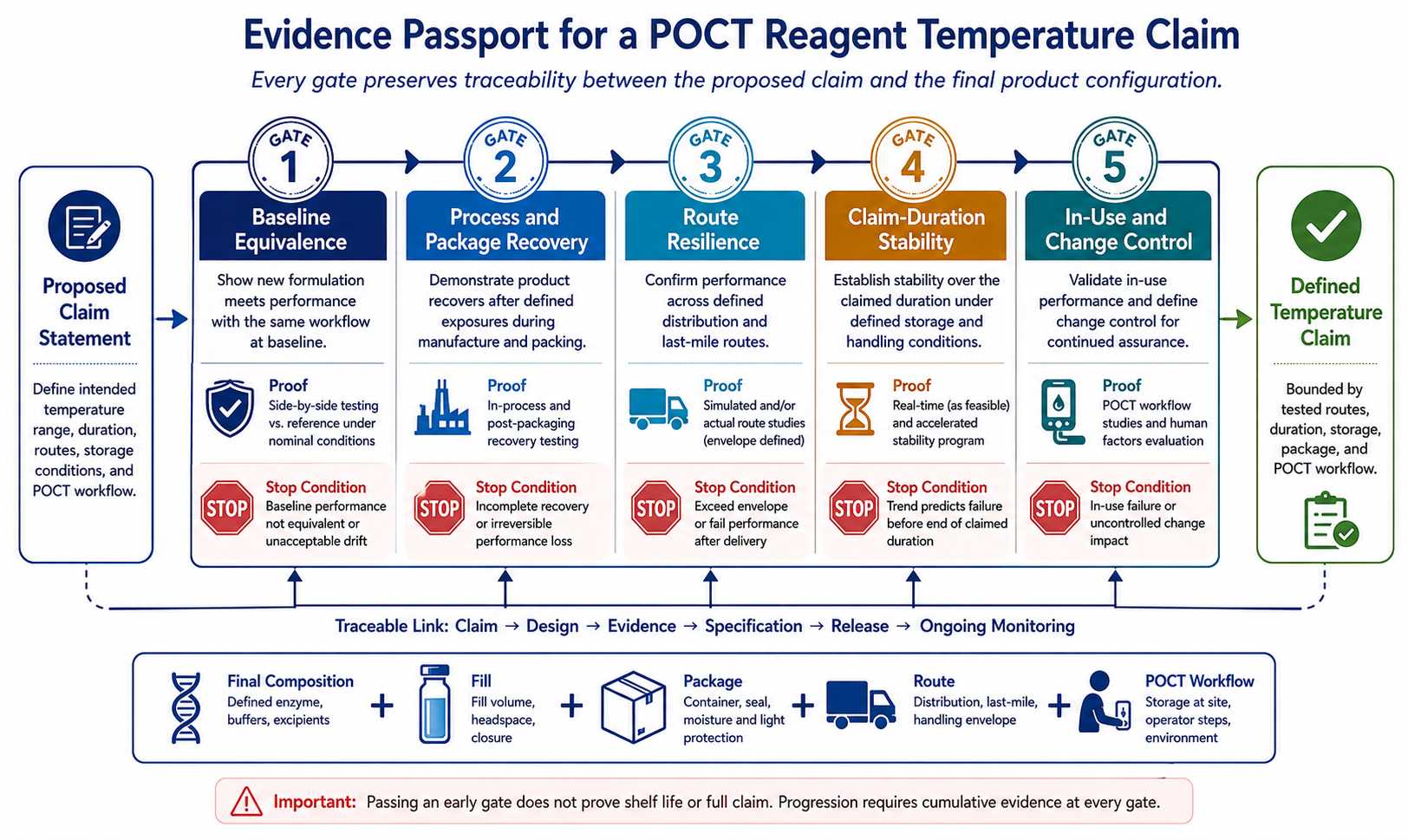
Enzyme activity is useful for diagnosing a molecular failure, but the customer receives value from an assay result. We therefore select endpoints at three levels: material attributes, enzyme function, and complete-assay performance. The endpoint panel is tailored to the technology—molecular amplification, immunoenzymatic detection, biosensor chemistry, clinical chemistry, or another enzyme-enabled format.
| Study module | Primary decision | What it can support | What it cannot establish alone |
|---|---|---|---|
| Feasibility stress screen | Rank formulations, formats, packages, or enzymes and expose failure modes quickly. | Down-selection and mechanistic understanding. | A marketed shelf life or unrestricted ambient claim. |
| Accelerated stability | Assess drift under elevated conditions using a scientifically justified design. | Risk assessment, model development where appropriate, and early evidence. | Real-time behavior when degradation pathways change with temperature, moisture, or physical state. |
| Real-time stability | Measure performance under the proposed long-term storage condition through the claim period. | Shelf-life support within the study scope and applicable requirements. | Unstudied transport routes, open-pouch use, or a different package/process. |
| Transport simulation or route study | Challenge the packaged product with route-relevant temperature sequences and mechanical stresses. | Suitability of defined transport conditions and post-transport performance. | Long-term shelf life unless the study is integrated with subsequent real-time storage. |
| In-use / open-vial / on-board | Assess exposure after the primary barrier is opened or the reagent is placed in the device. | Discard time, repeat access, on-board dwell, and user-workflow limits. | Sealed-product transport or shelf life. |
For dedicated shelf-life design and analysis, we can connect the strategy to our Ambient-Temperature Stability and Shelf-Life Study and Accelerated and Real-Time Stability Testing for Diagnostic Reagents. Route-specific challenges can be developed through Freeze-Thaw and Shipping Stress Testing for Diagnostic Enzymes. Once the primary barrier is opened or the reagent resides on the reader, Open-Vial and On-Board Stability in IVD Reagents becomes a separate evidence module.
Reagents designed for centralized laboratory workflows may be transferred with calibrated pipettes, controlled humidity, trained operators, and rapid refrigeration after opening. POCT systems remove many of these assumptions. A cartridge may contain small dried deposits with high surface-area exposure. A handheld reader may warm the consumable. A user may add a variable specimen volume, leave a pouch open, or interpret a color change at a different time. Cold-chain reduction is successful only if the system remains robust to the intended workflow.
We assess adsorption to plastics or membranes, drying location, seal materials, extractables/leachables risk signals, reconstitution path, bubbles, capillary flow, valve actuation, and the contact sequence among sample, buffer, and dried reagent. A formulation that performs in a polypropylene tube may behave differently in a porous pad or a narrow microfluidic chamber. If the final consumable is available, confirmation is planned in that geometry; if it is not, we document the surrogate and the bridging work required. The related POCT Cartridge Compatibility for Enzyme Reagents page covers this integration work in greater depth.
Site simulations can include high and low humidity, delayed unpacking, open-pouch exposure, variable equilibration after cold storage, reconstitution-volume error, timing variation, reader heat, repeat access, and interruption of the workflow. The purpose is not to create an indiscriminate torture test. It is to identify the user actions and environmental conditions that are both plausible and performance-relevant, then convert them into controls, instructions, or design changes.
A dried single-use reagent may reduce refrigeration and simplify dosing, yet require new filling equipment, longer processing, a barrier pouch, desiccant, and a reconstitution step. A liquid unit dose may offer simpler manufacturing but still need refrigeration. A two-component system may keep the most labile enzyme cold while allowing other components to ship ambient, but it adds user steps. The decision should be made using the complete operating model. Our Liquid vs Dried Diagnostic Reagents: Development Trade-Offs service helps compare these alternatives before process investment.
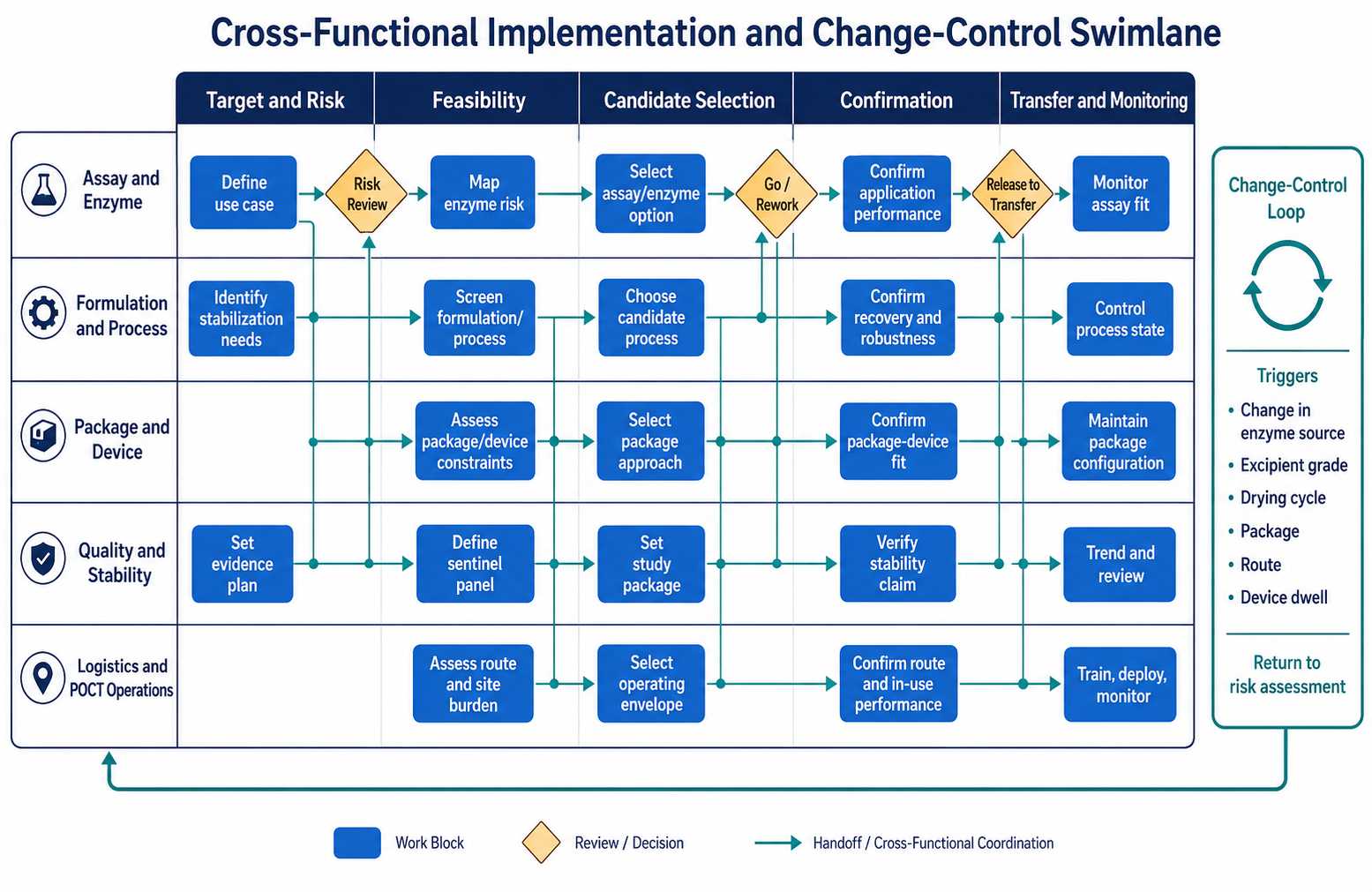
The workflow is modular because programs enter at different maturity levels. Some customers have a working assay and a final cartridge but insufficient route evidence. Others have a labile enzyme stock and need a new format. At each gate, the team decides whether to advance, revise the target, add a control layer, or stop. This keeps the evidence proportional to the claim and prevents downstream studies on an unstable or poorly defined configuration.
| Gate | Key question | Possible decisions | Evidence retained |
|---|---|---|---|
| Target gate | Is the proposed reduction tied to a real operational burden and a defined route/use profile? | Proceed; narrow the claim; collect missing route data; stop. | Product-use profile, burden ledger, claim statement, risk register. |
| Margin gate | Does the baseline assay have enough functional margin to tolerate formulation or process change? | Proceed; improve assay/enzyme first; adjust acceptance criteria with scientific justification. | Baseline performance and stress-response dataset. |
| Technology gate | Which intervention stack meets performance and manufacturing constraints? | Select liquid optimization, drying, package upgrade, route controls, or a hybrid. | Ranked options, comparator data, failure analysis, manufacturing fit. |
| Claim gate | Does the final packaged configuration meet the predefined criteria under the evidence plan? | Support target; reduce range/duration; retain cold chain; add real-time or use data. | Study reports, statistical analysis, deviations, and claim-to-evidence matrix. |
| Transfer gate | Can manufacturing, quality, logistics, and field teams maintain the qualified state? | Transfer; add controls; conduct bridging; defer launch-market expansion. | Specifications, SOP inputs, monitoring plan, change-impact rules. |
If some inputs are unavailable, the first phase can be used to define the information gap and a practical way to obtain it.
Analytical methods can be supported through Enzymes Activity and Stability Analysis or Enzyme-Based Product Custom Analysis Method Development. Quality-focused characterization and documentation can be coordinated with Enzyme QC/QA. Customers who need a broader view of available materials can also review our molecular diagnostic enzymes and kits.
Study duration and sample count are not fixed on this page because they depend on the proposed claim, number of candidates, lots, temperatures, time points, packaging configurations, assay replicates, and whether real-time work is included. A route-window feasibility program can be materially smaller than a final shelf-life program. After review of the starting package, we propose phased work with decision gates so that higher-effort confirmation begins only after the candidate and claim are sufficiently defined.
No. An optimized liquid, unit-dose presentation, package upgrade, qualified ambient shipping window, seasonal distribution rule, or revised inventory practice may meet the actual objective. Drying is considered when it provides enough stability or workflow benefit to justify the process, packaging, and reconstitution burden.
Not by itself. Accelerated studies are valuable for candidate ranking, failure-mode work, and scientifically justified modeling, but elevated temperature can introduce degradation pathways that do not dominate at the intended storage condition. Real-time and final-configuration evidence is generally needed to support the proposed duration according to the applicable claim and requirements.
Ambient storage is a long-term condition defined by a specified range and claim period. A controlled ambient window is a bounded interval—such as a defined shipment or receiving delay—after which the product may return to its normal storage condition or be used. The window must also define the package, exposure sequence, cumulative rules, and post-exposure handling.
No. The program is designed to determine what is technically and operationally supportable. The defensible result may be full removal, partial reduction, a narrower temperature range or duration, or retention of cold chain with improved controls. We report the evidence and remaining risks rather than guaranteeing a predetermined stability outcome.
Strong positive samples can retain an obvious signal even when a reagent has lost meaningful performance margin. Weak-positive, low-copy, near-cutoff, or otherwise challenging material is more sensitive to drift in kinetics, sensitivity, background, and detection agreement. The exact panel depends on the assay technology and intended decision.
It may be an important component-level method, but a POCT reagent should also be evaluated through its functional assay. Formulation, packaging, reconstitution, matrix, or device effects can change the reported result even when an isolated enzyme activity method appears acceptable.
Where the final configuration is available and within scope, it should be used for confirmation. Earlier phases may use a development container or surrogate to conserve resources, but the surrogate and required bridging are documented. A claim should not silently transfer from a laboratory vial to a different cartridge or package.
For dried reagents, temperature and moisture interact. Water uptake can increase molecular mobility, promote chemical degradation, change physical structure, or affect dissolution. We therefore consider drying endpoint, residual moisture or water activity where appropriate, seal integrity, barrier performance, desiccant, open-pouch exposure, and the humidity profile of the intended setting.
Yes. A last-mile or receiving window is often a practical target when long-term refrigerated storage is acceptable but local transport, unpacking delay, or site infrastructure is unreliable. The study should reproduce the relevant sequence and confirm what happens after exposure, including remaining shelf-life implications.
The handoff includes a change-impact map. Changes that can alter stability—such as enzyme source, excipient grade, drying cycle, fill, primary package, seal, desiccant, shipping lane, or device dwell—are identified for risk assessment and potential bridging. The extent of bridging depends on the change and the existing evidence.
Study design is aligned as applicable with current versions of relevant standards, guidance, customer quality requirements, product maturity, and target-market expectations. ISO 23640, CLSI EP25, FDA-recognized consensus-standard information, and WHO IVD stability guidance are useful references, but the applicable framework must be confirmed for the specific product and jurisdiction.
This page completes the cold-chain decision layer within our Lyophilized and Ambient-Stable Diagnostic Reagent Development service family. The following pages provide focused work packages for the selected strategy:
Share your current reagent format, storage instruction, POCT workflow, target distribution route, and the cold-chain step you want to change. Creative Enzymes can translate that objective into a phased intervention and evidence plan, with clear decision gates and no assumption that full ambient storage is the only successful outcome.
Discuss Your POCT Reagent Program