
Cross-reactivity reduction is not simply a request for a "more specific enzyme." It is a defined discrimination problem: the enzyme must retain useful performance on the intended substrate while rejecting a named set of alternatives under the concentrations, timing, formulation, matrix, and detection conditions that matter to the diagnostic reagent.
Creative Enzymes provides project-specific substrate-specificity engineering for diagnostic enzymes and related reagent-development programs. A project can combine risk-panel design, assay-source triage, sequence and structural analysis, AI-assisted variant prioritization, paired target and counter-screen measurements, kinetic characterization, and application-functional confirmation. Most service outputs are intended for research use; selected projects may support industrial diagnostic-reagent raw-material development under an agreed scope. They are not finished consumer tests and do not constitute regulatory authorization.
An unwanted signal in a diagnostic reaction does not automatically demonstrate enzyme substrate promiscuity. The same observation can be produced by a contaminating activity, spontaneous substrate breakdown, a reporter or coupling reaction, nonspecific molecular recognition elsewhere in the assay, optical overlap, matrix-dependent detector response, or a threshold rule applied to noisy data. Engineering the enzyme before locating the source can consume a variant campaign without correcting the true failure.
We begin with a source-triage question set. Does the unwanted response track with enzyme concentration? Does it disappear when the enzyme is omitted, heat-inactivated, immunodepleted, or replaced with a mechanistically different comparator? Is the non-target converted into the expected product, or is the detector responding to something else? Does a direct analytical method agree with the coupled readout? Does purified material behave differently from crude or formulated material? Does the effect depend on reaction time, reporter capacity, cofactor concentration, matrix, or instrument settings?
Engineering gate: the campaign advances as an enzyme-specificity project only when the available evidence supports the enzyme as a meaningful control lever. If the issue is primarily impurity, formulation, reporter, or matrix interference, a better route may be enzyme purity analysis, activity and stability analysis, assay-system optimization, or a revised detection method.
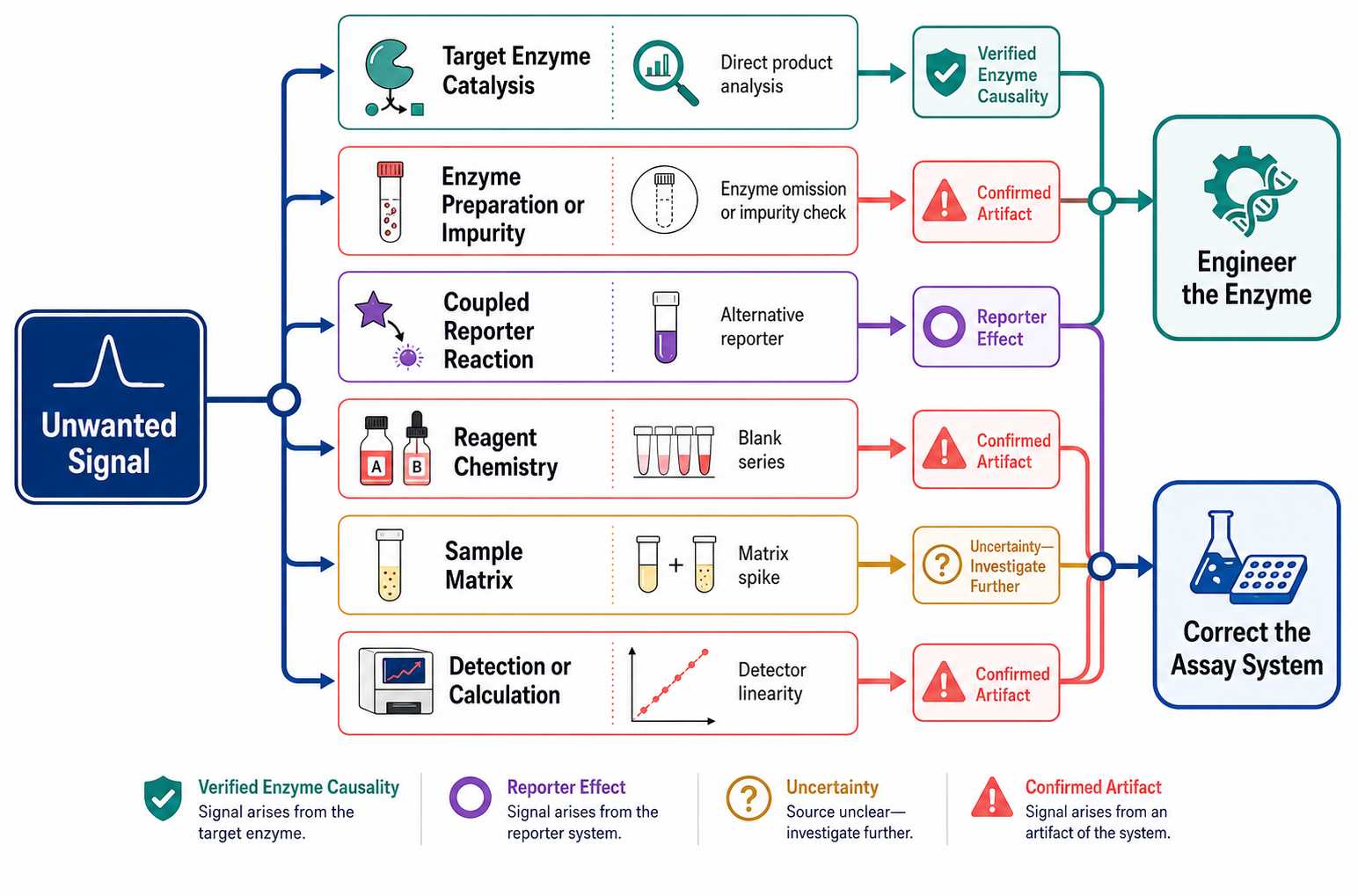 Fig 1. Cross-reactivity source triage. Unwanted signal is separated into target-enzyme catalysis, preparation impurities, coupled-reaction behavior, reagent chemistry, sample matrix, and detection or calculation effects before an enzyme-engineering campaign is opened.
(Creative Enzymes Diagnostic)
Specificity is relative to the alternatives that are tested. A statement such as "variant A is specific for substrate X" has little meaning unless the non-target panel, concentrations, reaction conditions, material state, analytical method, and reporting threshold are also stated. The risk panel therefore becomes part of the target product profile for the enzyme. It is designed from the intended diagnostic chemistry, known structural relationships, sample composition, reagent bill of materials, process knowledge, and prior failure observations.
| Risk class | Why it belongs in the panel | Example decision question | Possible evidence |
|---|---|---|---|
| Closest chemical or structural analog | Small changes may preserve binding or catalytic geometry and create the hardest discrimination problem. | Can the enzyme retain the target reaction while lowering conversion of the closest analog? | Direct product measurement, initial-rate comparison, concentration-response profile, or time-resolved conversion. |
| Homologous biological substrate | Related nucleic acids, peptides, proteins, glycans, or metabolites may coexist with the intended target. | Is discrimination maintained across the sequence, modification, or molecular states that occur in the sample? | Panel testing with verified identities, matched input amounts, appropriate positive and negative controls, and orthogonal confirmation. |
| Reaction intermediate or product | Intermediates and products can re-enter the catalytic path, inhibit the enzyme, or produce signal through the reporter. | Does the enzyme create a side product or process a product further during the diagnostic time window? | Product-profile analysis, progress curves, mass balance, inhibitor response, or time-window challenge. |
| Reagent or reporter component | A dye substrate, cofactor analog, carrier, stabilizer, primer, probe, or coupling substrate may create apparent cross-reactivity. | Is the non-target signal preserved when the detection chemistry is changed or measured directly? | Component omission, alternative reporter, direct method, blank series, and coupling-capacity controls. |
| Matrix and interferent | Endogenous and exogenous materials may compete, inhibit, activate, bind, absorb, fluoresce, or alter physical reaction properties. | Does the variant's selectivity survive in representative matrix and at risk-relevant concentrations? | Spiked matrix, paired control material, interference screen, dilution response, recovery, and application-functional output. |
Panel composition is not universal. For a polymerase, the critical alternatives may include mismatched primer termini, modified nucleotides, damaged templates, or competing nucleic-acid contexts. For a ligase, they may include mismatched junctions, nick structures, or terminal modifications. For a nuclease, they may include sequence neighbors, structural states, or unintended cleavage contexts. For a biochemical diagnostic enzyme, they may include endogenous metabolites, isomers, medication-related compounds, or molecules that feed the same reporter cascade. Creative Enzymes can integrate early substrate profiling or enzyme screening against substrates when the relevant scope is not yet known.
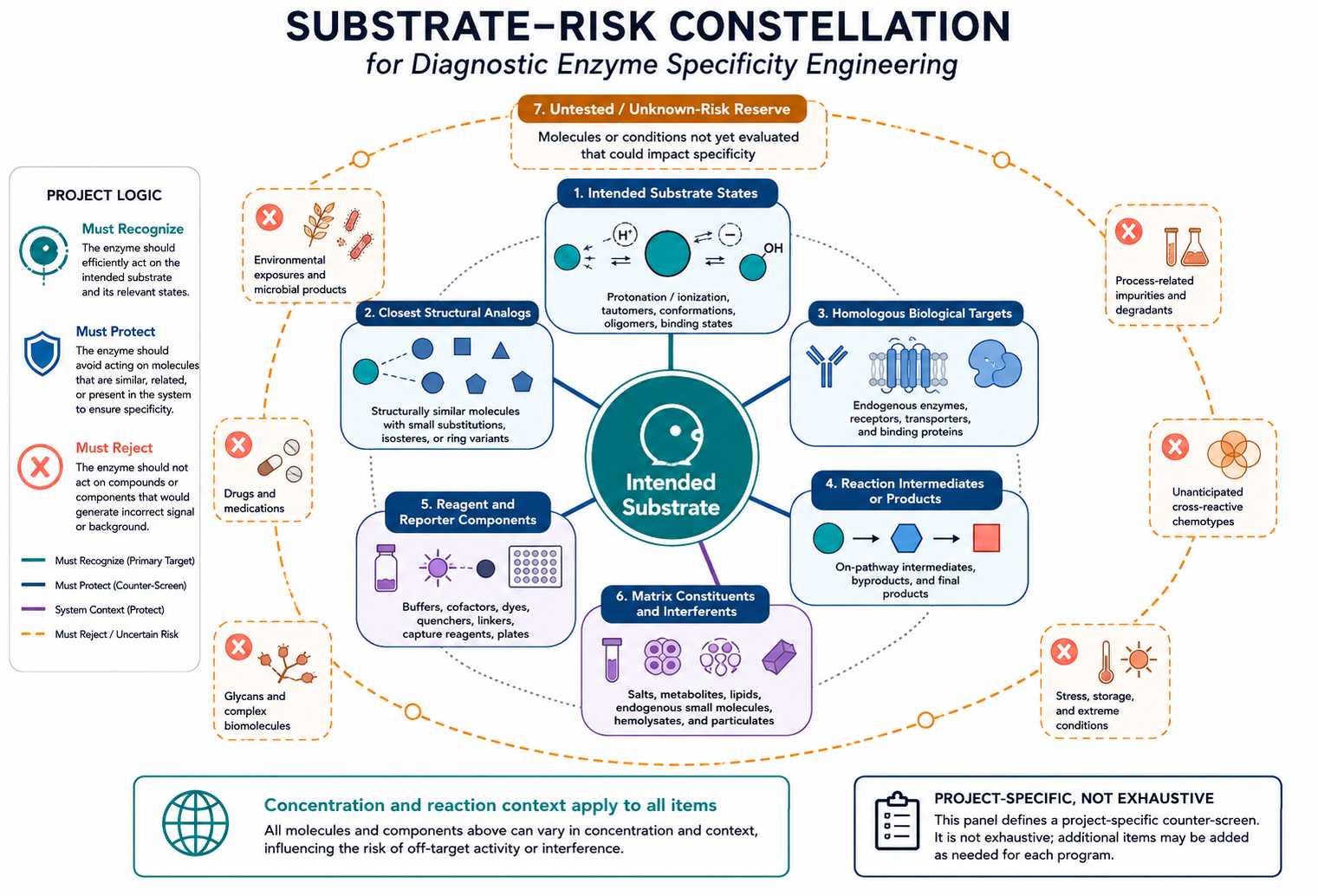 Fig 2. Must-recognize and must-reject substrate-risk constellation. The intended substrate is surrounded by structural analogs, homologous biomolecules, reaction intermediates, reagent components, matrix constituents, and an uncertainty reserve that together define the project-specific counter-screen.
(Creative Enzymes Diagnostic)
A low non-target signal can be obtained trivially by making the enzyme inactive. Conversely, high target activity does not prove improved discrimination. The engineering objective must therefore contain at least two sides: a target-retention requirement and one or more non-target limits. It should also define the conditions and protected properties under which the comparison is valid.
Ratios require care. A target/non-target activity ratio can improve because target activity rises, because non-target activity falls, or because both decline at different rates. Each mechanism has different consequences for reagent loading, reaction time, dynamic range, and stability. We retain the underlying measurements and their uncertainty rather than reporting only a composite score. Where true molar active-enzyme concentration is not available, the denominator and normalization strategy are stated explicitly.
The selectivity window also names protected properties. A variant that rejects an analog but loses soluble expression, intrinsic stability, cofactor compatibility, formulation recovery, or performance in the complete reaction may not be a useful raw material. When the main concern is catalytic efficiency rather than substrate discrimination, the adjacent AI-guided activity and kinetic performance optimization service provides the more appropriate primary route.
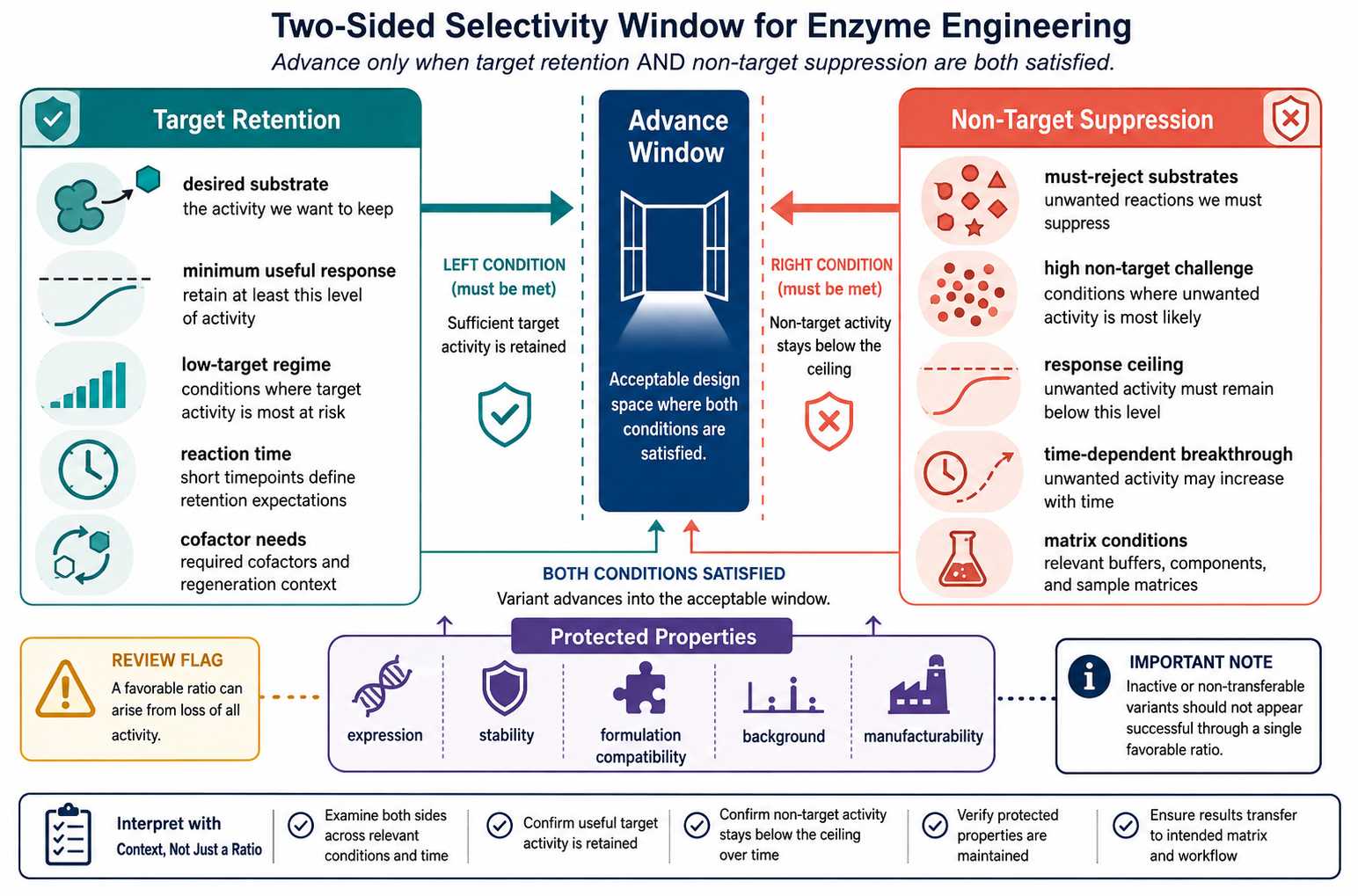 Fig 3. Two-sided selectivity window. Target activity retention, non-target suppression, protected properties, and application conditions are defined together so that inactive or non-transferable variants cannot appear successful through a single favorable ratio.
(Creative Enzymes Diagnostic)
Once the target and counter-panel are defined, computational analysis can convert the discrimination problem into testable sequence hypotheses. The available inputs may include the enzyme sequence, homologs, known substrates and non-substrates, structures or models, docking poses, molecular descriptors, prior variants, activity and expression data, and protected-property measurements. The exact model depends on data volume and quality. A zero-shot or structure-informed approach can prioritize an initial panel when project data are sparse; supervised or active-learning models become more useful as paired experimental measurements accumulate.
Substrate representations matter as much as protein representations. Closely related substrates should not be treated as interchangeable labels if stereochemistry, charge state, modification, sequence context, conformational state, or reactive atom geometry changes the catalytic problem. We can combine sequence embeddings, evolutionary conservation, coevolution, structural pocket features, substrate fingerprints, docking or simulation-derived descriptors, and measured project data as appropriate. The design report distinguishes model-derived prioritization from experimentally supported mechanism.
Recent enzyme-substrate prediction research illustrates both the opportunity and the limitation. Models such as ESP and EZSpecificity integrate protein and substrate information to prioritize plausible enzyme-substrate relationships, while multi-substrate mutational scanning shows that specificity-changing mutations can occur near and far from the active site. However, public databases contain incomplete substrate annotations and uncertain negative examples. For a diagnostic program, a project-specific target/non-target matrix is therefore more decision-relevant than a generic prediction score.
Candidate design is multi-objective. The initial portfolio can include high-confidence pocket hypotheses, distal or dynamics hypotheses, evolutionary substitutions, diverse sequence solutions, uncertainty-driven candidates, and interpretable single or low-order combinations. The portfolio is not limited to the top predicted score; diversity helps the experiment distinguish competing mechanisms and provides useful training data for the next design cycle. For broader candidate-generation and screen-allocation needs, see our AI-guided variant design and screening service, rational enzyme design, and directed evolution capabilities.
The experimental campaign is organized around a paired data structure. Each candidate is linked to exact sequence and construct identity, expression or material information, target response, non-target response, controls, plate or batch context, calculation method, and decision status. The target screen prevents selection of inactive suppressors. The counter-screen prevents selection of highly active but still promiscuous variants. Orthogonal measurements protect against reporter-specific artifacts.
The order and throughput are project-specific. A small high-information panel can be preferable to a large screen whose reporter cannot distinguish target catalysis from coupling or background effects.
Controls can include the parent enzyme, an independent parent preparation, blanks, no-enzyme reactions, no-substrate reactions, known positive and negative substrates, a nominated benchmark, inactive or catalytic-site controls where scientifically useful, reporter-capacity controls, and plate-distributed reference wells. Concentration series and time courses help determine whether apparent discrimination is stable or simply reflects a selected time point. If the primary assay is coupled, selected candidates may be confirmed by chromatographic, mass-spectrometric, electrophoretic, sequencing-based, or other direct methods as appropriate to the chemistry.
The model is updated with measurements that include failures, borderline cases, and uncertainty, not only winners. Negative examples are especially important for specificity learning, but they must be defined carefully. A response below the primary screen's detection capability is not proof of zero activity, and a substrate never tested is not a non-substrate. We label measured negatives, censored upper bounds, inconclusive results, and untested combinations separately.
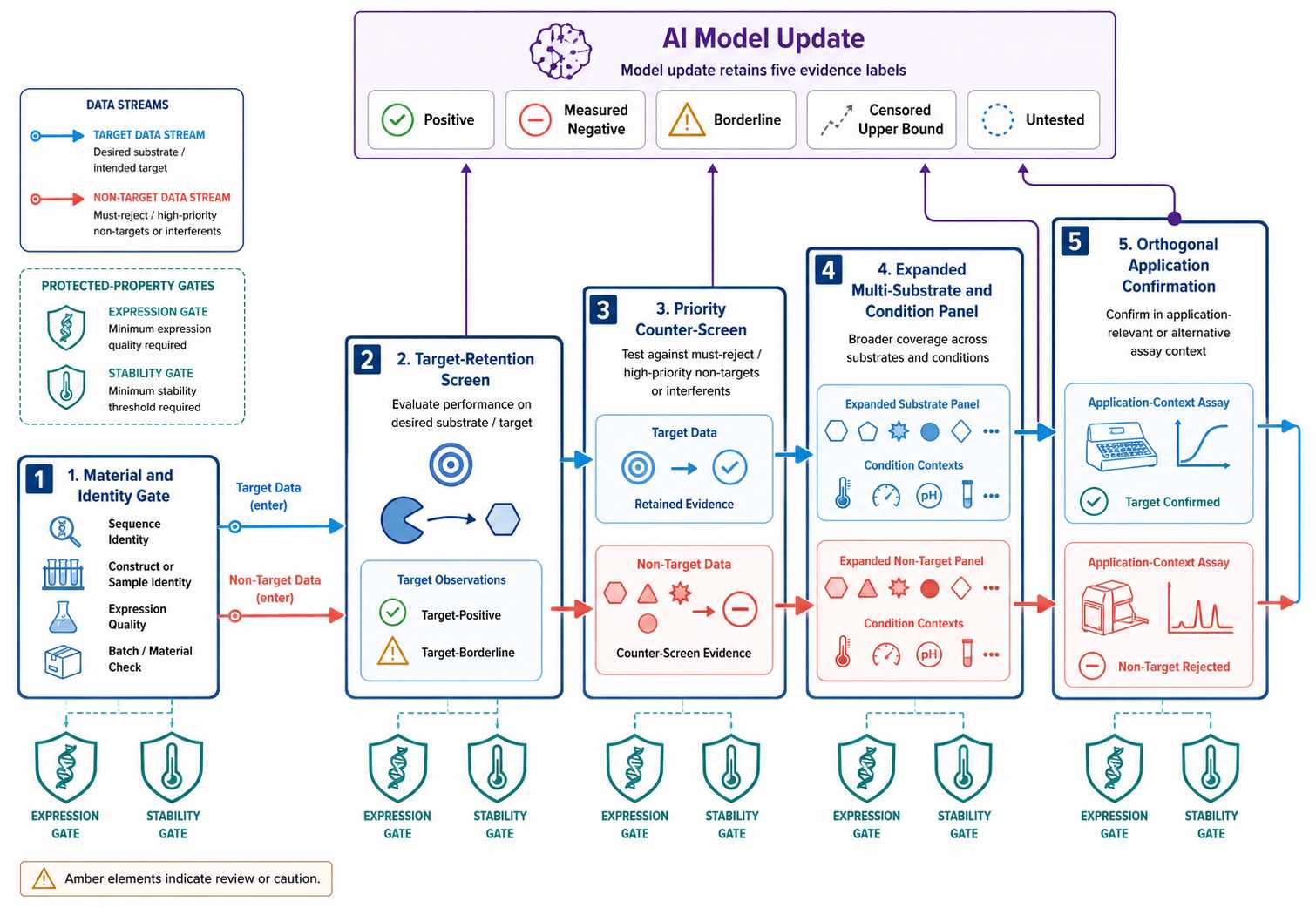 Fig 4. Paired positive-screen and counter-screen learning staircase. Candidate identity and material checks lead into target retention, priority counter-screening, expanded substrate profiling, orthogonal confirmation, and a model update that retains positive, negative, borderline, and censored evidence.
(Creative Enzymes Diagnostic)
A specificity shift observed at one substrate concentration and one reaction time may disappear in the actual reagent. Target and non-target rank can change with concentration, enzyme loading, pH, temperature, salt, metal or cofactor, inhibitor, reporter capacity, reaction time, sample matrix, or product accumulation. We therefore map the boundary that is most likely to determine whether the enzyme succeeds in its intended use.
The challenge design is risk-based rather than exhaustive. It selects conditions that could reverse the candidate ranking or expose a product-relevant failure. A high-priority analog may receive a full concentration and time profile, while a low-priority remote analog may be tested at a single conservative challenge condition. Untested regions remain labeled. We do not extrapolate a universal absence of cross-reactivity outside the panel and conditions studied.
When kinetic discrimination is central, selected candidates can enter enzyme kinetics services for target and non-target concentration-response analysis. Kinetic parameters are interpreted under the stated model and conditions. Binding affinity alone does not establish catalytic selectivity, and an apparent Km is not automatically a dissociation constant. For coupled diagnostic reactions, the complete system may also require comprehensive enzyme development and validation.
The most useful confirmation depends on what the enzyme does in the diagnostic system. A purified-enzyme assay isolates mechanism and supports clean comparisons, but the application test determines whether the change survives the complete reagent architecture. The two evidence layers answer different questions and should not be collapsed into one claim.
Projects that center on polymerase or reverse-transcriptase architecture can connect to the planned AI-guided polymerase and reverse transcriptase engineering service. CRISPR/Cas projects can connect to AI-assisted CRISPR/Cas diagnostic enzyme engineering support.
A complete reagent may require component-level and system-level studies because reducing the primary enzyme's promiscuity does not automatically eliminate reporter, matrix, or cascade cross-reactivity.
Application confirmation can include product identity, target and non-target signal profiles, time-to-threshold separation, background at zero target, response in mixed target/non-target samples, matrix recovery, inhibition or interference challenge, instrument compatibility, and comparison with the parent or nominated benchmark. The design and acceptance criteria are specified in the statement of work. No purified-enzyme or reagent-level study is presented as clinical specificity, clinical performance, or market authorization.
For multiplex nucleic-acid systems, specificity can also depend on primer and probe interactions, competition, target abundance imbalance, channel correction, and amplification chemistry. Those system-level problems may be better addressed through multiplex qPCR assay enzyme-system optimization rather than an enzyme-only campaign.
A lead is not defined by one improved ratio. The advancement dossier connects sequence identity to material context, paired substrate evidence, analytical validity, protected properties, application behavior, and untested boundaries. This makes the result transferable to formulation, raw-material qualification, process development, and later design-control work.
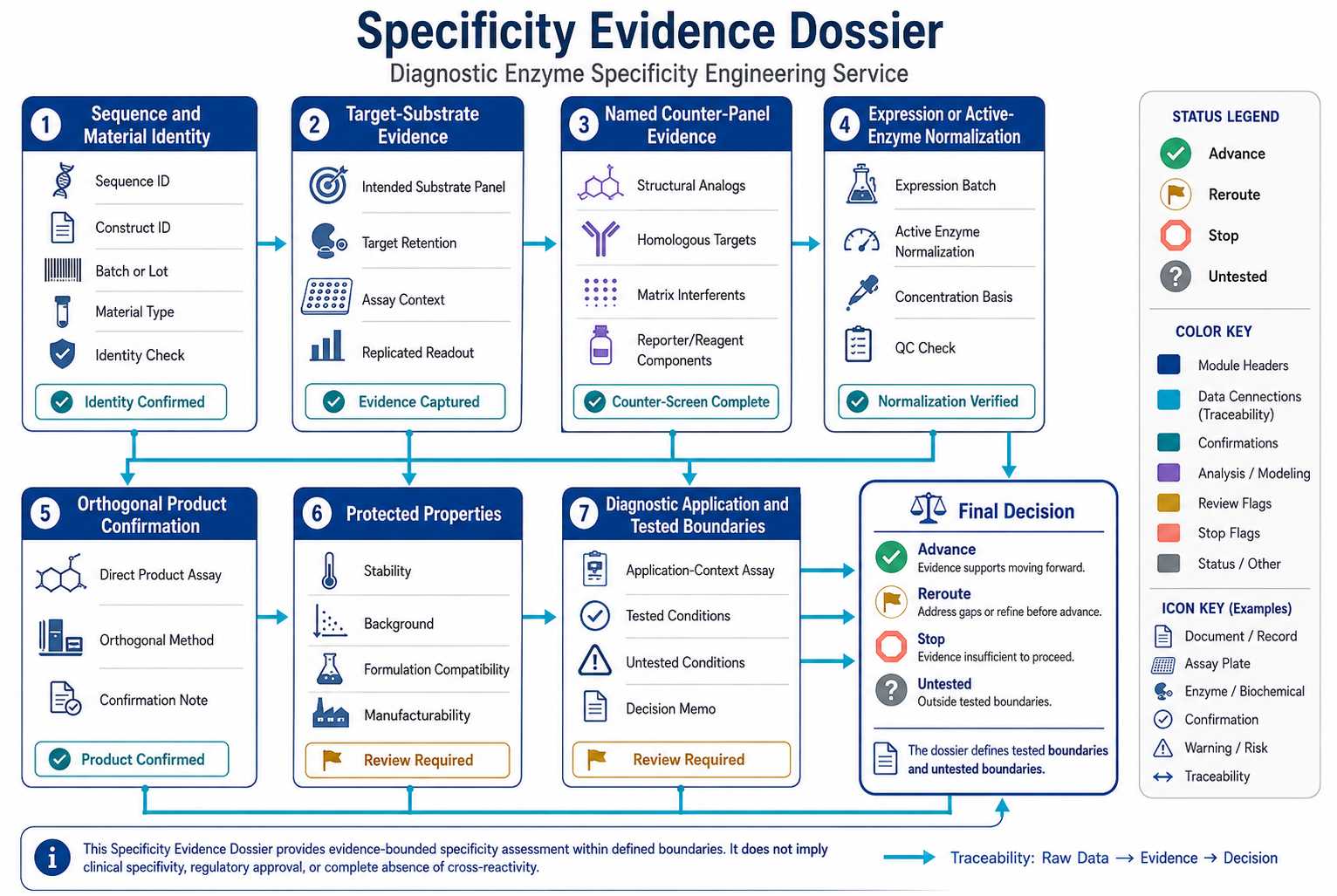 Fig 5. Specificity evidence dossier. A candidate is linked to exact material identity, target retention, counter-panel results, orthogonal confirmation, protected properties, application performance, and explicit tested and untested boundaries.
(Creative Enzymes Diagnostic)
Depending on scope, deliverables can include the target/non-target contract, risk-ranked substrate panel, source-triage plan, assay and counter-screen method, control map, computational hypothesis report, variant design list, sequence and construct records, raw and processed screening data, model outputs with stated limits, target and non-target profiles, kinetic or product analyses, protected-property results, application-functional data, lead recommendation, and next-stage transfer notes. Deliverables are defined project by project; a development data package is not a certificate of regulatory approval.
Some projects already have a clear catalytic cross-reactivity mechanism and a qualified assay. Others have only an unexplained non-target signal in a complete reagent. The engagement should begin at the first unresolved decision rather than automatically opening a large mutation campaign.
Creative Enzymes can connect specificity engineering to the broader AI-driven diagnostic enzyme engineering program, comprehensive enzyme development and validation, analytical characterization, and diagnostic-enzyme product portfolio. If a repeated design-build-test-learn loop is needed, the project can also transition to the planned closed-loop enzyme evolution service.
No. Enzyme substrate specificity describes preferential binding and catalysis among defined substrates under stated conditions. Analytical specificity is a property of the complete measurement procedure and includes cross-reactivity and interference from other targets, sample constituents, reagents, detection chemistry, instruments, and interpretation rules. Engineering an enzyme can improve one important component, but it does not by itself establish analytical specificity for the finished diagnostic test.
AI can prioritize mutations and substrate-enzyme hypotheses using sequence, structure, substrate representations, evolutionary information, and project data. It cannot guarantee elimination of cross-reactivity, especially when non-target data are sparse or the new substrates fall outside the model's training domain. Predicted variants require paired target and non-target experiments and application-relevant confirmation.
A target-only screen can select variants that are active but remain equally promiscuous. It also cannot distinguish a true specificity shift from a general activity increase. A useful campaign measures target retention and non-target suppression together, with expression or material normalization and controls that reveal reporter or background artifacts.
Not by itself. The variant may be less active on every substrate, expressed at a lower level, partially inactive, unstable, or measured in a detector range that compresses the signal. The target response, non-target response, enzyme material, method range, controls, and protected properties must be interpreted together.
The panel is risk-ranked from structural similarity, catalytic mechanism, expected sample composition, reagent components, homologous biological targets, known interferents, prior failures, and the intended use. The closest analog is not always the only important non-target; a less similar molecule at much higher concentration or a reporter component can create the greater product risk.
Usually not. A ratio can hide unacceptable target loss or a non-target response that remains above a critical upper bound. We retain the underlying target and non-target measurements and can combine a ratio with target-retention floors, non-target ceilings, uncertainty, protected-property gates, and application-functional criteria.
No. A structure can strengthen pocket, access-path, and dynamics hypotheses, but useful campaigns can also use sequence homologs, evolutionary information, predicted structures, prior variants, targeted mutagenesis, and experimentally learned models. The design strategy and uncertainty are adjusted to the evidence available.
Yes. Distal residues can affect conformational dynamics, active-site preorganization, access paths, electrostatics, expression, or stability. They may tune preference more subtly than direct active-site changes and can sometimes preserve activity better. They remain hypotheses until the paired substrate data confirm their effect.
Useful experiments include enzyme omission or replacement, concentration dependence, component omission, direct product analysis, alternative reporters, blanks, purified versus formulated material, matrix spikes, time courses, and orthogonal analytical methods. The exact set depends on the reaction architecture and observed failure.
Projects can be scoped for different enzyme families when an informative target and counter-screen can be established. The relevant definition of substrate differs: it may be a small molecule, nucleotide, primer-template junction, nucleic-acid structure, peptide, protein, glycan, cofactor, or coupled-reaction component. Feasibility depends on materials, readout, throughput, and the application decision.
No. The service can provide enzyme-level and validation-oriented reagent-development evidence under an agreed scope. The legal manufacturer or sponsor remains responsible for intended use, design control, complete analytical and clinical validation, risk management, registration, labeling, and market authorization.
Share the intended substrate, the observed non-target response, the current enzyme and assay, the must-reject panel you already know, and the diagnostic reaction in which the enzyme must operate. Creative Enzymes can help determine whether the enzyme is the correct lever, define a paired target/counter-screen strategy, and scope an AI-assisted engineering and confirmation program around the actual product decision.
Contact Creative Enzymes