Background
A successful prototype assay demonstrates that a biomarker can be measured with the required analytical performance, but it does not guarantee that the assay can be manufactured reliably, reproducibly, and at scale. The transition from prototype to commercial product is one of the most consequential and frequently underestimated phases of companion diagnostic (CDx) development. Many assays that perform well in a research or pilot setting encounter critical manufacturability barriers only when subjected to the rigors of process characterization, technology transfer, and routine production.
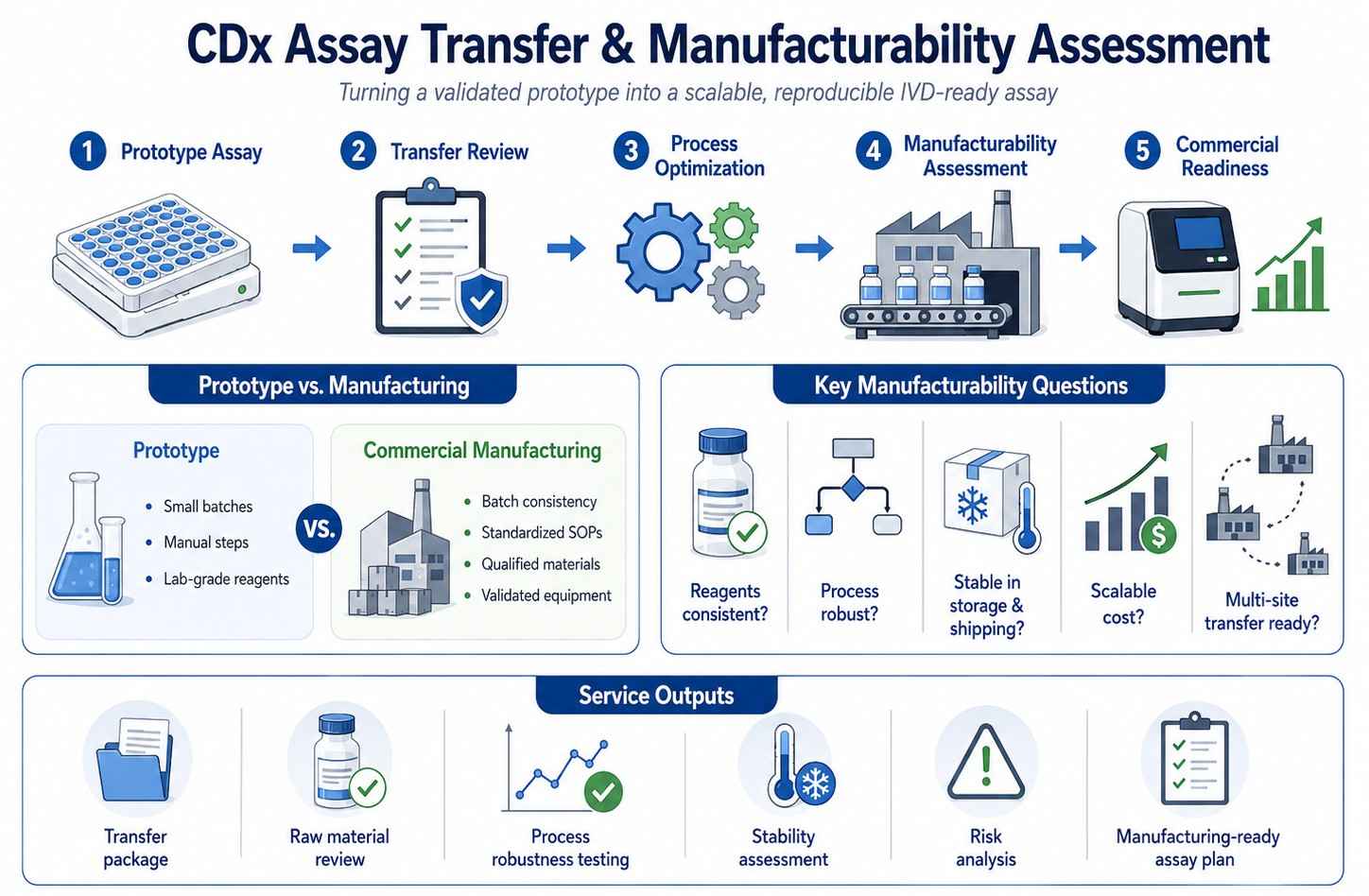
The core challenge lies in the fundamental difference between prototype development and commercial manufacturing. A prototype is typically assembled in small batches by experienced scientists using laboratory-grade reagents, with extensive manual intervention and flexible protocols. Commercial manufacturing, by contrast, demands batch-to-batch consistency, validated standard operating procedures, qualified raw materials, and processes that can be executed reproducibly by trained production personnel on validated equipment. Analytical performance must be maintained not just across a handful of runs, but across hundreds or thousands of production lots, potentially spanning multiple manufacturing sites and geographic regions.
Manufacturability failures manifest in many forms: unacceptable lot-to-lot variation in critical reagents, processes that are too sensitive to minor environmental or operator differences, formulations that degrade during shipping or storage, or cost structures that make commercial viability impossible. These issues, if discovered late in development, can trigger costly redesigns, delay regulatory submissions, and jeopardize clinical trial timelines. In the worst case, a manufacturability gap discovered after design lock can force a program restart, resulting in millions of dollars in lost investment and months or years of delay.
Creative Enzymes Diagnostic offers a dedicated CDx Assay Transfer and Manufacturability Assessment service that bridges the gap between prototype validation and commercial readiness. We systematically evaluate, optimize, and document every element of the manufacturing process, ensuring that your assay is not only analytically sound but also robustly manufacturable at the scale and quality standards required for IVD commercialization.
Technology Transfer Strategy
Technology transfer is the structured process of moving assay knowledge, materials, and methods from the development laboratory to the manufacturing environment. A well-executed transfer ensures that the manufacturing team can reproduce the assay with equivalent performance to the prototype, while identifying and resolving any gaps between development and production conditions. Our technology transfer strategy encompasses four integrated workstreams.
SOP Development
- Drafting of comprehensive standard operating procedures covering all manufacturing steps, from raw material receipt and preparation through final kit assembly, labeling, and release testing
- Integration of in-process controls, acceptance criteria, and hold points to ensure quality at each stage of production
- Alignment of SOPs with regulatory expectations (e.g., FDA QSR, ISO 13485) and inclusion of change control and version management protocols
- Development of associated batch records, worksheets, and traceability documentation to support lot history review and regulatory inspection readiness
Critical Process Parameter Identification
- Systematic mapping of the manufacturing process to identify all parameters that could influence assay performance, including temperature, time, pH, mixing speed, reagent concentration, and environmental conditions
- Application of risk-based tools (e.g., failure mode and effects analysis, FMEA) to prioritize parameters based on their potential impact on critical quality attributes
- Design and execution of targeted studies to define acceptable operating ranges and establish control strategies for high-risk parameters
- Documentation of parameter rationale, study design, and acceptance criteria to support process validation and regulatory submission packages
Raw Material Qualification
- Comprehensive qualification of all raw materials, including enzymes, antibodies, oligonucleotides, buffers, substrates, and consumables, against predefined specifications for identity, purity, potency, and stability
- Assessment of supplier quality systems, manufacturing capabilities, and regulatory compliance status to ensure long-term supply security
- Establishment of incoming inspection protocols, certificate of analysis review criteria, and supplier change notification requirements
- Evaluation of material equivalency across multiple supplier sources or manufacturing sites to mitigate single-source risks and support supply chain resilience
Batch Consistency Evaluation
- Manufacture and analytical testing of multiple production lots under controlled conditions to evaluate batch-to-batch reproducibility
- Statistical analysis of lot data using control charts, process capability indices (Cpk), and variance component analysis to quantify consistency
- Comparison of manufacturing lot performance against prototype performance specifications to confirm equivalence and identify any performance drift
- Definition of release specifications, stability-indicating test methods, and out-of-specification investigation procedures to maintain ongoing quality control
Manufacturability Assessment
Beyond technology transfer, we conduct a holistic manufacturability assessment that evaluates the assay from the perspective of commercial production economics, operational feasibility, and long-term sustainability. This assessment identifies hidden barriers to scale-up and provides actionable recommendations for process optimization.
Process Robustness
- Execution of robustness studies that deliberately challenge the process across a range of conditions (edge-of-failure testing) to identify the true operating window
- Evaluation of process sensitivity to common manufacturing variables: operator-to-operator variation, equipment differences, reagent lot changes, and environmental fluctuations
- Identification of process steps that require excessive precision or control, with recommendations for redesign or automation to reduce variability
- Assessment of process scalability: whether the method can be executed at pilot, clinical, and commercial batch sizes without loss of performance
Automation Compatibility
- Review of manual process steps for automation potential, including liquid handling, reagent dispensing, plate sealing, incubation, and detection readout
- Assessment of assay format compatibility with existing automated platforms and identification of format modifications that would enable full or partial automation
- Evaluation of throughput requirements against automation capacity, including batch size, cycle time, and parallel processing capabilities
- Cost-benefit analysis of automation investment versus manual production, considering labor costs, error rates, throughput targets, and regulatory advantages of reduced human intervention
Reagent Stability
- Accelerated and real-time stability studies of formulated reagents under intended storage and shipping conditions to establish shelf-life claims
- Evaluation of freeze-thaw stability, in-use stability after kit opening, and on-board instrument stability for automated platforms
- Assessment of lyophilization feasibility for temperature-sensitive reagents, including excipient screening, cycle development, and reconstitution performance
- Stability monitoring program design, including trending protocols, stability-indicating method validation, and shelf-life extension strategies
Cost Analysis
- Detailed bill-of-materials (BOM) analysis with cost breakdown by component category: enzymes, antibodies, oligonucleotides, consumables, packaging, and quality control testing
- Manufacturing cost modeling at different production volumes, including fixed costs (equipment, facility, validation) and variable costs (materials, labor, QC)
- Identification of cost drivers and opportunities for cost reduction through reagent optimization, supplier negotiation, process simplification, or format redesign
- Preliminary pricing analysis and margin projection to inform commercial strategy and support business case development for internal investment decisions
Transfer Deliverables
Upon completion of the technology transfer and manufacturability assessment program, you receive a comprehensive documentation package that enables immediate progression to process validation, scale-up, and regulatory submission:
| Item |
Description |
| Technology Transfer Report |
Comprehensive documentation of the transfer process, including protocol deviations, resolution actions, and confirmation that manufacturing can reproduce prototype performance. |
| Manufacturing SOP Package |
Complete set of standard operating procedures for all manufacturing, quality control, and release activities, formatted for regulatory submission and production use. |
| Critical Process Parameter Summary |
Documented identification, risk assessment, and operating range definition for all critical and key process parameters, with supporting study data. |
| Raw Material Qualification Dossier |
Specifications, test methods, supplier assessments, and qualification data for all raw materials, with recommendations for ongoing supplier management. |
| Batch Consistency Data Package |
Manufacturing and analytical data from multiple lots, with statistical analysis demonstrating batch-to-batch reproducibility and process capability. |
| Manufacturability Assessment Report |
Integrated evaluation of process robustness, automation compatibility, reagent stability, and cost structure, with prioritized recommendations for optimization. |
| Stability Study Protocol and Data |
Accelerated and real-time stability study design, raw data, statistical analysis, and proposed shelf-life claims for all kit components. |
| Cost Analysis and BOM |
Detailed cost breakdown, volume-scaled manufacturing cost projections, and identification of cost reduction opportunities. |
| Risk Register and Mitigation Plan |
Structured documentation of manufacturing risks with severity assessment, mitigation strategies, and residual risk acceptance rationale. |
| Regulatory Submission Support Package |
Formatted documentation aligned with FDA, EU IVDR, or other target regulatory requirements to support pre-submission meetings and formal submissions. |
FAQs
Q1. At what stage should we initiate a technology transfer and manufacturability assessment?
A1. Ideally, this assessment should begin as soon as the prototype assay has demonstrated acceptable analytical performance and the development team is confident in the assay format. Initiating transfer early allows manufacturability issues to be identified and resolved before design lock, avoiding costly late-stage changes. For programs with aggressive timelines, transfer activities can be initiated in parallel with final prototype optimization, provided that the core assay design is stable.
Q2. What is the difference between technology transfer and process validation?
A2. Technology transfer is the process of moving assay knowledge and methods from development to manufacturing and confirming that manufacturing can reproduce the assay. Process validation is the formal demonstration, through objective evidence, that the manufacturing process consistently produces a product meeting its predetermined specifications and quality attributes. Technology transfer must be completed successfully before process validation can begin; the transfer deliverables serve as the foundation for the validation protocol.
Q3. Can you support technology transfer to our internal manufacturing facility or to a contract manufacturing organization (CMO)?
A3. Yes. We have extensive experience supporting transfer to both internal manufacturing operations and external CMOs. Our team can act as the technical liaison between your development group and the manufacturing site, ensuring that all technical knowledge is communicated completely and that the receiving site has the capability and documentation needed for successful production. We can also support CMO selection, qualification, and ongoing technical oversight.
Q4. How do you handle raw materials that are currently single-source or custom-synthesized?
A4. Single-source dependencies are a significant risk in diagnostic manufacturing. We evaluate the technical feasibility of qualifying secondary suppliers or developing in-house manufacturing capabilities for critical reagents. For custom-synthesized materials, we work with the original supplier to secure long-term supply agreements, establish safety stock, and document the synthesis process to enable technology transfer to alternative suppliers if needed. Our enzyme engineering capabilities also allow us to develop proprietary enzyme alternatives where commercial sources are inadequate.
Q5. What happens if the manufacturability assessment identifies fundamental barriers to scale-up?
A5. A negative manufacturability finding, while disappointing, is far less costly than discovering the same issue after committing to full-scale production. Our assessment report will document the specific barriers, evaluate alternative process approaches or assay format modifications, and provide a revised development path with associated timelines and resource requirements. In many cases, targeted modifications—such as reagent reformulation, process redesign, or automation integration—can resolve the barrier without requiring a full assay redevelopment.
Q6. Can Creative Enzymes Diagnostic support the subsequent process validation and commercial manufacturing phases?
A6. Yes. Our integrated CDx development services extend seamlessly from manufacturability assessment through process validation, analytical validation, clinical bridging studies, and regulatory submission. We can also provide ongoing manufacturing support, including batch release testing, stability monitoring, change control management, and post-market surveillance, ensuring continuity from development through commercial lifecycle.
Creative Enzymes Diagnostic combines deep diagnostic manufacturing expertise, rigorous process science, and comprehensive regulatory knowledge to ensure that your CDx assay is ready for the demands of commercial production. From technology transfer to manufacturability optimization, we deliver the documentation, data, and confidence you need to move from prototype to product.
Contact our business development team today to discuss your specific project needs!
Related Services

