Background
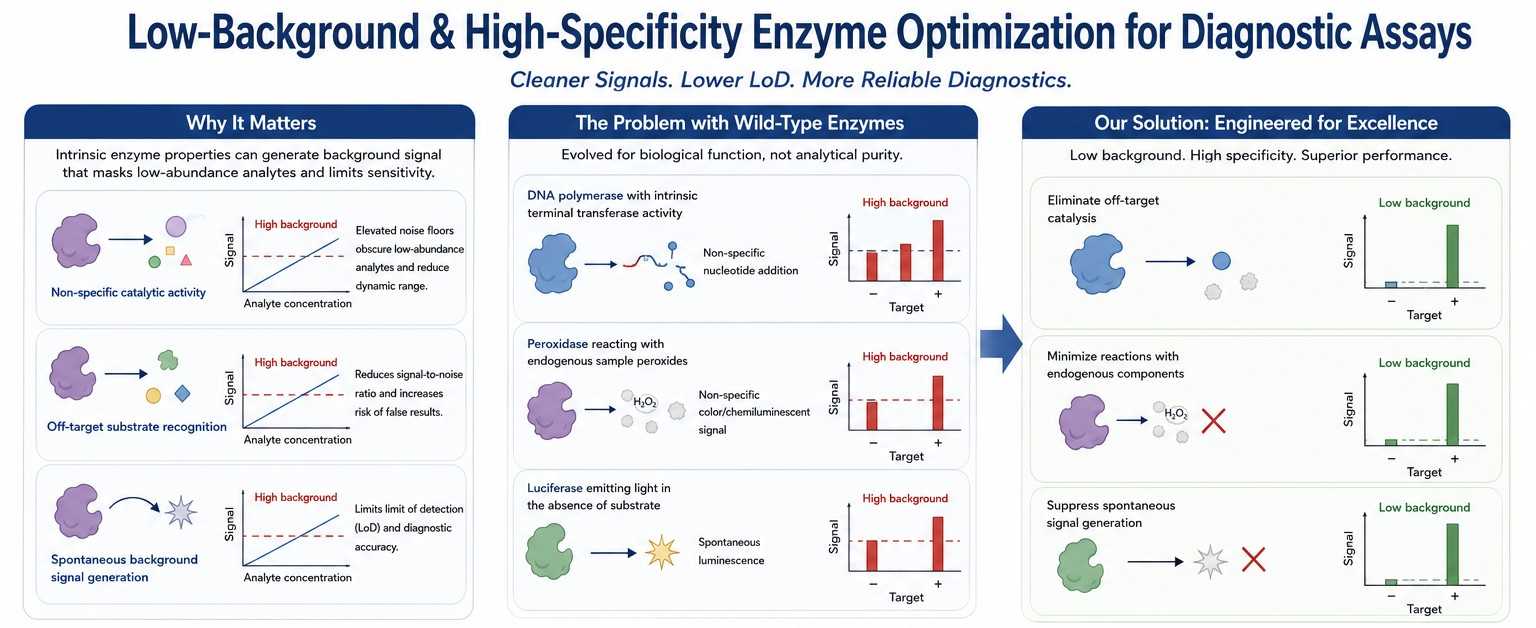
Diagnostic assay sensitivity and specificity are fundamentally limited by the intrinsic properties of the enzymes that generate the detectable signal. Non-specific catalytic activity, off-target substrate recognition, and spontaneous background signal generation all contribute to elevated noise floors that obscure low-abundance analytes and reduce the analytical dynamic range. For high-sensitivity applications such as early-stage disease detection, viral load quantification, and rare mutation screening, even modest reductions in background signal or improvements in signal-to-noise ratio can translate into clinically meaningful gains in limit of detection (LoD) and diagnostic accuracy.
Wild-type enzymes, evolved for biological function rather than analytical purity, typically exhibit a baseline level of off-target activity and background signal that is incompatible with the most demanding diagnostic platforms. A DNA polymerase with intrinsic terminal transferase activity, a peroxidase that reacts with endogenous sample peroxides, or a luciferase that emits light in the absence of substrate will all degrade assay performance in ways that cannot be fully compensated by assay design or data processing. Engineering enzymes for low background and high specificity addresses these limitations at the molecular source, enabling assays with lower LoD, wider dynamic range, and improved precision.
Creative Enzymes Diagnostic offers a dedicated Low-Background and High-Specificity Enzyme Optimization service that applies structure-guided mutagenesis, kinetic engineering, and rigorous analytical validation to develop enzyme variants with quantifiably superior signal purity. Our optimized enzymes deliver cleaner signals, sharper specificity, and more reliable quantification across the full spectrum of diagnostic detection platforms.
Signal Optimization
Our signal optimization strategy targets the molecular mechanisms that generate off-target signal and background noise. By systematically identifying and eliminating these sources of unwanted catalytic activity, we engineer enzymes that produce signal only in response to the intended substrate or target, with minimal interference from sample matrix components or spontaneous reactions.
Off-target Activity Reduction
- Structural mapping of off-target binding sites and catalytic promiscuity using crystallography, cryo-EM, or AlphaFold-predicted models complexed with non-target substrates and analogs
- Site-directed mutagenesis of residues in the active site periphery and substrate-binding pocket to tighten substrate recognition without compromising catalytic efficiency for the target substrate
- Directed evolution screening against panels of structurally related non-target analytes to select variants with reduced promiscuous activity while maintaining target substrate turnover
- Quantification of off-target activity reduction by determining the ratio of target-to-off-target catalytic efficiency (kcat/KM)target / (kcat/KM)off-target, with typical improvements of 10- to 100-fold
Substrate Specificity Enhancement
- Rational redesign of the substrate-binding pocket using molecular dynamics simulations and docking studies to identify steric and electrostatic constraints that exclude non-target substrates
- Introduction of gatekeeper residues that impose size or charge selectivity at the substrate entry channel, preventing access of structurally similar but functionally distinct molecules
- Engineering of co-substrate or cofactor specificity to prevent signal generation in the absence of the complete reaction system, reducing false-positive rates in multiplexed assays
- Kinetic validation of specificity enhancement by measuring KM and kcat for target and off-target substrates, confirming that improved specificity arises from reduced off-target affinity rather than compromised target activity
Background Suppression
- Identification and elimination of spontaneous signal-generating reactions, including substrate autolysis, cofactor-independent light emission, and oxidation of chromogenic substrates by atmospheric oxygen
- Engineering of enzyme conformational states to stabilize the inactive (closed) conformation in the absence of target substrate, reducing basal catalytic activity and pre-activation signal
- Optimization of metal ion coordination and prosthetic group binding to prevent partial catalytic cycles that generate background signal without full substrate turnover
- Screening in substrate-only reactions (no target analyte) to quantify background signal reduction, with selection of variants that maintain near-zero signal until target-dependent activation
Cross-reactivity Reduction
- Profiling of cross-reactivity against panels of structurally related analytes, isomeric variants, and metabolites that may be present in clinical samples at high concentrations
- Structure-based design of discriminating residues that form specific hydrogen bonds, salt bridges, or hydrophobic contacts with the target substrate but not with cross-reactive analogs
- Directed evolution under competitive conditions, where the target substrate and cross-reactive competitors are present simultaneously, to select variants with improved discrimination ratios
- Validation in complex sample matrices containing high concentrations of potentially cross-reactive endogenous substances to confirm analytical specificity under clinically relevant conditions
Performance Validation
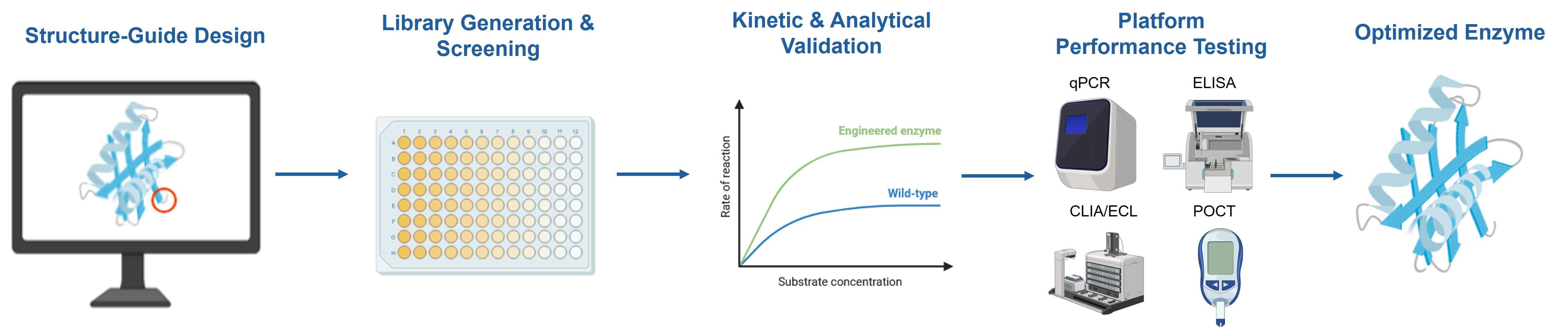
Every optimized variant undergoes comprehensive analytical performance validation to confirm that signal optimization translates into measurable improvements in diagnostic assay parameters. Our validation protocols are aligned with CLSI guidelines and regulatory expectations for IVD analytical validation.
S/N Ratio
- Quantitative signal-to-noise ratio determination by measuring the ratio of target signal (in the presence of saturating analyte) to background signal (in the absence of analyte) under standardized assay conditions
- Comparison of S/N ratios between engineered variant and wild-type enzyme across a range of substrate concentrations, detection times, and instrument settings to identify optimal operating conditions
- Statistical analysis of S/N ratio improvement using paired t-tests or ANOVA to confirm that observed differences are significant and reproducible across replicate experiments
- Correlation of S/N ratio improvement with structural modifications to establish mechanistic understanding and guide further optimization
LoD
- Limit of detection determination following CLSI EP17-A2 guidelines, using probit analysis or precision profile methods to establish the lowest analyte concentration detectable with 95% confidence
- Comparison of LoD between engineered and wild-type enzymes in the target assay format, with quantification of the fold-improvement in detection sensitivity attributable to background reduction
- Evaluation of LoD stability across multiple reagent lots, storage conditions, and operator executions to confirm that improved sensitivity is robust and not dependent on specific experimental conditions
- Assessment of LoD in clinically relevant matrices (serum, plasma, urine) to confirm that background suppression translates to real-world diagnostic performance gains
Precision
- Repeatability assessment by measuring replicate samples at low, medium, and high analyte concentrations within a single run, with coefficient of variation (CV) calculation for each concentration level
- Intermediate precision evaluation across multiple days, operators, instruments, and reagent lots to assess the robustness of the optimized enzyme under routine laboratory variability
- Comparison of precision profiles between engineered and wild-type enzymes to confirm that background reduction improves precision at low analyte concentrations where signal approaches the noise floor
- Statistical process control charting to monitor ongoing precision performance and detect any drift that might indicate enzyme degradation or lot-to-lot inconsistency
Repeatability
- Intra-assay repeatability testing with ≥20 replicates per concentration level to establish the baseline variability of the optimized enzyme under controlled conditions
- Inter-assay repeatability evaluation across ≥10 independent runs to assess run-to-run consistency and identify any systematic bias introduced by the engineered variant
- Long-term repeatability monitoring over 6-month storage periods to confirm that the background-suppressed phenotype is stable and does not degrade during typical reagent shelf-life
- Correlation of repeatability metrics with enzyme purity, aggregation state, and formulation stability to identify and mitigate sources of variability unrelated to the intrinsic enzyme properties
Service Workflow
Applications
Low-background and high-specificity enzymes enable diagnostic applications that demand the highest levels of sensitivity, specificity, and quantitative precision. Our optimized variants have been successfully deployed across a diverse range of detection platforms and clinical indications.
- Ultra-sensitive immunoassays: Peroxidase and alkaline phosphatase variants with suppressed spontaneous oxidation and enhanced substrate specificity enable sub-picomolar detection limits in ELISA, chemiluminescence, and electrochemiluminescence platforms, critical for cardiac troponin, cytokine, and hormone quantification.
- Digital and single-molecule PCR: DNA polymerases with reduced terminal transferase activity and enhanced proofreading fidelity improve droplet digital PCR (ddPCR) precision and reduce false-positive partitions in rare mutation detection and copy number variation analysis.
- Isothermal amplification for POC diagnostics: LAMP and RPA enzymes engineered for minimal primer-dimer amplification and reduced non-template-dependent signal generation enable robust detection at low copy numbers in unprocessed clinical samples, without the need for thermal cycling infrastructure.
- Bioluminescent reporter assays: Luciferase variants with near-zero basal light emission and enhanced ATP specificity improve the dynamic range of cell-based assays, pathogen detection systems, and ATP bioluminescence sanitation monitoring.
- Multiplexed detection panels: Enzymes with narrowed substrate scope enable the design of orthogonal signal generation systems where multiple analytes are detected simultaneously without cross-talk between reporter channels, simplifying panel design and improving throughput.
- Gene-based diagnostics: Cas nucleases and trans-cleavage reporters engineered for reduced non-target collateral activity and enhanced guide-RNA specificity improve the signal-to-noise ratio of SHERLOCK, DETECTR, and related CRISPR-Dx platforms.
FAQs
Q1. How much improvement in signal-to-noise ratio can typically be achieved?
A1. The magnitude of S/N improvement depends on the starting enzyme, the assay format, and the dominant source of background signal. Typical projects achieve 3- to 20-fold improvements in S/N ratio, with some variants showing >50-fold reduction in background signal. The specific improvement is quantified during validation by direct comparison of engineered and wild-type enzymes in the client's target assay format under identical conditions.
Q2. Will reducing background signal or off-target activity compromise the enzyme's catalytic efficiency for the intended substrate?
A2. Our engineering strategy explicitly selects for mutations that discriminate against off-target substrates while preserving or enhancing target substrate binding and turnover. Because off-target activity and background signal typically arise from catalytic promiscuity or conformational flexibility rather than from the primary catalytic mechanism, these properties can often be improved independently. Kinetic characterization (kcat, KM) is performed on all variants to confirm that target substrate efficiency is maintained or improved.
Q3. Can you optimize enzymes for specific detection chemistries or instrument platforms?
A3. Yes. We tailor the screening and validation protocols to the client's specific detection chemistry (colorimetric, fluorogenic, chemiluminescent, bioluminescent, electrochemical) and instrument platform (microplate reader, lateral flow reader, real-time PCR thermocycler, POC device). This ensures that the optimized variant performs optimally under the exact optical, temporal, and environmental conditions of the target assay, rather than in generic buffer systems.
Q4. What is the typical timeline for a low-background and high-specificity optimization project?
A4. A standard project, from structural analysis through analytical validation, typically spans 10 to 14 weeks. This includes 2–3 weeks for structural analysis and mechanism identification, 4–5 weeks for library construction and screening, and 4–5 weeks for comprehensive analytical validation in the target assay format. Projects requiring iterative rounds of evolution or optimization for multiple substrates may extend to 16–20 weeks. Expedited timelines are available for urgent programs.
Q5. How do you validate that specificity improvements are clinically relevant and not just artifacts of the screening assay?
A5. We validate specificity in clinically relevant matrices containing high concentrations of potentially interfering substances, using matched patient samples and clinical standard materials. Cross-reactivity is tested against panels of structurally related analytes, metabolites, and common prescription drugs at pharmacological concentrations. The final validation report includes clinical concordance data comparing engineered and wild-type enzyme performance in a minimum of 50 clinical specimens.
Q6. Can you support the transition from optimized variant to diagnostic-grade manufacturing and regulatory submission?
A6. Yes. Our integrated platform provides seamless continuity from optimization through manufacturing scale-up and regulatory documentation. The validated expression construct, analytical methods, and stability data are formatted for technology transfer to our production team or to your internal manufacturing group. We provide comprehensive Certificates of Analysis, batch records, and validation reports aligned with FDA, IVDR, and ISO 13485 requirements to support diagnostic-grade raw material qualification and IVD submission.
Creative Enzymes Diagnostic combines deep mechanistic understanding of enzyme catalysis, advanced protein engineering capabilities, and rigorous analytical validation to deliver enzyme variants with the signal purity and specificity that next-generation diagnostics demand. From single-molecule detection to multiplexed panels, our low-background and high-specificity optimization service provides the molecular precision your assay requires.
Contact our business development team today to discuss your specific project needs!
Related Services

