| Cat# | ENZD-MDLyo03 |
| Specification | 2000 U; 10000 U; 20000 U |
| Unit Concentration | 40 U/μl |
| Description | Glycerol-free Murine RNase Inhibitor offers enhanced high-temperature tolerance and storage stability without glycerol. Unlike human RNase Inhibitor, it lacks oxidation-sensitive cysteine residues, resulting in higher antioxidant activity and suitability for reducing agent-sensitive experiments. This product is excipient-free, allowing for customized additions. |
| Notes | Glyceryl-free RNase inhibitor. |
| Features | Excellent high temperature resistance; Higher antioxidant activity; Highly efficient RNase inhibitory activity |
| Components | Murine RNase Inhibitor (Glycerol-free) (40 U/μl) |
| Quality Control | Excellent storage stability and high temperature resistance; Higher antioxidant activity; Highly efficient RNA repressive activity |
| Shipping and Storage Conditions | Store at -30 ~ -15℃, transport at ≤0℃. |
| Download Datasheet: | 
|
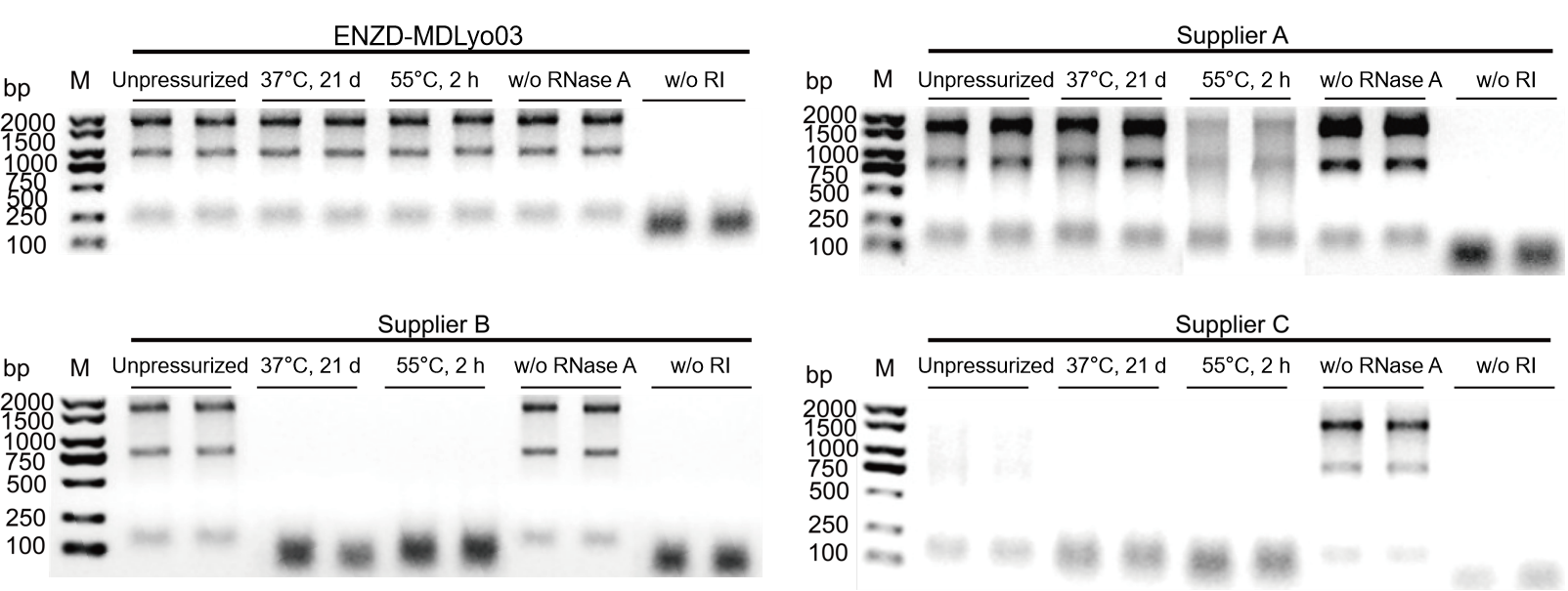
The performance of ENZD-MDLyo03 from Creative Enzymes was evaluated under prolonged storage and elevated temperature stress conditions. Compared with commercial references (Supplier A, B, and C), ENZD-MDLyo03 maintained stable performance after incubation at 37°C for 21 days under accelerated stress conditions, showing no significant loss of activity.
In addition, ENZD-MDLyo03 demonstrated strong thermal resistance, retaining functional activity after exposure to 55°C for 2 hours. These results indicate excellent storage stability and high-temperature tolerance, making it suitable for temperature-sensitive workflows such as RT-qPCR and RT-LAMP. Data generated from internal validation studies, confirming robust stability under elevated temperature and long-term storage conditions.
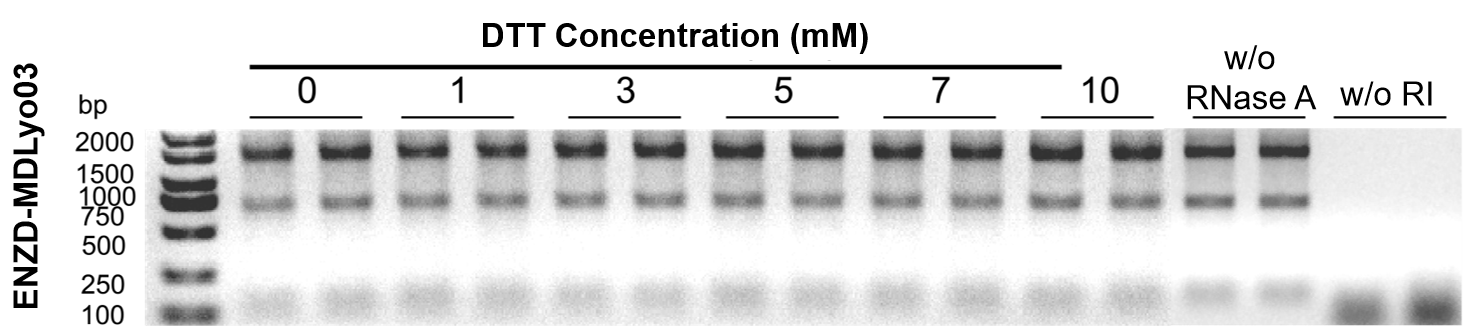
RNase inhibitors typically contain cysteine residues that are prone to oxidation, requiring reducing agents for stability. ENZD-MDLyo03 was engineered with improved antioxidation properties, significantly reducing dependence on reducing agents while maintaining enzymatic activity. Data generated from internal validation studies, demonstrating improved oxidative resistance and reduced dependency on reducing conditions.
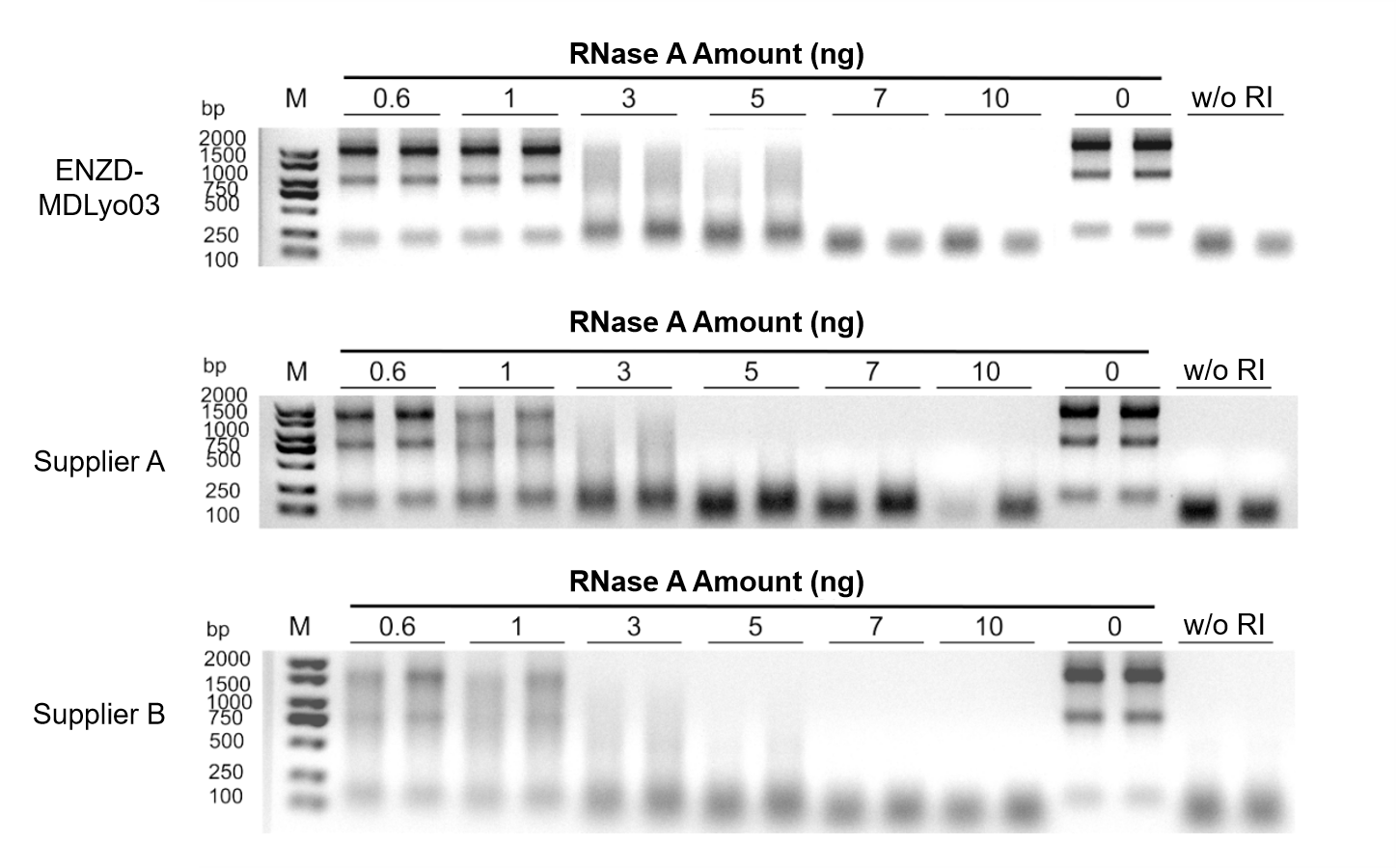
TThe RNase inhibitory performance of ENZD-MDLyo03 was evaluated in a 20 μL reaction system using 40 U inhibitor with increasing RNase A concentrations (0.6, 1, 3, 5, 7, and 10 ng). RNA integrity was assessed and compared with commercial reference products.
Results showed that ENZD-MDLyo03 effectively suppressed RNA degradation at low RNase A levels (0.6 ng), with significantly stronger inhibitory performance than competitor products. RNA integrity was maintained without observable degradation under tested conditions, demonstrating high-efficiency RNase inhibition capability. Data generated from internal validation studies, confirming high-efficiency RNase inhibition across a range of RNase A concentrations.