| Cat# | ENZD-P09 |
| Specification | 1600U 8000 U |
| Aplications | Isothermal Amplification; LAMP (Loop-Mediated Isothermal Amplification), HDA (Helicase-Dependent Amplification), RCA (Rolling Circle Amplification) |
| Description | Modified from a large segment of Bacillus stearothermophilus DNA polymerase, possessing strong strand displacement activity and lacking 5'→3' exonuclease activity. Suitable for isothermal amplification, combining hot-start technology to enhance specificity and stability. |
| Features | 1. Strong amplification performance. 2. High tolerance to impurities. 3. System establishment at room temperature. |
| Quality Control | Outstanding amplification performance. Compatible with various crude lysed samples. System can be established at room temperature. |
| Components | Bst II Pro DNA Polymerase Large Fragment (8 U/µl) 10 × IsothermalAmp Buffer MgSO₄ (100 mM) |
| Shipping and Storage Conditions | Store at -30 ~ -15°C, transport at ≤0°C |
| Download Datasheet: | 
|
ENZD-P09 was evaluated using λDNA as the template under standardized reaction conditions. The λDNA template was diluted to 2 × 10² copies/μL, with a reaction input of 5 μL per assay.
The results demonstrated that both ENZD-P09 and the tested Bst enzymes were able to detect as low as 103 copies per reaction. In terms of reaction kinetics, ENZD-P09 exhibited faster amplification speed compared to most commonly used equivalents. In addition, ENZD-P09 showed improved suppression of non-specific amplification relative to control products, indicating enhanced specificity and overall amplification performance. These results are derived from internal validation studies evaluating amplification sensitivity and specificity using λDNA templates.
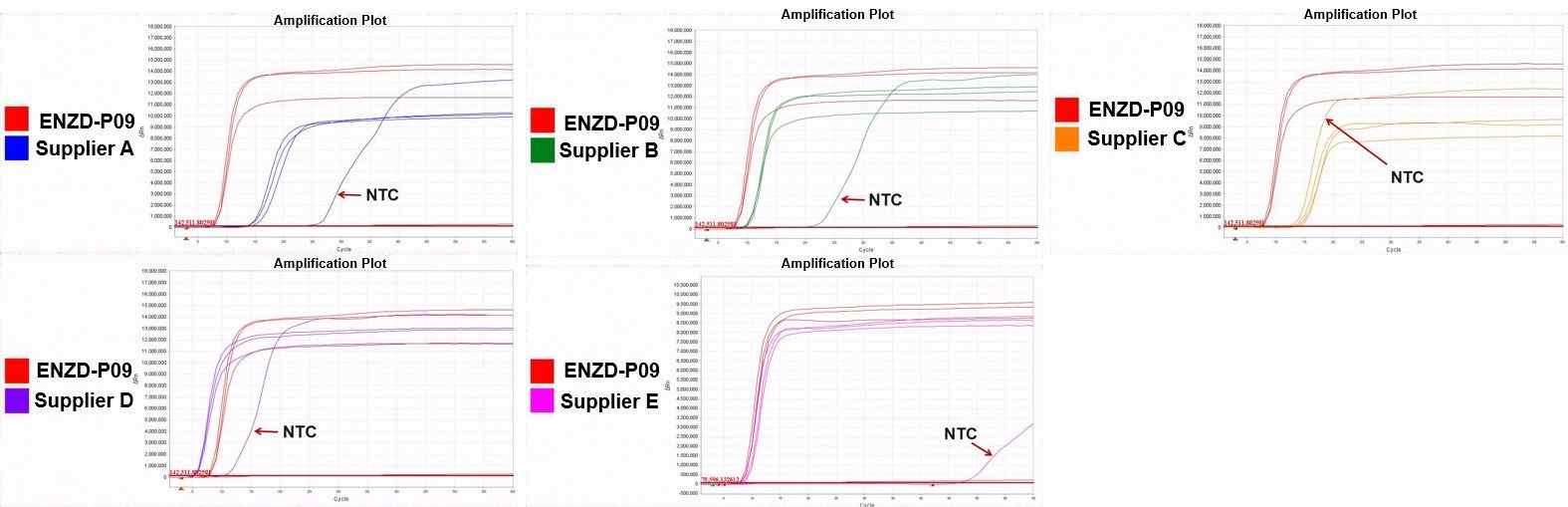
The performance of ENZD-P09 was evaluated using human Actin as the target gene in crude sample matrices. Saliva, oral swabs, and whole blood samples were processed with lysis buffer, vortexed, and incubated at room temperature for 5 minutes. A total of 5 μL of lysate was used as the template input.
Compared with Supplier A, B, C, and D, ENZD-P09 demonstrated faster amplification in crude lysate samples, indicating strong tolerance to inhibitors and robust performance in minimally processed sample conditions. These findings are based on internal validation studies assessing amplification efficiency in crude biological sample matrices.

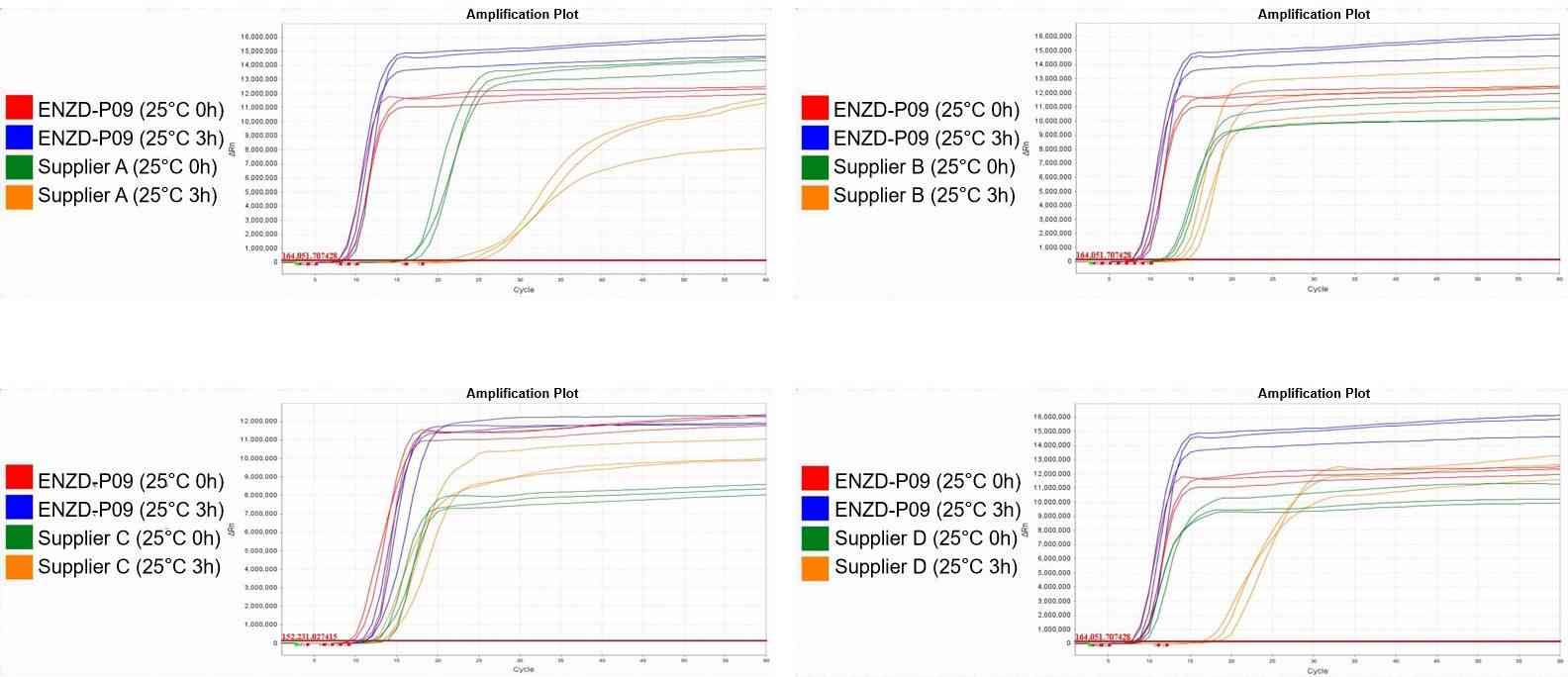
ENZD-P09 was evaluated alongside Supplier A, B, C, and D under two conditions: immediate reaction setup after reagent preparation and after incubation at room temperature for 3 hours prior to amplification.
The results showed that after 3 hours at room temperature, ENZD-P09 maintained stable amplification performance comparable to Supplier B and Supplier C, with no significant loss in reaction efficiency. This indicates good system stability and suitability for workflows requiring flexible setup conditions. These results are based on internal validation studies evaluating reaction stability under room temperature exposure conditions.