| Cat# | ENZD-QM03 |
| Specification | 500 rxns(20 μl/rxn) 2500 rxns(20 μl/rxn) |
| Aplications | Gene Expression Analysis |
| Description | Adopting chemically modified enzyme and optimized buffer system, the sensitivity and amplification efficiency of probe-based qPCR are enhanced. Equipped with dUTP/UDG anti-contamination system and ROX passive reference dye, it is compatible with various qPCR instruments and easy to use. |
| Features | 1. Outstanding amplification sensitivity: The rigorous chemical method hot-start enzyme Acetaq DNA Polymerase, combined with a carefully optimized buffer system, can detect down to single-copy templates. 2. Excellent linearity: Exhibits good linearity within a wide template range, with an amplification efficiency of up to 99%. 3. dUTP/UDG anti-contamination system: The introduction of Heat-Labile UDG anti-contamination system rapidly degrades U-containing contaminants at room temperature, eliminating the impact of amplification product contamination on qPCR reactions. 4. Wide platform compatibility: Special ROX reference dye suitable for all qPCR instruments, no need to adjust ROX concentration on different qPCR instruments. |
| Components | 2 × Universal U+ Probe Master Mix V2(20 µl/run), including dNTP/dUTP Mix, Mg²⁺, AceTaq HS DNA Polymerase, Heat-labile UDG, Specific ROX Reference Dye, etc. |
| Shipping and Storage Conditions | Store at -20℃ in the dark. Store at 4℃ for 3 weeks; can be frozen and thawed 30 times; The prepared mixture (primers, template, reagents) can be stored at 4℃ for 6 hours. |
| Download Datasheet: | 
|
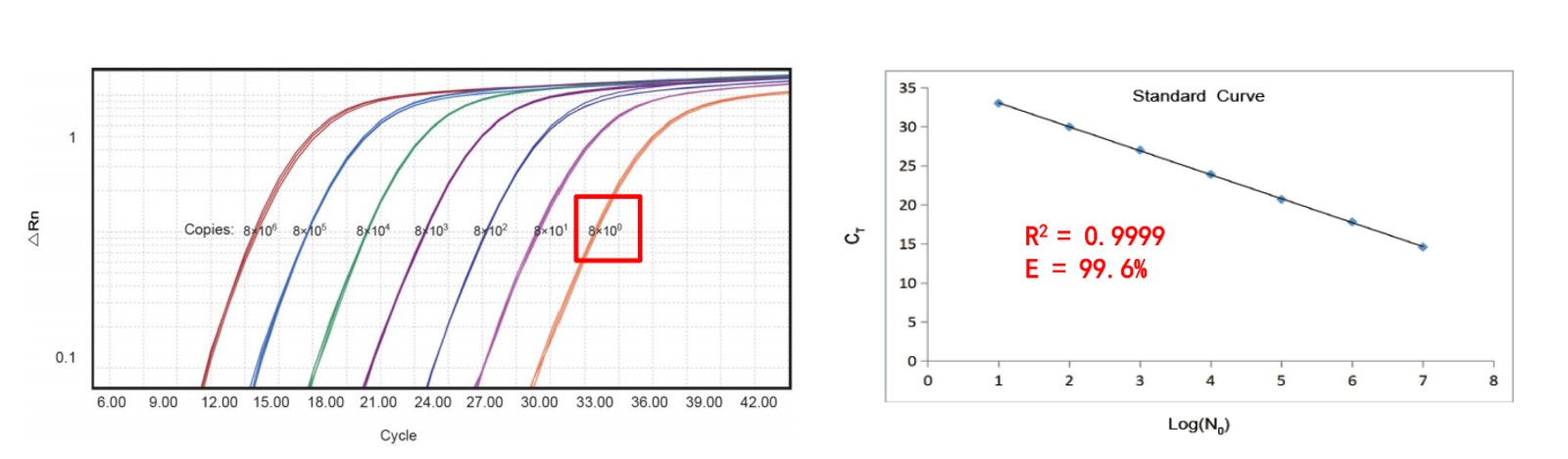
A 7-point tenfold serial dilution of plasmid Puc57-Kan was prepared, with the lowest concentration corresponding to approximately 8 copies per 4 μL reaction. Each reaction contained 4 μL of template.
Using ENZD-QM03, a chemically modified hot-start enzyme system developed by Creative Enzymes, amplification signals exhibited strong linear correlation across all dilution points. Reliable detection was achieved even at very low copy numbers, demonstrating high sensitivity and consistent quantitative performance over a broad template range. Data sourced from internal validation studies evaluating linear dynamic range and low-copy-number detection performance.
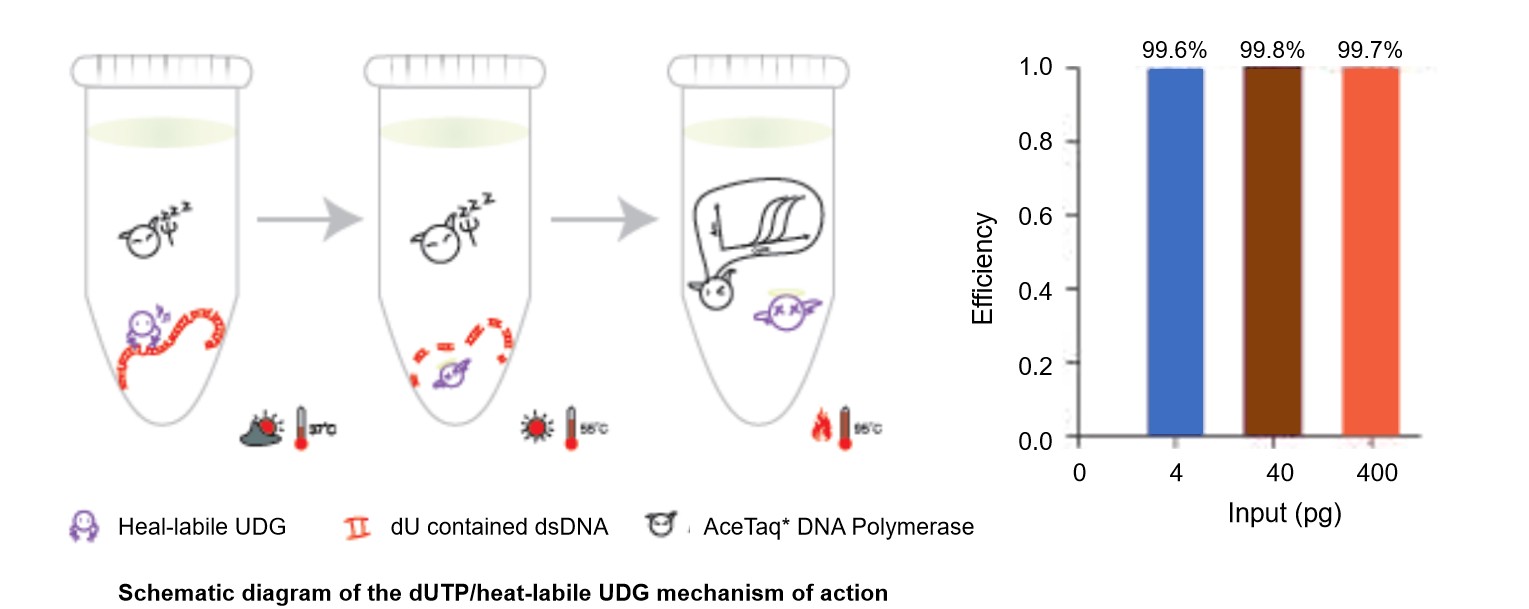
ENZD-QM03 incorporates a dUTP/Heat-Labile UDG system for efficient removal of carryover contamination. At ambient temperature, uracil-containing DNA contaminants are selectively degraded, while Heat-Labile UDG is rapidly inactivated at 50-55°C, preserving template integrity during amplification.
To evaluate system performance, uracil-containing DNA templates at 4 pg, 40 pg, and 400 pg were introduced into the reaction. ENZD-QM03 achieved over 99.6% removal efficiency, ensuring high accuracy and reliability in qPCR workflows. Data sourced from internal validation studies assessing contamination removal efficiency using uracil-containing DNA templates.
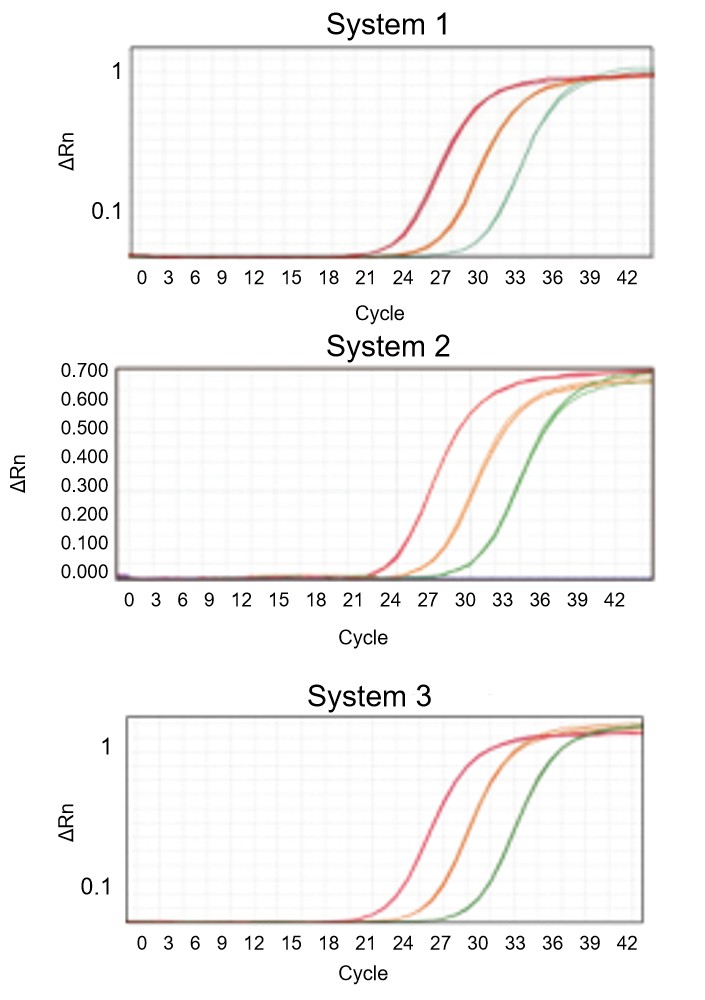
HeLa-derived cDNA was subjected to three 10-fold serial dilutions and analyzed using ENZD-QM03 across multiple real-time PCR platforms. Amplification of the GAPDH gene showed consistent quantification results across all systems.
These results indicate that ENZD-QM03, as a chemically modified hot-start enzyme from Creative Enzymes, delivers reliable cross-platform performance without requiring ROX adjustment, simplifying assay setup. Data sourced from internal validation studies evaluating cross-platform amplification consistency.