| Cat# | ENZD-RT03 |
| Specification | 2000 U; 10000 U |
| Unit Concentration | 200 U/μl |
| Description | Second-generation reverse transcriptase with strong heat resistance and elongation efficiency |
| Features | • High thermal stability: Half-life exceeds 240 min at 50℃ and reaches 60 min at 55℃. • Strong impurity tolerance: Compared with other products, it exhibits high reverse transcription efficiency in the presence of impurities such as xylan, guanidine isothiocyanate, and CTAB. • Good detection sensitivity: This enzyme demonstrates high detection sensitivity under different primer systems. |
| Applications | Reverse transcription; first-strand cDNA synthesis; RNA virus detection; RT-qPCR |
| Components | 5 x High Buffer II High Reverse Transcriptase II (200 U/µl) |
| Quality Control | 1. High thermal stability 2. Greater tolerance to impurities 3. Higher detection sensitivity |
| Shipping and Storage Conditions | Store at -30 ~ -15℃, transport at ≤0℃. |
| Download Datasheet: | 
|
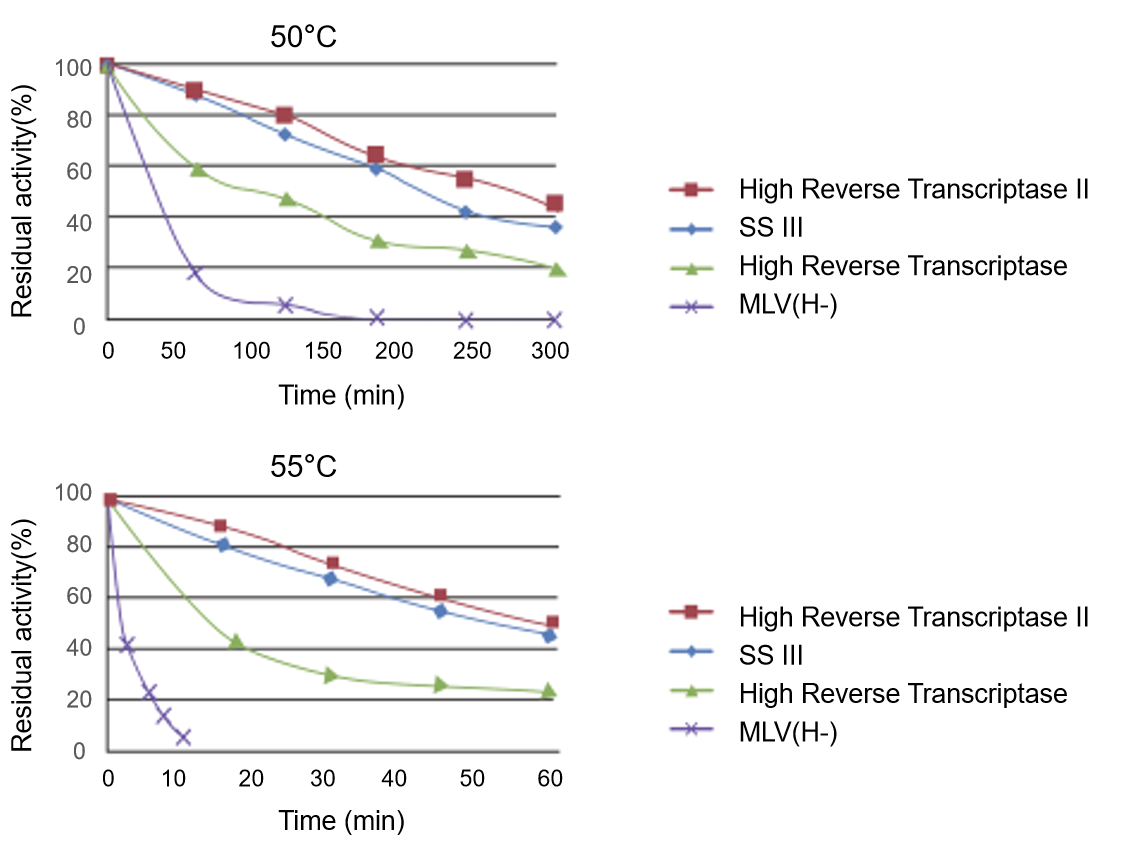
ENZD-RT03 exhibits superior thermal stability compared with other reverse transcriptases. In comparative evaluations at 50°C and 55°C, the enzyme maintains higher and more consistent reverse transcription performance, demonstrating improved stability and activity retention at elevated temperatures. These observations are supported by data sourced from internal validation studies on thermal stability.
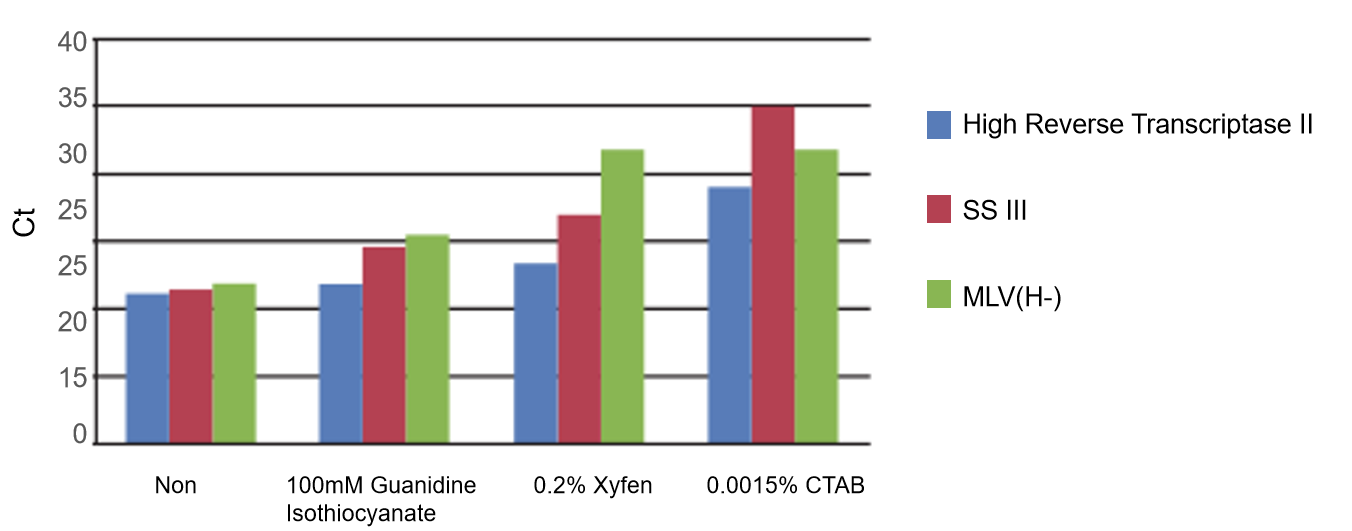
Using 1 μg of HeLa total RNA as template, reverse transcription was performed with ENZD-RT03 in the presence of various concentrations of common reaction inhibitors. The resulting cDNA was used for qPCR amplification of the human B2M gene.
Lower CT values indicate higher reverse transcription efficiency. ENZD-RT03 maintained stable CT values across inhibitor-containing conditions, indicating strong tolerance to impurities and consistent cDNA output. These results are supported by data sourced from internal validation studies evaluating impurity tolerance.
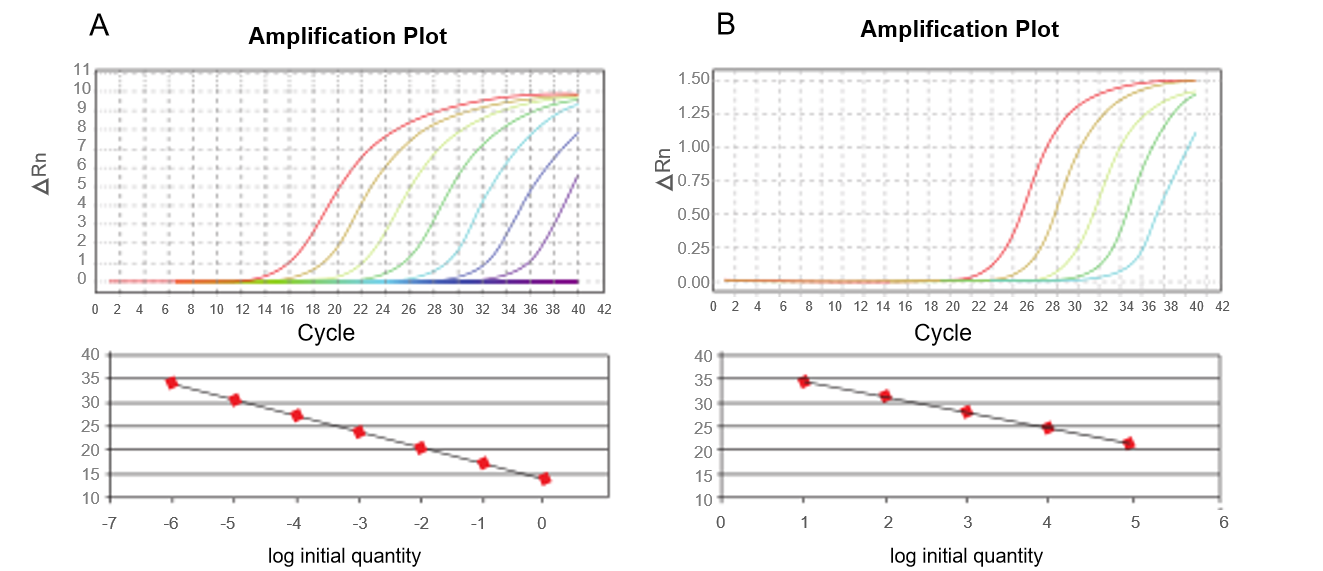
UHeLa total RNA ranging from 1 μg to 1 pg was used as template for reverse transcription with ENZD-RT03. The resulting cDNA (1 μL) was analyzed by qPCR targeting the B2M gene (A) and EGFR gene (B) using a SYBR Green-based qPCR system. The amplification results demonstrate consistent detection across a wide range of RNA inputs. These findings are supported by data sourced from internal validation studies on detection sensitivity.