
| Catalog | Product Name | EC No. | CAS No. | Source | Price |
|---|---|---|---|---|---|
| DIA-133 | Cholesterol Esterase from Schizophyllum commune | EC 3.1.1.13 | 9026-00-0 | Schizophyllum commune | Inquiry |
| DIA-134 | Cholesterol Esterase from Pseudomonas sp. | EC 3.1.1.13 | 9026-00-0 | Pseudomonas sp. | Inquiry |
| DIA-135 | Cholesterol Esterase from Microorganism | EC 3.1.1.13 | 9026-00-0 | Microorganism | Inquiry |
| DIA-138 | Cholesterol Oxidase from Microorganism | EC 1.1.3.6 | 9028-76-6 | Microorganism | Inquiry |
| DIA-139 | Native Arthrobacter globiformis Choline oxidase | EC 1.1.3.17 | 9028-67-5 | Arthrobacter globiformis | Inquiry |
| DIA-184 | Native Alcaligenes sp. Choline Oxidase | EC 1.1.3.17 | 9028-67-5 | Alcaligenes sp. | Inquiry |
| EXWM-0399 | choline oxidase | EC 1.1.3.17 | 9028-67-5 | Inquiry | |
| Kit-004 | L-Type Total Cholesterol Assay Kit | Inquiry | |||
| Kit-005 | High-Density Lipoprotein Cholesterol (HDL-C) Assay Kit | Inquiry |
Cholesterol in serum and plasma is present as both free cholesterol and fatty-acid esterified cholesterol. A total cholesterol assay must account for both pools, which distinguishes it from a free cholesterol assay and from methods designed to measure cholesterol associated with a selected lipoprotein fraction such as HDL or LDL.
A widely used enzymatic total cholesterol method combines cholesterol esterase, cholesterol oxidase, and peroxidase. Cholesterol esterase releases free cholesterol from cholesterol esters, cholesterol oxidase converts the resulting cholesterol while generating hydrogen peroxide, and peroxidase couples the peroxide to a measurable chromogenic reaction.
Creative Enzymes supplies cholesterol esterase from several microbial sources, cholesterol oxidase, and reporter enzymes for cholesterol reagent development. We also provide the L-Type Total Cholesterol Assay Kit, a configured cholesterol oxidase reagent system for customers requiring a complete assay rather than individual raw enzymes.
Free cholesterol can be oxidized directly by cholesterol oxidase when it is accessible in the reagent system. Cholesterol esters must first be hydrolyzed by cholesterol esterase before their cholesterol component can enter the oxidation reaction.
The relationship can be summarized as:
If ester hydrolysis is incomplete, the assay may recover free cholesterol adequately while under-recovering one or more esterified forms. Cholesterol esterase performance must therefore be assessed across substrates representative of the intended sample.
The common colorimetric reaction uses three functional enzyme stages:
The final color response depends on the complete sequence. A high cholesterol oxidase activity cannot compensate for incomplete ester hydrolysis, and adequate peroxide generation cannot compensate for an unstable or inhibited reporter reaction.
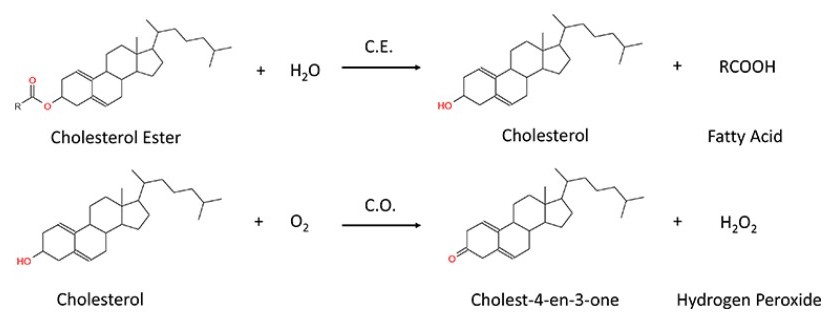 Figure 1. Enzymatic reaction for the quantification of cholesterol. (Lo et al., 2016)
The term “cholesterol assay” can refer to different analytical targets. The reagent architecture and product claims should clearly identify which cholesterol population is measured.
| Measurand | Principal Reaction Requirement | What Is Included | What Must Not Be Assumed |
|---|---|---|---|
| Free cholesterol | Cholesterol oxidase and a compatible reporter system | Cholesterol accessible without prior ester hydrolysis | Cholesterol esters are not necessarily included |
| Total cholesterol | Cholesterol esterase, cholesterol oxidase, and reporter chemistry | Free cholesterol plus cholesterol released from accessible cholesterol esters | The result does not identify individual lipoprotein fractions |
| HDL-C | Selective separation, masking, or reaction chemistry plus cholesterol conversion | Cholesterol associated with the HDL fraction defined by the method | Total cholesterol enzymes alone do not provide HDL selectivity |
| LDL-C | LDL-selective chemistry or a separately validated calculation or measurement method | Cholesterol assigned to the LDL fraction by the selected method | Total cholesterol response cannot be relabeled as LDL-C |
| Cholesterol ester content | Paired total and free cholesterol measurements or another validated approach | Difference attributable to esterified cholesterol under the defined calculation | It is not a direct measurement unless the method is specifically designed as one |
The core CE–CHOD–POD enzymes may also appear in HDL-C or LDL-C reagent systems, but fraction selectivity is created by the complete reagent architecture, not by the enzymes alone.
| Stage | Component | Function | Potential Assay Limitation |
|---|---|---|---|
| 1. Solubilization | Surfactants and reagent matrix | Makes hydrophobic cholesterol and cholesterol esters accessible to the enzymes | Poor solubilization can limit substrate recovery even when enzyme activity is adequate |
| 2. Ester hydrolysis | Cholesterol esterase | Releases free cholesterol from esterified cholesterol | Substrate preference, detergent inhibition, or slow hydrolysis can produce incomplete recovery |
| 3. Cholesterol oxidation | Cholesterol oxidase | Oxidizes accessible cholesterol and generates hydrogen peroxide | Catalase contamination, oxygen limitation, or surfactant incompatibility can reduce peroxide recovery |
| 4. Color development | Horseradish peroxidase and chromogens | Converts hydrogen peroxide into a measurable color response | Reducing substances, chromogen instability, or background oxidation can affect the signal |
| 5. Measurement | Calibrator, analyzer settings, and calculation | Converts absorbance response into the reported cholesterol concentration | Calibration mismatch, turbidity, reagent blank, or timing errors can bias the result |
Serum cholesterol esters contain different fatty-acid groups and are carried in a complex lipoprotein matrix. Cholesterol esterase should therefore be selected using both activity data and performance in the complete reagent.
Available options include:
Relevant comparison criteria include:
Cholesterol Oxidase from Microorganism converts accessible cholesterol and produces hydrogen peroxide for the reporter reaction.
Selection should consider:
Cholesterol oxidase and choline oxidase are different enzymes. Choline oxidase acts on choline-related substrates and should not be substituted for cholesterol oxidase in a standard CE–CHOD–POD total cholesterol reaction.
Individual enzymes are appropriate when developing, modifying, or second-sourcing a cholesterol reagent.
The raw-material route supports:
The final enzyme ratio must be established under the intended reagent, sample, and analyzer conditions rather than calculated only from catalog activity values.
The L-Type Total Cholesterol Assay Kit provides a configured alternative for customers who do not need to formulate the CE–CHOD–POD system from individual raw materials.
Total cholesterol, HDL-C, and LDL-C are related components of a lipid panel, but they are not interchangeable assay targets. A total cholesterol reagent is designed to recover cholesterol across accessible lipoprotein fractions. HDL-C and LDL-C methods require additional fraction-selective chemistry.
For a configured HDL-C method, see the High-Density Lipoprotein Cholesterol (HDL-C) Assay Kit.
Cholesterol is hydrophobic and transported within lipoprotein particles. Reagent performance therefore depends strongly on substrate accessibility and the compatibility of the enzymes with the solubilization and reporter systems.
Need Help Selecting Total Cholesterol Assay Enzymes or a Complete Kit?
Share the intended measurand, sample type, reaction format, surfactant system, chromogen, analyzer platform, reagent format, and production scale with our technical team.
Request Total Cholesterol Assay Support
Q1. Which enzymes are commonly used in a total cholesterol assay?
Q2. Why is cholesterol esterase required?
Q3. Can cholesterol oxidase alone measure total cholesterol?
Q4. Are cholesterol oxidase and choline oxidase the same enzyme?
Q5. Can the same enzymes be used in total cholesterol and HDL-C assays?
Q6. How should I choose among cholesterol esterase sources?
Q7. Why are detergents important in a cholesterol assay?
Q8. Can catalog activity values determine the final CE-to-CHOD ratio?
Q9. Can Creative Enzymes support custom cholesterol reagent development?
