
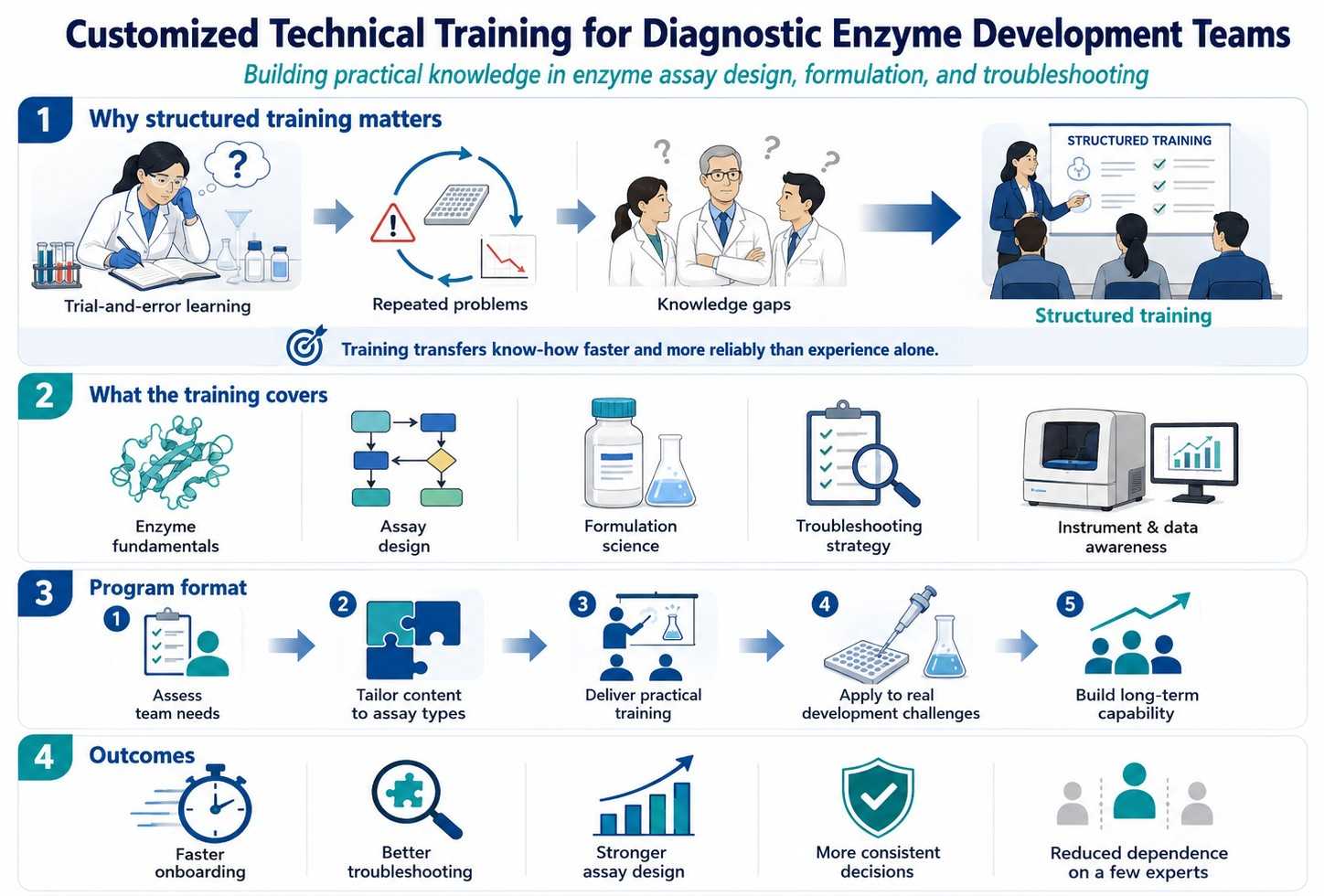
Diagnostic enzyme development sits at the intersection of enzymology, analytical chemistry, and instrument engineering—and most teams inherit that knowledge informally. A scientist trained in molecular biology learns reagent formulation by trial and error; a new QC analyst learns troubleshooting by watching failures accumulate. The result is predictable: development cycles driven by intuition rather than mechanism, problems solved repeatedly because the reasoning behind earlier solutions was never transferred, and a dependence on a few experienced individuals whose knowledge leaves when they do. Structured technical training closes this gap faster and more reliably than experience alone.
As part of our Professional Diagnostic Enzyme Consulting Services, Creative Enzymes provides customized technical training for diagnostic enzyme development teams. Programs combine enzyme fundamentals, assay design principles, formulation science, and troubleshooting strategy, tailored to your team's experience level, your assay types, and the development challenges you actually face—and delivered by scientists who develop enzyme-based assays for a living.
| Item | Summary |
|---|---|
| Starting Point | A development, manufacturing, or quality team that needs stronger, more systematic enzyme and assay knowledge—onboarding, capability building, or targeted problem solving. |
| Core Work | Training-needs assessment, curriculum customization, interactive delivery, and case-study-based practical analysis. |
| Primary Output | Customized training materials, technical reference documents, troubleshooting guides, and a team better equipped to develop and support enzyme-based assays. |
Programs are built for the full range of roles that touch an enzyme-based reagent: R&D scientists designing new assays, assay development and formulation teams, raw material qualification staff who need to understand what a supplier's specification actually means, manufacturing technical teams transferring reagents to production, quality control personnel interpreting unexpected results, and technical support teams diagnosing customer complaints. Content depth is calibrated to each audience—a QC-focused session emphasizes different aspects of the same enzyme kinetics than a development-focused one—and we regularly design programs for new employees entering diagnostic enzyme development, compressing what would otherwise be years of informal learning into a structured curriculum.
Core modules cover the five knowledge areas every diagnostic enzyme team needs, each connecting theory to the decisions your team makes daily.
Diagnostic Enzyme Fundamentals
Diagnostic Assay Reaction Design
Enzyme Reagent Formulation
Analytical Performance
Troubleshooting
The troubleshooting module is consistently rated the most immediately useful: it teaches a structured diagnostic method—classifying the failure pattern, forming hypotheses across enzyme, formulation, process, and instrument categories, and discriminating between them with targeted tests—rather than a list of symptoms and fixes. For teams facing an active investigation, this module pairs naturally with our Diagnostic Assay Failure Investigation Service.
For experienced teams, advanced modules address the topics where informal knowledge runs out: diagnostic enzyme engineering and what recombinant variants can and cannot change; selection and qualification of recombinant alternatives to native enzymes; raw material equivalency assessment for supplier changes; optimization of coupled enzyme systems, including kinetic matching of auxiliary and indicator enzymes; enzyme stabilization chemistry in depth; adaptation of reagents to new instrument platforms; formal root-cause analysis methodology; and the distinct failure modes that emerge during manufacturing scale-up. Advanced sessions assume the core material and spend their time on the judgment calls—when a coupled reaction should be rebalanced rather than the enzyme replaced, when a stability problem is really a formulation compatibility problem—that distinguish experienced developers.
Building enzyme development capability in your team?
Discuss a customized training program
No two programs are identical, because no two teams are. Customization considers your assay types and product pipeline, the team's current experience level, the instrument platforms you work on, the enzyme categories central to your products, known development challenges—including, with your agreement, real anonymized problems from your own history—and your internal SOPs and workflows, so that what is taught aligns with how your organization actually operates. A molecular diagnostics team and a clinical chemistry reagent manufacturer receive fundamentally different programs built from the same underlying framework.
Customization begins with a structured needs assessment: we interview your technical leads, review representative assays and recent failure or deviation histories, and identify where knowledge gaps are costing time. The resulting curriculum explicitly maps each module to a capability your team needs, so training time is spent where it returns the most—and content your team already commands is condensed rather than repeated.
Delivery format follows the content and your logistics. Remote technical workshops work well for distributed teams and modular curricula spread over several weeks. On-site training supports intensive multi-day programs and allows discussion around your actual equipment and reagents. Small-group technical sessions suit focused topics for specialist audiences, while project-specific workshops combine training with live work on an active development problem—effectively consulting with a training component. Case-study-based training works through real failure and development scenarios in detail, and standalone technical Q&A sessions give teams direct access to our scientists for accumulated questions. Formats can be combined; many clients begin with an on-site core program and follow with periodic remote sessions.
Case studies anchor every program. Representative examples include troubleshooting a high reagent blank caused by a contaminating activity in an enzyme raw material; selecting an alternative enzyme supplier and designing the equivalency study; improving the shelf life of a liquid enzyme reagent through systematic stabilizer screening; diagnosing poor assay linearity traced to a coupled reaction becoming rate-limiting at high analyte concentrations; optimizing a coupled reaction system by rebalancing enzyme ratios; and adapting a reagent to a new analyzer whose reaction timing and temperature differ from the original platform. Where confidentiality permits, case studies are drawn from real engagements with identifying details removed; alternatively, we build case studies around your team's own historical challenges.

Each engagement follows a defined sequence: a training-needs assessment with your technical leads; definition of the audience and target technical level; curriculum customization against your assays and challenges; training delivery in the agreed format; interactive discussion throughout; practical case analysis applying the material; and follow-up technical recommendations, including suggested reading and internal practice exercises.
Typical deliverables include customized training materials and presentation decks your team keeps for ongoing reference, technical reference documents, case-study exercises, troubleshooting guides formatted for laboratory use, a training summary for management and training records, and an optional knowledge assessment to verify that key concepts were transferred.
Teams that complete the program typically report faster problem solving when assays misbehave, a shared technical vocabulary that improves cross-functional communication between R&D, manufacturing, and QC, more systematic development practices that reduce trial-and-error iteration, a working understanding of raw material variability and how to manage it, and reduced dependence on the informal knowledge of a few senior individuals.
Q1. How long does a typical training program last?
Q2. Can training address problems our team is facing right now?
Q3. What experience level does the training assume?
Q4. Do participants receive materials they can keep?
Q5. Can you train teams on our internal assays and SOPs specifically?
Creative Enzymes delivers training from the practitioner's perspective: our instructors develop, formulate, and troubleshoot enzyme-based assays as their core work, so every module is grounded in what actually happens at the bench rather than textbook abstraction. The objective is durable capability—a team that develops more systematically, troubleshoots by mechanism, and communicates across functions with a shared technical foundation—long after the sessions end.
Build stronger technical capabilities in your diagnostic enzyme development team—contact our business development team today!
