
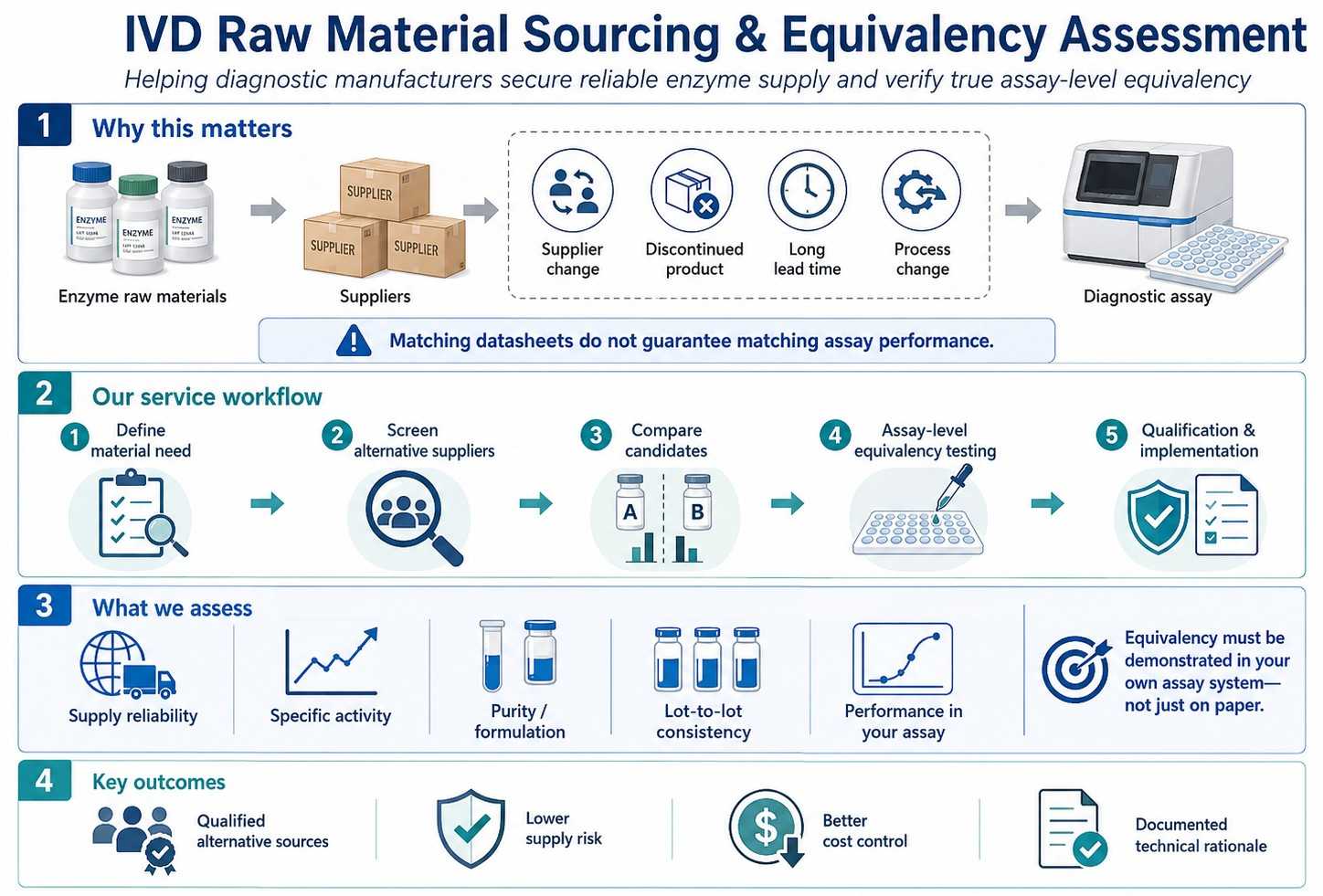
Diagnostic reagent manufacturers depend on enzyme raw materials that arrive on time, meet specification, and behave identically from lot to lot. In practice, supply chains rarely cooperate: suppliers discontinue products, merge, change production processes, or quote lead times measured in months. When a manufacturer responds by switching to an alternative source, the new material may match the old one on every datasheet line yet still shift assay performance—because datasheets describe the enzyme, not the enzyme as your formulation uses it. Managing this reality requires two connected capabilities: structured sourcing that identifies credible alternatives before a crisis, and functional equivalency assessment that proves, in your own assay, whether an alternative material truly performs the same.
As part of our Professional Diagnostic Enzyme Consulting Services, Creative Enzymes provides an IVD raw material sourcing and equivalency assessment service focused on diagnostic enzymes. We help manufacturers identify and screen alternative suppliers, compare candidate materials on a like-for-like basis, and plan or execute the analytical equivalency testing that supports supplier qualification, cost optimization, and supply-chain risk reduction.
| Item | Summary |
|---|---|
| Starting Point | A need to qualify an alternative enzyme raw material, replace a supplier, reduce single-source dependency, or control cost without compromising assay performance. |
| Core Work | Supplier and candidate screening, specification comparison, side-by-side functional testing, and structured equivalency assessment. |
| Primary Output | A supplier shortlist, raw material comparison matrix, equivalency results, specification gap analysis, and a qualification recommendation. |
The triggers for a sourcing project are familiar to most IVD manufacturers. Single-source dependency concentrates risk in one supplier's business decisions; discontinuation notices force qualification work on someone else's timeline; and long or unreliable lead times complicate production planning. Even with a stable supplier, lot-to-lot variation in activity or purity can consume formulation headroom and generate unexplained assay drift. Specification documents add another layer of difficulty: two suppliers may express activity in different units, measure it under different conditions, or define purity by different methods, so a superficial specification match says little about functional equivalence. The most expensive failure mode is the substitution that appears successful in incoming QC but produces an unexpected performance shift in the finished reagent—discovered during verification, stability testing, or in the field. A structured sourcing and equivalency program is designed to surface these differences in the laboratory rather than in the market.
Our sourcing support converts a broad supplier landscape into a defensible shortlist. We identify potential suppliers for the enzyme in question, screen candidate products against your technical requirements, and compare specifications after normalizing units and test methods so the comparison is meaningful. Because an enzyme's behavior depends on how it was made, the assessment covers source organism and production method—native extraction versus recombinant expression, host system, and downstream purification—as well as the supplier's documentation quality, batch records availability, and change-notification practices. Supply continuity is evaluated as a technical criterion in its own right: manufacturing scale, quality system maturity, and commercial stability all bear on whether a technically suitable material will remain available for the life of your product. Candidates that pass this screen proceed to laboratory assessment; those that fail are documented with the reasons, so the sourcing rationale remains auditable.
One detail deserves emphasis: incoming QC alignment. A supplier's release assay and your incoming inspection method rarely measure activity under identical conditions, so the same material can pass one and fail the other. As part of sourcing support, we review the alignment between supplier CoA methods and your QC methods and, where they differ, define a correlation or method-adjustment strategy—preventing qualified materials from being rejected, or unqualified ones accepted, for purely methodological reasons.
Equivalency cannot be established by a single test. Our framework compares the original and alternative materials across four property groups, moving from identity through to performance in the real assay.
Identity and Functional Properties
Physicochemical Properties
Assay Performance
Stability
The framework is deliberately hierarchical. Identity and physicochemical agreement are necessary but not sufficient; equivalency is only claimed when the alternative material performs equivalently in the finished reagent across the measuring range and over a relevant stability window.
Qualifying an alternative enzyme supplier?
Discuss your equivalency study with our team
Side-by-side comparison is the core of every equivalency project. Original and alternative materials are tested in parallel in the same reagent formulation, on the same instruments, by the same operators, using the same samples and calibrators. Activity normalization is handled explicitly: because suppliers define and measure activity units differently, materials are compared at matched functional activity in the assay, not at matched label values. Kinetic profiles are examined for differences in lag phase, reaction rate, and endpoint that aggregate statistics can hide. Where differences appear, the analysis separates their origin—enzyme identity, purity, formulation of the raw material itself—and quantifies their effect on reportable results, so the qualification decision rests on measured impact rather than assumption.
When a raw material change is driven by discontinuation or supplier transition, the work is framed as a change impact assessment. We begin by identifying the critical quality attributes of the incumbent material—the properties the assay actually depends on, which are not always the properties printed on the specification—then compare the candidate against those attributes analytically. Specification gap analysis documents where the two materials differ and whether each gap is functionally relevant. The outcome is one of three documented conclusions: the alternative is equivalent and can be qualified directly; it is equivalent after defined assay re-optimization, with the required adjustments specified; or it is not suitable, with the disqualifying evidence recorded. Where re-optimization is needed, recommendations cover concentration adjustments, formulation modifications, and any re-verification testing the change control process requires.

Typical deliverables include the supplier shortlist with screening rationale, a raw material comparison matrix, equivalency testing results with statistical summaries, a specification gap analysis, a risk assessment for each candidate, and a qualification recommendation formatted to support your supplier qualification and change control records.
Recurring applications include second-source qualification, supplier replacement after discontinuation, cost-reduction programs, supply-chain continuity planning, raw material selection for new product development, material re-qualification during manufacturing scale-up, and the technical assessment component of raw material change control.
Q1. How many alternative suppliers should we evaluate?
Q2. The candidate matches our specification on paper. Is testing still necessary?
Q3. What acceptance criteria define "equivalent"?
Q4. Can you help if the alternative material is not equivalent?
Q5. Does equivalency assessment replace our regulatory obligations for material changes?
Creative Enzymes treats raw material equivalency as a question answerable only by experiment: specification documents narrow the field, but the decision is made by data generated in your formulation, on your platform, against criteria set before the first test. Because our teams work across enzyme production, assay development, and reagent formulation, differences uncovered during comparison are interpreted mechanistically—distinguishing a disqualifying mismatch from a manageable adjustment—and every conclusion is documented to the standard your quality system expects.
Evaluate alternative IVD enzyme raw materials with confidence—contact our business development team today!
