
The clinical value of an enzyme-based diagnostic assay is often decided at the bottom of its measuring range. When an analyte is present at low abundance, or when a decision threshold sits close to the detection limit, small improvements in analytical sensitivity can determine whether a result is reportable, repeatable, and clinically meaningful. Sensitivity, however, is not governed by a single reagent component. It emerges from the balance between signal generation and background: enzyme turnover, coupling efficiency, reporter chemistry, reagent blank, instrument optics, and the stability of every signal-generating component all contribute to the final limit of detection.
As part of our Diagnostic Enzyme Assay Development and Troubleshooting Services, Creative Enzymes provides a focused limit of detection (LoD) and sensitivity optimization service. We work with developers whose assays show weak low-level response, elevated background, or an insufficient signal-to-noise ratio, and we systematically identify which reaction steps or formulation elements are limiting performance before making targeted changes.
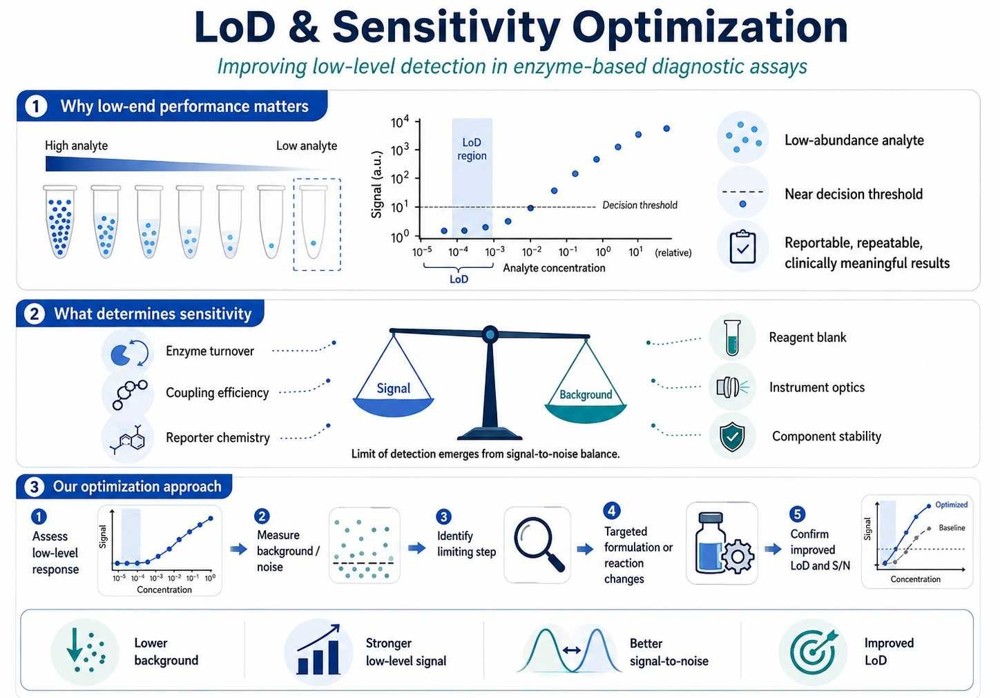
| Item | Summary |
|---|---|
| Starting Point | An enzyme-based assay with weak low-analyte signal, high reagent blank, poor signal-to-noise ratio, or a detection limit that does not meet the intended clinical use. |
| Core Work | Blank and low-level characterization, kinetic and coupling optimization, signal amplification, background reduction, and low-concentration verification. |
| Primary Output | Baseline versus optimized sensitivity data, a recommended reaction formulation, estimated LoD/LoQ performance where requested, and an optimization report. |
Sensitivity problems present in recognizable patterns. Some assays produce an adequate signal at mid-range concentrations but an unreliable response near the blank; others show a strong signal that is masked by an equally strong reagent blank, leaving the net response too small to quantify. In coupled-enzyme systems, insufficient turnover of the primary enzyme or low coupling efficiency can cap the achievable signal, while excess background conversion or instability of the reporter components raises the noise floor. Instrument-related limitations, such as an unfavorable wavelength, a narrow reading window, or limited photometric resolution, can further restrict what the chemistry is able to deliver.
Because these causes require different remedies, our work begins with a baseline sensitivity assessment rather than immediate reformulation. We characterize the blank signal and its variability, analyze the response of low-level samples relative to the blank distribution, and evaluate the overall signal-to-noise behavior of the current system. Where applicable, we perform a preliminary assessment of the limit of blank (LoB), limit of detection (LoD), and limit of quantitation (LoQ) using replicate designs consistent with established clinical laboratory evaluation principles. Equally important, we examine the reaction kinetics to identify which step—primary conversion, coupling, or signal generation—is limiting sensitivity, so that subsequent optimization is directed at the true bottleneck.
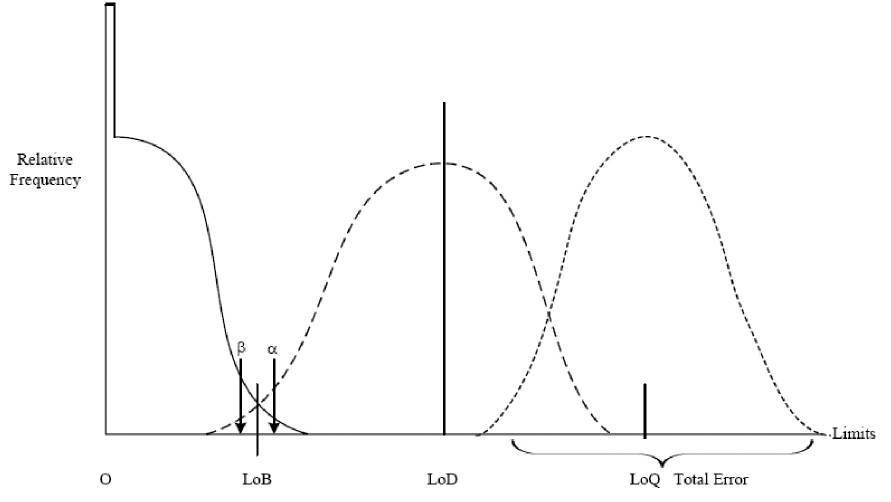 Figure 1. Relationship between LoB, LoD and LoQ. (Armbruster and Pry, 2008)
Once the limiting step is known, the reaction system is optimized in a structured manner. Enzyme concentration is titrated to increase turnover at low analyte levels without introducing excessive blank or reagent cost. Substrate concentration is adjusted to sustain an adequate reaction rate while avoiding solubility problems, spontaneous conversion, or detector saturation. Cofactor levels are reviewed and adjusted where the reaction depends on nicotinamide cofactors, ATP, metal ions, or other activators, since partial cofactor limitation is a common and easily overlooked cause of weak low-end response.
In coupled assays, the coupling-enzyme loading is optimized so that the reporter reaction never becomes rate-limiting across the measuring range. Incubation time is examined together with the reading window: a longer incubation can increase product accumulation, but only if background conversion does not grow proportionally. We also assess whether a kinetic measurement strategy or an endpoint strategy offers the better sensitivity for the specific reaction, since the choice affects both the achievable signal and the influence of blank drift.
Reaction Variables Optimized
Typical Limiting Mechanisms
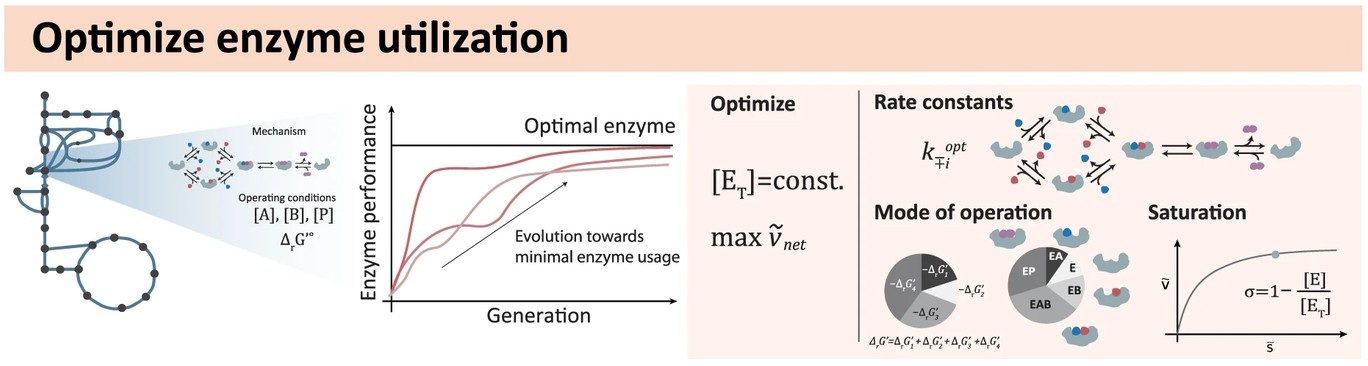 Figure 2. Optimize enzyme utilization. (Sahin et al., 2023)
Signal Amplification
Where kinetic optimization alone is insufficient, we evaluate amplification strategies appropriate to the assay format. These include optimization of enzyme cascades and coupled-reaction amplification, in which the product of one reaction drives a second, signal-generating reaction; improvement of the reporter system, such as a more sensitive chromogenic formulation or a fluorogenic detection strategy where the instrument supports it; and reaction designs that increase product accumulation within the reading window without a corresponding rise in background. Each amplification route is assessed not only for signal gain but also for its effect on blank, precision, reagent stability, and cost.
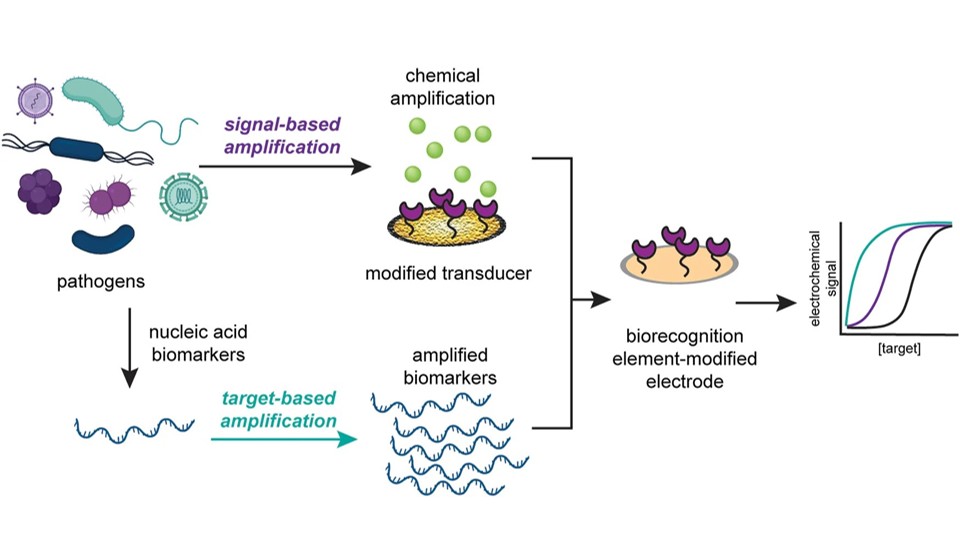 Figure 3. Signal amplification strategies can be classified into target-based amplification (top) or signal-based amplification (bottom). (Zhou et al., 2022)
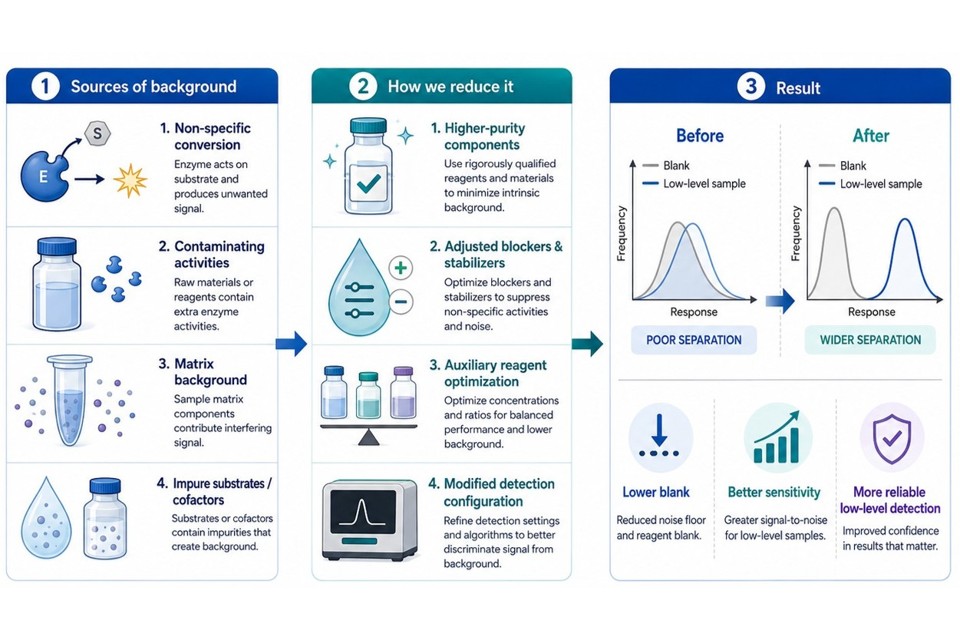
Background Reduction
Sensitivity gains achieved by lowering the noise floor are often more durable than gains achieved by increasing signal. We investigate the sources of reagent blank, including non-specific enzymatic conversion, contaminating enzyme activities in raw materials, matrix-related background, and impurities in substrates or cofactors. Depending on the findings, mitigation may involve higher-purity components, adjusted concentrations of blockers, stabilizers, and auxiliary reagents, or a modified detection configuration that discriminates the analytical signal from the background. The combined objective is a wider separation between the low-level sample response and the blank distribution—the practical definition of improved analytical sensitivity.
Is background masking your low-level signal?
Discuss your assay with our team
Optimized conditions are verified at the concentrations that matter. We perform replicate testing at low analyte levels to confirm that the improved signal is consistent and not an artifact of a single favorable run. Response consistency near the detection limit, calibration behavior at the low end of the curve, and low-level precision are evaluated together, because a detection limit that cannot be supported by acceptable precision has limited practical value. Where the assay serves a defined clinical decision point, we examine performance specifically at that concentration, confirming that the optimized system provides reliable discrimination around the decision threshold rather than only a nominal improvement in LoD.
| Evaluation Focus | Purpose |
|---|---|
| Replicate low-level testing | Confirm response consistency and estimate realistic detection capability. |
| Low-end calibration behavior | Verify that the calibration model remains appropriate near the detection limit. |
| Low-level precision | Determine whether repeatability supports quantitation at low concentrations. |
| Decision-point sensitivity | Confirm reliable measurement at clinically relevant thresholds. |

Typical deliverables include a comparison of baseline versus optimized sensitivity, the recommended reaction formulation, a signal-to-noise improvement assessment, estimated LoD and LoQ performance where requested, low-level precision data, and a comprehensive optimization report documenting the work and the rationale behind each recommendation.
This service is suitable for low-abundance metabolite assays, enzyme activity measurements, clinical chemistry reagents, specialty biochemical tests, and high-sensitivity enzyme-based detection systems. It is also valuable for assays being transferred to lower-volume or miniaturized platforms, where reduced reaction volumes and shorter optical paths frequently erode the signal-to-noise margin that the original format enjoyed.
Q1. How do you decide whether to increase signal or reduce background?
Q2. Can you provide formal LoB, LoD, and LoQ values?
Q3. Will sensitivity optimization affect the rest of the measuring range?
Q4. Our assay is moving to a miniaturized platform. Can this service help?
Q5. What information is helpful at project initiation?
Creative Enzymes combines enzyme kinetics, reagent chemistry, and analytical evaluation to improve detection capability in a controlled, evidence-based manner. Whether the goal is a lower detection limit, a wider clinically useful measuring range, or a more robust low-end response, the optimization is documented so that the improvements can be carried forward into verification and validation.
Improve the detection capability of your enzyme-based assay—contact our business development team today to discuss your sensitivity optimization needs!
