
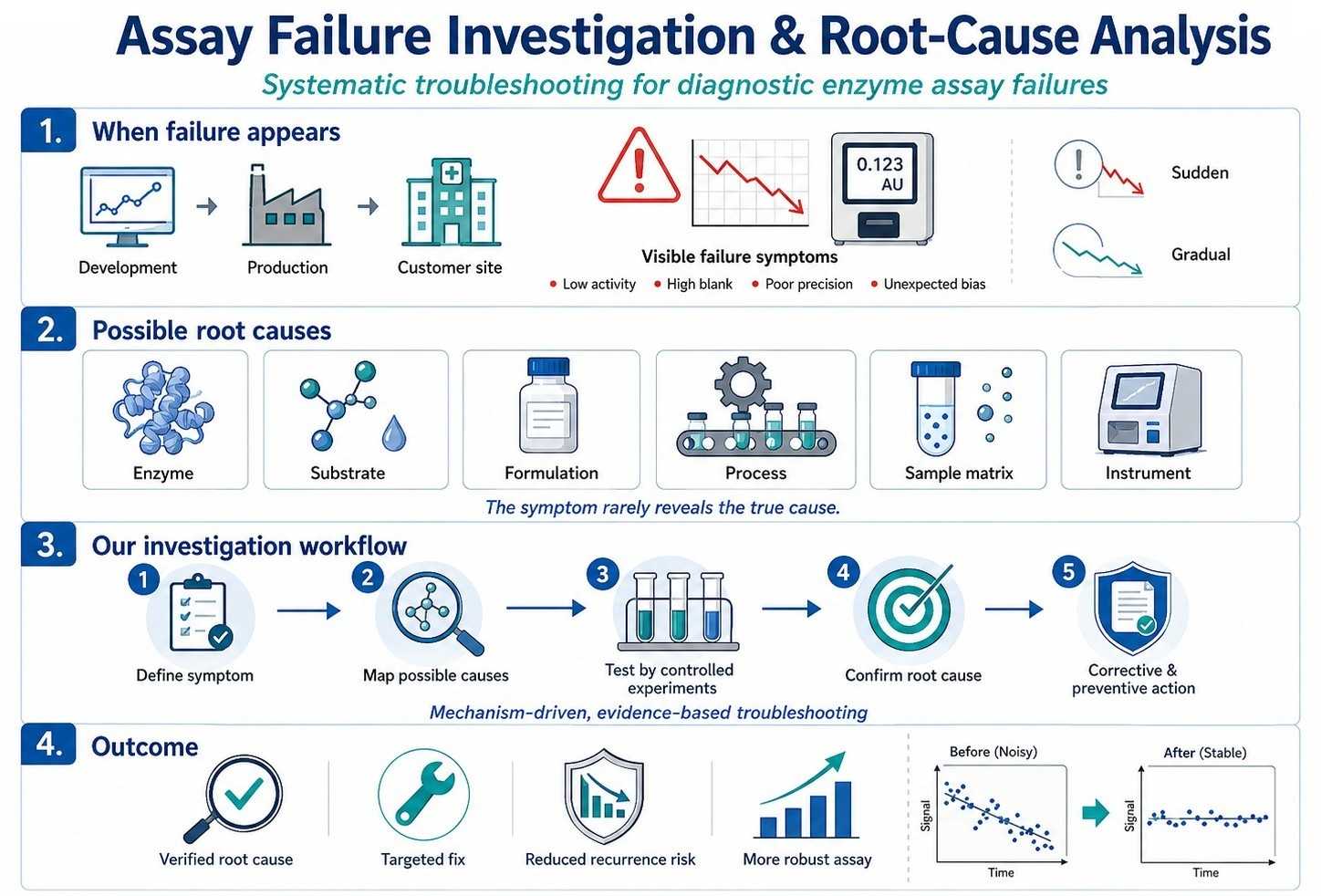
When a diagnostic enzyme assay fails—suddenly or gradually, in development, in production, or at a customer site—the visible symptom rarely identifies the cause. A loss of activity may originate in the enzyme itself, in a degraded substrate, in a formulation interaction, in a manufacturing deviation, in the sample matrix, or in the instrument configuration. Replacing components by trial and error can resolve the immediate batch while leaving the underlying mechanism untouched, free to recur in the next lot or the next scale-up. Durable resolution requires a systematic investigation that connects the symptom to a verified root cause.
As part of our Diagnostic Enzyme Assay Development and Troubleshooting Services, Creative Enzymes provides a diagnostic assay failure investigation and root-cause analysis service. We apply a structured, mechanism-driven framework that examines enzyme, substrate, formulation, process, sample, and instrument factors in combination, confirms the root cause through controlled experiments, and develops evidence-based corrective and preventive strategies.
| Item | Summary |
|---|---|
| Starting Point | An enzyme-based assay with an unexpected performance failure in development, production, stability, or field use, where the cause is unknown or disputed. |
| Core Work | Failure reproduction, multi-factor root-cause investigation, controlled confirmatory experiments, and corrective-action development. |
| Primary Output | Confirmed or prioritized root causes, corrective and preventive recommendations, verification data, and a root-cause analysis report. |
Our investigations cover the full range of enzyme-assay failure modes: unexpected loss of activity, high reagent blank, low sensitivity, poor precision, calibration failure, poor linearity, low or high recovery, lot-to-lot variation, excessive interference, reagent instability, drift during storage, instrument-dependent bias, inconsistent performance between laboratories, and unexpected results following raw-material or process changes. The failure pattern itself carries diagnostic information—a sudden change after a new raw-material lot points in a different direction than a gradual drift during storage or a failure that appears only on one analyzer—so the investigation begins by classifying the failure mode precisely. We also document when and where the failure occurs—during manufacture, during stability storage, at a specific customer site, or only with particular sample types—because the temporal and environmental pattern frequently narrows the hypothesis space before any experiment is run.
Root causes in enzyme-based assays are distributed across six factor categories, and most real investigations must consider more than one.
Enzyme-Related Factors
Substrate and Cofactor Factors
Formulation Factors
Process and Manufacturing Factors
Sample and Matrix Factors
Instrument Factors
Because these categories interact—a marginally stable enzyme may fail only after a process change shortens the stabilizer's protection, for example—hypotheses are generated across categories rather than within the one that appears most obvious.
A root cause cannot be confirmed against a failure that cannot be reproduced. We first reproduce the reported failure under controlled conditions, comparing suspect material against control or historical reagent lots, and against normal versus failed conditions in parallel. Controlled variable testing isolates individual factors, stress-condition testing accelerates suspected degradation mechanisms, and component substitution experiments—replacing one component at a time with a qualified reference—localize the failure to a specific element of the system.
Depending on the failure mode, the investigation applies component-by-component examination, reaction kinetic profiling to reveal changes in lag phase, rate, or endpoint, enzyme activity and specific-activity testing, raw-material comparison between lots, stability and degradation assessment of suspect components, matrix challenge experiments, manufacturing process variable assessment, instrument cross-checking, and formulation reconstruction studies in which the reagent is rebuilt from qualified components to confirm the contribution of each element. Findings are organized in a root-cause hypothesis matrix that tracks which hypotheses have been excluded, which remain open, and which are confirmed by direct experimental evidence. This disciplined record matters practically as well as scientifically: it prevents premature conclusions, makes the reasoning auditable by your quality team, and ensures that excluded hypotheses do not resurface as speculation in future investigations.
Facing an unexplained assay failure?
Discuss the case with our team
A confirmed root cause is translated into corrective action matched to its mechanism. Corrective options include reformulation, adjustment of raw-material specifications, correction of enzyme or substrate concentrations, stabilization strategies, manufacturing process modifications, and instrument parameter changes. Where the investigation reveals a vulnerability rather than a single defect—for example, a specification that is technically met but too wide for the assay's sensitivity—we recommend preventive measures as well: tightened specification limits, QC control points positioned to detect the failure mode early, and risk-reduction strategies for future batches. Each corrective action is verified experimentally against the original failure mode before the investigation is closed, so that the resolution is demonstrated rather than presumed. Where relevant, we also recommend the confirmatory studies—precision, sensitivity, interference, or stability testing—needed to show that the corrective change has not introduced a new problem elsewhere in the assay's performance profile.

Typical deliverables include the failure-mode assessment, the complete experimental investigation dataset, the root-cause hypothesis matrix, confirmed or prioritized root causes, corrective-action recommendations, preventive recommendations, verification data, and a comprehensive root-cause analysis report suitable for quality records and CAPA documentation.
Recurring project scenarios include a reagent that previously worked but suddenly fails; a new enzyme lot that changes assay performance; scale-up that causes performance deterioration; shelf-life performance falling below specification; a reagent that works on one analyzer but fails on another; customer-site results that differ from internal QC; reformulation that introduces unexpected bias; and manufacturing batches that show unexplained variability.
Q1. Why choose an enzyme-centered investigation rather than general troubleshooting?
Q2. What materials and information should we provide?
Q3. What if the root cause cannot be uniquely confirmed?
Q4. Can the investigation support our CAPA process?
Q5. Do you also implement the corrective actions?
Creative Enzymes investigates assay failures with the same discipline used to develop the assays themselves: mechanism first, hypotheses tested by controlled experiments, and corrective actions verified against the original failure. Our experience across enzyme sourcing, reaction design, reagent formulation, and instrument application means that hypotheses spanning several of these domains can be tested within one investigation rather than referred between suppliers, each examining only their own component. The objective is not only to fix the current problem but to remove the conditions that allowed it, reducing the likelihood of recurrence in future batches and future products.
Identify the root cause behind your diagnostic assay failure—contact our business development team today!
