
The enzyme at the center of a diagnostic assay is not an interchangeable commodity. Two preparations carrying the same EC number can differ in specific activity, isoenzyme composition, cofactor dependency, purity profile, and formulation—and each of those differences can propagate into measurable changes in sensitivity, background, linearity, and reagent shelf life. Choosing the wrong enzyme rarely stops a project outright; more often it locks in a performance ceiling that only becomes visible during optimization, scale-up, or stability testing, when changing course is expensive. A disciplined selection process, made before formulation work begins, is one of the most cost-effective decisions in assay development.
As part of our Professional Diagnostic Enzyme Consulting Services, Creative Enzymes provides a diagnostic enzyme selection consulting service. We help IVD manufacturers and assay developers define what an enzyme must do in their specific system, identify credible candidates across sources and production methods, compare them against defined criteria, and reach a shortlist supported by documented technical rationale—whether for a new assay or for replacing an existing enzyme raw material.
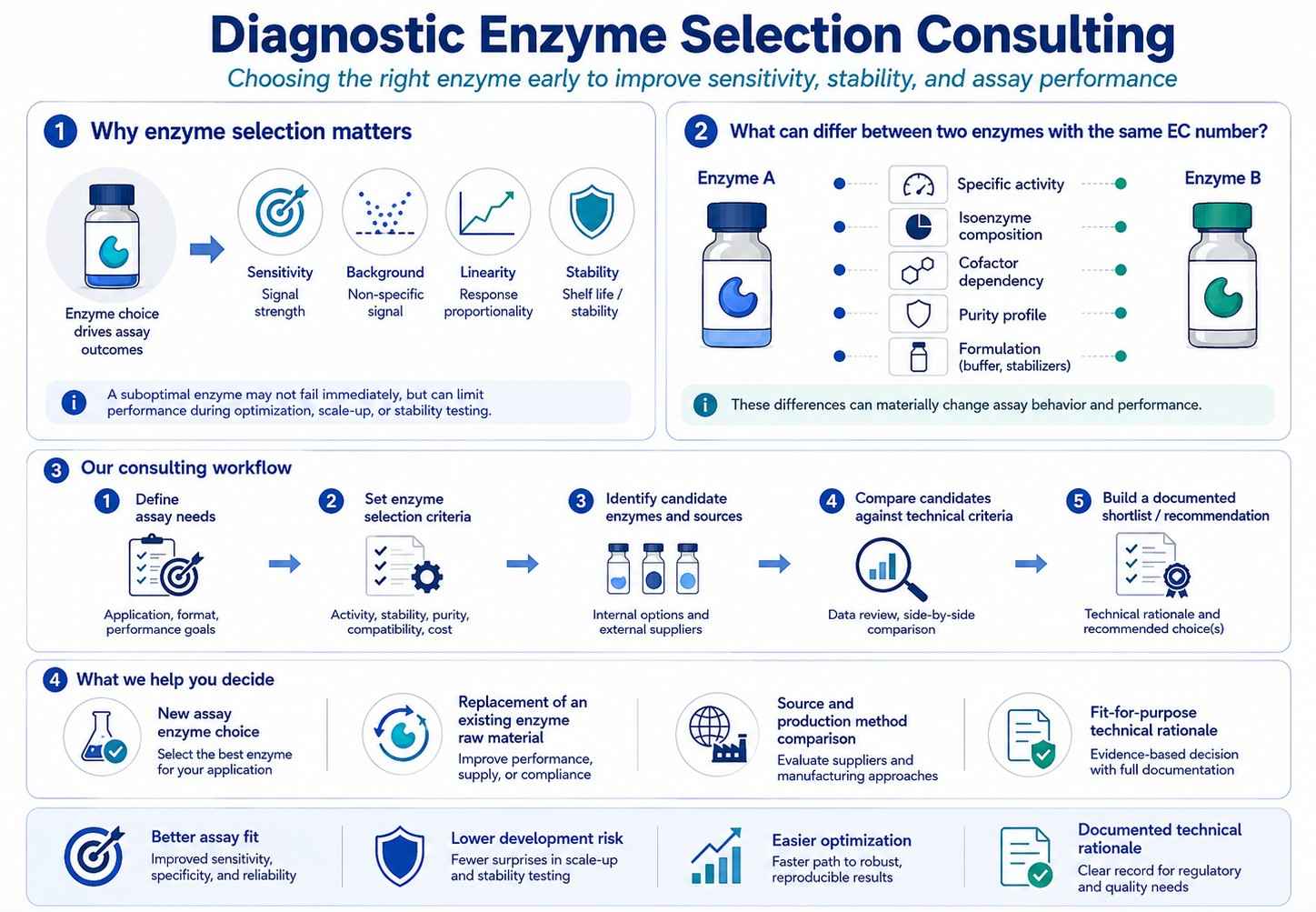
| Item | Summary |
|---|---|
| Starting Point | A new diagnostic assay concept, an enzyme replacement need, or a performance improvement goal requiring a technically justified enzyme choice. |
| Core Work | Assay requirement analysis, enzyme function definition, candidate identification, multi-criteria comparison, and risk assessment. |
| Primary Output | A candidate enzyme shortlist with comparison matrix, selection rationale, recommended specifications, and validation planning guidance. |
The selected enzyme touches nearly every performance attribute of the finished assay. Its specific activity and turnover rate set an upper bound on reaction speed and, together with substrate affinity, influence how much enzyme each reagent lot must contain—which in turn affects cost and background. Substrate specificity and cross-reactivity determine how cleanly the assay distinguishes its target from related metabolites, while contaminating activities in an impure preparation can generate background signal that no amount of downstream optimization fully removes. Linearity depends on maintaining predictable kinetics across the measuring range, and reagent stability is largely inherited from the enzyme's intrinsic tolerance to temperature, pH, and formulation components. Finally, instrument compatibility—reaction timing windows, wavelength choices in coupled reactions, and temperature control—constrains which kinetic behaviors an analyzer can accommodate. An enzyme selected without considering these dimensions may perform adequately in early feasibility work yet fail in verification, and the cost of substitution rises sharply once a formulation and manufacturing process have been built around it.
Our evaluations are organized around five criterion families, weighted according to the assay's intended use and platform.
Catalytic Performance
Specificity
Stability
Formulation Compatibility
Manufacturing Considerations
These criteria interact: a highly active enzyme with narrow pH tolerance may force formulation compromises that erode its kinetic advantage. Weighting the criteria against the actual assay architecture—rather than selecting on datasheet activity alone—is where most selection projects are won or lost.
Candidate identification begins broadly. We compare enzymes from different biological sources and production methods, because each route carries distinct trade-offs. Native enzymes isolated from microbial or mammalian sources may offer proven assay behavior but can vary in isoenzyme composition and carry contaminating activities from the source material. Recombinant enzymes, produced in well-characterized expression systems, typically deliver higher lot consistency, defined sequence, and freedom from source-related contaminants, and they allow engineered variants with improved stability or altered kinetics—though their behavior in a specific formulation must still be confirmed experimentally. Where isoenzymes exist, we compare their kinetic and stability differences explicitly rather than treating the enzyme class as uniform. Commercial candidates are then benchmarked side by side under conditions that reflect the real assay, and the comparison concludes with a performance-to-cost assessment, since the technically optimal enzyme is not always the economically sustainable one for a high-volume reagent.
Choosing an enzyme for a new assay or a replacement program?
Discuss your requirements with our team
Selection logic shifts with the application. In clinical chemistry and metabolite detection assays—glucose, cholesterol, creatinine, uric acid, and similar targets—the priority is usually a combination of high specificity, robust kinetics suitable for fixed-time or rate measurements, and proven stability in liquid reagents. Enzyme activity assays, where the analyte is itself an enzyme, impose different constraints on the coupled indicator enzymes. Biosensor and point-of-care applications add requirements for immobilization tolerance, operation in miniaturized or dry formats, and performance at ambient or variable temperatures. Molecular diagnostic workflows require enzymes with defined purity and the absence of interfering nuclease or nucleic-acid-related activities. Coupled enzyme reaction systems deserve particular care: the auxiliary and indicator enzymes must be kinetically matched so that the coupling step does not become rate-limiting, and their substrates and cofactors must coexist without cross-interference. Our recommendations are always framed around these application-specific constraints rather than generic enzyme rankings.
A substantial share of selection projects concerns replacement rather than new development: a discontinued product, an unreliable supplier, a cost-reduction mandate, or a desire to move from a native to a recombinant source. Replacement begins with a documented review of the incumbent enzyme's role and performance in the current assay—what it actually contributes, and which of its properties the assay silently depends on. We then identify alternatives, match specifications at the level of function rather than catalog description, and plan functional equivalency assessment in the real reagent. Where the replacement differs in formulation or kinetics, we provide assay adaptation recommendations—adjusted concentrations, revised incubation timing, or formulation modifications—so the transition is managed as an engineering exercise rather than discovered as a failure. For formal equivalency testing of raw material changes, see our IVD Raw Material Sourcing and Equivalency Assessment service.

Typical deliverables include the candidate enzyme shortlist, a comparison matrix across the agreed criteria, a documented selection rationale, recommended enzyme specifications for procurement and QC, a risk analysis covering supply and performance dimensions, and validation recommendations that connect the consulting conclusion to a practical experimental plan.
Recurring project scenarios include selecting enzymes for a new diagnostic assay, replacing a discontinued or unreliable enzyme, improving the performance of an underperforming assay, reducing dependence on a single raw-material source, evaluating recombinant alternatives to a native enzyme, and selecting kinetically matched enzymes for coupled reaction systems.
Q1. At what stage of development should we seek enzyme selection support?
Q2. Can you compare enzymes we have already identified?
Q3. Do you recommend specific commercial products or suppliers?
Q4. How do you handle coupled enzyme reaction systems?
Q5. Does the consulting include experimental confirmation?
Creative Enzymes approaches enzyme selection as an engineering decision with scientific inputs: requirements defined in measurable terms, candidates compared against those requirements rather than against marketing descriptions, and every recommendation documented so it can be defended in design history files and supplier qualification records. Our teams work across enzyme sourcing, assay chemistry, and reagent formulation, which means the selection considers not only what the enzyme does in isolation but how it will behave in your buffer, on your analyzer, and across your product's shelf life.
Find the right enzyme for your diagnostic assay—contact our business development team today!
