
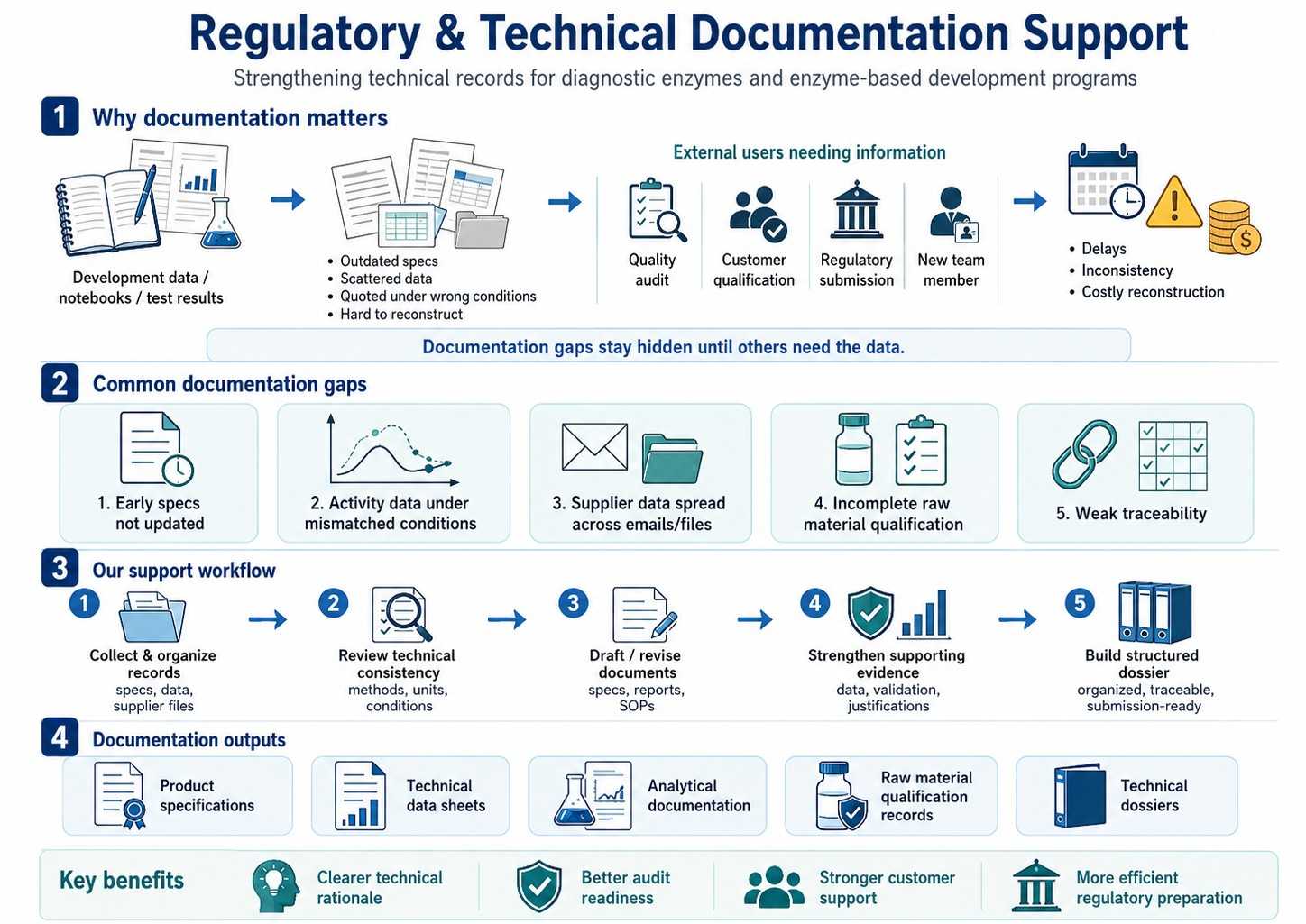
Diagnostic development generates data continuously, but documentation lags behind. Enzyme specifications drafted early in a project are never updated after optimization; activity values measured under one set of conditions are quoted against another; raw material characterization lives in scattered notebooks and supplier emails. The gap usually stays invisible until someone outside the development team needs the information—a quality auditor, a customer conducting supplier qualification, a regulatory affairs colleague assembling a submission, or a new team member trying to reconstruct a decision. At that point, reconstructing coherent technical documentation from fragmented records costs far more than maintaining it would have.
As part of our Professional Diagnostic Enzyme Consulting Services, Creative Enzymes provides regulatory and technical documentation support for diagnostic enzymes. We help IVD manufacturers and assay developers organize, draft, and strengthen the scientific and technical documentation behind their enzyme raw materials and enzyme-based development programs—product specifications, technical data sheets, analytical documentation, raw material qualification records, and structured technical dossiers.
| Item | Summary |
|---|---|
| Starting Point | A diagnostic enzyme product or development program whose technical documentation is incomplete, inconsistent, or not structured for its intended audience. |
| Core Work | Document review, gap analysis, data organization, technical drafting and revision, and scientific consistency review. |
| Primary Output | Technical data sheets, enzyme specifications, raw material qualification summaries, gap analyses, and customized technical dossiers. |
The documentation problems we encounter most often are variations on a few themes. Enzyme specifications may be incomplete—activity defined without a method, purity stated without acceptance limits, storage conditions without supporting data. Technical data may be internally inconsistent, with values that differ between the data sheet, the certificate of analysis, and the development reports because each was written at a different stage of the project. Analytical performance information is frequently missing where it matters most: precision, linearity, and stability data exist in laboratory records but were never summarized in a form a customer or auditor can use. Raw material characterization is often thinner than the assay's dependence on the material warrants. Change-control information is unstructured, making it difficult to show what changed, when, and why. Perhaps most common is the gap between R&D data and formal documentation: the science was done, but it was never translated into documents that survive outside the team that produced them.
Our drafting and revision work covers the three document families that carry the most weight for diagnostic enzyme products.
Product Specifications
Technical Data Sheets
Analytical Documentation
Each document is written to be technically self-contained: a reader outside your organization should be able to understand what the enzyme is, how its activity is defined and measured, what performance to expect, and how to handle it—without informal knowledge from your team.
Enzyme raw materials require their own documentation layer, distinct from finished-product documents. We support the preparation and organization of raw material qualification records, the review and interpretation of supplier technical information and certificates of analysis—including whether the supplier's activity definition and test conditions match your incoming QC methods—and structured specification comparisons when materials or suppliers change. Change notifications from suppliers are assessed for technical impact: what the change is, which of your critical quality attributes it could affect, and what confirmatory testing is prudent. Traceability documentation is organized so that every material lot used in development or production can be connected to its qualification status, its CoA, and the batches in which it was used—records that prove their value during audits and investigations alike.
Development-phase documentation converts project history into a usable technical record. We draft or revise experimental protocols, assay development summaries, optimization study reports, investigation reports, risk assessments, and technical justification documents—the last of which answer the question auditors and reviewers ask most often: why was this decision made? Where development decisions were sound but poorly recorded, we reconstruct the rationale from available data and interviews with your team, clearly distinguishing between contemporaneous records and retrospective summaries. For enzyme-centered development programs, this work connects naturally with our Diagnostic Enzyme Selection Consulting Service and Raw Material Equivalency Assessment services, whose outputs are themselves designed as documentation-ready reports.
Documentation gaps slowing down your program?
Discuss your documentation needs with our team
Many engagements begin with a gap assessment rather than immediate drafting. We review your existing document set against the intended use—internal qualification, customer supplier evaluation, or regulatory preparation—and identify what is missing, what is inconsistent, and what exists as data but not as documentation. Findings are prioritized by risk: a missing stability summary behind a shelf-life claim ranks above a formatting inconsistency. Where gaps reflect missing studies rather than missing write-ups, we recommend the additional experimental work needed to close them, sequenced so that documentation-critical data is generated first. The gap assessment itself is a deliverable your team can act on independently, with or without further support from us.
Beyond individual documents, we support the documentation layer of complete development programs. Depending on your needs, this may include technical information organized for design history documentation; raw material characterization packages that consolidate identity, purity, activity, and stability evidence for each critical enzyme; specification justification documents explaining how each acceptance limit was derived; performance summaries that present precision, linearity, interference, and stability results in a review-ready form; supplier qualification documentation aligned with your purchasing controls; and technical responses to detailed questions raised by customers, partners, or auditors. Each element is prepared so that your quality and regulatory teams can integrate it into their own controlled systems without re-engineering its structure.

Typical deliverables include technical data sheets, enzyme specification documents, raw material qualification summaries, technical assessment reports, documentation gap analyses with prioritized actions, analytical data summaries, and customized technical dossiers assembled for a defined audience—whether an internal design history file, a customer's supplier qualification questionnaire, or your regulatory affairs team's preparation work.
This service provides scientific and technical documentation support. All documentation we prepare or revise should be reviewed, approved, and maintained within your organization's applicable quality management system and regulatory framework. Final regulatory strategy, submission content, and submission decisions remain the responsibility of the product manufacturer and its qualified regulatory professionals; Creative Enzymes does not act as your regulatory representative, and our documentation support does not constitute regulatory advice or a guarantee of regulatory acceptance.
Q1. Can you work with documentation written by a previous team or supplier?
Q2. Do you write documents to specific regulatory formats?
Q3. What if the supporting data for a document no longer exists?
Q4. Can you support customer or partner documentation requests?
Q5. How do you handle confidential information in shared documentation?
Creative Enzymes approaches documentation as a scientific discipline in its own right: every claim traceable to data, every specification tied to a method, every document consistent with the rest of the set. Because our writers are the same scientists who develop assays and qualify raw materials, the documents we produce reflect how the work was actually done—which is exactly what auditors, customers, and reviewers look for.
Strengthen the technical documentation behind your diagnostic enzyme program—contact our business development team today!
