
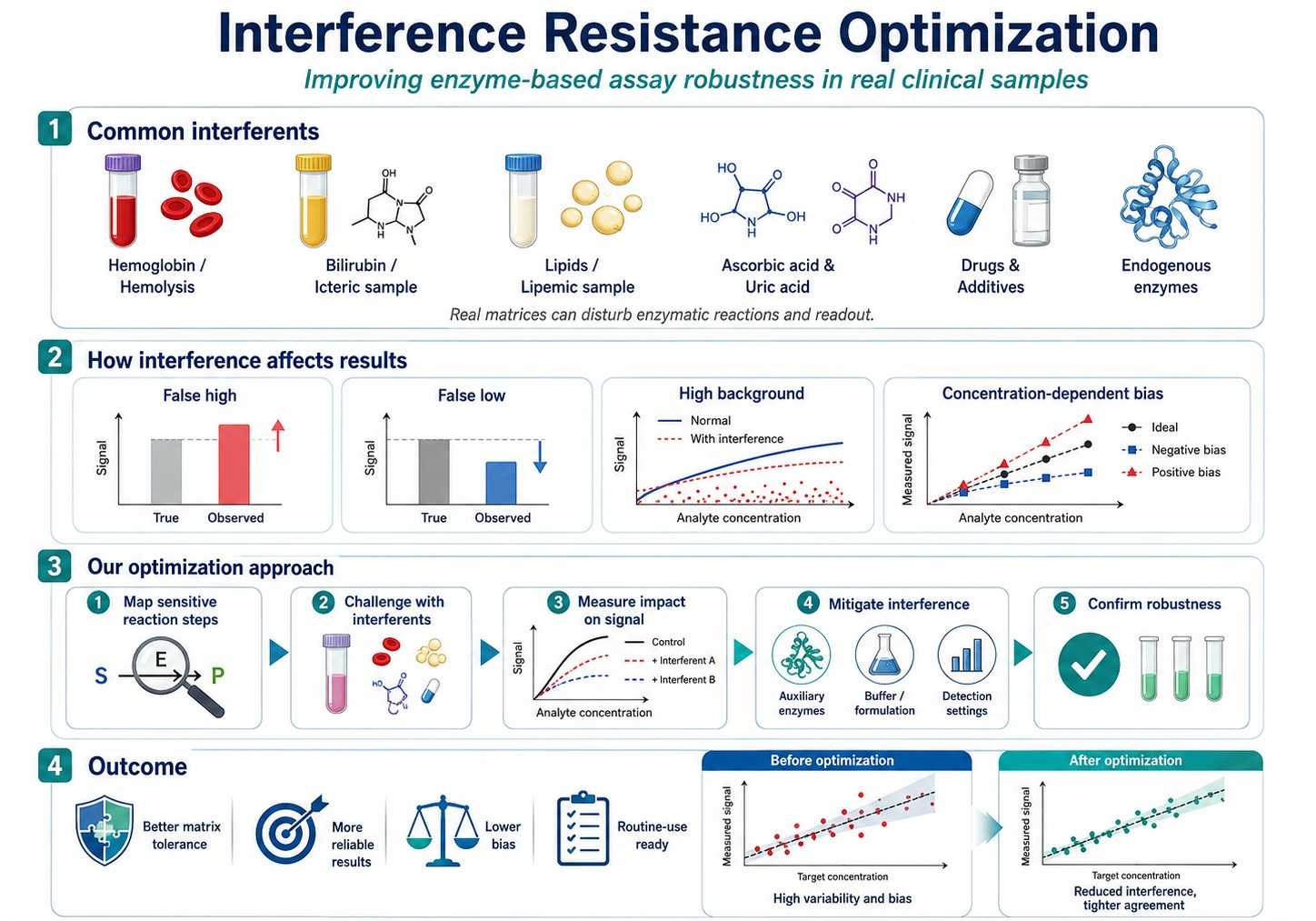
Enzyme-based diagnostic assays rarely operate on pure analytes. Real specimens contain hemoglobin from hemolysis, bilirubin from icteric samples, lipids from lipemic samples, ascorbic acid, uric acid, reducing substances, endogenous enzymes, and a long list of drugs, anticoagulants, preservatives, and sample additives. Any of these can disturb an enzymatic reaction or its detection system, producing falsely elevated or suppressed results, elevated background, or concentration-dependent bias. Interference susceptibility is therefore not an edge case but a central determinant of whether an assay performs reliably in routine use.
As part of our Diagnostic Enzyme Assay Development and Troubleshooting Services, Creative Enzymes provides an interference resistance optimization service for enzyme-based assays. We identify interference-prone reaction steps through mechanism-based analysis, quantify interference through controlled challenge testing, and develop mitigation strategies—from auxiliary enzyme systems to detection-condition adjustments—that make the reagent more tolerant of real sample matrices.
| Item | Summary |
|---|---|
| Starting Point | An enzyme-based assay with known or suspected susceptibility to hemolysis, icterus, lipemia, drugs, or other endogenous and exogenous interferents. |
| Core Work | Mechanism-based risk analysis, controlled interference challenge testing, mitigation strategy screening, and formulation optimization. |
| Primary Output | Interference profile, bias analysis, recommended mitigation strategy, optimized reagent conditions, and a comparative performance report. |
Endogenous interferents are sample constituents that disturb the reaction or its measurement. The classical triad of hemolysis, icterus, and lipemia affects many photometric assays through optical absorption, turbidity, or chemical participation in the reaction. Beyond these, ascorbic acid and other reducing substances can consume reaction intermediates in peroxidase-based detection systems, uric acid can participate in redox reactions, and endogenous enzymes or metabolites can compete with the analytical reaction or generate additional signal.
Exogenous interferents enter the sample from outside the patient: therapeutic drugs and their metabolites, anticoagulants such as EDTA, heparin, or citrate, preservatives, and other sample additives. The relevant panel of exogenous interferents depends on the intended specimen type and the clinical setting in which the assay will be used, and is defined at the start of the project. Importantly, interference is rarely a single-substance phenomenon: a lipemic sample from a patient receiving drug therapy presents a combined challenge, and the reaction mechanism determines which of these constituents actually threatens the measurement.
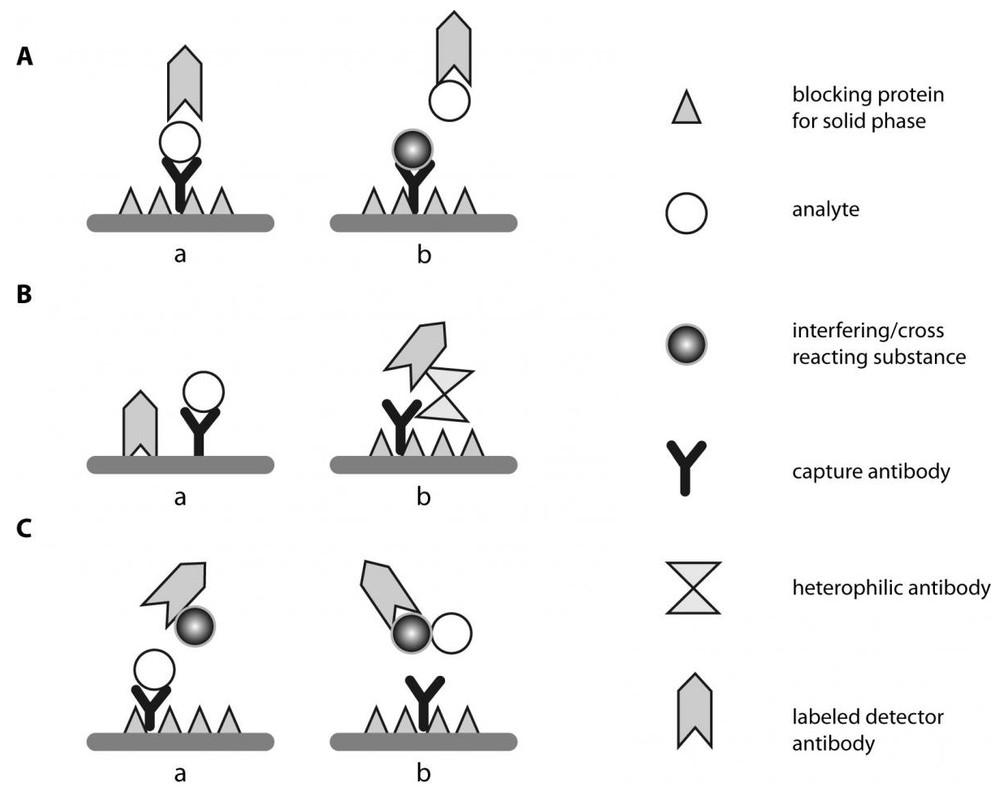 Figure 1. Different interferences in immunoassays. (Dodig, 2009)
Mechanism-based risk assessment
Effective interference work begins with the reaction mechanism, not with testing. We review the complete reaction sequence and identify steps that are intrinsically vulnerable: optical interference at the measurement wavelength, competing enzymatic reactions that consume shared substrates or cofactors, redox interference in oxidase/peroxidase detection chemistry, and matrix-dependent effects that appear only in real specimens. This analysis defines which interferents are plausible threats and at which reaction step they act, so that testing is focused and mitigation is mechanistically rational.Controlled interference testing
Susceptibility is quantified by comparing baseline and spiked samples across an interferent concentration series, at multiple analyte concentrations including clinically relevant decision levels. Bias is calculated relative to the baseline condition, and tolerance thresholds—the interferent concentrations at which bias exceeds an accepted limit—are identified. The experimental design is informed by established clinical laboratory interference evaluation principles, adapted to the development stage of the assay. Testing at multiple analyte concentrations is essential, because interference bias is frequently concentration-dependent: an interferent that is harmless at high analyte levels may cause clinically significant bias near a decision threshold, where the analytical signal is smallest.
Mitigation strategies are selected according to the identified mechanism. Chemistry-level options include improving enzyme specificity, selecting or modifying substrates to reduce cross-reactivity, adjusting the reaction sequence so that a vulnerable step occurs before the analytical read, optimizing cofactors, and refining buffers and additives. Detection-level options include wavelength or detection-condition optimization and blank-correction approaches that subtract the interferent contribution. Sample-level options include scavenging systems that chemically neutralize the interferent and masking strategies that prevent its participation in the reaction.
A distinctive capability of our service is the use of auxiliary enzyme systems that remove or neutralize the interferent enzymatically before or during the analytical reaction. Development areas include ascorbate oxidase-based systems for ascorbic acid reduction, mitigation strategies for bilirubin-related interference, optimization of peroxidase and redox detection systems to resist reducing substances, enzymatic depletion of ATP or competing metabolites, and custom auxiliary enzyme combinations designed for assay-specific interference patterns. Enzymatic removal is often the most elegant option for oxidase/peroxidase-based assays because it acts selectively and within the existing reagent format.
| Interference Mechanism | Representative Mitigation Options |
|---|---|
| Reducing substances consume detection intermediates | Ascorbate oxidase pre-treatment, redox-system redesign, scavengers. |
| Optical absorption or turbidity (hemolysis, lipemia, icterus) | Wavelength selection, blank correction, sample-blank measurement. |
| Competing endogenous enzymes or metabolites | Specificity optimization, reaction sequencing, enzymatic depletion. |
| Anticoagulant or additive effects | Buffer and chelator balancing, cofactor adjustment, specimen guidance. |
Struggling with hemolysis, icterus, or lipemia susceptibility?
Discuss your assay with our team
Interference mitigation is only successful if it improves matrix tolerance without damaging everything else. The optimized formulation is compared directly with the original under the same interference challenge conditions, and interference bias is re-quantified against the tolerance thresholds. In parallel, we verify that precision and sensitivity are preserved, assess matrix compatibility across representative specimen types, and confirm that the mitigation measures do not compromise analyte recovery—for example, that an auxiliary scavenging enzyme removes the interferent without affecting the analyte or the detection chemistry. Any residual trade-offs are documented explicitly. This verification step is what distinguishes interference optimization from interference testing alone: the deliverable is not merely a list of susceptibilities, but a demonstrated improvement in matrix tolerance with evidence that the rest of the analytical performance survived the change intact.

Typical deliverables include the interference profile, interferent concentration-response data, bias analysis, a description of the identified interference mechanisms, the recommended mitigation strategy, optimized reagent conditions, and a comparative performance report covering the original and optimized formulations.
This service is suited to clinical chemistry assays, oxidase/peroxidase-based assays, NAD(P)H-dependent assays, metabolite assays, enzyme activity assays, and serum or plasma diagnostic reagents—particularly assays with known hemolysis, icterus, or lipemia susceptibility, and assays in which drug or additive interference has been observed during development or reported from the field.
Q1. Which interferents should we test first?
Q2. Can interference be eliminated completely?
Q3. Will adding an auxiliary enzyme affect assay cost or stability?
Q4. Our assay shows bias only in some patient samples. Can you investigate?
Q5. Does mitigation change the calibration or measuring range?
Creative Enzymes approaches interference as a reaction-chemistry problem with an enzymatic toolbox. Our scientists work daily with oxidase/peroxidase detection chemistry, NAD(P)H-dependent reactions, and auxiliary enzyme systems, and this experience informs both the risk analysis and the design of mitigation strategies. By connecting mechanism analysis, controlled challenge testing, and enzyme-based mitigation, we help developers build matrix tolerance into the reagent itself rather than managing interference at the bench—a more reliable and more economical solution over the product's lifetime.
Build greater interference resistance into your enzyme-based assay—contact our business development team today!
