
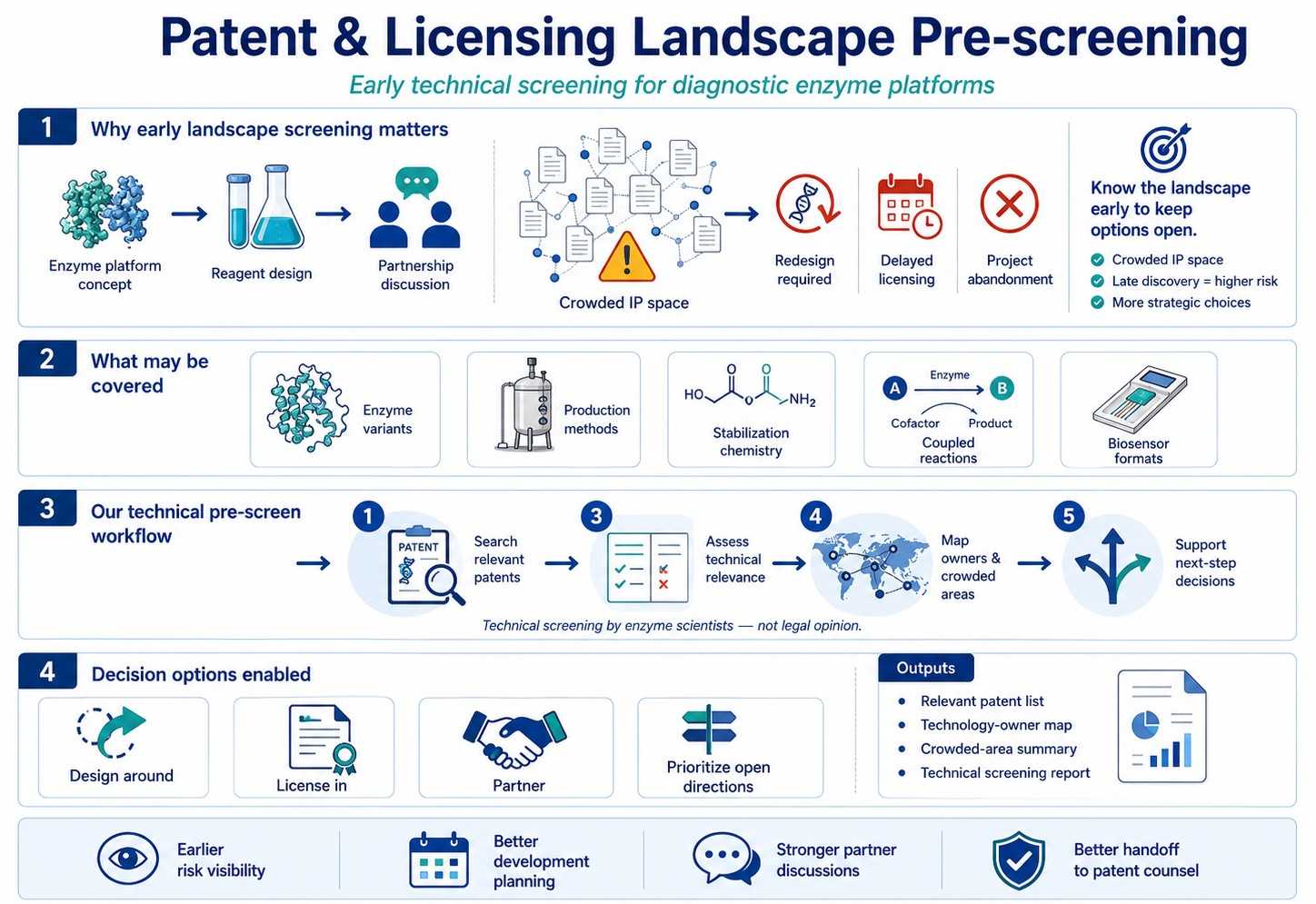
Diagnostic enzyme platforms sit in a densely patented technology space. Enzyme variants, recombinant production methods, stabilization chemistries, coupled reaction architectures, and biosensor configurations have all attracted decades of patent activity from reagent manufacturers, platform companies, and academic groups. A development team that discovers this landscape late—after a platform is designed, a reagent is formulated, or a partnership is negotiated—faces redesign, licensing at unfavorable terms, or abandonment. The earlier a team understands who holds relevant technology and where the crowded areas lie, the more options it retains: designing around, licensing in, partnering, or simply confirming that the chosen direction is relatively open.
As part of our Professional Diagnostic Enzyme Consulting Services, Creative Enzymes provides a patent and licensing landscape pre-screening service for diagnostic enzyme platforms. This is a technical screening service performed by enzyme scientists: we identify patents and technology owners plausibly relevant to your platform, assess their technical relevance, and map the landscape so that your team—and your patent counsel—can make informed decisions about where deeper legal analysis is warranted.
| Item | Summary |
|---|---|
| Starting Point | A planned or ongoing diagnostic enzyme platform where early visibility into relevant patents, technology owners, and licensing considerations would inform R&D or business decisions. |
| Core Work | Structured patent and technology screening, technical relevance assessment, technology-owner mapping, and strategic summarization. |
| Primary Output | A preliminary landscape summary with relevant patent families, a technology-owner map, a relevance matrix, and recommended areas for further legal review. |
The value of pre-screening is timing. At the concept stage, landscape information can redirect development away from crowded technical areas before resources are committed, or confirm that a direction is open enough to justify investment. During platform design, knowing which enzyme variants, stabilization approaches, or assay architectures are actively patented informs design-around discussions while design freedom still exists. On the business side, an early view of technology ownership identifies potential licensors, partners, or acquisition targets, and strengthens a company's position before negotiations begin—parties who understand the landscape negotiate differently from those who do not. Finally, pre-screening focuses legal spending: instead of commissioning broad freedom-to-operate analysis across an entire field, companies can direct qualified patent counsel toward the specific patent families that technical screening has flagged as most relevant.
Screening scope is defined with you at the start of each engagement and can cover any combination of the following areas.
Scope definition matters practically: an overly broad scope dilutes relevance, while an overly narrow one misses adjacent patents whose claims reach further than their titles suggest. We calibrate scope against your platform's actual technical features.
The landscape review builds from a defined search strategy combining keyword sets with patent classification codes relevant to enzyme and IVD technologies, screened across major patent jurisdictions. Results are organized by patent family to avoid double-counting related filings, then summarized by applicant and assignee to show who holds what. Technology clustering groups the families by subject—enzyme engineering, formulation, assay architecture—so the structure of the field becomes visible at a glance. Geographic coverage is reviewed against your intended markets, and, where status information is available, expiration dates, pending applications, and lapsed patents are distinguished, since an expired patent on a stabilization method may represent free-to-use knowledge rather than an obstacle.
Planning a new enzyme-based diagnostic platform?
Discuss a landscape pre-screening with our team
Most patents surfaced by a keyword search are not relevant to your platform; relevance assessment is where enzyme expertise does the filtering. For prioritized families, we read the claims technically—identifying the claim themes, comparing them against the features of your proposed platform, and, where applicable, examining enzyme sequences, variant definitions, or functional characteristics recited in the claims against the enzyme you intend to use. Formulation-specific and application-specific claims are reviewed separately, because a broad composition patent and a narrow application claim carry different implications for the same platform. The output is a preliminary differentiation assessment for each relevant family: why it appears relevant, which of your platform's features it touches, and where your approach may already be technically distinct. This assessment flags questions for patent counsel; it does not answer the legal question of infringement.
Where the landscape review identifies relevant technology owned by others, licensing screening maps the commercial dimension. We identify the organizations holding the most relevant families, summarize publicly available information about their existing licensing relationships and technology-transfer practices, and distinguish between technology owners who actively license and those whose portfolios appear defensive. Potential licensing targets are ranked by technical relevance and practical accessibility. The screening also identifies collaboration opportunities—academic groups or smaller companies whose technology complements your platform—and informs technology acquisition considerations where a relevant portfolio might be purchased rather than licensed.
Beyond individual patents, the landscape reveals strategy. Competitive mapping summarizes which organizations are active in your technology area, what their filing patterns emphasize, and how their technical focus differs from yours. Application-area concentration shows where competitors are directing their enzyme platform development; differentiation analysis identifies where your platform occupies relatively open technical ground; and emerging trends—rising filing activity around particular stabilization chemistries or detection architectures, for example—give early indication of where the field is moving. For companies planning multi-year platform investments, this strategic layer is often as valuable as the patent list itself.

Typical deliverables include a preliminary patent landscape summary, a list of relevant patent families with bibliographic details, a technology-owner map, a technical relevance matrix connecting prioritized families to your platform's features, a list of potential licensing targets, a summary of preliminary risk areas, and—importantly—a prioritized list of areas recommended for formal review by qualified patent counsel.
This service is a technical patent landscape pre-screening. It is not a freedom-to-operate opinion, not a legal validity or infringement analysis, and not legal advice of any kind. Patent claim interpretation, freedom-to-operate determinations, and licensing negotiations require qualified patent counsel, and we recommend that any patent family flagged as relevant in our screening be reviewed by such counsel before commercial decisions are finalized. Our role is to make that legal review faster, better targeted, and less expensive by resolving the technical questions first.
Q1. How does pre-screening differ from a freedom-to-operate analysis?
Q2. At what project stage is pre-screening most useful?
Q3. Which patent jurisdictions do you cover?
Q4. What do you need from us to start?
Q5. Can you support design-around work after the screening?
Creative Enzymes brings to patent landscape work what generic search providers cannot: scientists who read enzyme patents the way enzyme developers write them. Claim language about variants, kinetics, and stabilization is interpreted against real assay practice, so the families flagged as relevant genuinely are—and the summary your counsel receives starts from a technically sound foundation rather than a raw keyword hit list.
Gain early visibility into the diagnostic enzyme patent landscape—contact our business development team today!
